By [VERIFY: add real author byline + credentials] · Last updated: [VERIFY: set to the real date of this revision] · Checked against OSHA 29 CFR 1910.243 and current Bosch and Makita circular saw manuals.
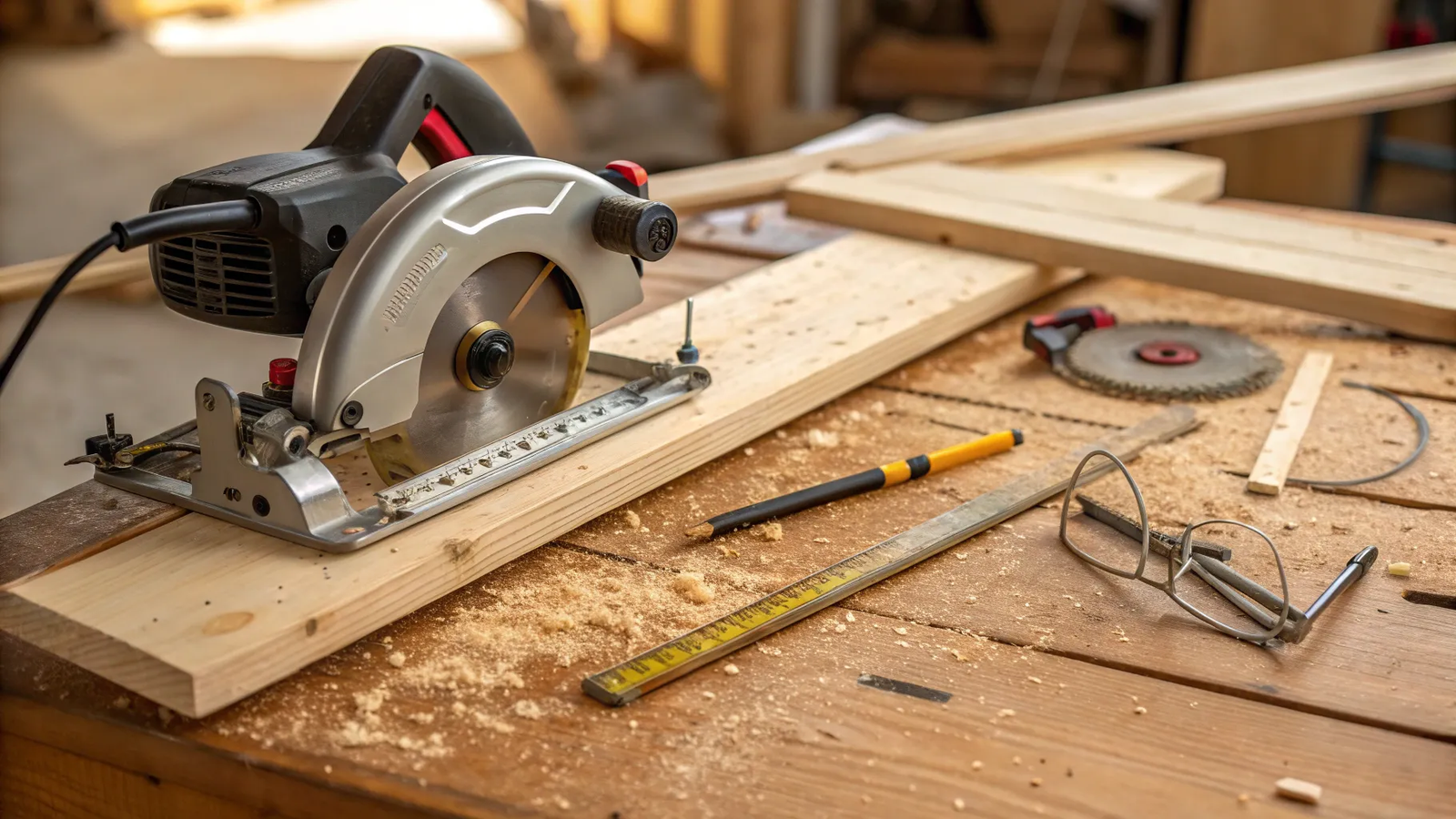
A homemade circular saw jig is a thin plywood or MDF base with a straight fence glued to it, trimmed with your own saw so the base edge sits exactly on the blade’s cut line. Build it about 10 to 14 inches wide, make it several inches longer than your longest cut, and it turns a basic circular saw into a repeatable straight-cut guide for plywood, MDF and boards. It improves alignment. It does not replace the saw’s guard, your owner’s manual, or safe cutting technique.
This is worth doing for a reason beyond neatness. Bosch’s circular saw safety instructions state that when ripping, you should always use a rip fence or straight edge guide, because it improves cut accuracy and reduces the chance of blade binding. A guide is not just a precision aid — the manufacturer treats it as a safety instruction.
Quick Answer
Cut a 1/4-inch plywood or hardboard base 10 to 14 inches wide, and a 2-1/2 to 4-inch fence from a straight factory edge. Glue and clamp the fence to the base, let it cure fully, then run your own saw along the fence to trim the base. That trimmed edge is now your cut line: lay it directly on your pencil mark, clamp the guide and the workpiece, and cut. The guide is accurate only for the saw, blade, shoe side and 90-degree setting used to trim it.
Key Takeaways
- Use a thin, flat base (1/4 to 3/8 inch) and a straight factory edge for the fence.
- Build the guide for one specific saw, blade, shoe side and bevel setting.
- Trim the base only after the glue has fully cured, with the blade set about 1/8 inch deeper than the base thickness.
- Align the trimmed edge with the cut line, then clamp both the guide and the workpiece.
- Place plywood good face down — a circular saw blade cuts upward, so tear-out lands on the top face.
- Support the material so the kerf cannot close and pinch the blade.
- Set blade depth per your saw manual; Bosch specifies less than one full tooth showing below the workpiece.
At a Glance
| Time Required | 45 to 90 minutes, plus glue-curing time |
| Difficulty | Beginner to intermediate |
| Tools Needed | Circular saw, drill/driver, straightedge or square, tape measure, pencil, and clamps |
| Cost | About $0 to $25 when built from scrap or common sheet goods |
What’s in This Article
- How Does a Circular Saw Jig Work?
- Should You Build This or Buy a Track Guide?
- Materials and Tools
- What Size Should the Guide Be?
- Before You Begin
- Step-by-Step Build
- How to Use the Jig
- How Do You Square the Guide for a Crosscut?
- Circular Saw Safety Checklist
- Tips and Tricks
- When Should You Use This Jig — and When Shouldn’t You?
- Common Problems and Fixes
- Frequently Asked Questions
- Final Thoughts
- Sources
How Does a Circular Saw Jig Work?
The jig has two parts: a flat base and a straight fence. The saw shoe rides against the fence while the blade cuts along the trimmed edge of the base. Once calibrated, that edge shows exactly where the blade will cut at a 90-degree bevel setting.
The first trimming pass creates a zero-clearance cut-line edge. That is the whole point of the design. Instead of measuring the distance from your blade to the edge of the saw shoe before every cut — and getting it wrong occasionally — you lay the trimmed edge straight onto your layout marks and clamp.
The trimmed edge is accurate only for the saw, blade, shoe side, and bevel setting used to make it.
The base does a second job that is easy to miss: it sits on top of the workpiece and backs up the cut, which reduces splintering along the good edge. That is the same principle behind the replaceable anti-splinter strip on a commercial guide rail.
You can use the guide for long rip cuts, crosscuts, and diagonal straight cuts. It is not an adjustable track saw, a plunge-cut guide, or a substitute for a table saw fence. A separate guide is the safer choice when you regularly switch saws, blade kerfs, or bevel angles.
Should You Build This or Buy a Track Guide?
Both work. The honest trade-off is not accuracy — a well-built shop guide cuts as straight as a rail — it is convenience, portability and how many saws you own.
Build this jig if: you own one circular saw and mostly keep one blade in it; you need the guide occasionally rather than daily; you want an 8-foot capacity without paying for an 8-foot rail; or you have scrap sheet goods sitting in the shop already. The zero-clearance edge means no offset math, ever.
Buy a rail or track system if: you own several saws or swap blade types constantly, since each combination needs its own calibrated wooden guide; you need bevel cuts at set angles; you want a guide that stores in a bag and does not bow in a damp garage; or you need the non-slip strips and integrated clamps that come standard on commercial rails. Many saws, including the Bosch model cited throughout this article, have track slots moulded into the shoe specifically for this.
The practical middle path most people land on: build the wooden guide first, use it for a season, and buy a rail only if the limitation you actually hit is one a rail solves. [VERIFY: internal link — anchor “track saw vs circular saw” → confirm target URL]
Products Worth Considering

Premium Home Improvement Tools: Universal compatibility fits most circular saws in the market with blades up to 7-1/4”
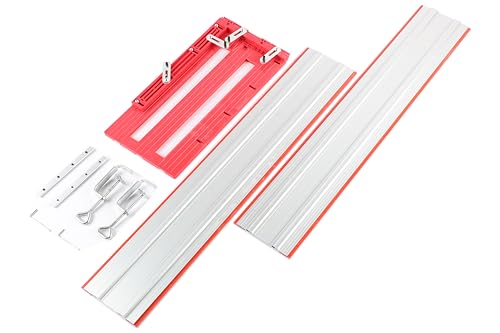
【Easy to use】Take your saw to the material, guides your circular saw along an extended-length aluminum track that holds the saw steady and keeps your cuts straight

Premium Home Improvement Cutting Tools: Track saw guide turns circular saws into precision, track-guided tools
Materials and Tools
Choose flat material that will not rock under the saw. A thinner base preserves more of the saw’s cutting capacity, while a thicker fence is easier for the saw shoe to follow.
Products Worth Considering

High Quality Material: This tall Stair Gauges are Made of CNC-Machined Anodized Aluminum alloy which make it rust proof, durable and corrosion resistant.ensuring long-lasting performance.

Universal Design: WORKPRO track saw clamp is a fast, easy set-up woodworking tool commonly used as an integral part of the track saw guide rail system and circular saw guide rail system. Securely hold guide rails in place for confident cutting

Precision & Stable Cutting with 5-Bearing Design for All Woodworking Tasks:This professional skate plate circular saw guide features a 5-bearing structure that drastically reduces friction during cuts, allowing your tool to glide smoothly without jitter or deviation. As a reliable circular saw roller guide, it ensures straight, accurate cuts every time—perfect for furniture making, DIY woodworking, flooring installation, and repeated batch cutting tasks. The built-in high-precision laser scale guarantees consistent results, eliminating errors and waste in your projects.
Materials
- Base: 1/4- to 3/8-inch (6- to 9-mm) plywood, MDF, or tempered hardboard
- Fence: A straight 1/2- to 3/4-inch (12- to 18-mm) plywood or hardwood strip with a clean factory edge
- Wood glue
- Short screws, brads, or other fasteners that cannot protrude through the base
- Two or more clamps for the build and two clamps for using the finished guide
- Scrap sheet material for the first trimming cut and later test cuts
- Optional non-slip tape or thin rubber pads; these improve grip but do not replace clamps
Tools and Protective Equipment
- Circular saw with the blade you plan to use with the guide
- Drill/driver and countersink bit if you use screws
- Tape measure, pencil, and a reliable straightedge or framing square
- Eye and hearing protection
- Dust collection or a suitable dust mask or respirator for the material and exposure
Note: Cutting MDF and other sheet goods creates fine wood dust. OSHA’s permissible exposure limit for nuisance dust is 15 mg/m³ total dust (5 mg/m³ respirable) as an 8-hour average, while NIOSH recommends a far stricter 1 mg/m³. Hardwood species including oak, beech, walnut and ash have been linked to nasal cancer in woodworkers. Work in a well-ventilated area, use dust collection when available, and follow the material supplier’s safety information.
What Size Should the Guide Be?
Make the guide several inches longer than the longest cut you expect, so the saw shoe registers against the fence before the blade enters the workpiece and stays supported as the blade exits. A typical 7-1/4-inch saw shoe is roughly 9 to 11 inches front to back, so add at least 4 inches of guide beyond each end of the cut.
| What you’re cutting | Guide length | Base width | Fence width |
| Boards and narrow panels | 24–30 in | 10–12 in | 2-1/2–3 in |
| Crosscutting a 4-ft sheet | 54–56 in | 10–12 in | 2-1/2–3 in |
| Ripping a full 8-ft sheet | 102–104 in | 12–14 in | 3–4 in |
Base width needs to hold the fence plus the full saw shoe, with extra material on the blade side for the trimming pass. Leave more overhang than the distance from your chosen shoe edge to the blade, plus at least 1/2 inch spare.
How much cutting depth does the base cost you?
This is the number most guides leave out. The jig base sits under the saw shoe, so every fraction of its thickness comes straight off your maximum cut depth. Bosch rates the 7-1/4-inch GKS18V-25G at 2-1/2 inches (63.5 mm) maximum depth of cut at 0 degrees. Do the arithmetic before you build:
- 1/4-inch base → about 2-1/4 inches of usable depth
- 3/8-inch base → about 2-1/8 inches of usable depth
Both still clear a nominal 2x board at 1-1/2 inches with room to spare. Neither will get through 2-1/2-inch stock. Check your own saw’s rated depth, subtract your base thickness, and know the number before you need it.
Use the widest, flattest side of the saw shoe that lets the saw travel without the motor housing, blade guard, battery, cord, or adjustment levers hitting the fence. Check the entire travel path before attaching anything.
Before You Begin
Read the instructions for your exact circular saw before building or using the guide. Check the blade, upper and lower guards, shoe, power cord or battery, switch, and depth and bevel locks. The lower guard must cover the blade and return automatically and instantly when the tool is withdrawn from the work. The same standard requires that cracked saws be removed from service.
Unplug the saw or remove its battery before measuring near the blade, checking the shoe-to-blade distance, changing the blade, or adjusting depth and bevel settings. Use the same blade and 90-degree setup for calibration that you plan to use later.
Warning: Never tie, wedge, or clamp the lower blade guard open. Do not use a saw with a damaged guard, loose blade, damaged cord, unreliable switch, or depth or bevel lock that will not stay secure.
Step-by-Step Build
1. Cut the Base and Fence
Cut the base to the length and rough width you need. Cut the fence from a factory edge or another edge you have confirmed is straight. Mark the factory edge so you do not accidentally place the rough edge against the saw shoe.
How to check an edge is actually straight: lay the piece on a flat surface, mark a pencil line along the edge, then flip the piece end-for-end and re-mark against the same line. Any bow shows up doubled between the two lines and becomes obvious immediately. A fence that is off by 1/32 inch over 8 feet will put that error into every cut you ever make with the guide.
2. Position the Fence
Place the disconnected saw on the base with the chosen side of the shoe against the fence. Leave enough base material beyond the blade for the first trimming pass. Slide the saw from one end to the other and confirm that the motor, guard, battery or cord, and adjustment levers clear the fence.
Mark the fence location at several points. Check that the fence is straight and that the saw shoe stays fully supported along the entire guide.
3. Check That the Blade Is Parallel to the Shoe
Do this once, before you commit glue. It is the step almost every guide skips, and it is the reason some jigs never cut straight no matter how good the fence is.
With the saw disconnected and the blade at full depth, measure from the edge of the shoe that will ride the fence to the blade body at the front of the blade, then measure to the blade body at the rear. Measure to the flat plate, not to a tooth — tooth set will give you a false reading. The two measurements should match.
If they do not, the blade is toed relative to the shoe. The saw will fight the fence for the entire cut and produce a bowed or tapered kerf. Your saw manual will cover shoe adjustment; on the Bosch model referenced here, a small alignment screw underneath the foot sets the blade-to-foot relationship. Fix this before building the guide, not after.
4. Attach the Fence
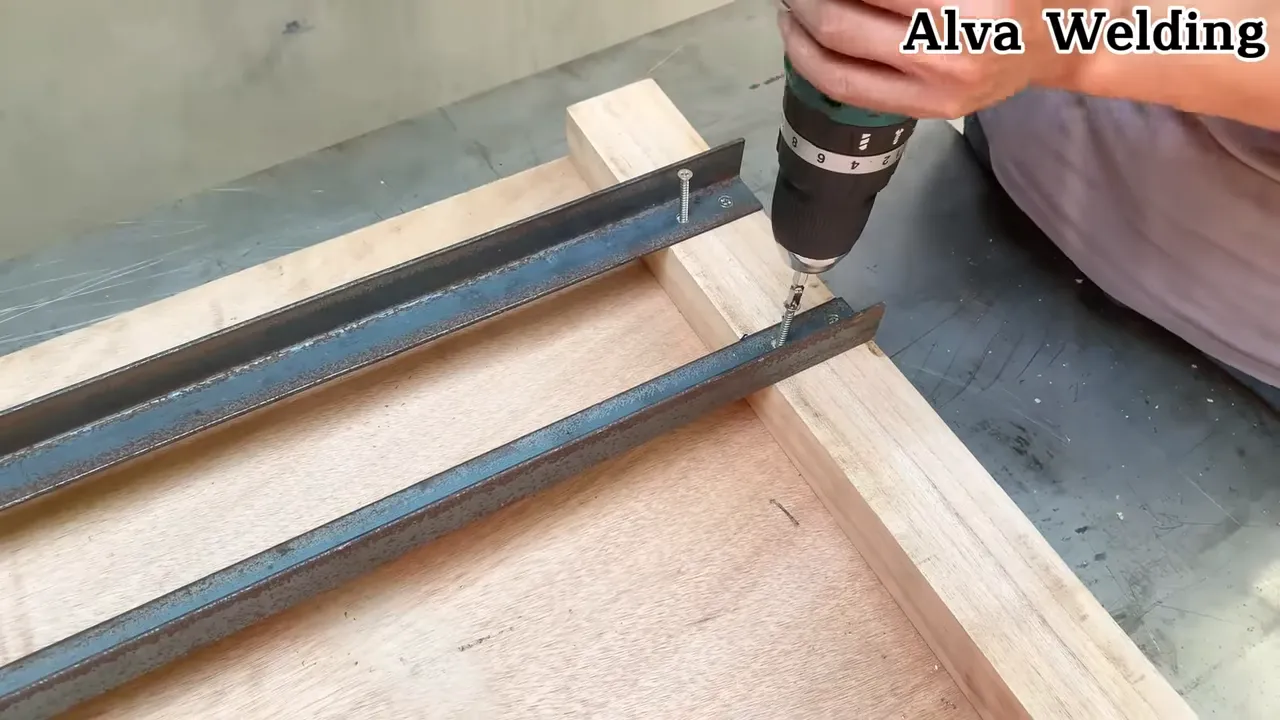
Apply a thin, even layer of wood glue under the fence. Clamp it in place and recheck the alignment before the glue sets. Add short screws or brads if desired. Countersink screw heads and keep every fastener away from the future blade path.
Let the glue cure for the time listed by its manufacturer. Do not trim the base while the fence can still move.
5. Trim the Zero-Clearance Edge
Place the guide on a stable sacrificial surface. Clamp the guide and support the scrap so the blade cannot be pinched. Set the saw to 0 degrees.
Set the depth for this pass specifically. You are only cutting through the base, so set the blade about 1/8 inch deeper than the base thickness — roughly 3/8 inch for a 1/4-inch base. That is the same logic Bosch uses when preparing a guide rail’s anti-splinter edge: about 3/8 inch of depth, leaving the blade 1/8 inch below the strip. A shallow setting keeps you from chewing into whatever is underneath and keeps blade exposure low.
Start the saw with the blade clear of the material. Let it reach operating speed, keep both hands on the saw, hold the shoe firmly against the fence, and make one smooth forward cut. Do not force the saw. [VERIFY: add a first-hand observation here — what the finished edge looked like, how the saw tracked, anything you noticed on your own build.]
6. Label the Guide
Write the saw model, blade diameter or blade description, fence side, and “90°” on the guide. Mark the trimmed edge as the cut-line edge. This prevents the guide from being mixed with a different saw or bevel setup.
7. Test the Guide on Scrap
Draw a straight line across scrap, align the trimmed edge with the line, clamp the guide, and make a test cut. Check the cut with a reliable square or straightedge. If the cut is not straight, fix the cause before using the guide on finished material.
How to Use the Jig
- Inspect the saw, blade, guard, guide, clamps, and workpiece.
- Support the workpiece on a stable surface. Place supports close enough to the cut to prevent sagging and kerf closure. Rigid foam insulation under the whole sheet works well and is forgiving of a slightly deep blade setting.
- Mark the cut at both ends. Identify the kept side and waste side.
- Place the good face of plywood down. The blade cuts upward, so tear-out lands on the top surface.
- Place the trimmed edge on the intended cut line. Confirm that the blade kerf will fall on the waste side of the mark.
- Clamp the guide at both ends. Position clamp handles where they cannot contact the saw, cord, battery, or your hands.
- Set the blade depth and tighten the depth and bevel locks. Keep both hands on the saw and your body to either side of the blade line.
- Start with the blade clear of the work, let the saw reach speed, and move forward with light, continuous pressure while holding the shoe against the fence.
- If you have to stop partway, release the trigger and let the blade stop before doing anything else. To resume, centre the blade in the existing kerf so the teeth are not touching material, let the saw reach full speed, then re-enter the cut slowly.
- At the end, release the trigger and wait for the blade to stop before lifting or setting down the saw. Bosch’s electric brake stops the blade in about two seconds, but a brake is not a safety feature and needs a charged battery to work at all.
Warning: If the blade binds or the cut must stop, release the trigger and hold the saw still until the blade stops completely. Do not pull the saw backward while the blade is moving. Find and correct the cause of the binding before restarting.
How Do You Square the Guide for a Crosscut?
A straight cut and a square cut are not the same thing. The guide gives you straight for free; square takes one extra step.
Start from an edge of the workpiece you know is straight — a factory edge, or one you have already cut with this guide. Hold a framing or speed square against that reference edge and bring the guide’s trimmed edge up against the square’s blade. Clamp the first end.
Now re-check before you clamp the second end, and check again afterwards. Clamps pull as they tighten, and a guide that was square at 1 inch of travel can be out by a noticeable amount at 48 inches. Check square at both ends of the guide, not just where the square is sitting.
If you crosscut often, a short dedicated guide with a fence stop that registers against the workpiece edge will square itself every time and save this whole routine. [VERIFY: internal link — anchor “how to cut plywood without a table saw” → confirm target URL]
Circular Saw Safety Checklist
A guide can improve alignment, but it cannot prevent every kickback or contact hazard. Follow your saw manual and use these checks before each cut:
- Wear eye and hearing protection. Control wood dust with ventilation, extraction, and suitable respiratory protection when needed.
- Use the blade size and type specified for the saw and material.
- Keep the blade sharp, clean, undamaged, and properly installed. Dull or badly set blades cut a narrow kerf, which causes friction, binding and kickback.
- Confirm that the lower guard moves freely and closes immediately.
- Check that the trigger is a constant-pressure switch that shuts off power when released. OSHA requires this on hand-held circular saws with blades over 2 inches, and unlike a drill, they are not permitted a lock-on control.
- Clamp the workpiece to a stable platform; never hold it in your hands or across your leg.
- Keep both hands on the saw handles and never reach under the workpiece.
- Position your body to either side of the blade, not directly in line with it.
- Support large panels near the cut and near their edges so they cannot sag and pinch the blade. Supports go under both sides of the cut line.
- Keep the wider supported part of the saw shoe on the section that will remain stable through the cut.
- Do not set the blade deeper than needed. Excess blade exposure increases the chance of the blade twisting in the kerf and increases the surface available for pinching.
- Remove nails, screws, staples, and other hidden metal from the cutting path.
- Keep cords, vacuum hoses, clamp handles, and loose clothing out of the saw’s travel path.
- Do not use this simple guide for plunge or pocket cuts.
- Never exceed the saw’s cutting capacity after subtracting the thickness of the jig base.
Tips and Tricks
- Make a short guide for crosscuts and a long guide for sheet goods. Short guides are easier to store and clamp.
- Extend the guide beyond both ends of the workpiece so the saw is stable before the blade enters and as it exits.
- Use a fine-tooth blade suited to plywood or veneered panels when tear-out matters. [VERIFY: internal link — anchor “circular saw blade guide for sheet goods” → confirm target URL]
- Place plywood good face down. The blade cuts upward, so tear-out appears on the top face — Bosch’s manual gives the same instruction.
- Add thin non-slip material under the guide only if it stays flat. Continue to use clamps. [VERIFY: internal link — anchor “clamps for woodworking” → confirm target URL]
- Store the guide flat or hang it from several support points so it does not bow. MDF in particular takes on moisture and will not come back once it has cupped. [VERIFY: add a first-hand note on how your own guide has held up in storage.]
- Make a separate guide for a different saw, a substantially different blade kerf, or a bevel setting.
Pro Tip: Before every important cut, place the disconnected saw against the fence and check that the blade still meets the trimmed edge. A worn edge, loose fence, bent shoe, or changed blade can shift the cut line.
When Should You Use This Jig — and When Shouldn’t You?
This jig is most useful when you need portable, repeatable straight cuts without setting up a table saw or buying a dedicated track system.
Good Uses
- Breaking down plywood, MDF, particleboard, and other sheet goods
- Making long straight rip cuts
- Making square crosscuts when the guide is squared against a known reference edge
- Making diagonal straight cuts across panels
- Working in a small shop or at a jobsite
Do Not Rely on It For
- Curved cuts
- Plunge or pocket cuts
- Stock too thick for the saw after the base thickness is deducted
- Very narrow or small workpieces that cannot be clamped and supported safely
- Bevel cuts unless the guide was separately calibrated for that exact angle
- Repeat-width ripping without a separate, secure indexing setup
- Any setup that mounts the saw permanently to the jig. Bosch states plainly that a circular saw should not be mounted to a table and converted into a table saw — circular saws are not designed or intended for that use.
Common Problems and Fixes
- The cut wanders: Check the fence with a known straightedge first. If the fence is straight, check blade-to-shoe parallelism (Step 3) — a toed blade makes the saw fight the fence for the whole cut. Replace a bowed fence, tighten a loose fence, and keep steady side pressure without forcing the saw. [VERIFY: add a first-hand note on which of these actually caused the problem on your build.]
- The cut is straight but tapered or bowed: Almost always blade-to-shoe alignment rather than the guide. Re-measure front and rear blade-to-shoe distance against the blade plate, not the teeth.
- The trimmed edge no longer matches the blade: Confirm that you are using the same saw, blade, shoe side, and bevel setting. Re-trim the edge only if enough base remains; otherwise rebuild the guide.
- The saw rocks: Remove debris, countersink raised fasteners, flatten high spots, and replace a warped base. Do not use loose shims that can move during a cut.
- The motor or guard hits the fence: Use a lower or narrower fence, or move the fence before calibration. The lower guard must move freely through the entire cut.
- The clamps block the saw: Move them farther from the travel path or use low-profile clamps that still hold securely.
- The blade burns the wood or slows down: Stop and inspect for a dull or dirty blade, excessive feed pressure, wrong blade type, closed kerf, low battery, or incorrect depth. Do not continue forcing the saw.
- The panel splinters: Check the good face is down, use a sharp blade intended for sheet goods, reduce feed speed, and support the material well.
- The cut pinches the blade: Reposition the supports so the material cannot sag and close the kerf. Keep the stable portion under the wider part of the saw shoe.
- Repeat cuts vary: Check that the guide edge is aligned to both layout marks and that the clamps do not pull the guide out of position as they tighten.
Frequently Asked Questions
What materials do you need to build this jig?
Use a thin, flat plywood, MDF, or hardboard base; a straight plywood or hardwood fence; wood glue; short fasteners if desired; and clamps. You also need scrap material for the first trimming cut and accuracy test.
Should you build this jig or buy a track saw guide?
Build it if you own one saw, keep one blade in it, and need occasional straight cuts — the zero-clearance edge removes all offset math and an 8-foot version costs almost nothing. Buy a rail if you swap saws or blades often, need repeatable bevel angles, or want a guide that stores in a bag and will not bow in a damp garage. Each saw and blade combination needs its own calibrated wooden guide.
How long should the guide be for a 4×8 sheet of plywood?
For full-length 8-foot rips, make the guide about 102 to 104 inches. The saw shoe on a 7-1/4-inch saw runs roughly 9 to 11 inches front to back, so you want at least 4 inches of guide beyond each end of the cut — enough that the shoe is registered against the fence before the blade touches the sheet and still supported as it exits. For crosscutting a sheet across its 4-foot width, 54 to 56 inches is plenty.
Should the good face of the plywood go up or down?
Good face down. A circular saw blade rotates so the teeth cut upward through the workpiece, which means splintering and tear-out appear on the top surface. Bosch’s manual gives the instruction directly: face the good side down for minimum splintering. This is the opposite of a table saw, where the blade cuts downward and the good face goes up.
How much cutting depth does the jig base cost you?
Exactly the thickness of the base. The saw shoe rides on top of it, so a 1/4-inch base takes 1/4 inch off your maximum depth of cut. A 7-1/4-inch saw rated at 2-1/2 inches at 0 degrees drops to about 2-1/4 inches with a 1/4-inch base, or 2-1/8 inches with a 3/8-inch base. Both still cut a nominal 2x board at 1-1/2 inches. Check your own saw’s rated depth and subtract before you build.
Will this jig work with any circular saw?
It works with many conventional circular saws, but the saw shoe must sit flat and travel without the motor, guard, battery, cord, or adjustment levers hitting the fence. Build and calibrate the guide for one specific saw and blade setup.
How accurate can the cuts be?
A straight, rigid fence and careful clamping can produce very repeatable straight cuts. Accuracy still depends on the saw shoe, blade condition, blade-to-shoe parallelism, fence straightness, support setup, and operator technique. Always test the finished guide on scrap.
Is this jig safer than using a table saw?
It is not accurate to call one setup universally safer. The jig can improve guidance and keep a large panel stationary, but a circular saw still presents blade-contact, dust, electrical, and kickback hazards. Choose the tool and support method that let you control the work safely.
Can you add stops for repeat cuts?
Yes, but keep stop blocks, bolts, and tracks outside the saw and blade path. A separate spacer or indexing block is often simpler than cutting slots into the basic guide. Test the repeat setup on scrap and make sure no hardware protrudes through the base.
Why did the cut line change after replacing the blade?
Different blades have different plate thicknesses and kerf widths. The Bosch blade specification for a 7-1/4-inch saw lists a 0.079-inch maximum body thickness against a 7/64-inch tooth thickness — the teeth cut wider than the plate, and that difference varies between blades. A changed blade shifts the effective cut line. Check the guide on scrap after every blade change, and make a separate guide when consistent precision matters.
Can you use the same guide for bevel cuts?
Not reliably. Tilting the saw changes the blade’s relationship to the shoe and trimmed edge, and the motor may hit the fence. Depth of cut also drops sharply — the same saw rated at 2-1/2 inches at 0 degrees cuts only 1-13/16 inches at 45 degrees. Make and label a separate guide for a commonly used bevel angle after confirming full clearance.
Is plywood or MDF better for the base?
Plywood is lighter and handles moisture better, which matters if the guide lives in an unheated garage. MDF is flat and smooth but heavier, less moisture-resistant, and dustier to cut. Either works if the sheet is flat, the base is thin enough for the required cutting depth, and dust is controlled.
Safety Disclaimer: This article provides general information and does not replace the instructions for your saw, blade, clamps, or work material. Stop if the setup feels unstable or the guard cannot operate normally, and seek hands-on instruction from a qualified professional when needed.
Final Thoughts
A homemade circular saw guide is simple, but accuracy depends on three things you get right before any glue comes out: flat material, a genuinely straight fence, and a blade that is parallel to the shoe edge it will ride against. Get those wrong and no amount of careful clamping will save the cut.
After that it is routine. Same saw, same blade, trimmed edge on the line, everything clamped, good face down, test on scrap. Store the guide flat and check it before important cuts. When the fence bows or the edge no longer matches the blade, repair or rebuild rather than forcing an inaccurate setup.
Your next step: before you cut anything you care about, make one test cut on scrap and check it with a square. That single cut tells you whether the guide is trustworthy — and it costs you a two-minute offcut instead of a sheet of hardwood ply.
Once the basic guide works well, build separate versions for shorter crosscuts, full sheets, or a frequently used bevel angle. Keep each one clearly labeled.
Sources
- OSHA 29 CFR 1910.243: Guarding of Portable Powered Tools — circular saw guard requirements, constant-pressure switch requirement, removal of cracked saws
- OSHA: Hand and Power Tools — clamping, disconnection, guarding, and general power-tool practices
- Bosch GKS18V-25G Circular Saw Manual — straight edge guide when ripping, blade depth, depth-of-cut specifications, good-face-down orientation, blade thickness specifications, panel support, kickback response, restarting an interrupted cut
- Makita 5005BA Circular Saw Manual — workpiece support, clamping, blade condition, and safe cutting technique
- OSHA Woodworking eTool: Wood Dust — permissible exposure limits, NIOSH recommended exposure level, hardwood species and nasal cancer