Choosing the right flap disc grit can be the difference between fast weld cleanup and hours of scratch removal. The best choice depends on how much metal you must remove, the material, the disc shape, and the finish you need next. This guide explains common grit ranges, safe grinder setup, material-specific choices, and a practical progression from rough grinding to final blending.
Quick Answer
Use 36 or 40 grit for heavy weld and stock removal, 60 grit for general weld cleanup and beveling, 80 grit for blending, and 120 grit for fine surface preparation. Standard coated-abrasive flap discs commonly stop near 120 grit; for finer finishing, use a purpose-made non-woven flap disc or another finishing abrasive.
Key Takeaways
- Use 36 to 60 grit for fast material removal, weld cleanup, beveling, and rough shaping.
- Use 80 to 120 grit for blending, light deburring, and smoother surface preparation.
- Do not assume every product line offers 24, 150, 240, or 320 grit; check whether the product is a coated-abrasive grinding disc or a non-woven finishing disc.
- Match disc diameter, arbor, maximum RPM, abrasive grain, and shape to the grinder and material.
- Use light, steady pressure and clean the workpiece between grit changes.
At a Glance
| Time Required | About 1 to 5 minutes to select and inspect a disc; grinding time depends on the job |
| Difficulty | Beginner to intermediate |
| Tools Needed | Compatible angle grinder, correctly rated flap disc, safety glasses, face shield, hearing protection, gloves, and workholding |
| Cost | Varies by disc diameter, abrasive grain, density, mounting system, and brand |
What’s in This Article
- Understanding Flap Disc Grit Numbers
- Why Grit Size Matters in Flap Discs
- Flap Disc Grit Chart Explained
- How to Select Grit Size for Material Removal
- Type 27 vs. Type 29 Flap Discs
- Choosing the Abrasive Grain
- Optimal Grit Sizes for Blending and Finishing
- Common Mistakes When Picking Grit Sizes
- How Grit Size Affects Surface Quality
- Matching Grit Sizes to Different Materials
- Tips for Transitioning Between Grit Sizes
- Grinder and Disc Compatibility
- Flap Disc Troubleshooting
- When Not to Use a Flap Disc
- Final Flap Disc Grit Checklist
- Frequently Asked Questions
- Conclusion
- Sources
Understanding Flap Disc Grit Numbers
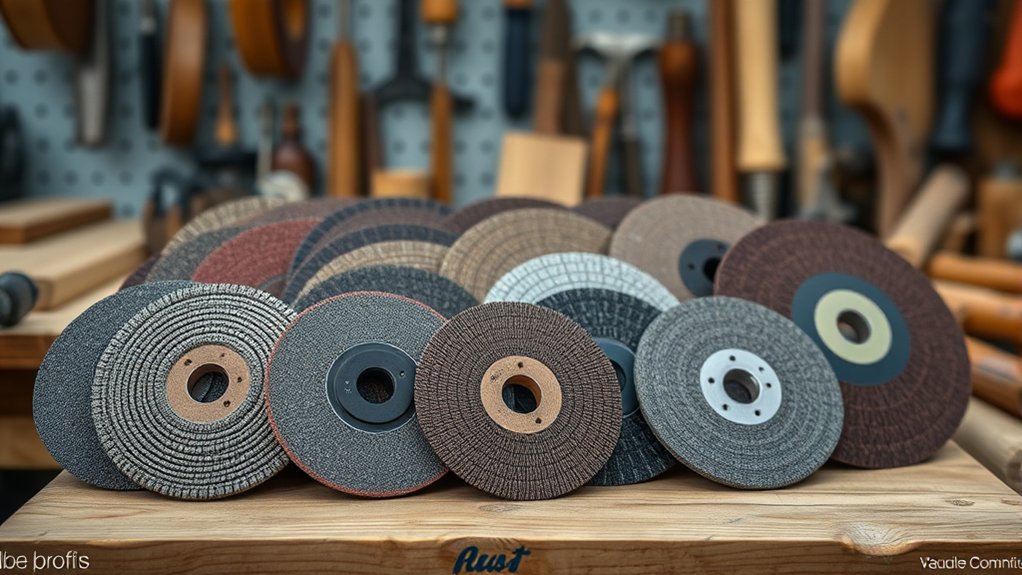
Flap disc grit numbers describe the abrasive grade. Lower numbers use larger, more aggressive particles that remove material faster and leave deeper scratches. Higher numbers use finer particles that remove less material per pass and leave a smoother scratch pattern.
For standard coated-abrasive flap discs, the most common range is roughly 36 to 120 grit. Manufacturers also sell specialty coarse products below that range and non-woven finishing flap discs in finer grades such as 180 or 240. Those products do not cut and finish exactly like a standard coated-abrasive disc, so read the label rather than choosing by the number alone. Weiler’s flap disc guide identifies 36 to 120 as the typical coated-abrasive range, while PFERD’s non-woven flap discs extend into finer finishing grades.
Coarse grits, such as 24, 36, 40, and 60, are used for stock removal, heavy weld grinding, rust and scale removal, edge shaping, and rough cleanup. Grits below 36 are less common in general-purpose flap-disc lines and can remove metal very quickly.
Medium grits, such as 60 and 80, balance cutting speed and control. They are useful for weld blending, deburring, removing coarse scratch marks, and preparing a surface for the next abrasive step.
Fine coated-abrasive grits, most often 120, are used for light blending and surface preparation. For a finer cosmetic finish, switch to a non-woven surface-conditioning product, a fine flap wheel, or another abrasive designed for finishing rather than forcing a standard flap disc to do polishing work.
The grit number is only one part of the choice. Disc shape, abrasive grain, pressure, speed, and material can change how aggressive the same grit feels.
Why Grit Size Matters in Flap Discs
Grit size controls the tradeoff between removal rate and surface finish. A coarse disc cuts quickly, but it can leave deep marks and remove too much metal near edges. A finer disc gives better control and a smaller scratch pattern, but it works more slowly and can glaze or overheat if it is forced into heavy stock removal.
Choosing the right starting grit reduces rework. The goal is to start only as coarse as necessary, remove the defect or weld efficiently, and then use progressively finer abrasives until the remaining scratch pattern is suitable for the next operation.
How Grit Size Changes the Result
Very coarse and coarse grits, from about 24 to 60, provide strong cutting action. Use them for thick welds, heavy burrs, mill scale, beveling, and rough shaping. They are not the best choice when dimensions, edge shape, or appearance must be protected.
Medium grits, usually 60 to 80, provide more control. They can blend weld toes, remove the scratch pattern left by a coarser disc, and prepare metal for a final finishing step.
Fine coated-abrasive grit, commonly 120, suits light finishing and surface preparation. Specialty non-woven flap discs can provide finer grades, but their open, conformable structure is designed more for blending and conditioning than aggressive metal removal.
How to Select the Right Grit
Start by identifying the next required result. If a weld must be leveled quickly, begin with 36 or 40 grit. If the weld is already close to flush and you only need to blend the edges, 60 or 80 grit may be enough. If the surface is nearly finished, start at 80 or 120 grit to avoid unnecessary scratches.
For edge beveling and common weld cleanup, 40 to 60 grit often gives a useful balance. For blending and light finishing, 80 to 120 grit is usually more appropriate. Test the least aggressive practical option on scrap or an inconspicuous area when the final appearance matters.
Flap Disc Grit Chart Explained
A flap disc grit chart is a starting point, not a universal rule. Product lines differ in abrasive grain, backing weight, flap density, grinding aid, and shape. A premium ceramic 60-grit disc can cut differently from a basic aluminum-oxide 60-grit disc, even though both carry the same nominal grit number.
| Grit or Grade | Best Use | Typical Result | Important Note |
|---|---|---|---|
| 24 to 36 grit | Heavy stock removal, thick welds, rough shaping | Very rough, deep scratch pattern | Not offered in every flap-disc line; easy to over-grind thin or soft material |
| 40 grit | Weld removal, beveling, rust and scale removal | Fast cut with a coarse finish | A common starting grit for substantial metal removal |
| 60 grit | General weld cleanup, deburring, bevel refinement | Moderate scratch pattern | Often the best all-purpose compromise for fabrication work |
| 80 grit | Blending, light grinding, surface preparation | Smoother and easier to refine | Good for removing 40- or 60-grit scratches before final prep |
| 120 grit | Fine blending and light surface preparation | Fine coated-abrasive finish | A common upper end for standard coated-abrasive flap discs |
| 150 to 240 grade | Fine blending, conditioning, cosmetic finishing | Smooth, low-cut finish | Usually found in specialty or non-woven flap-disc products, not every standard line |
| 320 and finer | Very fine cosmetic preparation | Very smooth finish | A different abrasive format, such as a flap wheel, sanding disc, or surface-conditioning disc, is often a better choice |
Products Worth Considering
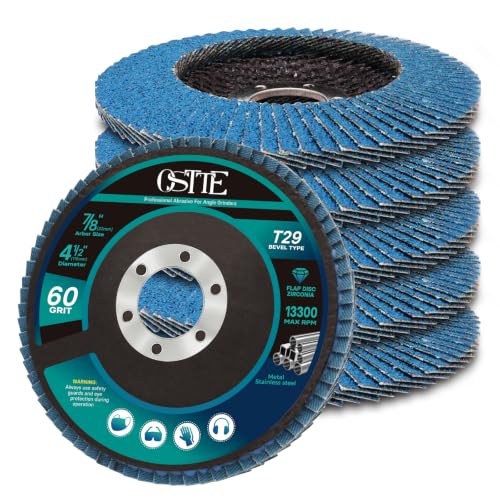
4.5-Inch Flap Discs for Angle Grinder:OSTTE 5-pack of quality flap discs features 60 grit and a Type 29 conical design with a 7/8-inch arbor, suitable for grinding metal and stainless steel. Max Speed: 13,300 RPM

HIGH-DENSITY JUMBO DESIGN: Type 29 flap discs with a high-density jumbo layout support surface blending, beveling, grinding, deburring, and edge chamfering. Curved profile aids finishing, stock removal, and rust cleanup for pros and DIY enthusiasts
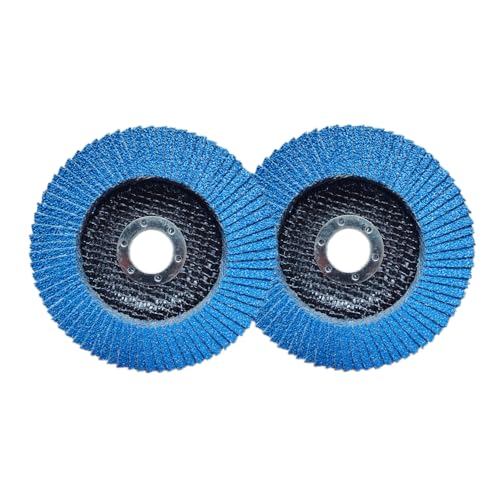
👍【60 Grit Fast Grinding】:The type 27 and 60 grain coarse zirconium corundum particles adhere firmly to the flap disc surface, allowing you to quickly polish a variety of materials, improving efficiency and saving time.
Grit Size Categories
Coarse grits remove material quickly and are best when speed matters more than appearance. Medium grits suit blending, light grinding, and prep work. Fine grades reduce scratch depth, but the product construction becomes increasingly important as you move beyond standard 120-grit coated flap discs.
Material Removal Applications
For heavy material removal, choose a coarse disc that is explicitly rated for the material and application. A 36- or 40-grit ceramic or zirconia disc is a common choice for hard use on steel. A 60-grit disc is often easier to control when the weld is small, the base metal is thin, or the final profile matters.
For weld blending, 60- or 80-grit flap discs commonly work well. Norton lists 60- and 80-grit coated flap discs for deburring welds and uses finer abrasives for subsequent blending and finishing. Norton’s welding abrasive selection guide provides application-based starting points.
Finishing Techniques Overview
Finishing work needs a controlled sequence. Start with the least coarse grit that can remove the defect. Keep the grinder moving, use the correct contact angle, and stop as soon as the coarse scratch pattern is even. Then clean the surface and move to the next finer grit.
A practical coated-abrasive progression is 40 to 60 to 80 to 120. You do not always need every step, but a large jump can leave deep scratches that the finer disc removes slowly. Norton describes this same common sequence for weld blending. See Norton’s discussion of common grinding steps.
How to Select Grit Size for Material Removal
Choose grit by the amount of stock that must come off, the thickness of the workpiece, and the finish required afterward. A lower grit number removes stock faster. A higher number gives more control and a smaller scratch pattern.
- Identify the job. Decide whether you are removing a weld, beveling an edge, deburring, blending, or preparing for coating.
- Check the material. Select a disc labeled for carbon steel, stainless steel, aluminum, wood, or the specific composite.
- Start only as coarse as needed. Use 36 or 40 grit for heavy removal, 60 grit for general cleanup, and 80 or 120 grit when the surface is already close to shape.
- Match the finish process. Paint, powder coating, plating, and visible stainless finishes may require different final scratch patterns. Follow the coating or finishing-system instructions.
- Test and inspect. Make a short pass, stop the grinder, and check heat, scratch depth, flatness, and remaining weld height before continuing.
Warning: Wear impact-rated eye protection with side protection and a face shield, plus hearing protection, suitable gloves, and protective clothing. Keep the grinder guard installed, secure the workpiece, direct sparks away from people and flammables, and never exceed the disc’s marked maximum RPM. OSHA requires suitable eye or face protection for flying-particle hazards and guards on portable abrasive wheels. OSHA eye and face protection and portable-tool guarding requirements provide the relevant workplace rules.
Products Worth Considering
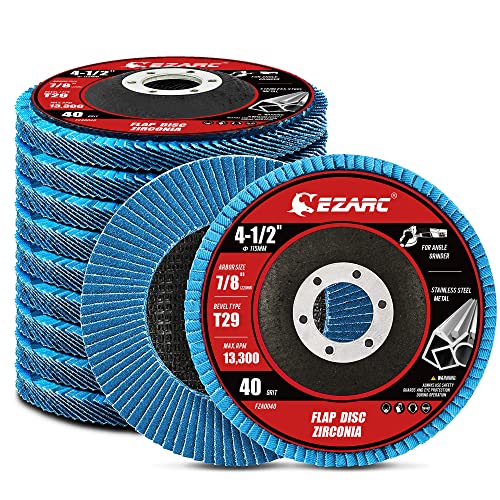
【Great Performance】EZARC flap sanding discs are made of hard zirconia material which lasts longer than standard aluminum oxide abrasive material, built for a more robust and economical grinding wheel

HIGH-DENSITY JUMBO DESIGN: Type 29 flap discs with a high-density jumbo layout support surface blending, beveling, grinding, deburring, and edge chamfering. Curved profile aids finishing, stock removal, and rust cleanup for pros and DIY enthusiasts

High performance, contaminant free
Type 27 vs. Type 29 Flap Discs
Disc shape affects both contact angle and cutting behavior. Type 27 flap discs have a flatter face and are generally used at shallow angles for blending and finishing flat surfaces. Type 29 discs have a conical face and are used at steeper angles for more aggressive stock removal.
- Type 27 flat: Best for flat surfaces, light contours, smooth blending, and shallow contact angles.
- Type 29 conical: Best for aggressive grinding, beveling, and stock removal at a steeper angle.
3M’s current right-angle grinding guidance recommends using the shape that keeps the full width of the flap material in contact with the workpiece. It lists Type 27 for approximately 0 to 15 degrees and Type 29 for approximately 15 to 25 degrees. See the 3M right-angle grinding brochure.
Pro Tip: Watch the wear pattern on the flaps. If only the outer edge is wearing, your angle may be too steep for the disc shape. Full-width, even contact usually improves control and disc life.
Choosing the Abrasive Grain
Grit tells you particle size, while abrasive grain tells you what the cutting particles are made from. Both matter.
- Aluminum oxide: A general-purpose option for common steel work, maintenance, and lighter-duty grinding.
- Zirconia alumina: A durable, self-sharpening choice for steel, stainless steel, and medium-to-heavy pressure.
- Ceramic alumina or precision-shaped ceramic grain: Designed for fast cutting and long life in demanding metalworking applications, especially on harder alloys.
- Non-woven abrasive: A conformable structure used for blending, cleaning, and fine finishing rather than rapid stock removal.
For aluminum, choose a product specifically rated for non-ferrous metal and designed to resist loading. For stainless steel, use a disc labeled for stainless and keep it separate from carbon-steel abrasives if surface contamination matters.
Optimal Grit Sizes for Blending and Finishing
For blending and finishing, 60 to 120 grit usually gives the best balance. A 60-grit disc can remove remaining weld height and soften coarse grinding marks. An 80-grit disc can blend the repair into the surrounding metal. A 120-grit disc can provide light final preparation before a separate finishing or coating step.
For delicate cosmetic finishing, switch to a fine non-woven flap disc or surface-conditioning abrasive rather than assuming a standard 150-, 240-, or 320-grit coated flap disc is available. Specialty products exist, but they cut differently and may be labeled by grade as well as grit.
Material type matters. Aluminum, mild steel, stainless steel, wood, and composites can react differently to the same nominal grit. Test a small area, keep pressure low, and watch for heat, loading, gouging, or discoloration.
Common Mistakes When Picking Grit Sizes
Small selection and technique errors create most flap-disc rework. The most common problem is starting too coarse for the finish or thickness. The next is using a fine grit for heavy removal, which slows the job and encourages excess pressure.
- Skipping too many grit steps: Deep scratches remain visible or take too long to remove.
- Using the wrong abrasive grain: The disc cuts slowly, loads up, overheats, or wears quickly on the material.
- Pressing too hard: Excess pressure can overheat the workpiece, shorten disc life, and make the grinder harder to control.
- Holding the wrong angle: Edge-only contact can gouge the surface and wear the flaps unevenly.
- Over-grinding: The base metal becomes thin, wavy, undercut, or out of dimension.
- Using one disc on incompatible materials: This can load the abrasive or transfer unwanted material to a finished surface.
- Failing to clean between stages: Loose coarse grit and metal particles can create random scratches.
- Ignoring disc condition: Missing flaps, cracks, water damage, or a distorted backing are reasons to discard the disc.
Pro Tip: Let the abrasive cut. Use enough pressure to keep the disc working, but do not lean on the grinder. If removal slows, inspect the disc, angle, speed, and material match before adding force.
How Grit Size Affects Surface Quality
Lower grit numbers leave a wider and deeper scratch pattern. Higher grit numbers leave smaller scratches, but the final appearance also depends on the grain, flap density, backing, tool speed, pressure, and operator motion.
Medium grits such as 60 and 80 often provide the best transition between weld removal and finish work. A 120-grit coated flap disc can refine the surface further, but it may still leave a directional scratch pattern. If the finished metal will remain visible, plan the final abrasive around the desired grain direction and appearance.
If the surface will be painted or coated, follow the coating manufacturer’s preparation requirements. A surface can be too rough, too polished, contaminated, or thermally damaged even when it looks clean.
Matching Grit Sizes to Different Materials
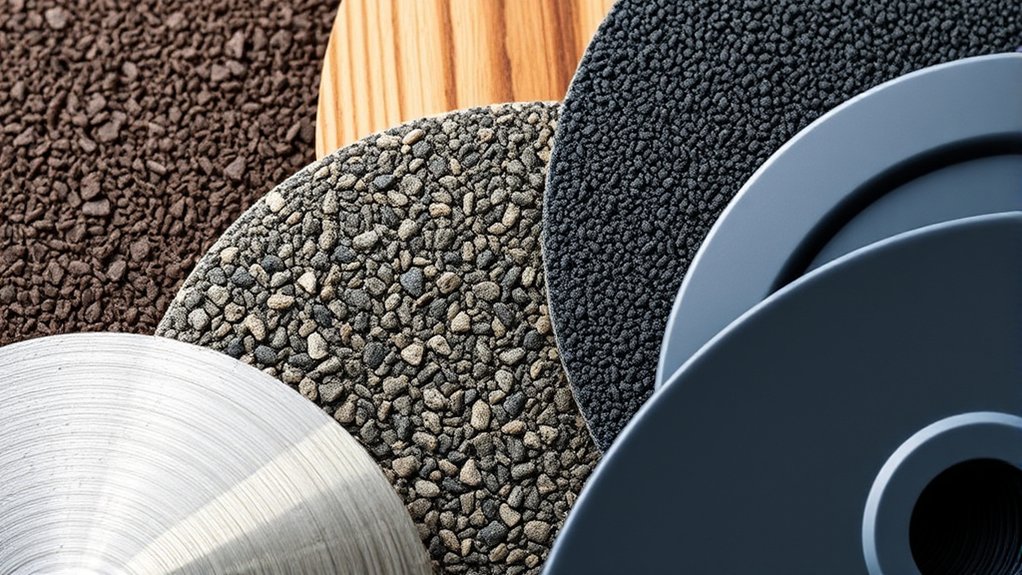
Selecting the right grit and abrasive for the material improves cutting speed and reduces damage. Harder materials may benefit from ceramic or zirconia grain. Softer or heat-sensitive materials need lighter pressure and a product designed to avoid loading or excess heat.
| Material | Starting Point | Disc Guidance | Main Risk |
|---|---|---|---|
| Carbon or mild steel | 40 to 60 grit for weld removal; 80 to 120 for blending | Aluminum oxide, zirconia, or ceramic depending on duty cycle | Over-grinding thin material or changing edge geometry |
| Stainless steel | 40 to 60 for removal; 80 to 120 for blending | Use a stainless-rated, cool-cutting disc and keep it separate from carbon-steel abrasives | Heat tint, distortion, and surface contamination |
| Aluminum and other non-ferrous metal | 60 or 80 grit is often easier to control than very coarse grit | Use a non-ferrous-rated, load-resistant product | Loading, smearing, heat, and gouging |
| Cast iron | 40 to 60 grit for cleanup and shaping | Choose a disc labeled for ferrous metal and control dust | Dust exposure and edge chipping |
| Wood | Use a finer grit and very light pressure | Use only a product whose manufacturer permits wood use | Rapid gouging, burning, kickback, and airborne dust |
| Composites | Fine grit and low pressure | Confirm the abrasive and dust controls are suitable for the exact composite | Delamination, heat damage, and hazardous dust |
Note: The disc label takes priority over a general grit chart. Confirm the approved materials, maximum RPM, disc shape, mounting system, and any required backing hardware before use.
Tips for Transitioning Between Grit Sizes
Move through grit sizes in stages so each disc can remove the scratch pattern from the previous step. Clean the workpiece between stages so loose abrasive and metal particles do not drag across the surface.
Use Gradual Grit Progression
A common sequence for leveling and blending a weld is 40, 60, 80, and 120 grit. You may start at 60 or 80 when little material must be removed, and you may stop at 60 or 80 when the next process does not require a finer finish.
- Start with 36 or 40 grit for heavy material removal.
- Move to 60 grit for controlled cleanup and removal of the deepest scratches.
- Use 80 grit for smoothing and blending.
- Finish with 120 grit when a fine coated-abrasive surface is needed.
- Use a non-woven or other finishing abrasive for finer cosmetic preparation.
Clean Between Grits
Use a clean brush, vacuum, or lint-free rag to remove dust and loose particles before the next stage. Compressed air can spread hazardous dust and drive particles into the eyes or skin, so use it only when your work practices and protective equipment make it safe.
Inspect the work under good light after each grit. If isolated deep scratches remain, return to the grit that can remove them efficiently instead of polishing the surrounding area with a much finer disc.
Grinder and Disc Compatibility
A correct grit is unsafe if the disc does not match the tool. Before mounting a flap disc, disconnect the grinder from power or remove the battery and verify all of the following:
- The disc diameter is approved for the grinder and fits inside the installed guard.
- The arbor hole, threaded hub, or mounting system matches the spindle.
- The grinder’s no-load speed does not exceed the maximum RPM marked on the disc.
- The guard, side handle, spindle, flange, and mounting hardware are present and undamaged.
- The disc has no cracks, missing flaps, moisture damage, distortion, or other visible defects.
- The disc is approved for the material and for grinding, not cutting.
Norton advises matching disc size to the machine, checking tool speed against the disc’s safe operating speed, disconnecting power before a disc change, and discarding damaged products. Review Norton’s flap-disc safety checklist.
Warning: Never remove the grinder guard to fit an oversized disc, never mount a disc with a lower RPM rating than the grinder, and never use the side of a cutting wheel as a substitute for a flap disc. A damaged or overspeed abrasive can break apart and cause severe injury.
Flap Disc Troubleshooting
| Problem | Likely Cause | Fix |
|---|---|---|
| Disc removes metal too slowly | Grit is too fine, grain is wrong for the material, flaps are glazed, or contact angle is poor | Use a coarser or material-specific disc, correct the angle, and replace a glazed or worn disc |
| Deep gouges or waves | Grit is too coarse, pressure is excessive, or the grinder is held in one spot | Use a finer grit, reduce pressure, and keep the tool moving with overlapping passes |
| Workpiece turns blue or discolors | Excess heat from pressure, dwell time, a dull disc, or the wrong abrasive | Reduce pressure, shorten passes, use a sharp cool-cutting disc, and allow the work to cool |
| Disc loads with aluminum or soft material | The disc is not designed for non-ferrous metal or is being run with too much heat and pressure | Stop using the loaded disc and switch to a non-ferrous-rated, load-resistant product |
| Flaps wear only at the outer edge | Grinding angle is too steep or the wrong disc shape is being used | Flatten the angle for Type 27 work or use a Type 29 disc for steeper grinding |
| Random scratches appear after changing grit | Coarse particles remain on the workpiece, bench, rag, or gloves | Clean the work, tools, gloves, and nearby surface before continuing |
When Not to Use a Flap Disc
A flap disc is versatile, but it is not the correct tool for every job.
- Cutting through metal: Use a properly guarded cut-off wheel that is designed for cutting.
- Removing a large amount of heavy weld quickly: A grinding wheel or suitable fiber disc may be more efficient, followed by a flap disc for blending.
- Creating a decorative stainless finish: Use the surface-conditioning, belt, or finishing system specified for the desired grain.
- Working in tight internal corners: Use a product designed to reach the geometry without forcing the flap-disc edge.
- Fine polishing: Use a polishing or finishing abrasive rather than treating a standard coated flap disc as a polishing pad.
- Removing hazardous coatings or grinding hazardous materials: Stop and identify the coating or material first, then use the required containment, ventilation, and respiratory controls.
Final Flap Disc Grit Checklist
Before grinding, choose the disc by task, material, tool compatibility, and finish goal. Coarse grits remove stock quickly. Finer grits improve control and reduce scratch depth, but they are not a substitute for the correct finishing abrasive.
- Use 36 or 40 grit for heavy removal and thick welds.
- Use 60 grit for common weld cleanup, beveling, and deburring.
- Use 80 grit for blending and controlled surface preparation.
- Use 120 grit for fine coated-abrasive blending.
- Use a purpose-made non-woven or finishing product beyond the normal coated-disc range.
- Choose ceramic or zirconia for demanding metal removal and aluminum oxide for many general-purpose tasks.
- Use a non-ferrous-rated disc for aluminum and a stainless-rated disc for stainless steel.
- Use Type 27 at a shallow angle for flat blending and Type 29 at a steeper angle for aggressive grinding.
- Verify diameter, arbor, maximum RPM, guard, and disc condition before every use.
- Clean and inspect the surface between grit changes.
Frequently Asked Questions
What is the grit range for flap discs?
Standard coated-abrasive flap discs commonly range from about 36 to 120 grit. Some product lines include coarser 24-grit discs, while specialty non-woven flap discs may be offered in finer grades such as 180 or 240. Always check the product type and label.
What is the difference between 40-grit and 60-grit flap discs?
A 40-grit flap disc removes material faster and leaves a deeper scratch pattern. A 60-grit disc cuts more slowly but gives better control and a smoother result. Choose 40 grit for heavier weld removal and 60 grit for general cleanup, bevel refinement, or thin material.
What do grit numbers mean?
Grit numbers identify the abrasive particle-size grade. Lower numbers are coarser and cut faster. Higher numbers are finer and leave a smaller scratch pattern. The abrasive grain and disc construction also affect the actual cut.
What grit flap disc should I use?
Use 36 or 40 grit for heavy stock removal, 60 grit for common weld cleanup, 80 grit for blending, and 120 grit for fine coated-abrasive preparation. Start with the least aggressive grit that can complete the job efficiently.
Can you use a flap disc on wood?
Some flap discs can be used on wood when the manufacturer permits it. Use a finer grit, light pressure, secure workholding, and dust control. Coarse discs can remove wood rapidly, gouge the surface, burn the material, and increase the risk of kickback.
Is 120 grit fine enough before paint?
Sometimes, but there is no universal paint-prep grit. The correct finish depends on the metal, primer, coating system, and product instructions. Follow the coating manufacturer’s required surface profile and remove dust, oil, rust, and loose material before coating.
Should I use Type 27 or Type 29?
Use a Type 27 flat disc for shallow-angle blending and finishing on flat surfaces. Use a Type 29 conical disc at a steeper angle for more aggressive stock removal, beveling, and edge work. Follow the angle range printed by the disc manufacturer.
When should a flap disc be replaced?
Replace it if flaps are missing, the backing is cracked or distorted, the disc has been wet or damaged, the abrasive is badly loaded or glazed, or the disc no longer cuts predictably. Never use a disc after its structure or mounting area has been compromised.
Conclusion
The best flap disc grit depends on the amount of material you need to remove, the base material, the grinder, and the finish required next. Use 36 or 40 grit for heavy removal, 60 grit for general weld cleanup, 80 grit for blending, and 120 grit for fine coated-abrasive preparation. Move through grits only as needed, keep the work clean, and switch to a dedicated finishing abrasive when you need a result finer than a standard flap disc can provide. Correct disc shape, grain, RPM rating, guard setup, and technique are just as important as the grit number.
Sources
- Weiler Abrasives: Guide to Flap Discs — typical grit range, disc shapes, and application guidance.
- Norton Abrasives: Choosing the Right Abrasive Product for Welding and Metal Fabrication — grit and abrasive recommendations for weld cleanup and blending.
- 3M: Cubitron 3 Right-Angle Grinding Brochure — Type 27 and Type 29 contact-angle guidance.
- Norton Abrasives: Do’s and Don’ts of Flap Discs — RPM, inspection, mounting, storage, and operating precautions.
- OSHA 29 CFR 1910.133: Eye and Face Protection — protection from flying-particle hazards.
- OSHA 29 CFR 1910.243: Guarding of Portable Powered Tools — grinder guard requirements.