Disclosure: As an Amazon Associate I earn from qualifying purchases. Buying through these links costs you nothing extra.
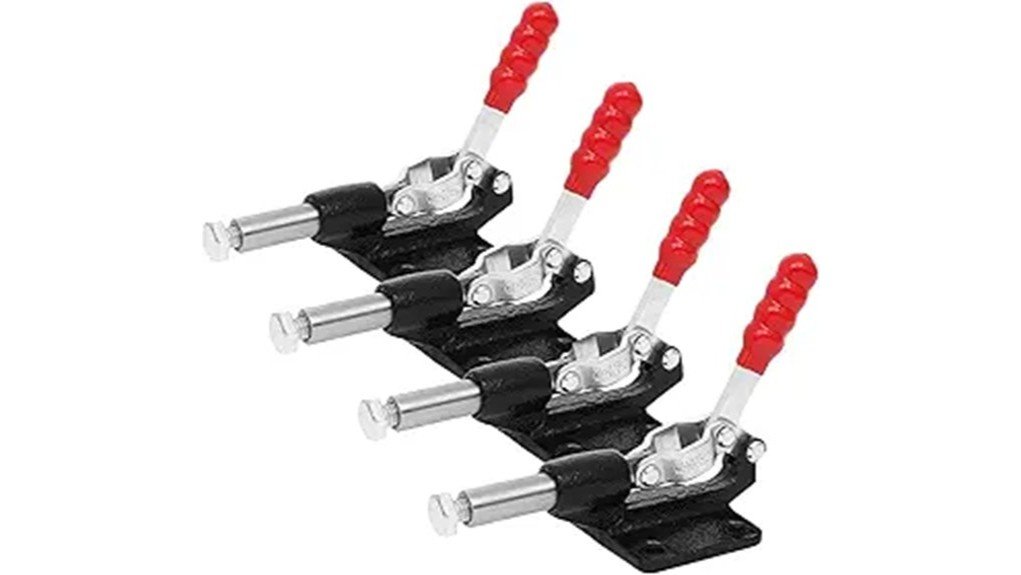
The GH-305C toggle clamp is a horizontal push-pull latch clamp, not a classic hold-down clamp. You mount its flange base to a bench or jig, and the plunger pushes or pulls a workpiece in a straight line against a stop. Listings give it a 500 lb (227 kg) holding capacity, a 32 mm plunger stroke and a zinc-plated carbon steel body. This review covers the specs, where the clamp makes sense in woodworking and light fabrication fixtures, and what to check before you mount one.
Quick Verdict
Best for: Jig builders and woodworkers who need repeatable straight-line clamping against a fixed stop, such as router-table fences, drilling jigs and small assembly fixtures.
Bottom line: A compact, fast-acting push-pull clamp when you can mount it square to the work. It is not a lifting device, and it is the wrong style if you need a vertical hold-down. Pack size and hardware can vary, so confirm both on the listing.
GH-305C Toggle Clamp Specs
| Spec | Detail |
|---|---|
| Model | GH-305C (some listings write GH-305-C) |
| Style | Horizontal push-pull latch clamp, straight-line action |
| Holding capacity | 500 lb / 227 kg, per the listing |
| Plunger stroke | 32 mm, per the listing |
| Handle | Ribbed plastic, opens 180 degrees per the listing |
| Body material | Zinc-plated carbon steel, per the listing |
| Mounting | Flange base plate (screws or bolts not confirmed, check the listing) |
| Maximum overall length | 6-1/2 in per retailer listings |
| Pack size | Varies by listing, check before ordering |
What Is the GH-305C Toggle Clamp?
A toggle clamp uses a lever linkage that locks over center, so the handle holds the clamping force without you keeping pressure on it. The GH-305C is the horizontal push-pull version: the handle moves a plunger forward to push a part against a stop, or back to pull it, along the clamp axis.
That makes it a good fit for jigs where the part always seats against the same stop. The adjustable pressure tip lets you set how firmly the clamp bears on the part, so you can test on scrap before committing to the final mounting position.
Who Should Buy It?
- Woodworkers building router-table, drilling or sanding jigs that repeat the same operation.
- Fabricators who want a quick positioning clamp on a layout table or fixture, keeping the plastic handle away from heat and sparks.
- Anyone replacing slow screw clamps on a production-style jig.
Skip it if you need a vertical hold-down clamp that presses a part down onto a surface, a deep-reach clamp, or a clamp for random, one-off workpiece shapes. For hold-down style see the POWERTEC hold-down toggle clamp review.
How to Mount and Set Up the Clamp
- Clamp a scrap part in place and mark where the plunger tip meets it with the handle fully closed.
- Check the handle swing through its full travel so it does not hit a fence, wall or workpiece.
- Mark and drill the flange holes in a flat, solid base. Use fasteners that suit your base material, since the listing does not clearly confirm included hardware.
- Align the plunger axis square to the part so the force goes straight along the clamp.
- Adjust the pressure tip until the clamp holds the part firmly without crushing soft wood or thin sheet.
- Test several cycles before using the jig on real work.
Safety and Limits
The 500 lb figure is a holding rating for a properly mounted clamp. It does not make the GH-305C suitable for lifting, hoisting, pulling suspended loads or any application where a failure could injure someone.
The handle is plastic. Near welding or hot work, keep it clear of sparks, spatter and hot metal, and do not treat the clamp as a rated welding fixture. At the router table, keep guards, push blocks and safe feeding technique in place; a clamp does not replace them.
GH-305C vs Other Toggle Clamps
Hold-down clamps press a part down onto a surface and are better for flat sheet work. Push-pull clamps like the GH-305C work along a line and suit fences, stops and edge clamping. If you want to compare push-pull options, see the POWERTEC 2PK push-pull toggle clamp review. Compared with bar or F-style clamps, any toggle clamp is faster to reset but tied to one mounting spot.
Pros and Limitations
Pros
- Fast clamp and release once mounted
- Adjustable pressure tip for dialing in the hold
- Metal body with zinc plating, per the listing
- Compact enough for tight jig layouts
Limitations
- Fixed mounting position, not portable
- Straight-line action only, not a vertical hold-down
- Mounting hardware and pack size not clearly confirmed on listings
- Plastic handle needs protection from heat and sparks
Related reading: what a welding jig is and how it helps, POWERTEC push-pull toggle clamp and DIY welding jig ideas for a small shop.
Frequently Asked Questions
What is the GH-305C toggle clamp used for?
It is used for repeat straight-line clamping on jigs and fixtures, such as router-table fences, drilling jigs, small assembly fixtures and light fabrication setups.
Is the GH-305C a hold-down or push-pull clamp?
Listings describe it as a horizontal push-pull latch clamp with straight-line action, not a vertical hold-down clamp.
What is the holding capacity of the GH-305C?
Listings state 500 lb (227 kg). Treat it as a rating for a securely mounted clamp, not as a lifting or load-bearing rating.
What is the stroke of the GH-305C?
Listings give a 32 mm plunger stroke. Check that the pressure tip reaches your workpiece with the handle fully closed before drilling mounting holes.
Does the GH-305C come with mounting screws?
The listings do not clearly confirm included hardware, so choose screws or bolts that suit your bench or jig material and check the Amazon listing.
Can I use it near welding?
Only for positioning work, with the plastic handle kept away from sparks, spatter and hot metal. It is not a rated welding fixture.
The Bottom Line
The GH-305C is a practical push-pull toggle clamp for jigs and fixtures where parts seat against a fixed stop. Buy it for repeatable straight-line clamping, mount it square on a solid base, and keep it away from heat. Choose a hold-down clamp instead if you need to press parts down onto a surface.