Disclosure: As an Amazon Associate, we earn from qualifying purchases. If you click a link on this page and make a purchase, we may receive a small commission at no extra cost to you.
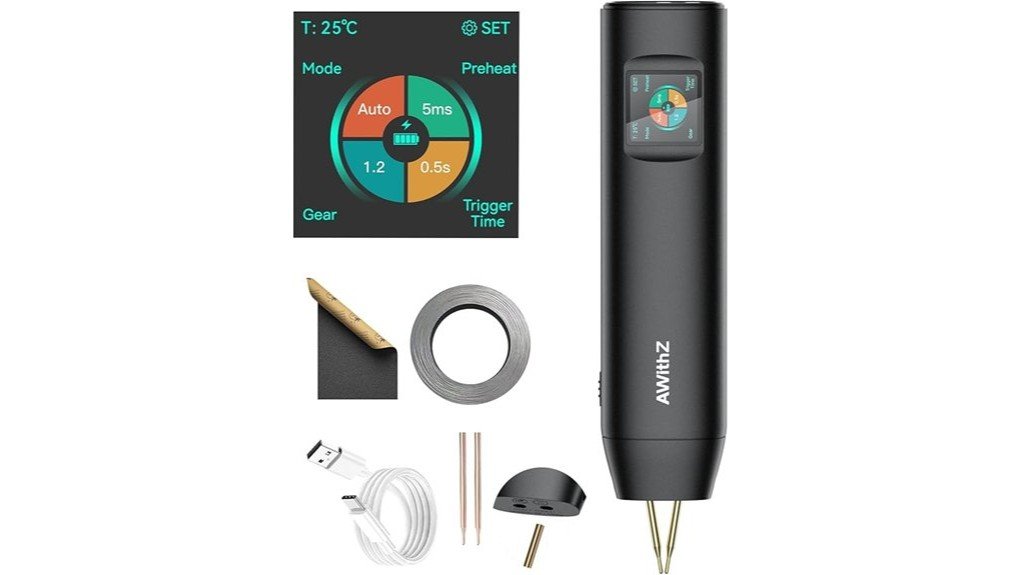
Building or repairing a lithium battery pack is difficult when your spot welder is bulky, vague about its settings, or hard to position over a narrow nickel strip. The AWithZ H2 Handheld 18650 Battery Spot Welder combines the power supply and welding tips in one 140-gram tool, with a 1.5-inch color screen and 99 adjustable output levels. This review explains what its controls, dual-pulse modes, battery compatibility, and safety cutoff mean in practical use. It is a useful portable option for careful DIY work, but its listing does not state a verified strip-thickness range, battery capacity, or duty cycle.
Quick Verdict
Rating: 8/10, recommended with caveats
Best For: DIY battery-pack repair, light cylindrical-cell projects, and portable workshop use.
Bottom Line: The AWithZ H2 is easy to carry and gives you unusually fine control through its screen, 99 power levels, and automatic or manual triggering. Its main limitation is incomplete published performance data, so you must test settings carefully instead of assuming a specific strip thickness or production capacity.
Key Takeaways
- The AWithZ H2 weighs 140 grams and measures 6.8 inches long by 1.7 inches wide, which supports one-handed positioning.
- Its integrated design combines the power source and welding pen, so there is no separate handheld probe assembly.
- The 1.5-inch color screen shows temperature, mode, timing, and power information, although the seller copy uses both LCD and OLED terminology.
- You get 99 adjustable power levels, dual-pulse output, and automatic or manual triggering.
- The listing names 18650, 21700, 26650, and 32650 cylindrical cells among the supported battery formats.
- A temperature detector shuts the unit down at 60°C, but safe battery handling and cooling pauses are still required.
| Specification | Detail |
|---|---|
| Brand | AWithZ |
| Model | H2 |
| Product Type | Integrated handheld battery spot welder |
| Primary Use | Small battery-pack assembly, repair, and tab welding |
| Compatible Cylindrical Cells | 18650, 21700, 26650, and 32650 |
| Listed Materials | Thin nickel-plated sheet, stainless steel sheet, and similar thin conductive strips |
| Weight | 140 grams |
| Dimensions | 6.8 inches long by 1.7 inches wide |
| Display | 1.5-inch color screen; listing title says LCD while feature copy also calls it OLED |
| Power Adjustment | 99 selectable levels |
| Pulse Output | Dual pulse |
| Operating Modes | Automatic and manual triggering |
| Screen Information | Temperature, mode, preheat time, trigger time, and power level |
| User Settings | Seven languages, brightness, 180-degree screen rotation, key sound, and automatic power-off timing |
| Temperature Protection | Automatic shutdown at 60°C |
| Included Accessories | Spot welder, nickel sheet, seller-described gauze, and charging cable |
| Unpublished Details | Battery capacity, welds per charge, charging time, exact strip-thickness range, and duty cycle |
| Best Use | Careful hobby work, repair, prototyping, and light portable use |
What Is the AWithZ H2 Handheld Spot Welder?
The AWithZ H2 is a compact resistance spot welder designed to attach thin metal tabs to battery terminals. Its integrated body combines the welding tips and internal power source, which removes the need to hold a separate pen connected to a larger control box.
The H2 is marketed mainly for cylindrical lithium battery work, including 18650, 21700, 26650, and 32650 cells. The seller also lists several other battery formats and thin metal materials, but you should confirm suitability for your exact cell chemistry, strip material, and thickness before starting.
Its main selling point is adjustable control in a small package. You can select from 99 power levels, view timing and temperature data on the screen, and choose automatic or manual triggering based on the amount of control you need.
Before You Buy: The listing does not publish a verified maximum strip thickness, battery capacity, weld count per charge, or continuous-duty rating. Buy it for controlled, small-scale work, not because you expect benchtop output or a guaranteed production rate.
Integrated Design and Portability
At 140 grams, the H2 is light enough to position with one hand while you stabilize the battery holder or nickel strip with the other. Its 6.8-inch by 1.7-inch body also takes less storage space than a benchtop unit with separate welding leads.
The compact format is best suited to short sessions, field kits, and hobby benches. It does not provide the clamping stability, foot-pedal workflow, or documented duty cycle that buyers may expect from a larger shop machine.
The AWithZ H2 trades benchtop capacity for a lightweight, self-contained design that is easier to position and store.
1.5-Inch Display and Controls
The 1.5-inch color screen shows temperature, operating mode, preheat time, trigger time, and selected power level. These readouts help you record a working setup and make small adjustments instead of relying on memory.
The seller title identifies the screen as LCD, while the feature text also uses the word OLED. Because those descriptions conflict, the safest description is a 1.5-inch color display. The screen can rotate 180 degrees, which is useful when your grip or work angle places the display upside down.
Power Levels, Dual Pulse, and Weld Control
The H2 provides 99 power levels rather than a few broad presets. That range gives you room to tune output for differences in strip material, surface condition, contact pressure, and battery-terminal geometry.
More settings do not automatically produce a better weld. A low setting can leave a weak joint, while too much energy can mark the strip, damage the cell terminal, or create excessive heat. Use peel tests on scrap or noncritical samples to confirm that a setting produces a secure bond before working on a complete pack.
The listing also specifies dual-pulse output. In practical terms, two controlled pulses can help establish contact and then form the joint, but the seller does not publish pulse duration, current, or energy figures. You should judge performance by tested weld quality, not by the number of available settings alone.
Automatic and Manual Modes
Automatic mode is useful when you want the tool to trigger after the tips make contact, which can speed up repeated tab placements. Manual mode gives you direct control through the side button and may be easier when you are learning the correct tip angle or working in a tight layout.
The listing confirms automatic and manual operation, but it does not say that automatic mode identifies the battery type or chooses the correct power level for you. You still need to select and test the output setting yourself.
- Use automatic mode for repeatable placements after you have validated the setting.
- Use manual mode when timing and tip placement need closer control.
- Record successful settings for each strip material and cell type.
- Re-test after changing strip thickness, contact pressure, or electrode condition.
Included Accessories and First Setup
The package is listed with the H2 spot welder, a nickel sheet, a charging cable, and an item described by the seller as gauze. The included strip gives you material for basic setup and practice, but the listing does not state its composition, purity, or thickness.
Pro Tip: Create a small test chart for each strip and cell combination. Record the power level, mode, contact pressure, and peel-test result so you can repeat a good setup without starting from zero.
Who Should Buy It?
Best For
- DIY builders making or repairing small packs with common cylindrical cells.
- Hobbyists who value portability and visible control over power, mode, and timing.
- Repair benches that need a compact secondary tool for light tab-welding work.
Skip If
- You need documented current, energy, strip-thickness, or duty-cycle specifications.
- You regularly weld thick material or run high-volume production sessions.
- You are not equipped to test weld strength and follow lithium-battery safety practices.
How It Performs in Real Use
For 18650 Pack Repair
The narrow handheld body is easy to place over individual cell terminals, especially when you are replacing a damaged strip or rebuilding a small section of a pack. Manual mode is the safer starting point because it lets you confirm the tip position before triggering each weld.
For Mixed Cylindrical Cell Projects
The listing names 18650, 21700, 26650, and 32650 formats, so the H2 is not limited to one cylinder size. Cell size alone does not determine the correct setting, however. Terminal design, strip material, strip thickness, and surface condition can all change the energy needed.
For Portable Workshop Use
The 140-gram integrated design is convenient when you move between benches or keep tools in a compact case. You do not have to transport a separate welding pen and control box, although you still need a stable, nonconductive work surface and safe cell storage.
For Learning and Prototyping
The screen and 99 levels make controlled experiments easier because you can change one variable at a time. Beginners should treat the wide adjustment range as a testing tool, not permission to start at a high level on a live battery.
How to Use It Correctly
- Inspect the cell: Do not weld a swollen, dented, leaking, corroded, overheated, or otherwise damaged battery.
- Prepare the work area: Use a clean, dry, nonconductive surface away from loose metal objects and flammable material.
- Secure the battery and strip: Prevent movement so both tips land squarely on the intended weld points.
- Start low: Select a conservative level and test on spare material or a noncritical sample.
- Check the joint: Use a controlled peel test. A strip that lifts with almost no resistance indicates a weak weld.
- Increase gradually: Raise the level one step at a time until the joint is secure without excessive marking or heat.
- Pause between groups: Let the tool and cells cool, even though the H2 includes a 60°C shutdown.
- Follow the manual: Use the supplied instructions for charging, mode selection, maintenance, and storage.
Compatibility and Battery Safety
The H2 is intended to join thin conductive tabs to battery terminals. Spot welding is generally preferred over prolonged soldering directly to many cylindrical cells because the weld is delivered in a brief pulse, but poor technique can still overheat, short, or damage a cell.
Keep the positive and negative terminals isolated throughout the build. Remove jewelry, keep loose tools away from exposed contacts, and use cell holders or insulating barriers where the pack design requires them. Never rely on the welder’s temperature sensor to detect every battery hazard because it measures the tool, not the internal condition of each cell.
The seller lists thin nickel-plated sheet and stainless steel sheet, but it does not publish an exact thickness range. Confirm the strip material before use because nickel-plated steel and pure nickel can behave differently, and a setting that works for one strip may not work for another.
Pros and Cons
Pros
- Integrated 140-gram body is easy to position and carry.
- 99 power levels support fine adjustment for different test setups.
- Screen displays temperature, mode, timing, and power information.
- Automatic and manual triggering support repeated or closely controlled work.
- Dual-pulse output and support for several common cylindrical cell sizes improve versatility.
Cons
- No verified strip-thickness range, current output, battery capacity, or duty-cycle figure is published.
- The listing uses conflicting LCD and OLED descriptions for the screen.
- Finding a safe, strong setting requires practice and peel testing.
Is It Worth the Price?
The AWithZ H2 offers reasonable value for buyers who prioritize portability, a visible settings interface, and more adjustment than a basic fixed-output mini welder. The integrated design can also save bench space and reduce the number of separate components you need to carry.
You get the most value if you are willing to test settings and use the tool for light repair, prototyping, or occasional pack assembly. The included nickel sheet and charging cable help with initial setup, but they do not replace proper holders, insulation, test material, and safety equipment.
It is not the best value for production work because the listing does not document output current, energy, strip-thickness limits, battery capacity, or duty cycle. Buyers who need repeatable shop specifications should compare a documented benchtop or capacitor-based system.
How It Compares to Alternatives
Compared with a benchtop transformer spot welder, the H2 is lighter and easier to store, but a larger machine can provide better clamping stability, hands-free controls, and a more suitable workflow for repeated production. Compared with a simple pen-style portable unit, the H2 gives you a built-in screen, 99 levels, dual-pulse output, and integrated one-handed operation.
Frequently Asked Questions
What is the exact brand and model?
The verified listing identifies the product as the AWithZ H2 Handheld 18650 Battery Spot Welder. Its Amazon product code is B0DZNJRLTT.
Is the screen LCD or OLED?
The seller title calls it a 1.5-inch LCD, while the feature copy also calls it OLED. Because the listing is inconsistent, treat it as a 1.5-inch color display unless AWithZ provides a clearer panel specification.
What battery sizes does the AWithZ H2 support?
The listing specifically names 18650, 21700, 26650, and 32650 cylindrical batteries. You must still match the power setting to the terminal, strip material, strip thickness, and cell condition.
What strip thickness can it weld?
The available listing does not publish an exact verified thickness range. Do not assume a common portable-welder figure applies to the H2; test the actual strip and confirm the joint with a controlled peel test.
Does automatic mode choose the correct power level?
No automatic material or battery recognition is stated in the verified feature list. Automatic mode refers to triggering behavior, while you remain responsible for selecting and testing the power level.
How long does it run on a full charge?
The listing does not state battery capacity, charging time, or a verified number of welds per charge. Charge it according to the manual and do not plan a large project around an unverified runtime estimate.
Is the 60°C shutdown enough for safe use?
It is a useful backup for tool overheating, not a complete battery-safety system. It does not replace cell inspection, short-circuit prevention, cooling pauses, protective equipment, or correct pack design.
Who should skip this handheld spot welder?
Skip it if you need documented production specifications, thick-metal capability, or sustained high-volume output. It is also a poor choice if you cannot safely inspect cells and validate weld strength before assembling a pack.
The Bottom Line
The AWithZ H2 Handheld 18650 Battery Spot Welder is recommended with caveats for hobbyists and repair users who want a 140-gram integrated tool with a color screen, 99 power levels, and automatic or manual triggering. Its main strength is portable control, while its main weakness is the lack of published output, runtime, thickness, and duty-cycle specifications.
Buy it for careful small-scale battery work and testing. Skip it for thick metal, high-volume production, or any project that requires fully documented welding parameters.
Ready to Buy?
Check the latest price, seller details, and product specifications before you decide.