Disclosure: As an Amazon Associate, we earn from qualifying purchases. If you click a link on this page and make a purchase, we may receive a small commission at no extra cost to you.
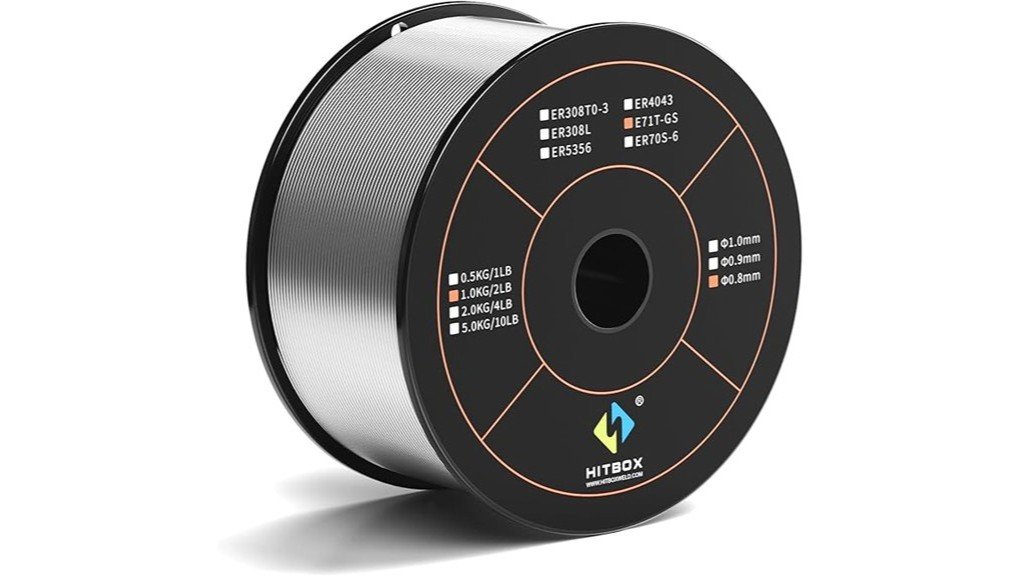
Gasless flux-core wire makes sense when you want to weld without carrying a shielding-gas cylinder, especially for outdoor repairs or a portable setup. The HITBOX E71T-GS Flux Core Gasless MIG Wire is a self-shielded option built around a 0.030-inch (0.8 mm) wire size and a compact 2 lb spool. Its main appeal is convenience, but you still need a compatible wire-feed welder, correct setup, good ventilation, and realistic expectations about slag and cleanup. This review explains where the HITBOX wire fits, what you should check before buying, and where a different welding wire may make more sense.
Quick Verdict
Rating: Recommended with caveats
Best For: DIY welders, portable flux-core setups, outdoor repairs, and buyers using a machine that supports 0.030-inch self-shielded wire.
Bottom Line: The HITBOX E71T-GS gives you a compact self-shielded wire option without the need for external shielding gas. Its biggest tradeoffs are the normal slag, fumes, and setup sensitivity of flux-core welding, so it is not automatically the best choice for every indoor or precision job.
| Specification | Detail |
|---|---|
| Brand | HITBOX |
| Classification | E71T-GS |
| Product Type | Self-shielded flux-core welding wire |
| Shielding Gas | No external shielding gas required |
| Wire Diameter | 0.030 in (0.8 mm) |
| Net Wire Weight | 2 lb |
| Other Listed Diameters | 0.035 in (0.9 mm) and 0.040 in (1.0 mm) |
| Useful Environments | Portable, outdoor, and windy welding setups where external gas is inconvenient |
| Surface Conditions | HITBOX states the wire can work on rusty, dirty, and painted material, although cleaning the weld area is still good practice when possible |
Key Takeaways
- The HITBOX E71T-GS is a self-shielded flux-core wire, so you do not need an external shielding-gas cylinder for normal use.
- The reviewed version uses 0.030-inch (0.8 mm) wire and HITBOX currently identifies its actual net wire weight as 2 lb.
- Its gasless design is useful for outdoor and portable welding where wind can make external gas shielding harder to manage.
- Flux-core welding still creates slag, fumes, and spatter, so you should expect more cleanup than with some gas-shielded solid-wire setups.
- Before buying, confirm that your welder accepts the spool size, 0.030-inch flux-core wire, and the polarity required by the wire and machine instructions.
What Is the HITBOX E71T-GS Flux Core Wire?
The HITBOX E71T-GS is tubular welding wire with flux inside the wire rather than a solid MIG wire that depends on an external shielding-gas supply. During welding, the flux helps protect the weld area, which is why the product is commonly described as gasless or self-shielded flux-core wire.
This particular version uses a 0.030-inch diameter, equal to 0.8 mm, and HITBOX lists the actual net wire weight as 2 lb. That smaller spool format can be convenient for home shops, occasional repair work, portable welders, and buyers who do not need a large production-size roll.
The main reason to choose it is portability. You can run a suitable flux-core machine without adding a gas cylinder, regulator, and gas hose to your setup. You still need to make sure the machine, feed system, polarity, and wire diameter are compatible before loading the spool.
Who Should Buy It?
Best For
- DIY welders using a machine designed for 0.030-inch self-shielded flux-core wire.
- Outdoor or mobile repair work where carrying shielding gas is inconvenient.
- Occasional welding jobs where a compact 2 lb spool makes more sense than a bulk roll.
Skip If
- Your welder cannot feed 0.030-inch flux-core wire or cannot use the polarity specified for your wire.
- You want a slag-free solid-wire MIG process with shielding gas.
- Your project requires a certified welding procedure, engineered structural weld, or a consumable with specific code approval not established for this spool.
Before You Buy: Do not choose wire by diameter alone. Confirm your welder’s spool capacity, drive-roll setup, contact-tip size, polarity instructions, and approved wire type. E71T-GS is generally associated with self-shielded single-pass welding, so do not assume it is suitable for a multi-pass or code-critical job.
Welding Performance and Features
0.030-Inch Wire Size
The reviewed wire is 0.030 inch, or 0.8 mm, in diameter. This is a common size for compact wire-feed welders and gives buyers a middle ground between very fine wire and larger flux-core diameters.
Wire diameter must match the parts that guide and deliver it. A mismatched contact tip, feed roller, or machine setting can lead to poor feeding, an unstable arc, excess spatter, or burn-back. Check the chart inside your welder or the manufacturer’s manual rather than copying settings from another machine.
Compact 2 lb Spool
HITBOX currently identifies the actual net weight of the 0.030-inch product as 2 lb. A spool this size can be useful if you weld occasionally, want to keep a spare roll on hand, or use a compact machine with limited spool capacity.
The tradeoff is quantity. Frequent fabrication work can consume small spools quickly, so higher-volume users may get more convenience from a larger roll that their machine can accept.
Arc and Cleanup Expectations
The original review praised stable feeding, low spatter, and easy slag removal. Those are useful goals, but actual results depend heavily on machine settings, wire-feed condition, stickout, travel speed, joint preparation, polarity, and operator technique.
You should therefore treat the wire as one part of the welding system rather than expecting the spool alone to guarantee a clean bead. Even a suitable flux-core wire can perform poorly when feed tension, polarity, voltage, or travel technique is wrong.
Self-Shielding Design Benefits
The biggest practical advantage of the HITBOX E71T-GS is that it does not rely on a separate shielding-gas cylinder. This removes the need to transport a bottle, regulator, and gas hose for basic self-shielded flux-core work.
That matters outdoors because wind can disturb externally supplied shielding gas. A self-shielded wire is therefore useful for field repairs, fences, brackets, farm equipment, and similar work where portability is more important than achieving the cleaner appearance associated with some gas-shielded processes.
Gasless does not mean mess-free. Flux-core welding normally leaves slag that must be removed before inspection, painting, or another operation. It also produces smoke and fumes, so you still need a suitable work area and proper protection.
Pro Tip: Before starting your project, load the spool, confirm the correct contact tip and drive-roll arrangement, verify polarity from the wire label and welder manual, then make a test weld on scrap of similar thickness. Adjust settings there instead of experimenting on the finished part.
Applications and Material Compatibility
HITBOX markets this self-shielded wire for challenging surface and environmental conditions, including rusty, dirty, and painted material as well as outdoor work. That can be helpful during general repair jobs where perfectly clean shop conditions are not always available.
However, the ability to strike and maintain an arc on a less-than-perfect surface does not mean surface preparation stops mattering. Removing loose rust, paint, oil, scale, and contamination when practical can help you see the joint better and reduce variables that affect weld quality.
For automotive use, this type of wire can make sense for appropriate non-critical repairs or fabrication when the base metal, thickness, and welding procedure are suitable. Safety-critical vehicle structures, suspension components, roll-cage work, and engineered structural repairs should follow the applicable manufacturer instructions, welding procedure, and professional requirements.
How It Performs in Real Use
Outdoor Repair Work
This is the situation where self-shielded wire has one of its clearest advantages. You are not depending on a cloud of externally supplied shielding gas around the arc, so normal outdoor air movement is less disruptive than it would be with conventional gas-shielded MIG.
Garage and Home-Shop Projects
For a home shop, the 2 lb spool keeps the setup relatively compact. You still need ventilation, safe clearance from flammable materials, appropriate welding PPE, and a welder that can run the wire correctly.
Rusty or Previously Painted Parts
HITBOX specifically promotes the wire for rusty, dirty, and painted material. Even so, cleaning the intended weld zone remains the better approach whenever the job allows it. Paint and coatings can create additional fumes and can hide the condition of the underlying metal.
Occasional Portable Welding
If you weld only periodically, eliminating a gas cylinder can simplify storage and transport. The smaller spool is also easier to keep with a compact machine, although regular users may prefer larger consumable quantities.
Setup Tips Before First Use
- Check the machine first. Make sure your welder supports self-shielded flux-core wire and a 0.030-inch diameter.
- Match the contact tip. Use a tip intended for the wire diameter specified by your welder or torch manufacturer.
- Inspect the drive system. Flux-core wire is tubular, so excessive drive-roll pressure can deform it. Follow your machine’s recommended roller type and tension.
- Verify polarity. E71T-GS products commonly use DCEN, but you should follow the instructions on the exact spool and your welding machine rather than assuming.
- Start with the machine chart. Use the manufacturer’s recommended voltage and wire-feed settings for the material thickness, then fine-tune on scrap.
- Keep the wire dry. Store unused wire away from moisture and contamination and protect the spool when the machine is not being used.
Compatibility and Safety
Welding wire compatibility includes more than spool diameter. Your welder must accept the physical spool, feed the 0.030-inch wire correctly, use a suitable contact tip, and allow the electrical configuration required by the wire.
Welding also creates fumes, ultraviolet radiation, heat, sparks, and electrical hazards. Use appropriate eye, face, hand, and body protection, and provide adequate ventilation or fume extraction for the work being performed.
Take particular care with painted, plated, galvanized, or otherwise coated metal. Heating coatings can release hazardous fumes. Do not treat the manufacturer’s statement that the wire works on painted or contaminated material as a reason to ignore surface preparation or fume-control requirements.
Pros and Cons
Pros
- Self-shielded design removes the need for an external shielding-gas cylinder.
- 0.030-inch diameter works with many compact flux-core welding setups.
- Compact 2 lb spool suits occasional users and portable machines.
- Well suited to outdoor jobs where gas shielding would be inconvenient.
- HITBOX specifically lists use on rusty, dirty, and painted material.
Cons
- Flux-core welding leaves slag and can require more post-weld cleanup.
- The 2 lb spool may be consumed quickly in regular fabrication work.
- Correct polarity, feed setup, and machine compatibility must be checked before use.
Is It Worth the Price?
The HITBOX E71T-GS is best viewed as a compact everyday consumable rather than a bulk-production spool. Its value comes from giving you a 0.030-inch self-shielded wire option without requiring an external gas setup.
It is worth considering if portability, outdoor use, and a smaller spool matter more to you than buying wire in large quantities. It is less compelling for a high-volume shop that regularly empties small rolls or for a welder who already prefers solid wire and shielding gas for indoor fabrication.
How It Compares to Alternatives
Other manufacturers sell E71T-GS self-shielded wire, including brands such as YESWELDER and UNIMIG. When comparing them, focus on the exact diameter, spool dimensions, net wire quantity, machine compatibility, manufacturer documentation, and cost per pound rather than assuming every E71T-GS spool will feed or behave identically.
If you need multi-pass capability or a code-specific welding procedure, compare the HITBOX E71T-GS with a consumable specifically approved for that job rather than choosing only by price or the “gasless” description.
Frequently Asked Questions
Is the HITBOX E71T-GS suitable for beginners?
It can suit beginners because you do not need to set up an external shielding-gas cylinder. You still need to learn wire-feed adjustment, polarity, travel speed, stickout, slag removal, and basic welding safety.
What type of welder do I need for this wire?
Use a wire-feed welder that specifically supports self-shielded flux-core wire and the 0.030-inch diameter. Confirm spool fit, drive-roll setup, contact-tip size, polarity, and recommended settings in your machine manual.
Does HITBOX E71T-GS require shielding gas?
No external shielding gas is required for this self-shielded wire. That is one of its main advantages for portable and outdoor welding.
Is the spool 2 lb or 2.2 lb?
HITBOX’s current official product page states that the actual net weight of the 0.030-inch wire is 2 lb. Check the current Amazon listing and package label before ordering if exact quantity matters to you.
Can this flux-core wire be used indoors?
Flux-core welding can be performed in suitable indoor work areas, but welding fumes still require proper control. Provide adequate ventilation or extraction, use appropriate PPE, and follow applicable workplace and equipment safety instructions.
How does it compare with other E71T-GS wires?
The basic self-shielded purpose is similar, but spool dimensions, feed behavior, documentation, available diameters, and price can vary by manufacturer. Compare the exact product specifications instead of assuming all E71T-GS wire is identical.
How should I store the HITBOX welding wire?
Keep the spool clean, dry, and protected from moisture and contamination. The available product information does not establish a specific shelf-life period, so inspect stored wire before use and follow any instructions printed on the packaging.
What is a common setup mistake with self-shielded flux-core wire?
Using the wrong polarity or an incorrect feed setup can cause poor arc behavior and excessive spatter. Confirm the exact wire instructions, machine polarity, drive roller, contact tip, and feed tension before troubleshooting the wire itself.
The Bottom Line
The HITBOX E71T-GS 0.030-inch Flux Core Wire is a practical choice if you want a compact 2 lb self-shielded spool for compatible DIY, portable, or outdoor welding equipment. Its gasless setup is the main strength, while slag, fumes, small-spool capacity, and the need for correct machine setup are the main tradeoffs. Skip it if your project requires a different wire classification, multi-pass procedure, or compatibility your welder cannot provide.
Ready to Buy?
Check the latest price, spool details, and product information before you decide.