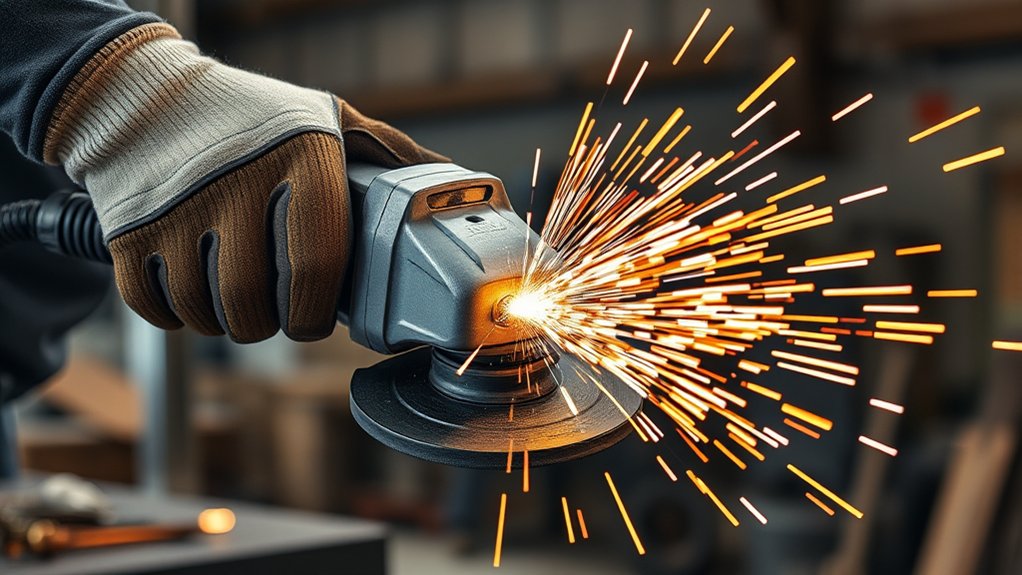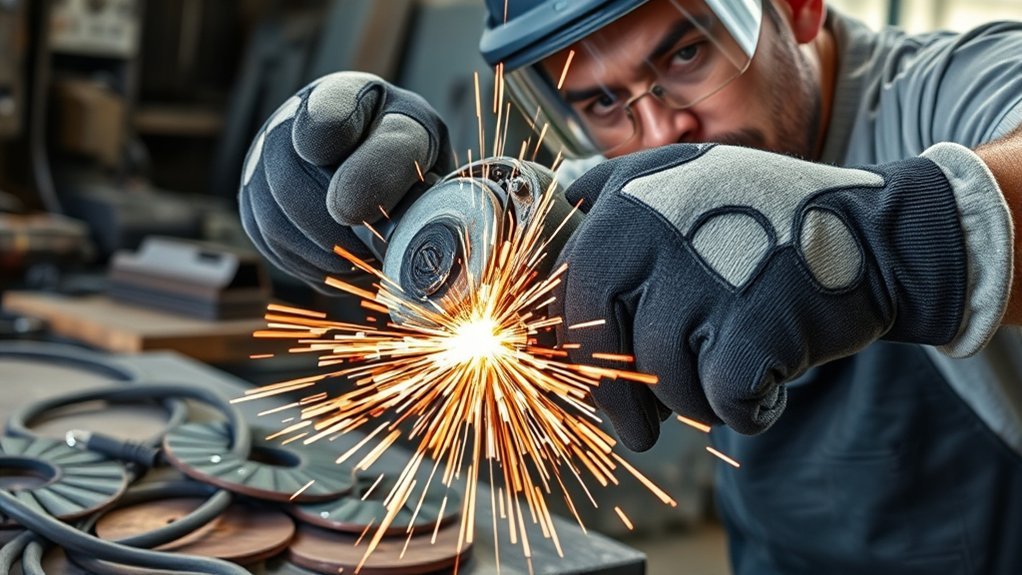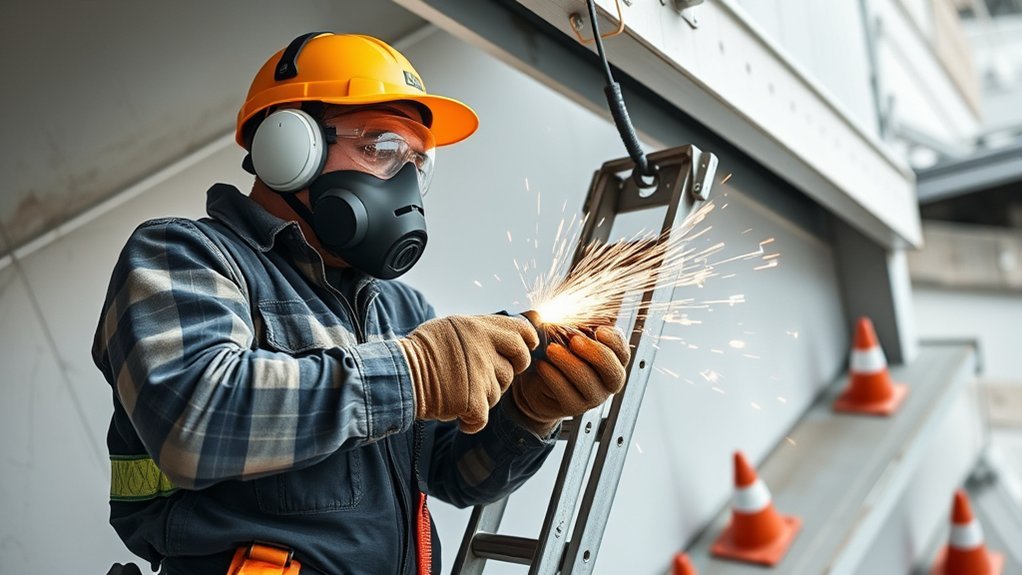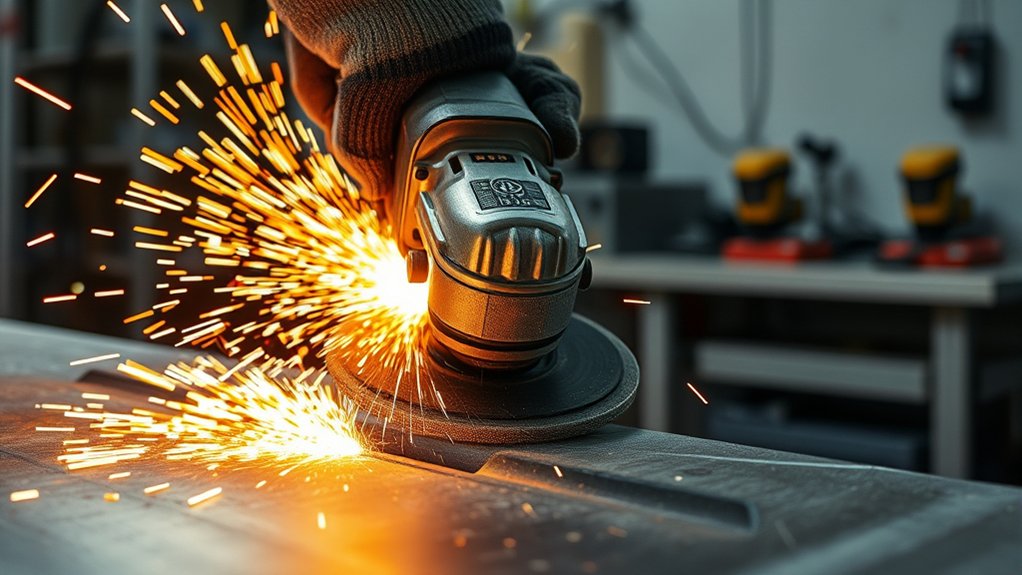
Smoothing sharp metal edges with an angle grinder makes a rough workpiece safer to handle and easier to paint, weld, or assemble. The best results come from identifying the metal first, choosing an accessory made for the task, and removing the burr in light passes. You should break the sharp edge without gouging, overheating, or thinning the surrounding metal.
Quick Answer
Secure the metal, install the correct guard and a grinder-rated flap disc or grinding wheel, then hold the tool with both hands. Let it reach full speed and make light, moving passes across the sharp edge. Use the accessory’s recommended working angle, check the result often, and finish with finer grit if needed.
Key Takeaways
- Identify the metal and any paint, plating, or coating before grinding because the dust may require special controls.
- Use the correct guard and an accessory whose size, arbor, application, and RPM rating match the grinder.
- A flap disc gives you more control for general deburring, while a grinding wheel removes heavy burrs faster.
- Use light pressure, keep the abrasive moving, and stop before the metal overheats or changes color.
- Disconnect the tool before checking the edge, cleaning the grinder, or changing accessories.
At a Glance
| Time Required | About 10 to 30 minutes for a typical edge, depending on its length, thickness, and condition |
| Difficulty | Beginner to intermediate; practice on scrap metal before working on a finished part |
| Tools Needed | Angle grinder, correct guard, side handle, suitable abrasive, clamps or vise, and personal protective equipment |
| Cost | Low if you already own the grinder; you normally need one suitable abrasive and an optional protective finish |
What’s in This Article
- Essential Safety Gear for Using an Angle Grinder
- Identify the Metal and Coating Before Grinding
- What You Need Before Smoothing Sharp Edges
- Step-by-Step Angle Grinder Process for Smoothing Sharp Edges
- How to Keep Control and Precision When Smoothing Edges
- Troubleshooting Edge-Smoothing Problems
- When to Use a File or Deburring Tool Instead
- Cleaning and Maintaining Your Angle Grinder After Use
- Rust Prevention for Metal Edges
- Avoiding Common Mistakes in Edge Smoothing
- Selecting the Right Grinding Disc for Edge Smoothing
- Tips for Ensuring Safe and Effective Grinding
- Frequently Asked Questions
- Conclusion
- Sources
Essential Safety Gear for Using an Angle Grinder

An angle grinder throws sparks, abrasive particles, metal fragments, and dust at high speed. Wear impact-rated safety glasses or goggles as your primary eye protection and place a full face shield over them. A face shield protects more of your face, but it does not replace safety glasses or goggles.
Wear hearing protection whenever the grinder or the workpiece creates harmful noise. Earplugs or earmuffs are suitable for many short jobs, but protection must fit correctly to work. Keep bystanders away from the grinding area or make sure they wear suitable protection.
Use close-fitting, non-melting workwear suitable for sparks. Avoid loose sleeves, jewelry, hoodie cords, and anything else that could reach the rotating accessory. Wear sturdy footwear and gloves suitable for hot, rough, and sharp metal. Keep your gloves away from the moving disc.
Respiratory protection depends on the base metal, coating, abrasive, ventilation, and amount of dust. Do not assume that a disposable dust mask is adequate for unknown paint, lead, chromate coatings, toxic metals, or heavy dust. Identify the material first, use suitable extraction, review its safety information, and select respiratory protection for the actual hazard. OSHA’s portable power-tool guidance explains the need for task-specific PPE, guards, inspection, and manufacturer-approved accessories.
Warning: Never operate the grinder without the correct guard securely installed. Position the guard between your body and the accessory, and use the guard type specified for that wheel or disc.
Products Worth Considering

Included: (1) DeWalt N441218 Angle Grinder Guard Replacement for Angle Grinder DCG414B

SUPERIOR PROTECTION — Experience all-around face protection thanks to the curved design of this faceshield. The visor of this face guard is ANSI Z87+ certified, and up to 2x thicker for increased durability. Plus, you can comfortably wear your grinding face shield over prescription glasses.

Powerful– with an 8 amp motor, This grinder is able to handle big and small household tasks.
Identify the Metal and Coating Before Grinding
Before you install a disc, identify what you are grinding. The correct abrasive and dust controls can change with the material. Also decide whether you need to remove a loose burr, break a sharp corner, form a small chamfer, round an edge, or remove heavy excess metal.
| Material or Surface | Suitable Starting Approach | Important Caution |
|---|---|---|
| Mild steel | Grinding wheel for a heavy burr or a 40- to 60-grit flap disc for controlled smoothing | Avoid deep gouges and excessive heat, especially on thin sheet |
| Stainless steel | Use an abrasive specifically rated for stainless steel | Use a clean accessory reserved for stainless to reduce iron contamination and later rust staining |
| Aluminum or soft nonferrous metal | Use a nonferrous-rated, anti-loading abrasive | Ordinary abrasives may load quickly, and fine aluminum dust can be combustible |
| Painted, plated, or galvanized metal | Identify the coating and use suitable extraction and PPE before disturbing it | Do not grind unknown old paint or hazardous coatings without proper controls |
| Hardened or heat-treated steel | Use a fine abrasive, short passes, and minimal pressure | Blue or dark heat marks may indicate that you have overheated the edge and affected its temper |
Warning: Fine aluminum and some other metal dusts can create a fire or explosion hazard. Do not connect metal-grinding dust to a collector designed only for wood dust, and do not allow fine metal dust to build up around sparks or ignition sources. Follow suitable combustible-dust controls for the material.
What You Need Before Smoothing Sharp Edges
Gather the equipment before you begin so you do not have to leave a partly completed setup unattended. Read the grinder manual and the abrasive label, because their limits take priority over general advice.
- Angle grinder: Use a tool with a working switch, correct guard, undamaged cord or battery, and securely fitted side handle.
- Abrasive: Choose a grinding wheel, flap disc, or sanding system rated for the material, task, grinder size, arbor, and maximum speed.
- Holding method: Use clamps, a vise, or another stable fixture that keeps your hands away from the accessory.
- Safety equipment: Use primary eye protection, a face shield, hearing protection, suitable gloves, protective clothing, footwear, and task-specific respiratory protection.
- Inspection items: Keep good lighting, a marker, straightedge, clean folded rag, and scrap metal available.
- Finishing items: Use fine-grit abrasive paper, a clean rag, and a coating suitable for the finished material.
Step-by-Step Angle Grinder Process for Smoothing Sharp Edges
Set up the workpiece, select and inspect the abrasive, then remove the sharp edge in several controlled passes. Stop frequently so you do not remove more metal than necessary.
Prepare Your Workspace Properly
Clear the area of gas cans, solvents, paper, sawdust, oily rags, loose dust, and other flammable material. Grind in a dry, well-lit area with enough ventilation or local extraction for the material. Aim the spark stream away from your body, power cords, batteries, windows, vehicles, and other people.
Clamp the workpiece to a stable bench or hold it securely in a vise. Support long or thin material close to the edge so it cannot flex, chatter, or vibrate. Do not hold a small workpiece in one hand while operating the grinder with the other.
| Task | Why It Matters | Safety Check |
|---|---|---|
| Clear the workspace | Reduces fire, trip, and dust hazards | Remove flammable material from the spark path |
| Secure and support the metal | Prevents movement, flexing, and chatter | Confirm that clamps cannot contact the disc |
| Inspect the grinder | Finds damage before the tool reaches full speed | Check the guard, handle, switch, cord, battery, spindle, and flanges |
| Control bystanders | Fragments can travel beyond the immediate work area | Keep others out or provide suitable PPE |
Select the Appropriate Grinding Disc
Choose an accessory intended for the metal and the exact operation. A rigid grinding wheel removes a large burr quickly. A flap disc is easier to control when blending and rounding a sharp edge. A sanding pad or hand abrasive works well for the final finish, provided the tool manufacturer approves that setup.
Check the accessory’s maximum RPM. It must be equal to or higher than the maximum speed marked on the grinder. Also confirm the outside diameter, thickness, arbor, flange arrangement, and guard type. An accessory may physically fit while still being unsafe for the tool.
Inspect the abrasive for cracks, chips, tears, moisture damage, warping, missing flaps, excessive wear, and an unreadable label. Disconnect the plug or remove the battery before installing it. Use the correct flanges and tighten them according to the manual rather than forcing the nut excessively tight.
After installation, stand out of the accessory’s plane and keep other people clear. Run the grinder at maximum no-load speed for one minute in a protected direction. Stop immediately if you notice unusual vibration, wobble, scraping, cracking, or movement between the accessory and spindle.
Execute the Smoothing Technique Safely
- Mark the edge. Draw a thin marker line along the burr or the amount you want to remove. This gives you a visual limit.
- Choose the final shape. Decide whether you only need to remove the burr, create a small chamfer, or form a rounded edge.
- Take a balanced stance. Keep your feet stable, your body out of the likely kickback path, and the cord away from the accessory.
- Hold the grinder with both hands. Keep one hand on the main handle and the other on the securely installed side handle.
- Start away from the metal. Let the accessory reach full operating speed before making contact.
- Use the correct working angle. Follow the accessory label and grinder manual. Type 27 flap discs commonly work at a shallow angle, while grinding wheels may require a steeper angle.
- Apply light pressure. Let the abrasive and tool speed remove the metal. Do not force the motor to slow noticeably.
- Keep the abrasive moving. Use short, overlapping passes so one area does not overheat or become deeply gouged.
- Work both faces when needed. On sheet metal, remove the projecting burr from each side instead of heavily thinning one face.
- Stop and inspect often. Let the accessory stop completely, disconnect the tool, and allow the workpiece to cool before checking it.
- Finish with finer grit. Switch to a finer flap disc, approved sanding system, hand file, or abrasive paper once the sharp projection is gone.
- Check the edge safely. Inspect it under good light and draw a folded shop rag lightly across the disconnected, cool workpiece. A remaining burr may catch or cut the rag. Do not slide a bare finger along the edge.
Note: Grinding angles are accessory-specific. Norton recommends 0° to 15° for Type 27 flap discs and 15° to 25° for Type 29 flap discs. Some grinder manuals list approximately 5° to 10° for flap discs and 20° to 30° for grinding wheels. Always follow the instructions for your actual grinder and abrasive.
How to Keep Control and Precision When Smoothing Edges
Control comes from your stance, grip, pressure, working angle, and awareness of the wheel’s rotation. Guide the tool with your arms and body rather than twisting your wrists or trying to force the grinder along the edge.
Proper Grip Techniques
Use both hands from startup until the accessory stops completely. Keep the side handle tight and place your hands where the guard shields them from sparks and fragments. A firm but relaxed grip gives you better control than squeezing the tool until your hands become tired.
Stand to one side during startup rather than directly in the accessory’s plane. Position your arms so you can resist a sudden movement if the disc snags. Never place your free hand near the rotating accessory or use it to steady the workpiece.
Steady Pressure Application
Use enough pressure to keep the abrasive cutting, but not enough to bog down the motor, distort the workpiece, or make the disc bounce. Heavy pressure can increase heat, shorten accessory life, and make the grinder harder to control.
Move continuously through short, overlapping passes. If the grinder jumps, chatters, or begins to dig in, lift it away, let it stop, and inspect the accessory, work support, and angle before continuing.
Tool Positioning Strategies
Use the abrasive’s working face rather than forcing the thin outer edge of a flap disc directly into the metal. Keep the guard between you and the disc, and position the open portion away from your body. Do not remove the guard to reach a tight spot.
Travel direction depends on the wheel’s rotation, the workpiece, and the accessory. Use a direction that lets you maintain control without allowing the disc to climb, snag, or pull the tool across the edge. Move forward and back in controlled passes when the grinder manual permits it, and remain outside the path the tool would follow during kickback.
Pro Tip: Color the sharp edge with a permanent marker before grinding. Stop when the marked burr disappears evenly, rather than continuing until the surrounding metal becomes thin.
Control Heat and Discoloration
Heat builds when you press too hard, hold the disc in one spot, use a loaded abrasive, or choose a disc that cuts too slowly. Pause between passes and let the workpiece cool naturally. Do not touch it until you have checked its temperature safely.
Blue, purple, or dark heat marks show that the surface became hot. On decorative steel this may affect appearance. On hardened or heat-treated parts, overheating can also change edge hardness. Stop before discoloration develops and use shorter passes, less pressure, or a sharper abrasive.
Troubleshooting Edge-Smoothing Problems
| Problem | Likely Cause | What to Do |
|---|---|---|
| Strong vibration or wobble | Damaged accessory, incorrect mounting, dirty flange, or worn spindle | Stop immediately, disconnect the tool, and inspect every mounting part before restarting |
| Deep gouges | Excess pressure, steep angle, coarse abrasive, or staying in one spot | Reduce pressure, flatten the working angle as permitted, and use overlapping passes |
| Blue or dark metal | Excess heat from pressure, dwell time, or a dull or loaded abrasive | Stop, let the metal cool, and continue with shorter passes and a suitable sharp abrasive |
| Disc loads with soft metal | The abrasive is not designed for aluminum or another soft nonferrous metal | Replace it with a nonferrous-rated, anti-loading accessory |
| Uneven bevel or rounded low spots | Workpiece movement, inconsistent angle, or poor visual reference | Improve the support, mark a guide line, and make lighter passes across the full edge |
| Burr remains after several passes | Only one face was treated or the accessory is gliding over the burr | Treat the projecting burr from the opposite face with light pressure or finish it with a file |
| Chatter on thin sheet | The sheet is unsupported or the accessory is too aggressive | Support the edge closer to the cut and switch to a finer flap disc, file, or deburring tool |
When to Use a File or Deburring Tool Instead
An angle grinder is fast, but it is not the best choice for every edge. Use a hand file, deburring blade, abrasive block, or similar hand tool when the part is too small to clamp safely, the sheet is very thin, the edge is close to a finished surface, or the amount of metal to remove is tiny.
Hand tools also give you better control around holes, tight inside corners, narrow tabs, precision fits, and heat-sensitive components. A few strokes with a file may be safer and faster than setting up a grinder for a small burr.
Note: Do not use an angle grinder on a small loose part simply because the grinder is nearby. If you cannot clamp and support the work securely while keeping both hands on the tool, choose another method.
Cleaning and Maintaining Your Angle Grinder After Use
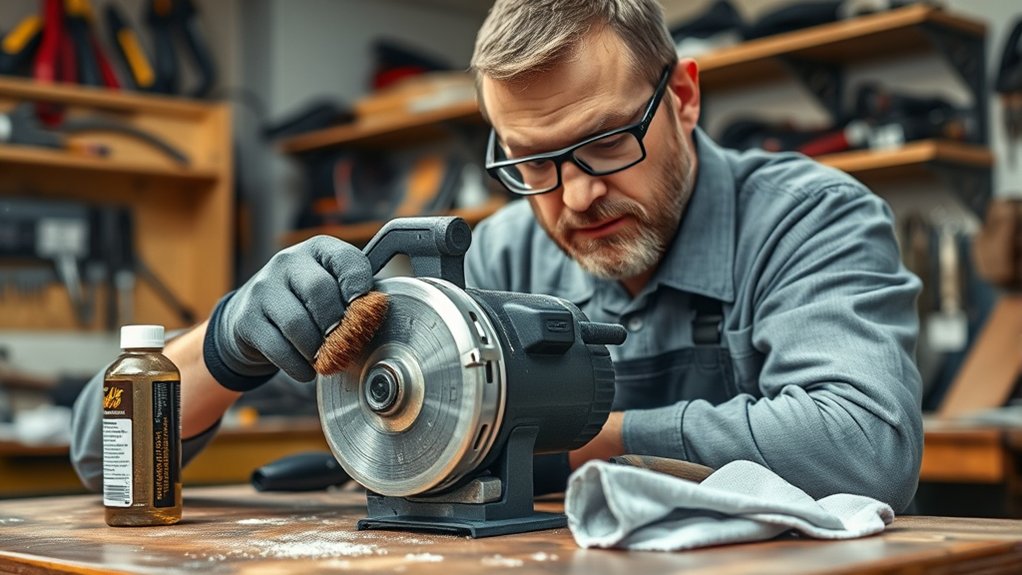
Unplug the grinder or remove its battery before touching the accessory, guard, spindle, or vents. Let the accessory and workpiece cool, then remove the disc according to the tool manual.
Use a suitable vacuum or soft brush to remove loose metal and abrasive dust from the guard, housing, and ventilation openings. Do not use an ordinary household or wood-shop vacuum for combustible metal dust unless the equipment is approved for that material. If the grinder manual permits compressed-air cleaning, use clean, dry, low-pressure air with eye and breathing protection and keep the dust away from other people.
Inspect the power cord, plug, battery, switch, guard, side handle, flanges, spindle, and accessory before storage. Replace damaged parts before the next use. Do not lubricate the grinder unless the manual identifies a user-serviceable lubrication point and the correct lubricant.
Store the grinder in a dry, dust-free location with the accessory removed. Keep abrasive wheels and flap discs dry, protected from impact, and supported so they do not bend or become damaged.
Rust Prevention for Metal Edges
Grinding can remove paint, mill scale, plating, oil, and other protection from the edge. After the metal cools, remove loose grit and dust with a clean rag or a cleaning method suitable for the material. Make sure the surface is dry before applying protection.
For ordinary non-food steel parts, choose a compatible primer, paint, rust-inhibiting spray, wax, or light machine oil. For kitchen tools, cookware, or another food-contact surface, use only a food-safe product intended for that specific material.
Stainless and galvanized steel resist corrosion better than bare carbon steel, but grinding can damage their protective surface or expose untreated areas. Use a finish suitable for the metal and inspect the edge later for staining or rust.
Avoiding Common Mistakes in Edge Smoothing
A cutting wheel is designed mainly for loading around its outer edge. Applying side pressure to a standard cut-off wheel can crack or shatter it. Use a grinding wheel, flap disc, or approved sanding accessory for smoothing unless the wheel is specifically labeled for more than one operation.
Do not press harder when an abrasive stops cutting well. It may be worn, glazed, loaded with soft metal, or unsuitable for the workpiece. Replace it with the correct accessory instead of adding force.
Never grind a loose workpiece. Movement can make the abrasive snag, throw the part, or pull the grinder out of your hands. Stop immediately if the accessory chatters, cracks, vibrates, rubs the guard, or begins to loosen.
- Do not use an accessory with the wrong RPM, diameter, arbor, thickness, or guard.
- Do not remove the guard or side handle to reach a difficult edge.
- Do not start the grinder while the accessory touches the workpiece.
- Do not grind toward fuel, solvents, sawdust, batteries, glass, or unprotected people.
- Do not force a flap disc flat or run its thin outer edge directly into the work.
- Do not continue after noticing unusual vibration, wobble, cracking, or overheating.
- Do not set the grinder down until the accessory has stopped completely.
- Do not check a newly ground edge with a bare sliding finger.
Selecting the Right Grinding Disc for Edge Smoothing
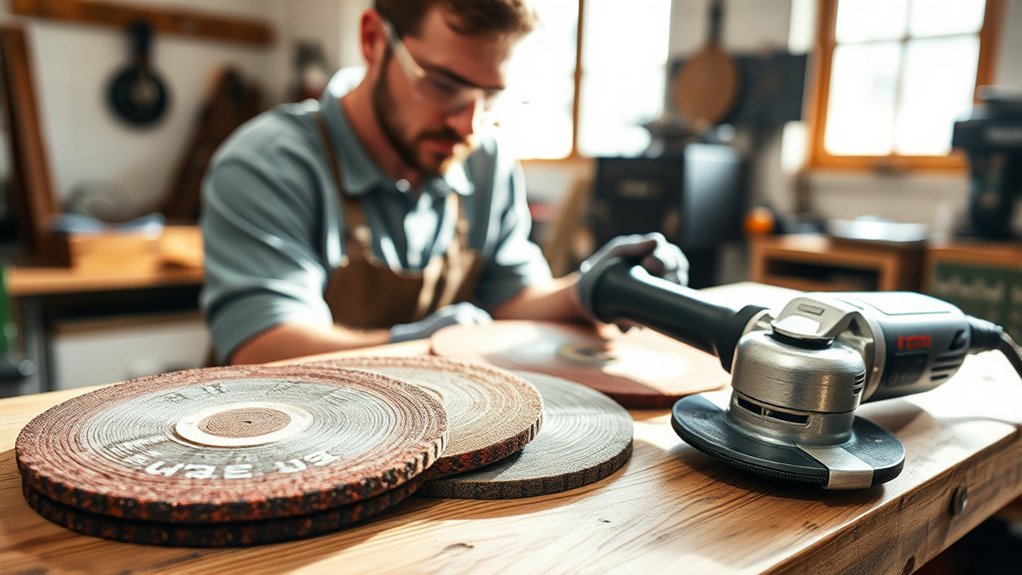
The right accessory depends on how much metal you need to remove and how smooth the final edge must be. Confirm compatibility with both the workpiece and grinder before relying on a general grit recommendation.
| Task | Accessory | Typical Starting Point | Best Use |
|---|---|---|---|
| Heavy burr or excess weld metal | Grinding wheel rated for the material | Use the wheel grade specified for the material and grinder | Fast stock removal before blending |
| General steel-edge smoothing | Type 27 or Type 29 flap disc | About 40 to 60 grit for shaping | Controlled deburring, blending, and small chamfers |
| Final smoothing | Fine flap disc, approved sanding system, or hand abrasive | About 80 to 120 grit when suitable for the material | Removing coarse scratches and improving the feel of the edge |
| Thin sheet or a small burr | Fine flap disc, file, or deburring tool | Start fine and remove as little metal as possible | Reducing heat, chatter, and accidental thinning |
| Aluminum or soft nonferrous metal | Nonferrous-rated anti-loading abrasive | Follow the accessory maker’s recommendation | Reducing loading, smearing, and excess heat |
Type 27 flap discs are flatter and are generally used at a shallower working angle. Type 29 flap discs are conical and usually work at a steeper angle. Norton’s flap-disc safety guidance lists 0° to 15° for Type 27 discs and 15° to 25° for Type 29 discs. Do not use either type flat or directly on its thin edge unless its instructions specifically allow that orientation.
The abrasive’s maximum rated speed must be equal to or higher than the grinder’s maximum speed. Physical fit alone does not make an accessory safe.
Note: Never side-grind with a standard cutting wheel. Use it only for the applications printed on its label and allowed by the grinder manufacturer.
Products Worth Considering

✨【Meets All Your Needs】Our 4-1/2-inch flap disc set comes with 40/60/80/120 grits, totaling 12 packs. This comprehensive set includes 4 pieces each of 40 grit and 60 grit, along with 2 pieces each of 80 grit and 120 grit, providing a versatile selection for grinding various metals. It perfectly caters to all your grinding needs.

✨【Premium Material】PRETEC flap sanding discs are crafted from high-density premium zirconia abrasive, ensuring strength, durability, and extended disc life. They are designed to withstand high temperatures and pressure for optimal performance.

HIGH-DENSITY JUMBO DESIGN: Type 27 flap discs with a high-density jumbo layout support surface blending, beveling, grinding, deburring, and edge chamfering. Flat profile seats flush on workpieces for controlled material removal, ideal for professionals and DIY use
Tips for Ensuring Safe and Effective Grinding
- Read both sets of instructions: Follow the grinder manual and the accessory label, including guard, speed, angle, and mounting requirements.
- Practice on scrap: Test your grip, angle, pressure, and abrasive before touching a finished part.
- Inspect before each use: Check the tool, guard, handle, flange, spindle, switch, cord or battery, and abrasive.
- Run a one-minute test: After installing a new or replacement accessory, run it at no-load speed while standing out of its plane.
- Support the workpiece: Clamp close enough to the edge to reduce flexing and chatter without putting the clamp in the disc path.
- Use light, overlapping passes: Let the abrasive cut rather than forcing the grinder.
- Watch the spark path: Keep sparks away from your body, cords, flammable material, vehicles, glass, and bystanders.
- Control heat: Pause before the metal discolors or becomes hot enough to affect coatings, dimensions, or heat treatment.
- Stop for vibration: Do not continue until you have found and corrected the cause.
- Disconnect before inspection: Remove power before touching the edge, changing the disc, or cleaning the tool.
Frequently Asked Questions
How do you use an angle grinder to smooth an edge step by step?
Identify the metal and coating, secure the workpiece, inspect the grinder, install the correct guard and abrasive, and perform a one-minute no-load test. Hold the grinder with both hands, let it reach full speed, and make light moving passes. Disconnect the tool before checking the edge and finish with a finer abrasive if needed.
What safety precautions should you take before using a grinding machine?
Wear primary eye protection under a face shield, hearing protection, suitable clothing, gloves, footwear, and respiratory protection selected for the material. Inspect the tool and accessory, install the correct guard, remove flammable material, control dust, secure the workpiece, and keep bystanders away.
Should you push or pull an angle grinder?
Do not follow a universal push-or-pull rule. Safe travel direction depends on wheel rotation, accessory type, workpiece position, and the grinder manual. Move in the direction that gives you control without making the disc climb or snag, and keep your body outside the tool’s likely kickback path.
What is the best angle for smoothing sharp edges?
Use the angle specified for your accessory. Type 27 flap discs commonly work between 0° and 15°, while Type 29 flap discs commonly work between 15° and 25°. Some grinder manuals list about 5° to 10° for flap discs and 20° to 30° for grinding wheels. The correct instructions for your disc and grinder take priority.
Can you use a cutting disc to smooth edges?
Do not side-load a standard cutting disc. Its thin construction is intended mainly for cutting around the outer edge, and side pressure may cause it to crack or shatter. Use a grinding wheel, flap disc, or approved sanding accessory unless the wheel is specifically labeled for multiple operations.
How do you know when the edge is smooth enough?
The projecting burr should be gone, and the edge should match the chamfer or radius you intended without deep low spots. Disconnect the grinder, let the metal cool, inspect it under good light, and draw a folded rag lightly across it. A remaining sharp burr may catch or cut the rag.
What grit flap disc should you use for sharp metal edges?
A 40- to 60-grit flap disc is a common starting point for a noticeable burr on ordinary steel. Move to about 80 to 120 grit for a smoother finish when the material and accessory permit it. Start finer on thin sheet, delicate parts, or edges that need only light deburring.
Can you smooth aluminum edges with an angle grinder?
Yes, but use an abrasive specifically rated for aluminum or soft nonferrous metal. Ordinary discs may load with aluminum and stop cutting cleanly. Control the dust carefully because fine aluminum dust can be combustible, and do not use unsuitable wood-dust collection equipment.
Conclusion
Smoothing sharp edges with an angle grinder works best when you remove only the burr or corner you intended to remove. Identify the material, clamp it securely, use the correct guard and abrasive, and keep the tool moving with light pressure. Stop for vibration, excess heat, or unusual noise. After the edge is safe and even, clean the grinder and protect exposed metal from corrosion.
Sources
- OSHA: Safe Use of Portable and Hand-Held Power Tools — PPE, guards, wheel inspection, working angle, startup position, and speed safety
- OSHA 1910.243: Guarding of Portable Powered Tools — portable grinder guarding and operator protection
- DeWalt DCG407/DCG408 Instruction Manual — accessory RPM, inspection, no-load testing, PPE, guard use, pressure, and working-angle examples
- Norton Abrasives: Do’s and Don’ts of Flap Discs — Type 27 and Type 29 working angles and safe flap-disc use
- OSHA: Hazards Associated With Aluminum Grinding — combustible aluminum dust and suitable dust collection
- OSHA PPE Selection Guidelines — face shields over primary eye protection