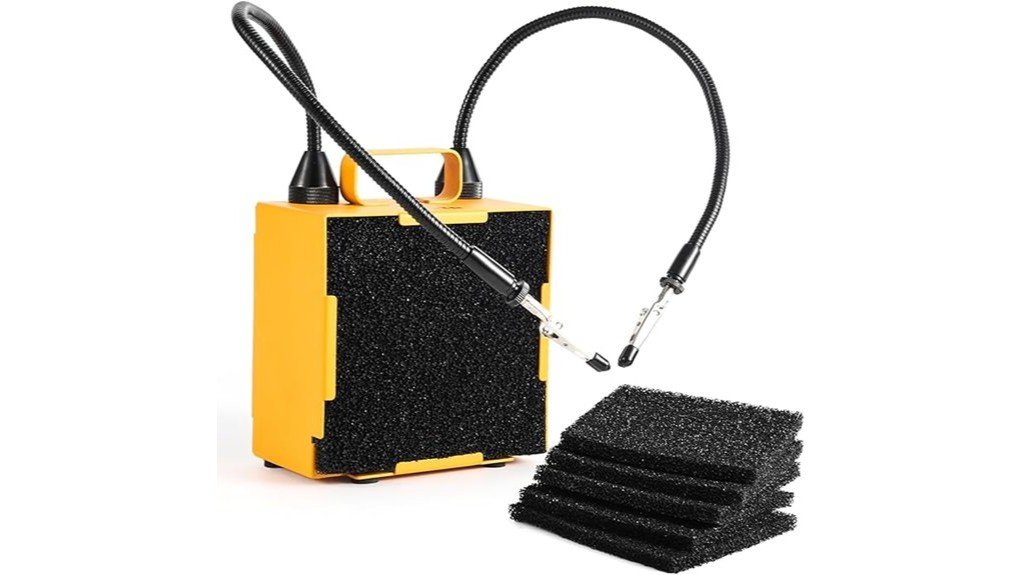
Solder smoke rises quickly, so a small desktop extractor only helps when it can sit close to the joint without crowding your tools. The KOTTO Solder Fume Extractor combines a 3000 RPM fan, an activated carbon filter, and two magnetic helping hands in one compact bench setup. Its strongest advantage is space-saving convenience for electronics repair and hobby work. Its main limitation is a short 5 to 6-inch capture range, which makes careful placement and normal room ventilation essential.
This is a specification-based editorial review. The product identity, listed specifications, included parts, and return information were checked against the current Amazon listing for ASIN B0D2QHHCC4.
Quick Verdict
Editorial Rating: 8/10, recommended with caveats
Best For: Hobby soldering, phone and circuit-board repair, wire work, jewelry projects, and light professional bench use.
Bottom Line: The KOTTO is a practical choice when you want close-range smoke capture and component-holding arms in one small tool. It is less suitable for long production sessions, wide work areas, or buyers who need a documented HEPA or multi-stage filtration system.
Key Specifications
| Specification | Detail |
|---|---|
| Brand | KOTTO |
| Manufacturer | Fstop Labs |
| Listed model number | yellow with hand helping |
| ASIN | B0D2QHHCC4 |
| Product type | Desktop solder smoke absorber with helping hands |
| Power | 30 watts |
| Voltage | 120 volts |
| Listed dimensions | 3 inches deep × 5 inches wide × 5 inches high |
| Listed weight | 1 kilogram |
| Fan rating | 3000 RPM |
| Listed extraction range | About 5 to 6 inches |
| Filter type | 0.4-inch activated carbon filter |
| Included filters | Five carbon filters |
| Helping hands | Two magnetic adjustable metal gooseneck arms |
| Clamp type | Stainless steel alligator-tip clamps |
| Stability and portability | Non-slip rubber feet and a carrying handle |
| Best use | Small electronics, wires, circuit boards, crafts, modeling, jewelry, and phone repair |
| Return information | Current Amazon listing shows a 30-day refund or replacement window, subject to current terms |
What Is the KOTTO Solder Fume Extractor?
The KOTTO is a compact, powered smoke absorber designed to sit on a soldering bench. Its fan draws nearby smoke through a 0.4-inch activated carbon filter. The listing gives the fan speed as 3000 RPM and the useful capture distance as about 5 to 6 inches.
The tool also includes two magnetic helping hands. Each flexible metal arm ends in a stainless steel alligator clamp that can hold wires, connectors, or a small circuit board. This combined layout is meant for buyers who have limited bench space and would otherwise need a separate smoke absorber and component holder.
The unit is listed at 30 watts and 120 volts, with dimensions of 3 by 5 by 5 inches and a weight of 1 kilogram. Those numbers describe a small desktop footprint, although the flexible arms and workpiece still need open space around the fan intake.
Who Should Buy It?
Best For
- Hobbyists who solder small boards, wires, connectors, and repair parts at a desk.
- Buyers who want two helping hands and close-range smoke capture in one compact tool.
- Light professional or classroom bench work where the extractor can stay within 5 to 6 inches of the joint.
Skip If
- You need wide-area capture, ducted extraction, or continuous production-level fume control.
- You require documented HEPA filtration, a stated airflow rating, or certified filtration efficiency.
- Your workpiece cannot be positioned close to the intake without blocking your hands or tools.
Before You Buy: A 3000 RPM motor rating does not tell you the fan’s airflow or filtration efficiency. The listing does not provide a CFM value or claim HEPA filtration, so treat this as a close-range bench absorber, not a replacement for proper room ventilation or an industrial local-exhaust system.
Feature-by-Feature Review
3000 RPM Close-Range Extraction
The listed 3000 RPM fan is designed to pull smoke toward the filter from roughly 5 to 6 inches away. That range is practical for a small circuit board or wire joint, but it leaves little room for poor placement. If the intake is off to the side or too far behind the project, the warm smoke can rise past it.
The listing describes the fan as low noise, but it does not publish a measured sound level. Buyers who need a very quiet recording, teaching, or shared-office setup should not assume a specific decibel rating.
Activated Carbon Filter System
The KOTTO uses a 0.4-inch activated carbon filter and includes five filters. Carbon media can help capture smoke components and reduce odors at the work area, but this product is not listed as a sealed, multi-stage purifier. The open desktop design also depends on getting the smoke into the intake before it disperses.
The source article estimated up to one month of filter life, but replacement timing varies with soldering frequency, flux type, smoke load, and session length. Inspect the filter rather than relying only on a calendar. Replace it when it becomes visibly loaded, develops persistent odor, or no longer seems to capture smoke as well.
Two Magnetic Helping Hands
The two magnetic arms add real bench value. You can use one clamp to steady a wire and the other to hold a connector or small board, leaving both hands free for the iron and solder. Because the bases are magnetic, you can reposition the arms around the work area instead of working from one fixed angle.
Alligator clamps can mark insulation, crush fine wires, or damage delicate board edges. Use the lightest grip that holds the part securely. For sensitive components, add a soft protective sleeve or clamp a sacrificial tab rather than a fragile lead.
Flexible Positioning and Bench Stability
The metal gooseneck arms can be bent to support different component shapes and angles. This flexibility helps with repetitive wire tinning, connector repairs, small assembly jobs, jewelry work, and modeling tasks. The tradeoff is that long arms can transmit movement if they are overextended or repeatedly bumped.
Non-slip heavy-duty rubber feet help the main fan stay planted on a flat bench. A carrying handle makes the unit easier to move between work areas, although you should lift the unit by the handle rather than pulling it by the cord or flexible arms.
Power and Basic Setup
The current listing specifies 120 volts and 30 watts. This version is intended for a standard compatible outlet in the United States. Buyers outside that electrical standard should confirm plug, voltage, and frequency compatibility before connecting the unit.
Set the fan on a dry, stable, heat-resistant work surface. Keep the power cord away from the iron tip, hot-air tools, molten solder, and sharp bench edges. Turn the extractor on before heating the joint so airflow is already established when flux begins to smoke.
How It Performs in Real Use
Circuit Board Repair
For a small PCB, place the intake behind the joint and use the magnetic arms to hold the board or lead. This setup can reduce part movement and keep the smoke path aimed toward the filter. It works best when the board is small enough to remain close to the front of the fan.
Wire and Connector Work
During wire tinning or connector repair, one clamp can hold the cable while the second holds a plug or terminal. The arrangement is useful for short, repeated joints because you can keep the work at the same capture distance. Avoid clamping directly onto a live circuit, battery terminal, or energized conductor.
Crafts, Jewelry, and Modeling
The listing also positions the tool for jewelry, crafts, and modeling. The helping hands can support small non-electronic parts, but the filter is still designed around close-range smoke capture. Check the safety data and ventilation needs for any flux, adhesive, coating, resin, or material you heat, because not every vapor is suitable for a simple carbon-filter bench fan.
Long or High-Volume Sessions
The KOTTO is less convincing for long production runs. A short capture range requires you to keep moving the intake or workpiece, and the listing does not give an airflow rate, filtration-efficiency percentage, or duty-cycle specification. For daily industrial use, a ducted local-exhaust system or a larger multi-stage extractor is a better category to compare.
Placement Tips for Better Results
- Start within the listed range: Position the filter face about 5 to 6 inches from the joint, then move it closer if smoke escapes upward.
- Work with the airflow: Put the intake behind the solder joint from your point of view, so smoke moves away from your face and toward the filter.
- Avoid cross-drafts: Strong desk fans, open windows, or HVAC vents can push smoke away from the extractor before it reaches the filter.
- Keep the intake clear: Do not let a circuit board, mat, tool, or loose filter cover block the fan face.
- Check each new setup: Watch the first small puff of smoke. If it rises past the fan, adjust the angle or distance before continuing.
Pro Tip: Place a small scrap piece in the clamps and do a brief test joint before starting the full repair. This lets you confirm the smoke path, arm stability, and tool clearance without risking the main component.
Safety, Filter Care, and Maintenance
A desktop absorber should supplement safe soldering practices, not replace them. Work in a ventilated area, keep the smoke out of your breathing zone, wear suitable eye protection, and follow the solder and flux manufacturer’s safety instructions. Heated rosin flux can release irritating decomposition products, so stop and improve ventilation if smoke is escaping toward your face.
Unplug the extractor before changing the filter or cleaning the housing. Let nearby soldering tools cool first. Do not wash or reuse a disposable carbon filter unless KOTTO’s current instructions specifically say that the filter is washable.
Wipe dust from the housing and rubber feet with the unit unplugged. Check that the intake and exhaust remain open. If the fan develops unusual noise, vibration, overheating, or an electrical smell, stop using it and contact the seller or manufacturer support.
If you use lead-containing solder, wash your hands after soldering and before eating or touching your face. Clean the work surface using methods appropriate for lead residue and follow local disposal rules for contaminated wipes, solder scraps, and used filters.
Performance and Limitations
The KOTTO’s design makes sense for a small bench because the fan, filter, and helping hands share one work zone. That reduces the number of separate stands on your desk and can improve repeatability when you are making several similar joints.
Its performance depends more on placement than the 3000 RPM number alone. Fan speed does not reveal how much air moves through the filter, and the listing gives no CFM figure. The 5 to 6-inch range is therefore the most useful published limit for setup.
The activated carbon filter is also a practical but basic solution. It may help reduce visible smoke and odor close to the joint, yet the listing does not state HEPA filtration, a particle-removal percentage, or a gas-removal certification. Buyers with frequent exposure, sensitive work environments, or formal workplace-control requirements should compare larger source-capture systems.
Pros and Cons
Pros
- Combines smoke absorption and two magnetic helping hands in one bench setup.
- Listed 5 to 6-inch range suits small circuit boards, wires, and connectors.
- Includes five activated carbon filters, reducing the need for an immediate refill purchase.
- Flexible gooseneck arms support varied work angles and component shapes.
- Rubber feet and a carrying handle improve stability and portability.
Cons
- Short capture range requires careful positioning for every project.
- No published CFM rating, HEPA claim, or filtration-efficiency percentage.
- Carbon filters are consumables, and replacement frequency varies with use.
Is It Worth the Price?
The KOTTO offers strong value for the price when your priority is combining three bench functions: a smoke absorber, two component-holding arms, and a starter supply of five filters. It is especially useful for hobbyists and repair users who do not have room for separate fixtures.
Value depends on your extraction expectations. Buyers who only need close-range capture for short soldering sessions may find the all-in-one design more useful than a dedicated fan. Buyers who need documented airflow, multi-stage filtration, or production-level source capture should spend more on a system designed for that workload.
Check the current listing for the seller, package contents, replacement-filter availability, and return terms before ordering. The product page was live at the time of this refresh, but offer and seller details can change.
Customer Support and Return Information
The current Amazon listing identifies Fstop Labs as the manufacturer and seller and states that US-based customer support is available. It also shows a 30-day refund or replacement window for the item in its original condition, subject to Amazon’s current policy and seller terms.
No specific manufacturer warranty length is clearly published in the visible listing details. Buyers who need warranty coverage beyond the return window should request the written warranty terms before purchase rather than assuming coverage.
How It Compares to Alternatives
The Weller WSA350 is a dedicated benchtop smoke absorber with a replaceable activated carbon filter and an adjustable stand. It is worth comparing if you prefer a recognized soldering-tool brand and do not need integrated helping hands.
The YIHUA 948DQ-I adds front-and-rear filtration, a tiltable stand, side fenders, and detachable helping hands. It may suit buyers who want more positioning controls. A larger hose-style KOTTO extractor is another option when you need to place a pickup hood near the work without moving the fan body. The reviewed KOTTO makes the most sense when compact size and magnetic work-holding arms matter more than advanced filtration specifications.
Frequently Asked Questions
How close should the KOTTO extractor be to the solder joint?
The listing gives an extraction range of about 5 to 6 inches. Start within that distance and move the intake closer if smoke rises past the filter face. Keep the intake behind the joint so airflow carries smoke away from your breathing zone.
How often should the carbon filter be replaced?
The original article suggests up to one month, but actual life depends on smoke load and use frequency. Inspect the filter regularly and replace it sooner if it looks loaded, smells persistent, or captures smoke less effectively.
Does this extractor replace room ventilation?
No. It is a close-range desktop absorber and should be used with suitable room ventilation and safe work practices. It is not a ducted industrial system, and the listing does not provide a CFM rating or certified filtration-efficiency claim.
Is the filter HEPA-rated?
The current listing specifies a 0.4-inch activated carbon filter but does not identify it as HEPA. Buyers who require HEPA or multi-stage filtration should compare products that publish those filter specifications.
What can the magnetic helping hands hold?
The adjustable arms are intended for wires, connectors, small circuit boards, and similarly sized craft or repair parts. Use light clamp pressure on fragile leads, insulation, and board edges to avoid damage.
What power does this model require?
The listing specifies 120 volts and 30 watts. Confirm outlet and plug compatibility before use, especially outside the United States. Do not connect the unit through an unverified voltage adapter.
What is included with the extractor?
The listing describes the extractor, two magnetic metal helping hands with stainless steel alligator clamps, and five carbon filters. Confirm the current package details on the seller page because bundles can change.
Is it suitable for industrial or all-day soldering?
It is better matched to hobby, repair, classroom, and light bench tasks. High-volume or all-day work usually calls for a larger source-capture system with documented airflow, filter performance, maintenance requirements, and workplace-safety suitability.
The Bottom Line
The KOTTO Solder Fume Extractor is a recommended-with-caveats choice for hobbyists and light bench users who want close-range smoke capture plus two magnetic helping hands. Its all-in-one layout, five included filters, and compact listed size are useful strengths. Skip it if you need wide-area extraction, HEPA filtration, documented airflow, or a production-grade ventilation system.
Ready to Buy?
Check the latest price, seller, package details, and return terms before you decide.