Disclosure: As an Amazon Associate, we earn from qualifying purchases. If you click a link on this page and make a purchase, we may receive a small commission at no extra cost to you.
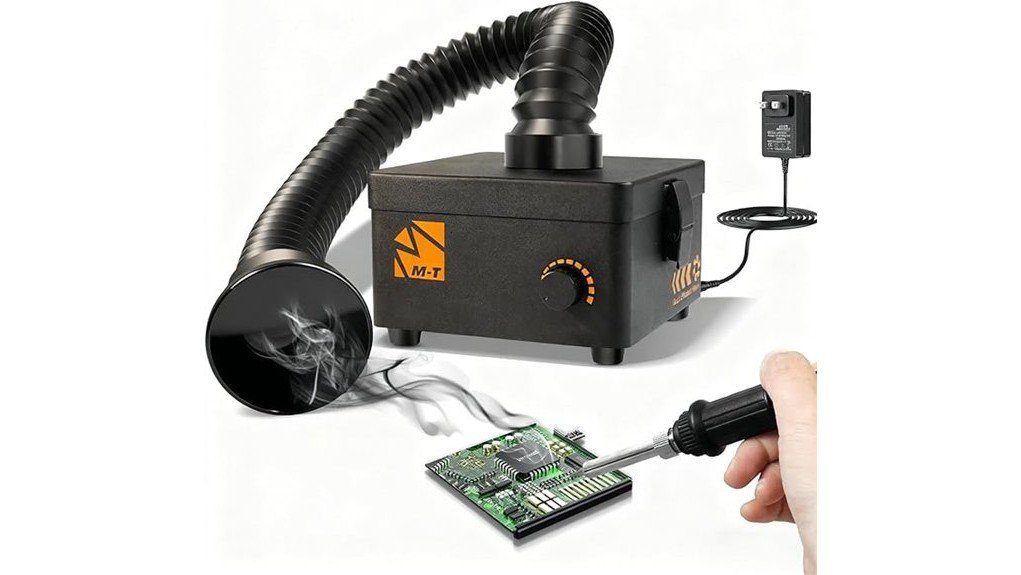
Solder smoke can drift into your breathing zone before a room fan has time to move it. The M-T MT308 Solder Fume Extractor is designed to capture that plume close to the source with a flexible hose, three speed settings, and a listed airflow of 168 m³/h. Its main strengths are compact source capture and layered particle and odor filtration. Its main limitation is capacity: this is a desktop unit for one nearby work area, not a replacement for industrial ventilation during heavy welding or high-output production.
Quick Verdict
Rating: 8.2/10, recommended with caveats
Best For: One-person electronics benches, hobby soldering, small repair stations, and localized 3D-printing odor control
Bottom Line: The M-T MT308 combines 168 m³/h airflow, a 7 to 25-inch adjustable hose, and H13 HEPA plus carbon media in a compact metal unit. It is a practical step up from basic fan-style smoke absorbers, but you must keep the inlet close to the work and replace filters as they load.
| Specification | Detail |
|---|---|
| Brand | M-T |
| Model | MT308 |
| Product type | Desktop source-capture fume extractor |
| Rated power | 80W |
| Maximum listed airflow | 168 m³/h |
| Speed control | Three settings |
| Motor speed | 15,000 RPM |
| Listed noise level | Under 60 dB |
| Filtration | High-density fiber, carbon cotton, H13 HEPA media, and activated carbon |
| Hose | 360° adjustable, listed range of 7 to 25 inches |
| Recommended capture distance | Within about 5 inches of the fume source |
| Power cord | 5 feet |
| Adapter input | 100 to 240V, as listed by the seller |
| Housing | Metal shell |
| Listed warranty | 3 years, subject to current seller terms |
| Best use | One nearby soldering or light-duty fume source at a time |
Key Takeaways
- The 168 m³/h listed airflow and three speed settings give you more control than a basic fixed-speed bench fan.
- The adjustable hose matters as much as the airflow rating because the seller recommends keeping the inlet within about 5 inches of the smoke source.
- H13 HEPA media targets particles, while carbon media is included to help with odors and some gases.
- The metal housing, 5-foot cord, and 7 to 25-inch hose suit compact benches where floor space is limited.
- The seller’s 99.99% filtration statement is a manufacturer claim, not an independent test result for every chemical or work process.
- This unit is better suited to one desktop station than multiple benches or heavy industrial welding.
What Is the M-T MT308 Solder Fume Extractor?
The M-T MT308 is an 80W desktop extractor that pulls smoke through a movable hose and a layered filter assembly. The listing positions it for soldering, 3D printing, light welding-related tasks, and other small work areas where fumes can be captured close to the source.
Its main selling point is the combination of a flexible inlet and multi-stage filtration. Instead of placing a flat fan behind your work, you can move the hose opening toward the plume. That setup can improve capture as long as the inlet stays close and does not interfere with your tools.
Editorial note: The airflow, noise, filtration, and warranty details in this review are seller-listed specifications. They should not be treated as independent laboratory verification or as proof that the unit controls every hazardous vapor.
Who Should Buy It?
Best For
- Hobbyists who solder at one electronics bench
- Repair technicians who need a movable inlet near small components
- 3D-printer users who want localized filtration near an enclosure outlet or print area
Skip If
- You need one machine to serve several active stations at the same time
- You perform heavy welding, laser work, or production tasks that require engineered exhaust
- You want a maintenance-free system with no recurring filter cost
Before You Buy: This desktop extractor should support source capture, not replace required room ventilation, process-specific engineering controls, or respiratory protection. Heavy welding and other high-fume work can require a properly designed local exhaust system.
Performance and Efficiency
Airflow and Speed Control
The MT308 lists a maximum airflow of 168 m³/h and uses a 15,000 RPM motor. Three speed settings let you use lower airflow for small solder joints and raise suction when the plume is stronger. That control is useful because full speed may not be needed for every task.
The airflow number alone does not guarantee capture. Smoke follows surrounding air currents, so an open door, desk fan, or air conditioner can pull the plume away from the hose. The short listed capture range makes placement a key part of performance.
Noise During Bench Work
The seller lists operation below 60 dB. That should be easier to tolerate than many shop vacuums or large blowers, although the highest speed will sound louder than the lowest setting. Room acoustics, hose position, and filter loading can also change the sound you hear.
Single-Station Capacity
The original article suggested that one unit could handle several soldering stations. That is not a safe assumption. The MT308 has one hose and is designed to work close to one active source, so each separate station may need its own capture point or a larger central system.
Filtration Technology
The seller describes a three-stage filter system using high-density fiber, carbon cotton, H13 HEPA media, and activated carbon. The fiber and HEPA portions are intended to trap airborne particles. The carbon media is the part intended to help adsorb odors and some gases or vapors.
The listing claims 99.99% removal of dust, mold, bacteria, chlorine, heavy metals, and harmful gases. Treat that figure as a seller claim tied to the filter design, not as a universal removal rate for every contaminant. HEPA efficiency applies to particles, while gas control depends on the carbon type, carbon quantity, contact time, and the chemical involved.
For a useful filter overview, see Metcal’s explanation of HEPA and carbon filter roles.
Design and Usability
The metal housing gives the MT308 a more durable bench presence than a thin plastic fan. Its 5-foot power cord offers reasonable placement freedom, while the 360° hose adjusts from about 7 to 25 inches. That range helps you reach over a soldering mat or around test equipment without moving the main unit each time.
The compact format also makes storage easier, but the hose still needs clear space to hold its position. Plan for the base, hose bend, and filter access before placing the unit against a wall or under a shelf.
Setup Tips for Better Capture
- Place the inlet near the plume: Start within about 5 inches of the work, as recommended in the listing.
- Position across the smoke path: Aim the opening so the rising plume moves toward the hose before reaching your face.
- Use the lowest effective speed: Raise airflow only when smoke escapes the capture area.
- Limit cross-drafts: Do not aim a room fan across the bench because it can push fumes away from the inlet.
- Check filter condition: Reduced airflow, visible loading, or odor breakthrough can signal that the filter needs attention.
- Confirm electrical fit: Verify that the supplied plug and adapter match your outlet and region before use.
Pro Tip: At the start of a normal task, watch the existing plume for a few seconds. Reposition the hose until the smoke moves into the inlet instead of drifting around it.
How It Performs in Real Use
For Electronics Soldering
This is the MT308’s strongest use case. The adjustable hose can sit close to a PCB without taking over the work surface, and three speed levels let you balance suction and noise. Keep the inlet beside or slightly behind the solder joint so the plume travels away from your breathing zone.
For Small Repair Benches
The 5-foot cord and movable hose suit a bench used for short repair jobs, wire tinning, or occasional assembly. You can leave the base in one spot and move only the inlet between tasks. It is less convenient when several tools or operators produce fumes at once.
For 3D Printing
The unit may help with localized particles and odors when the hose is placed near an enclosure vent or a controlled outlet. It should not be treated as a complete enclosure or outdoor exhaust system. Different printing materials release different emissions, so follow the printer and filament manufacturer’s ventilation guidance.
For Welding or Heavy Smoke
The seller markets the unit for welding, but its desktop size and short capture range limit that claim. It may assist with very small, localized tasks, yet it is not the right primary control for sustained welding, large smoke plumes, confined spaces, or regulated workplace exposure. For those jobs, follow OSHA welding ventilation requirements and use a properly selected local exhaust system.
Maintenance and Filter Replacement
Filter life depends on smoke volume, particle load, odors, and daily run time. The seller notes that laser marking or other heavy smoke and odor applications may require one to two filter sets per week. That is a high-use recommendation, not a universal schedule for occasional soldering.
Inspect the accessible filter surfaces regularly and follow the current product instructions for replacement. Do not assume every filter layer is washable. Replacing a loaded filter is important because restricted airflow weakens source capture even when the fan still sounds normal.
Compatibility and Safety
Local exhaust works best when it removes contaminants before they spread through the room. NIOSH and OSHA guidance both emphasize source capture for welding fumes and other airborne hazards. The MT308 follows that basic approach, but the correct control method still depends on the material, temperature, process, work duration, and workspace.
- Read the solder, flux, filament, adhesive, or metal safety data before use.
- Keep your face out of the rising plume, even when the extractor is running.
- Do not use the unit as proof that a confined or poorly ventilated space is safe.
- Use process-specific personal protective equipment when required.
- Stop and reassess the setup if smoke escapes toward your breathing zone.
Pros and Cons
Pros
- Strong 168 m³/h listed airflow for a desktop unit
- Three speeds let you balance capture and noise
- H13 HEPA and carbon media address particles and odors differently
- 7 to 25-inch adjustable hose supports close source placement
- Metal shell, universal-input adapter, and listed 3-year warranty add practical value
Cons
- Best for one nearby source, not multiple active stations
- Performance drops when the hose is too far away or filters become loaded
- Heavy smoke applications can create frequent filter replacement costs
Is It Worth the Price?
The MT308 offers a stronger feature set than a basic flat smoke absorber because you get a movable hose, three speeds, layered filtration, and a metal housing. It is worth considering when close placement and a small footprint matter more than whole-room air cleaning.
The best value goes to one-person benches that generate moderate fumes in short or regular sessions. It is not the best fit if your process needs certified industrial controls, several capture arms, large carbon capacity, or continuous production use. Check current filter availability and replacement cost before you decide because those costs affect long-term value.
How It Compares to Alternatives
A KOTTO smoke absorber is worth comparing if you want a simpler fan-and-filter format for occasional soldering. The FumeClear FC2001A and NEETOP 168 m³/h models are closer desktop alternatives with adjustable extraction features. The M-T MT308 makes the most sense when you specifically want its 7 to 25-inch hose, 80W motor, metal housing, and three speed settings.
Frequently Asked Questions
Is the M-T MT308 suitable for indoor soldering?
Yes, it is designed for close source capture at a soldering bench. Keep the inlet near the joint, maintain general room ventilation, and follow the solder and flux safety guidance.
How close should the hose be to the work?
The seller says the unit captures fumes within about 5 inches. Start close to the plume and move the hose only far enough to keep your tools and hands clear.
Can one unit handle multiple soldering stations?
It should be treated as a single-source extractor. One hose cannot stay close to several active stations, so multiple benches may need separate units or a larger central system.
Does the H13 HEPA filter remove gases?
HEPA media is intended for particles. The carbon cotton and activated carbon are the parts intended to help with odors and some gases, and their effectiveness varies by chemical and filter loading.
How often should the filters be replaced?
There is no single schedule for every user. Check for reduced airflow, visible loading, or odor breakthrough, and follow the seller’s instructions. Heavy smoke or laser applications may require one to two filter sets per week according to the listing.
Can it be used with a 3D printer?
It can provide localized filtration near a printer or enclosure outlet. It does not replace an enclosure or external exhaust when the printer or filament manufacturer recommends those controls.
Is it suitable for welding?
Only as a limited aid for very small, localized tasks. Sustained welding, confined spaces, and high-fume processes can require engineered local exhaust and other controls that this desktop unit cannot replace.
What warranty does the M-T MT308 include?
The Amazon listing states a 3-year warranty. Confirm the current warranty terms, seller, and claim process on the product page before purchasing.
The Bottom Line
The M-T MT308 is a good fit for a single soldering or repair bench where you can keep its adjustable hose close to the plume. Its 168 m³/h listed airflow, three speeds, and HEPA-plus-carbon filtration are useful strengths, while filter cost and limited multi-station capacity are the main tradeoffs. Skip it for heavy welding or any process that requires a designed industrial exhaust system.
Ready to Buy?
Check the latest price, filter availability, warranty terms, and product details before you decide.