Disclosure: As an Amazon Associate, we earn from qualifying purchases. If you click a link on this page and make a purchase, we may receive a small commission at no extra cost to you.
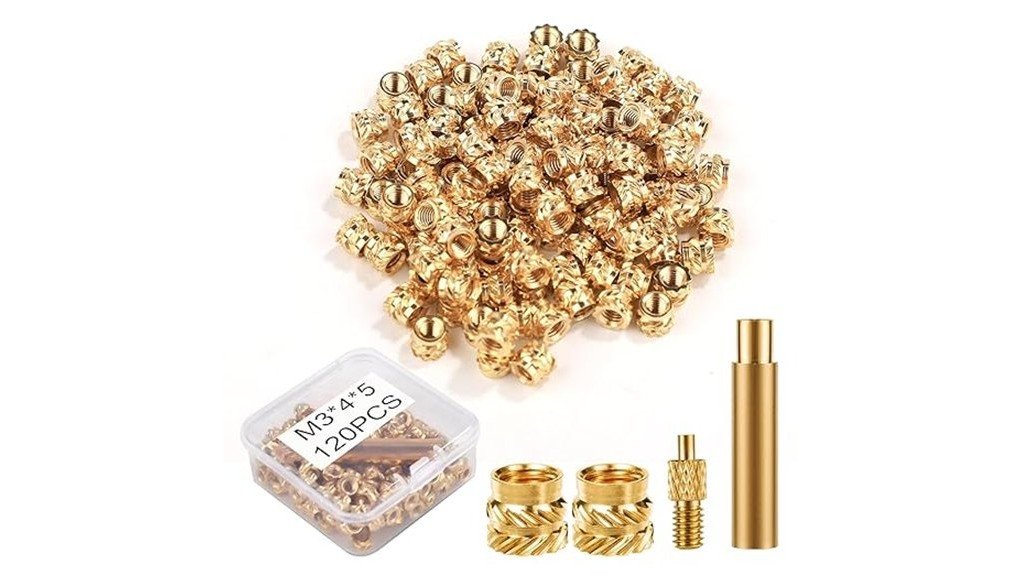
Weak threads can turn a strong 3D print into a frustrating project, especially when you need to remove and reinstall screws more than once. The PEUTIER 120pcs 3D Printing Brass Nuts M3x4x5mm set gives your printed parts stronger M3 threads by using heat-set brass inserts instead of relying on plastic alone. This review helps you decide whether this 120-piece kit fits your printer projects, soldering iron setup, and assembly needs. It offers strong value for repeatable fastening, but it still requires correct hole sizing, careful heat control, and steady installation.
Quick Verdict
Rating: 8.4/10
Best For: 3D printing users who need stronger M3 screw connections in PLA, ABS, PETG, PC, and similar printed parts.
Bottom Line: This PEUTIER brass insert kit is a practical upgrade when your printed parts need repeat assembly and better thread strength. The main tradeoff is that the inserts only work well when your printed holes, heat setting, and soldering iron fit are correct.
| Specification | Detail |
|---|---|
| Brand | PEUTIER |
| Model | 16327 |
| Manufacturer Part Number | 1002075 |
| Product Type | Heat-set threaded brass inserts for 3D printed parts |
| Size | M3x4x5mm |
| Thread Size | M3 ISO metric, right-hand thread |
| Count | 120 pieces |
| Material | Brass |
| Fastener Type | Knurled threaded insert |
| Heat Resistance Claim | Listed as heat resistant above 300°C |
| Compatible Materials | PLA, ABS, PETG, PC, and similar printable plastics when installed correctly |
| Included Accessories | Heat-set insertion tip and soldering adapter |
| Listed Iron Compatibility | Weller SP40NUS and T18-style irons |
| Item Dimensions | 47 x 45 x 18 mm |
| Item Weight | 0.05 kg |
| Best Use | Reinforcing screw holes in 3D printed parts that need repeat assembly |
What Is the PEUTIER 120pcs 3D Printing Brass Nuts Set?
The PEUTIER 120pcs 3D Printing Brass Nuts set is a pack of M3 heat-set threaded inserts for printed plastic parts. Instead of threading a screw directly into plastic, you heat the insert and press it into a printed hole. Once the plastic cools around the knurled brass body, the part has a stronger internal M3 thread.
This kit is made for hobbyists, prototype builders, repair projects, and small workshop users who print parts that need screws. It is most useful when you need to open a part later, such as an electronics enclosure, tool mount, jig, camera housing, RC part, printer accessory, or small mechanical assembly.
The main selling point is the 120-piece quantity paired with the included heat-set insertion tip and solder adapter. That makes the kit easier to start with than a bare insert pack, although your final result still depends on your printed hole size, material, heat setting, and installation technique.
Who Should Buy It?
Best For
- 3D printing users who need stronger M3 threads than printed plastic alone can provide.
- Builders making enclosures, brackets, jigs, mounts, or parts that need repeated screw removal.
- Users who want a starter-friendly 120-piece kit with an included heat-set insertion tip.
Skip If
- You need non-M3 insert sizes, such as M2, M4, M5, or mixed-size hardware.
- Your design does not leave enough plastic around the hole to support a heat-set insert.
- You need a certified industrial fastener for safety-critical or load-rated assemblies.
Before You Buy: This is an M3x4x5mm insert kit. Check your CAD hole size, screw size, insert depth, wall thickness, and soldering iron tip compatibility before ordering. A good insert can still fail if the printed hole is too loose, too tight, too shallow, or too close to an edge.
Key Takeaways
- The PEUTIER set includes 120 M3x4x5mm brass heat-set inserts for reinforcing 3D printed parts.
- The brass, knurled body helps create stronger screw threads than plastic-only holes in many printed assemblies.
- The kit includes a heat-set insertion tip and solder adapter, which helps with setup if your iron is compatible.
- It works best for parts printed in PLA, ABS, PETG, PC, and similar plastics when hole size and heat are controlled.
- It is not a universal insert kit, so you should skip it if your project needs other thread sizes or certified load-rated hardware.
Build Quality and Materials
The inserts use brass, a common material for heat-set threaded inserts because it transfers heat efficiently and resists everyday corrosion better than bare steel in many indoor uses. The knurled outer surface gives melted plastic a rougher shape to grip after the insert cools.
The M3 internal thread gives you a metal thread path for screws, which helps when you need repeated assembly and disassembly. That matters for printed electronics boxes, panels, brackets, covers, hinges, test fixtures, and modular parts.
The listed heat resistance above 300°C refers to the insert material and heat-setting process, not a promise that your printed plastic can handle that same temperature in use. PLA, ABS, PETG, and PC all behave differently under heat, so you should match your soldering iron setting to the plastic and avoid overheating the surrounding part.
Size, Fit, and Compatibility
Each insert is sized as M3x4x5mm. In practical terms, the M3 thread matches M3 screws, while the 4mm and 5mm measurements relate to insert height and outer diameter. Your printed part needs a hole that lets the insert press in squarely without splitting the plastic or spinning loose later.
The listing supports use with PLA, ABS, PETG, PC, and similar 3D printing plastics. These materials can work well with heat-set inserts, but they do not install the same way. PLA softens faster than many higher-temperature plastics, while ABS, PETG, and PC may need more heat and slower pressure.
The set also lists compatibility with Weller SP40NUS and T18-style irons. If you use another soldering iron, check the adapter fit before you rely on the included tip. A dedicated heat-set press or a steady vertical setup can improve alignment, but you can still install inserts carefully with a compatible soldering iron.
Installation and Setup
Installation is simple in concept: print the right hole, heat the insert, press it into place, and let the plastic cool. The challenge is keeping the insert straight while applying enough heat for the plastic to flow around the knurled body.
Start with a test print before using the inserts on an important part. Print several holes with small size differences, then check which one holds the insert best after cooling. This saves time because slicer settings, material shrinkage, printer calibration, and filament type can all change the final hole size.
Use steady downward pressure instead of forcing the insert. If you push too hard, you can deform the part, sink the insert too deep, or create a weak pocket around the brass. Press until the insert sits flush or slightly below the surface, then let it cool fully before driving a screw.
Pro Tip: Add a small chamfer at the top of the hole in your CAD model. The chamfer helps guide the insert, reduces plastic bulging, and makes it easier to seat the brass insert cleanly.
Performance in 3D Printed Parts
The biggest benefit is repeatable fastening. A screw driven directly into plastic can wear out the hole after repeated use, especially in softer prints or thin walls. A brass insert gives the screw a stronger thread path, so the printed part can handle more assembly cycles.
The knurled outside also helps the insert resist turning inside the part when installed correctly. That makes it useful for covers, brackets, printer mods, and parts where the screw needs to clamp two pieces together without chewing up the plastic.
These inserts are still limited by the printed material around them. If the wall is thin, the print has weak layer adhesion, or the hole is placed near an edge, the plastic may crack or deform before the insert itself fails. Good part design matters as much as the insert quality.
Compatibility and Safety
Heat-set inserts involve hot tools, softened plastic, and small metal parts. Wear eye protection, keep your fingers away from the heated insert, and work in a ventilated area, especially when heating plastics. Follow the instructions for your soldering iron and the filament manufacturer’s safety guidance.
Do not use these inserts as the only fastener in safety-critical parts, vehicle structural components, load-rated mounts, or anything that could injure someone if the joint fails. For those projects, use professionally rated hardware and engineering guidance.
For electronics projects, keep heat away from wires, circuit boards, batteries, and printed parts that already contain components. Install the inserts before final assembly when possible, then check for loose brass pieces before powering anything.
How It Performs in Real Use
For Electronics Enclosures
This kit is a strong fit for printed electronics boxes, access panels, sensor cases, and small controller housings. The M3 inserts let you remove the lid for repairs or wiring changes without wearing out plastic screw holes.
For Workshop Jigs and Fixtures
For jigs, guides, and fixtures, brass inserts help when you need clamping screws or removable plates. They work best when the print has enough wall thickness around the insert and the load stays within what the printed plastic can handle.
For Printer Mods and Hobby Projects
Printer upgrades, camera mounts, filament guides, and small brackets often use M3 hardware. A 120-piece count gives you enough inserts for several small builds, prototypes, and test pieces without buying a large industrial pack.
For Long-Term Assembly
Over time, the metal thread should hold up better than a screw cut directly into plastic. The real long-term risk is not the brass thread, but poor installation, thin part walls, heat damage, or a hole that lets the insert spin under torque.
Common Mistakes to Avoid
- Printing the hole too large: The insert may spin or pull out after cooling.
- Printing the hole too small: You may crack the plastic or deform the part while pressing the insert in.
- Using too much heat: Excess heat can melt surrounding details and weaken the finished part.
- Pressing at an angle: A tilted insert can make the screw bind or cross-thread.
- Overtightening the screw: The metal thread is stronger than plastic, but the surrounding print can still fail.
Pros and Cons
Pros
- 120-piece count gives you enough inserts for multiple projects and test prints.
- M3x4x5mm size works well for many common 3D printed enclosures, mounts, and accessories.
- Brass construction transfers heat efficiently during installation.
- Knurled outside improves grip in softened plastic when the insert is seated correctly.
- Included heat-set insertion tip and solder adapter reduce the need for a separate starter accessory.
Cons
- Only useful for M3 projects, so it will not replace mixed-size insert kits.
- Installation requires correct hole sizing, heat control, and alignment.
- Not suitable as load-rated hardware for safety-critical assemblies.
Is It Worth the Price?
The PEUTIER 120pcs M3 brass insert kit is worth considering if you build more than one 3D printed project with removable screws. The 120-piece count makes it practical for prototypes, small batches, repairs, and repeated design revisions.
It offers strong value for the price if you specifically need M3 inserts and can use the included heat-set tip with your soldering setup. You get less value if your projects use multiple screw sizes, because you would still need separate M2, M4, or M5 inserts.
The best buyer is someone who prints functional parts, not just decorative models. If your prints rarely need screws or repeated disassembly, this kit may sit unused after one or two projects.
How It Compares to Alternatives
Compared with driving screws directly into plastic, these brass inserts provide a stronger and more reusable thread path. That makes them better for covers, access panels, mounts, and parts you expect to open later.
Compared with mixed-size insert kits, this PEUTIER pack is more focused. It makes the most sense if you use M3 hardware often. If your work includes M2, M4, or M5 screws, a multi-size kit may be more flexible, while this set remains better for stocking one common M3 size in quantity.
Frequently Asked Questions
What size screws work with these inserts?
These are M3 threaded inserts, so they are made for M3 screws. Check screw length separately, because the right screw length depends on your part thickness, insert depth, and the parts you are clamping together.
Can you use them with PLA?
Yes, the kit is suitable for PLA when installed carefully. PLA softens quickly, so use controlled heat, press slowly, and test the hole size on a scrap print before using the insert on a finished part.
Do these work with ABS, PETG, and PC?
They are listed for ABS, PETG, PC, and similar 3D printing plastics. Each material softens differently, so you should adjust your temperature, pressure, and test fit instead of using one setting for every filament.
Do you need a special soldering iron?
You need a compatible soldering iron or heat-set tool that can hold the included tip or adapter. The listing mentions Weller SP40NUS and T18-style irons, but you should confirm fit if your iron uses a different tip system.
Can these brass nuts be reused?
The screw thread can handle repeated screw removal better than plastic alone. However, once an insert is heat-set into a printed part, you should treat it as part of that part rather than moving it from print to print.
How do you clean the inserts before or after use?
Before installation, keep the inserts dry and free from dust or oil. After installation, remove loose plastic strings near the insert with care, but avoid abrasive cleaning that could damage nearby printed surfaces.
Are these safe for automotive or electronics projects?
They can be useful for non-structural printed accessories, covers, brackets, and enclosures. Do not rely on them as certified load-rated hardware for safety-critical automotive parts, heavy mounts, or parts exposed to high stress.
What is the biggest installation mistake?
The biggest mistake is printing the hole without testing the fit first. A poor hole size can make the insert spin, tilt, crack the plastic, or sit too deep for the screw to engage correctly.
The Bottom Line
The PEUTIER 120pcs 3D Printing Brass Nuts M3x4x5mm set is a smart buy if you regularly build functional 3D printed parts that need stronger M3 threads. It is best for enclosures, brackets, jigs, printer mods, and hobby assemblies where repeated screw removal matters.
Skip it if you need a multi-size insert kit, certified load-rated fasteners, or a no-test installation process. The inserts are useful and well suited to M3 projects, but the final strength depends on your printed design and installation quality.