A plasma cutter does not have one universal power requirement. The correct supply depends on the exact model, input voltage, phase, input current, duty cycle, and the metal you plan to cut. Before plugging it in, compare the machine’s nameplate and manual with the breaker, wiring, receptacle, generator, and air supply available at your work area.
Quick Answer
Most portable plasma cutters use 120V or 240V single-phase power. Higher-output shop systems may require 200–240V single-phase or 400–600V three-phase service. Match the exact voltage, phase, frequency, input current, branch-circuit, and generator rating in the model’s manual—not the cutter’s output-amperage setting.
Key Takeaways
- Read the input-power section of the exact model’s manual before choosing an outlet, breaker, adapter, extension cord, or generator.
- Do not confuse plasma output amperage with the AC input current drawn from the circuit.
- A dual-voltage cutter may have lower output and cutting capacity on 120V than it has on 240V.
- Size generator power for the cutter and any separate air compressor that may run at the same time.
- Do not install a larger breaker, alter a plug, or modify high-amperage wiring without a qualified electrician and the required code review.
At a Glance
| Time Required | About 10–20 minutes to verify the manual, nameplate, outlet, and circuit; longer if an electrician must inspect or upgrade the installation. |
| Difficulty | Moderate for checking ratings; professional electrical work is required for new circuits, hardwiring, or panel changes. |
| Tools Needed | Plasma-cutter manual, machine nameplate, circuit-panel directory, and the generator or compressor specification sheet when applicable. |
| Cost | No cost to check existing ratings. The cost of a new circuit, receptacle, disconnect, or service upgrade depends on the building and local requirements. |
What’s in This Article
- Understanding Plasma Cutter Power Supply Basics
- How to Determine Your Plasma Cutter’s Power Requirements
- Voltage Requirements for Plasma Cutters
- Input Amps vs. Output Amps
- Single-Phase vs. Three-Phase Power Supplies
- Circuit Breaker Compatibility and Safety
- Impact of Material Thickness on Power Needs
- Adapting to Dual-Voltage Plasma Cutters
- Importance of Duty Cycle
- Generator Use for Plasma Cutters
- Air Compressor and Total Power Demand
- Troubleshooting Power Problems
- Upgrading Electrical Systems
- Frequently Asked Questions
- Conclusion
- Sources
Understanding Plasma Cutter Power Supply Basics
A plasma cutter uses AC power from the building or generator to create a controlled DC plasma arc. It also needs the correct gas or compressed-air supply. If either source is weak, the cutter may have trouble starting, lose the arc, leave heavy dross, overheat, or trip the circuit.
The first ratings to find are:
- Input voltage: The supply voltage the cutter accepts, such as 120V, 200–240V, 400V, or 480V.
- Phase: Single-phase or three-phase power.
- Frequency: Usually 50Hz, 60Hz, or both, depending on the model.
- Input current: The AC current the cutter draws at a stated input voltage and output load.
- Output current: The adjustable cutting amperage delivered by the plasma power supply.
- Duty cycle: The amount of operating time allowed within a stated test period and at stated conditions.
- Branch-circuit requirements: The manufacturer’s breaker or fuse, conductor, plug, receptacle, and disconnect instructions.
Note: Output amperage is not the same as input amperage. For example, the Hypertherm Powermax45 SYNC can deliver up to 45A of cutting output while its listed single-phase input current is 39A at 200V or 32A at 240V.
Do not size the breaker from the number printed beside the cutter’s output-current control. Use the input-power and branch-circuit tables in the manual for the exact model and voltage configuration.
Warning: Plasma systems contain hazardous voltage. Do not open the enclosure, alter internal wiring, defeat an interlock, or install a high-amperage circuit unless you are trained and authorized to do that work.
How to Determine Your Plasma Cutter’s Power Requirements
Follow this process before connecting a new or unfamiliar plasma cutter:
- Identify the exact model and regional version. The same product family may have different CSA, CE, CCC, or other regional power configurations.
- Read the nameplate and input-power section. Record the accepted voltage range, phase, frequency, maximum or rated input current, and any listed kW or kVA value.
- Find the branch-circuit table. Use the manufacturer’s recommended fuse or breaker, conductor, receptacle, plug, and disconnect information.
- Check the available circuit. Confirm that the outlet, circuit voltage, breaker, wiring, grounding, and plug configuration match the manual.
- Check the required cutting output. Use the manufacturer’s cut chart for the metal, thickness, consumables, and cut quality you need.
- Include the air supply. Confirm the required airflow and pressure, then include a separate compressor’s electrical load when sizing portable power.
- Review the duty cycle. Make sure the machine can handle the expected cut length, output setting, and work environment without exceeding its thermal rating.
When a manual lists several input voltages, read the current and duty-cycle values for the voltage you will actually use. Do not assume that the figures for 240V also apply at 120V, 208V, or another supply voltage.
Voltage Requirements for Plasma Cutters
Voltage determines which electrical supply can power the cutter. The receptacle must provide a voltage that falls within the machine’s approved input range.
Portable cutters may accept 120V, 240V, or both. The Powermax30 XP, for example, accepts 120–240V single-phase power. At 120V, its maximum recommended output is reduced to 25A, while 240V supports the model’s full 30A output.
A professional 45A-class cutter may require a higher supply. The current Powermax45 SYNC is offered in configurations including 200–240V single-phase and 480V three-phase for the CSA market. Larger systems can have still different voltage and phase options.
Industrial plasma systems may use 208V, 400V, 480V, or 600V power, but those voltages are not interchangeable. A cutter that accepts one of them does not automatically accept the others.
The correct voltage is the exact input range on the machine’s nameplate and manual—not the voltage that happens to be available nearby.
Check frequency as well as voltage. A machine marked 50/60Hz accepts either listed frequency, while a machine with only one frequency must be used as specified.
Never alter a plug or use an adapter that defeats the equipment-grounding connection. The plug, receptacle, voltage, and grounding arrangement must be compatible with both the machine and the circuit.
Input Amps vs. Output Amps
Plasma cutters have two different amperage figures:
- Output amperage is the cutting current delivered to the plasma arc. Higher output can support faster cutting or thicker metal when the consumables and cut chart allow it.
- Input amperage is the current drawn from the AC supply. This is one of the ratings used to plan the circuit and generator.
These figures are not interchangeable. A “45-amp plasma cutter” is normally describing maximum cutting output, not a promise that it belongs on any particular 45A branch circuit.
The required cutting amperage also cannot be determined from thickness alone. Consider this manufacturer example:
- At 120V and 25A output, the Powermax30 XP is listed as cutting 1/4-inch mild steel at about 19 inches per minute.
- The same 25A setup is listed as cutting 1/2-inch mild steel at about 3 inches per minute.
Both cuts are possible, but they do not offer the same speed, edge quality, or production value. That is why a statement such as “1/2-inch steel always needs 40–50A” is too broad.
Use the amperage and consumables specified in the cut chart. Too little output can slow travel, increase dross, or prevent full penetration. Excessive output for the installed nozzle can widen the kerf and shorten consumable life.
Single-Phase vs. Three-Phase Power Supplies
Single-phase power is common in homes, garages, farms, small fabrication shops, and portable jobsite setups. Many handheld plasma cutters are built for 120V, 200–240V, or dual-voltage single-phase service.
Three-phase power is common in industrial buildings and can supply larger plasma systems efficiently. Depending on the model and region, a three-phase cutter may use 208V, 400V, 480V, or 600V.
Three-phase is not automatically required for good plasma cutting. It is required only when the selected machine configuration calls for it. Many professional handheld systems are available in single-phase versions.
Do not connect a three-phase-only cutter to a single-phase circuit. A phase converter or other conversion equipment must be correctly engineered, rated for the plasma system, and permitted by the equipment manufacturer and local requirements. An ordinary plug adapter cannot convert the phase.
Circuit Breaker Compatibility and Safety
The circuit breaker protects the branch-circuit conductors and equipment from unsafe overcurrent. It is not a performance upgrade and must not be enlarged simply because the existing breaker trips.
Before cutting, confirm all of the following:
- Manual requirement: Find the manufacturer’s branch-circuit, fuse, or breaker instructions for the selected input voltage.
- Conductor rating: Make sure conductor material, insulation, length, installation method, terminal temperature rating, and local code support the circuit.
- Receptacle and plug: Confirm that both are correctly rated and have matching contact configurations.
- Grounding: Keep the equipment-grounding path intact. Do not remove the ground pin or use an adapter that interrupts grounding continuity.
- Dedicated load: Avoid sharing the circuit with a compressor, heater, grinder, welder, or other large load unless the circuit was designed for the combined demand.
- Condition: Stop using damaged plugs, loose receptacles, cracked insulation, crushed cords, or connections that become hot.
Warning: Do not repeatedly reset a tripped breaker. Disconnect the cutter and identify whether the cause is an overload, damaged cord, loose connection, wrong voltage, equipment fault, or another circuit problem before reenergizing it. Never substitute a larger breaker without confirming that the wiring and installation are designed for it.
Extension Cords and Voltage Drop
A long or undersized extension cord can reduce the voltage reaching the plasma cutter. Symptoms can include weak arc starts, unstable cutting, nuisance trips, reduced output, or a hot plug and cord.
Use a direct connection whenever the manual recommends one. When an extension cord is permitted:
- Follow the manufacturer’s minimum conductor-size and maximum-length table.
- Use a grounded cord rated for the circuit voltage, current, environment, and duty.
- Keep the cord as short as practical and fully uncoil it before heavy use.
- Inspect the jacket, plug, connector, strain relief, and ground pin before use.
- Remove the cord from service if it is crushed, cut, melted, loose, or unusually hot.
OSHA’s portable electrical-equipment rules require workplace cords and plug-connected equipment to be inspected for visible damage and prohibit adapters that interrupt grounding continuity.
Impact of Material Thickness on Power Needs
Thicker metal normally requires more arc energy, slower travel, or both. However, thickness alone does not tell you the required input circuit or output setting.
The manufacturer’s cut chart accounts for factors such as:
- Material type and thickness.
- Installed nozzle or cartridge rating.
- Output amperage.
- Torch-to-work distance and pierce height.
- Air or gas pressure and flow.
- Recommended travel speed.
- Whether the cut is handheld or mechanized.
Pay attention to how the manufacturer describes capacity:
- Recommended or rated capacity: The thickness intended for useful production cutting at the listed speed and conditions.
- Maximum-quality capacity: A slower or more demanding cut that may still produce an acceptable edge.
- Severance capacity: The thickest material the machine may separate at a very slow speed, often with a rougher edge and more cleanup.
- Pierce capacity: The thickness the torch can pierce without beginning from the plate edge.
A cutter’s ability to sever 1/2-inch plate does not mean it is the best machine for repeated 1/2-inch production cuts. Choose a system whose recommended capacity covers the material you cut most often.
Long cuts at high output can also approach the machine’s duty-cycle limit. This is a thermal limit inside the cutter, not proof that the breaker or wiring should be enlarged.
Adapting to Dual-Voltage Plasma Cutters
A dual-voltage plasma cutter can operate from two approved supply voltages, commonly 120V and 240V. Some models detect the supply automatically, while others require a switch, approved adapter, plug change, or setup procedure.
Use these steps when changing supplies:
- Shut down and disconnect the cutter. Do not change plugs or input settings while the machine is energized.
- Read the voltage-change procedure. Confirm whether input detection is automatic or manual.
- Use the approved cord and plug arrangement. Do not improvise an adapter or defeat the equipment ground.
- Check the new circuit. Confirm voltage, phase, frequency, breaker, wiring, receptacle, and grounding.
- Check the output limit. Some cutters reduce maximum output or duty cycle on the lower voltage.
- Use the correct cut chart. Follow any separate 120V and 240V consumable or capacity instructions.
For example, the Powermax30 XP lists a 20% duty cycle at 120V and 35% at 240V under its specified test conditions. Its recommended maximum output on 120V is also lower than its full 240V output.
Dual voltage improves portability, but it cannot make an undersized or damaged circuit safe.
Products Worth Considering
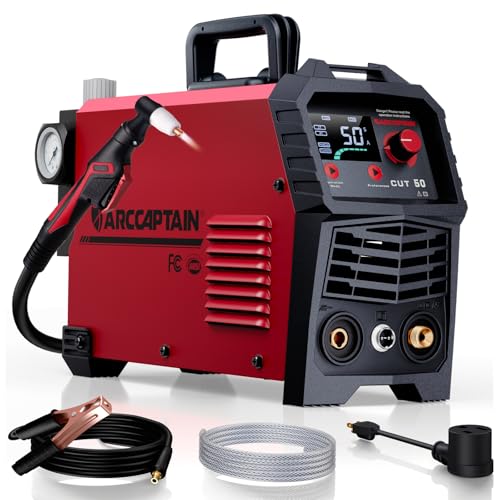
【Powerful Cutting Ability】Switch effortlessly between 110V and 220V for home or workshop use. Achieve professional 1/2" clean cuts on steel, aluminum, and copper with advanced LGBT technology. Perfect for DIY projects and heavy-duty tasks. Recommended maximum cutting thickness: 12mm @ 35A / 110V / 55 PSl; 18mm @ 50A / 220V / 75 PSI. Note: Requires compressed air (compressor sold separately).

Powerful Cutting: This VEVOR plasma cutter delivers a maximum output current of 65A for powerful cutting. It supports clean cuts up to 1/2" (12mm) at 110V and 9/16" (14mm) at 220V, with a maximum cutting thickness of 5/8" (16mm) at 110V and 3/4" (20mm) at 220V

POWERFUL CUTTING THICKNESS: This plasma cutter handles 1/2" (12mm) steel at 120V/35A and 5/8" (16mm) at 240V/60A. Dual voltage auto-detection (10-35A@120V / 30-60A@240V) with PSI guidance (70-75 PSI / 0.48-0.52MPa). Optimized for quick, efficient cuts in automotive repairs and metal fabrication
Importance of Duty Cycle
Duty cycle describes how long the plasma system can operate within a test period at stated output and environmental conditions. Plasma-cutter manufacturers commonly express it as a percentage of a 10-minute period.
A 60% rating means six minutes of arc-on time in a 10-minute period under the stated rating conditions. A 100% rating means the machine can operate throughout the test period at the listed output and conditions.
That percentage is not the whole story. According to Hypertherm’s duty-cycle explanation, output power, metal thickness, arc voltage, and ambient temperature can affect thermal loading.
A correct branch circuit prevents input-power problems, but it does not increase the plasma cutter’s published thermal duty cycle.
Operational Time Limits
Plan long cuts around the duty-cycle rating at the output you intend to use:
- Find the correct row: A machine may have different duty-cycle percentages at different output currents and input voltages.
- Consider the work: Thick plate and a longer arc can increase thermal demand.
- Consider the environment: High ambient temperature, restricted airflow, dust, and altitude can affect cooling or compressor performance.
- Watch the indicators: Stop when the thermal warning activates and let the machine complete its cooling cycle.
- Choose enough capacity: Repeated long cuts may justify a higher-duty-cycle machine rather than repeatedly operating a smaller cutter at its limit.
Preventing Overheating Risks
Keep the inlet and exhaust vents clear. Place the cutter where clean cooling air can move around it, and keep grinding dust, sparks, and metal debris away from the fan openings.
Use a lower output only when the cut chart and installed consumables permit it. Breaking a long cut into shorter sections can also provide cooling time.
If the thermal light comes on, release the trigger and allow the fan to run as directed by the manual. Do not switch the machine off immediately if the manual says the powered fan must continue cooling it.
Repeated thermal shutdowns can indicate an unrealistic workload, blocked airflow, fan trouble, high ambient temperature, low input voltage, or another fault that needs inspection.
Generator Use for Plasma Cutters
A generator must provide the correct voltage, phase, frequency, grounding arrangement, and usable output under load. A generator that starts the cutter at idle may still sag or become unstable when the arc transfers to the metal.
Do not rely on one universal generator minimum. Official requirements show how much models can differ:
- The Powermax30 XP lists an engine-drive requirement of 5.5kW for full 30A output.
- The Powermax45 SYNC lists 12.5kVA, or 10kW, for full 45A output.
Those values apply to the cited cutter models. Another machine may need more or less.
Products Worth Considering

[Powerful Cutting Ability] Dual voltage 110/220V good for home, workshop and hardware shop use. Professional performance 1/2" clean cuts on Iron, Steel aluminum and copper with Inverter IGBT Technology. Very powerful for DIY and heavy duty project. The Maximum cutting thickness is recommended to 1/2" @35A 110V 50PSI; 2/3" @50A 220V 65PSI. Dry and compressed air is required. Power breaker up to 60A@110V 35A; Up to 50A@220V 50A.
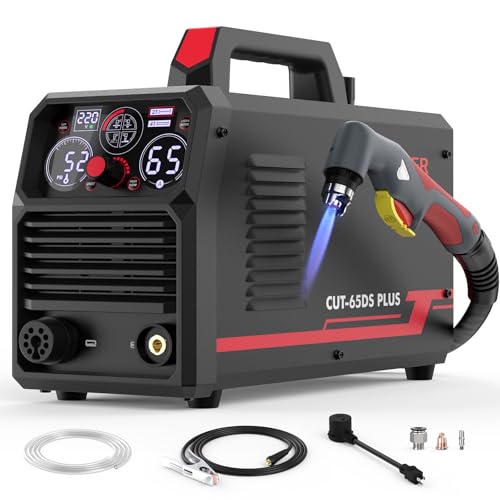
4 FUNCTIONS IN 1 MACHINE: Plate cutting, grid cutting, gouging, and marking give you more ways to handle fabrication, repair, and shop work. Plate Cutting delivers clean cuts on steel, stainless steel, and other conductive metals. Grid Cutting helps maintain a stable arc across grating and perforated metal. Gouging removes welds, rust, and damaged material. Marking creates clear guide lines for layout, hole positioning, and assembly.

【L14-30P to 6-50R Welder Generator Adapter Cord】: Designed specifically to solve the power interface mismatch between generators and welders, 4 prong NEMA L14-30 plug 30Amp 125/250V twist lock generator to 3 prong 6-50R for welder, rated for 250V max rate 7500 watts. Perfect for connecting welders, plasma cutters, or other 250V high-demand equipment in garages, workshops. Direct connection without circuit modification, quickly resolving the outdoor power supply problem for welders.
How to Size a Generator
- Find the engine-drive requirement. Use the manual’s stated kW or kVA figure whenever one is provided.
- Match the voltage and phase. Confirm that the generator outlet supplies the exact input required by the cutter.
- Check continuous output. Do not size from a brief peak or surge rating alone.
- Add simultaneous loads. Include the air compressor and any other equipment that may operate during cutting.
- Allow manufacturer-recommended capacity margin. Account for motor starting, elevation, temperature, and generator derating.
- Disable inappropriate economy operation if required. Follow the cutter and generator instructions when rapid load response is needed.
- Test under load. Stop if voltage falls outside the cutter’s allowed range, the generator surges, or plugs and cords overheat.
Pro Tip: A separate compressor can be the largest starting load in a portable setup. Check whether its motor may start while the plasma arc is active, then size the generator for that combined condition.
Air Compressor and Total Power Demand
Most air-plasma cutters require clean, dry, oil-free compressed air. Some portable models contain a built-in compressor, while others need a separate shop or jobsite compressor.
Read the cutter’s required airflow and inlet pressure. For example, the Powermax45 SYNC lists approximately 6.7 standard cubic feet per minute at 90 psi for its gas inlet. Supplying the correct pressure without enough airflow can still produce poor cutting.
When a separate compressor uses the same building service or generator, check:
- The compressor’s running current.
- Its motor-starting demand.
- Whether it can start while the cutter is operating.
- Whether the compressor and cutter share a branch circuit.
- The generator’s continuous and motor-starting capability.
- Air-tank capacity and expected compressor cycling.
A cutter can have adequate electrical input and still perform poorly because of restricted airflow, water in the air line, incorrect pressure, a clogged filter, or a compressor that cannot maintain the required flow.
Troubleshooting Plasma Cutter Power Problems
The Breaker Trips When Cutting
- Stop and do not repeatedly reset the breaker.
- Confirm that the supply voltage and phase match the machine.
- Check whether another large load is using the circuit.
- Inspect the plug, receptacle, cord, and extension cord for heat or damage.
- Compare the installed breaker and circuit with the manufacturer’s branch-circuit instructions.
- Have the cutter and circuit inspected if the cause is not an obvious temporary overload.
The Arc Is Weak or Unstable
- Check for low input voltage or excessive extension-cord drop.
- Confirm the generator maintains its rated voltage under load.
- Verify air pressure, airflow, dryness, and filter condition.
- Inspect consumables and install the correct nozzle or cartridge.
- Clean the work-clamp contact area and attach it to sound metal.
The Plug, Receptacle, or Cord Gets Hot
Stop cutting and disconnect power when it is safe to do so. Heat can indicate a loose contact, damaged connector, undersized cord, corrosion, overloaded circuit, or worn receptacle. Do not continue using the setup until a qualified person identifies and corrects the cause.
The Thermal Warning Keeps Coming On
- Check the duty cycle at the actual output setting and input voltage.
- Clear blocked cooling vents and remove dust.
- Allow the fan to complete the cooling cycle.
- Consider ambient temperature and the length of each cut.
- Have the fan or internal cooling system inspected if shutdowns occur during light work.
The Generator Surges or the Engine Lugs
- Compare its continuous kW or kVA rating with the cutter’s engine-drive requirement.
- Add the compressor and other simultaneous loads.
- Check generator derating for temperature and elevation.
- Confirm that the output voltage and frequency stay within the cutter’s permitted range.
- Use a larger or more suitable generator when the existing unit cannot hold stable output.
Upgrading Electrical Systems for Optimal Performance
An electrical upgrade may be appropriate when the existing service does not match the plasma cutter’s documented requirements. Common examples include installing a dedicated 240V circuit, replacing a worn receptacle, adding an approved disconnect, or supplying three-phase power for an industrial system.
Install a dedicated circuit because the calculated load and manufacturer instructions require it—not because a larger breaker seems like an easy way to stop trips.
A qualified electrician should evaluate:
- The plasma cutter’s input voltage, phase, frequency, current, and branch-circuit table.
- The existing service and panel capacity.
- Conductor material, size, length, insulation, installation method, and terminal ratings.
- The correct breaker or fuse type and rating.
- The receptacle, plug, disconnect, grounding, and bonding requirements.
- Local permits, inspections, workplace rules, and electrical code.
- Any simultaneous compressor, welder, heater, or shop load.
Do not assume that every 40A or 50A plasma cutter needs a circuit with the same number. The output rating on the front panel does not determine the branch-circuit rating.
A correctly designed supply can reduce undervoltage, overheating at connections, and nuisance trips. It cannot make the cutter exceed its rated output, recommended material capacity, or thermal duty cycle.
Frequently Asked Questions
Can a plasma cutter run from a standard 120V outlet?
Yes, but only when the exact cutter is approved for 120V and the branch circuit meets its manual. A dual-voltage model may have lower maximum output, cutting speed, or duty cycle on 120V than on 240V. Do not connect a 240V-only cutter to a 120V outlet.
What breaker size does a plasma cutter need?
Use the branch-circuit or fuse recommendation in the manual for the exact model, input voltage, and regional configuration. Do not choose the breaker from the cutter’s output-amperage rating. The breaker, conductors, receptacle, plug, and disconnect must be designed as one compatible system.
Do I need three-phase power for a plasma cutter?
Most portable handheld cutters use single-phase power, so three-phase service is not automatically required. Larger industrial configurations may require three-phase power. Match the phase printed on the machine nameplate and do not use a plug adapter as a phase converter.
Can I use an extension cord with a plasma cutter?
Use one only when the manufacturer permits it. The cord must be grounded and rated for the voltage, current, environment, conductor size, and length stated in the manual. An undersized or damaged cord can cause voltage drop, unstable cutting, overheating, or breaker trips.
Can plasma cutters operate on renewable energy sources?
Yes, when the renewable-energy system includes an inverter and battery or grid connection that can provide the cutter’s required AC voltage, phase, frequency, continuous output, and transient load. Include the compressor and other simultaneous loads. Check the cutter manufacturer’s generator or inverter restrictions before use.
How does altitude affect plasma-cutter power requirements?
Altitude does not create one universal power adjustment. It can affect generator output, compressor capacity, air density, and equipment cooling. Check the environmental limits and derating instructions for the cutter, generator, and compressor instead of changing air pressure or electrical settings without manufacturer guidance.
Are there portable power solutions for plasma cutters?
Yes. A suitable engine-driven generator, welder-generator with an approved auxiliary output, or high-capacity battery-inverter system may work. It must meet the exact voltage, phase, frequency, continuous-output, and engine-drive requirements of the cutter and any compressor.
Do plasma cutters have built-in power-surge protection?
Protection varies by model. A cutter may have overvoltage, undervoltage, overload, or thermal protection, but those features do not correct damaged wiring, an undersized circuit, unstable generator output, or an incompatible supply. Follow the manufacturer’s input-power limits.
What is the lifespan of a plasma cutter’s power components?
There is no fixed lifespan for every power supply. Heat, dust, moisture, duty cycle, input-power quality, fan condition, maintenance, impact damage, and component design all affect service life. Correct input power, clean cooling airflow, dry compressed air, and timely inspection can reduce avoidable failures.
Safety Disclaimer: This article provides general information and does not replace the plasma cutter’s manual, an electrical inspection, or advice from a licensed electrician or qualified welding professional. Follow the equipment manufacturer, local electrical code, permit requirements, and workplace safety rules. Plasma cutting can expose you to electrical shock, fire, hot metal, ultraviolet radiation, noise, and hazardous fumes. Use suitable PPE, ventilation, fire prevention, and a dry, correctly grounded work area.
Conclusion
Your plasma cutter works best when every part of the supply matches the exact machine: voltage, phase, frequency, input current, breaker or fuse, conductors, receptacle, grounding, generator capacity, air supply, and duty cycle. Do not size the circuit from output amperage or choose a generator from a universal wattage rule. Read the model-specific manual, use its cut chart and engine-drive requirement, and include any compressor load. When the electrical installation is uncertain, have a licensed electrician inspect it before cutting.
Sources
- Hypertherm Powermax30 XP Specifications — dual-voltage input, input current, duty cycle, cut capacity, airflow, and generator requirement.
- Hypertherm Powermax45 SYNC Specifications — current 45A-class input voltage, phase, input current, duty cycle, airflow, and engine-drive requirement.
- Hypertherm: What Is Duty Cycle? — duty-cycle definition and factors that affect thermal loading.
- Hypertherm Safety and Compliance Manual — grounding, electric-shock, damaged-cord, interlock, fire, fume, and PPE precautions.
- OSHA 1910.334: Use of Electrical Equipment — cord inspection, grounding continuity, plug compatibility, breaker resetting, and overcurrent-protection rules.
- OSHA Welding, Cutting, and Brazing Hazards and Solutions — electrical, burn, eye, radiation, and fume hazards.