The correct breaker size for a plasma cutter comes from the machine’s input-power requirements, not the cutting-amperage number on the front panel. A compact 30-amp-output cutter may run on a 120-volt, 20-amp circuit or a 240-volt, 20-amp circuit, while a larger 45-amp-output model may call for 50-amp time-delay protection at full output. Check the data plate and operator manual before choosing the breaker, receptacle, or wire.
Quick Answer
Most small 120V plasma cutters need a dedicated 20A circuit, but 240V models may require anything from 20A to 50A or more. Size the circuit from the manufacturer’s input-current and fuse/breaker table—not the cutter’s output amperage. Have new wiring checked or installed by a licensed electrician.
Key Takeaways
- A “50-amp plasma cutter” usually means 50A of cutting output; it does not automatically mean a 50A branch circuit.
- A dedicated 120V/20A circuit is common for compact cutters, often with reduced maximum cutting output.
- There is no universal 240V breaker size. Current manufacturer examples range from 20A for a compact 30A-output machine to 50A time-delay protection for a 45A-output machine at full power.
- Do not select wire gauge from a generic chart alone. Voltage, breaker size, conductor material, installation method, length, duty cycle, and local code all matter.
- Never stop nuisance trips by installing a larger breaker unless the manual, conductor sizing, receptacle, panel listing, and local code all permit it.
At a Glance
| Time Required | 5–10 minutes to identify the required circuit from the data plate and manual; longer if an electrician must inspect or install a circuit |
| Difficulty | Easy for reading specifications; advanced and potentially hazardous for panel, receptacle, or branch-circuit work |
| Tools Needed | Operator manual, data-plate photo, and panel/circuit information; electrical test equipment only for a qualified person |
| Cost | No cost to verify specifications; circuit-installation cost varies with panel capacity, distance, conductor method, receptacle, permits, and local labor |
Warning: A breaker protects the branch-circuit conductors; it is not a performance upgrade. Do not replace a tripping breaker with a larger one, alter a plug, or install a 120V/240V circuit unless the complete installation is rated for it. Incorrect electrical work can cause shock, fire, equipment damage, or death.
How to Determine Plasma Cutter Breaker Size
Start with the operator manual or the rating plate on the back or bottom of the cutter. The number advertised in the product name—30A, 45A, 50A, and so on—is normally the torch’s DC output current. The wall circuit supplies AC input current, which is a different value.
1. Identify the Exact Input Configuration
Record all of the following:
- Input voltage: 120V, 200–240V, 480V, or another listed range
- Phase: single-phase or three-phase
- Input current at rated output: often shown as I1 or “input amperes”
- Recommended fuse or circuit-breaker size: use the manual’s installation table when provided
- Frequency and voltage tolerance: especially important when using a generator
- Plug and power-cord configuration: confirm that it matches the intended supply
2. Use the Manual’s Electrical-Service Table
The manufacturer’s table is more useful than a generic breaker chart because it accounts for the power supply’s design, rated output, duty cycle, and short current peaks. For example, the Hypertherm Powermax30 AIR operator manual calls for a circuit capable of 120V/20A or 240V/20A for proper operation. By contrast, the Powermax45 SYNC operator manual lists 50A time-delay protection for full-output operation on 200–240V single-phase power.
Breaker size follows the cutter’s AC input requirements—not the DC output amperage printed on the front of the machine.
3. Verify the Entire Circuit
The breaker is only one part of the installation. The branch-circuit conductors, equipment grounding conductor, receptacle, plug, disconnecting means, panel compatibility, and any required ground-fault protection must work together. The current edition of NFPA 70, National Electrical Code, includes requirements that can apply to arc-cutting equipment, but the locally adopted code and local amendments control the installation.
Pro Tip: Photograph the cutter’s data plate and the electrical-service table in its manual before calling an electrician. Those two items usually provide the voltage, phase, input current, recommended protection, and plug details needed for an accurate quote.
Why Correct Breaker Sizing Matters
A properly selected overcurrent device protects the circuit while allowing the cutter to operate as designed. An undersized or unsuitable circuit may trip when the arc starts, when the operator stretches the arc, or when the cutter works near full output. An oversized breaker can leave conductors or receptacles without the protection intended for them.
Input Current Can Change During Cutting
Plasma cutters do not always draw one fixed amount of current. Input can rise during arc stretch, gouging, thick-material cutting, or low-voltage conditions. Modern inverter machines may also limit output when connected to a lower-rated supply. That is why a dual-voltage machine can have different cutting capacity on 120V and 240V even when the front-panel maximum is unchanged.
Duty Cycle Also Matters
Duty cycle is the percentage of a 10-minute period that the machine can cut at a stated output and ambient temperature before it must cool. It affects equipment heating and may affect code calculations for certain arc-cutting circuits. Do not use duty cycle as permission to improvise a smaller circuit; follow the installation table and have any code calculation completed by a qualified electrician.
Typical Breaker Sizes for 120V Plasma Cutters
A dedicated 120V/20A circuit is common for portable plasma cutters, but it is not a universal rule. Some machines can operate on a 15A circuit at reduced output, while others require 20A or 30A to reach their advertised capacity. The plug adapter supplied with a dual-voltage cutter does not override the manual’s output limits.
| 120V Supply | What It Usually Means | What to Check |
|---|---|---|
| 15A circuit | Possible on selected compact models, often with reduced output and a greater chance of tripping | The manual must specifically permit it; do not share the circuit |
| 20A circuit | Common dedicated supply for portable dual-voltage cutters | Maximum allowed output on 120V, plug type, and extension-cord restrictions |
| 30A circuit | Used only when the specific cutter and installation call for it | Breaker, receptacle, conductors, panel, and manual must all agree |
Do not assume every 120V cutter draws “about 15 amps.” The Powermax30 AIR, for example, lists 19.2A input at its recommended 19A cutting output on a 120V/20A supply, and its manual advises against normal operation on a 120V/15A circuit.
Products Worth Considering
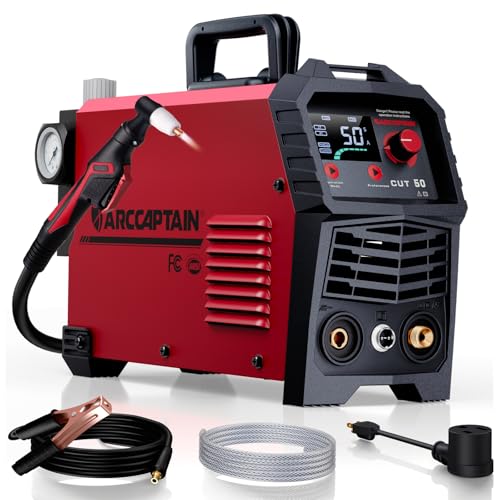
【Powerful Cutting Ability】Switch effortlessly between 110V and 220V for home or workshop use. Achieve professional 1/2" clean cuts on steel, aluminum, and copper with advanced LGBT technology. Perfect for DIY projects and heavy-duty tasks. Recommended maximum cutting thickness: 12mm @ 35A / 110V / 55 PSl; 18mm @ 50A / 220V / 75 PSI. Note: Requires compressed air (compressor sold separately).

[Powerful Cutting Ability] Dual voltage 110/220V good for home, workshop and hardware shop use. Professional performance 1/2" clean cuts on Iron, Steel aluminum and copper with Inverter IGBT Technology. Very powerful for DIY and heavy duty project. The Maximum cutting thickness is recommended to 1/2" @35A 110V 50PSI; 2/3" @50A 220V 65PSI. Dry and compressed air is required. Power breaker up to 60A@110V 35A; Up to 50A@220V 50A.

CUTTING THICKNESS UP TO 20MM: Featuring a brand-new MCU technology upgrade, the plasma cutter machine has a high degree of internal integration, combining full digitalization for more precise control of cutting parameters such as current and voltage. This results in better cutting effects and improved stability. Cutting thickness: Quality 12mm (1/2"), maximum 20mm (3/4").
Typical Breaker Sizes for 240V Plasma Cutters
There is no single standard breaker size for all 240V plasma cutters. Compact models may need only a 20A circuit, while higher-output shop machines may require 30A, 40A, 50A, or a different value stated in the manual. Three-phase models can have very different input-current requirements from single-phase models with the same cutting output.
| Manufacturer Example | Input Configuration | Published Protection |
|---|---|---|
| Hypertherm Powermax30 AIR | 200–240V, single-phase | Circuit capable of 240V/20A for proper operation |
| Hypertherm Powermax45 SYNC | 200–240V, single-phase, full 45A output | 50A time-delay fuse listed in the voltage-configuration table |
Note: These examples show why “240V equals a 50A breaker” is unreliable. They are not substitute specifications for another brand or model.
Breaker Type, Dedicated Circuit, and Wire Size
Use the Protection Type the Manual Specifies
“Slow-blow” is primarily a fuse term. Some manuals specify a time-delay fuse; others permit a circuit breaker with an appropriate time-current characteristic. Use a breaker that is listed for the electrical panel and permitted by the cutter manufacturer and local code. Do not install a breaker merely because it physically fits the panel.
Use a Dedicated Circuit When Required
A dedicated branch circuit prevents lights, compressors, grinders, and other shop loads from adding to the cutter’s demand. Manufacturer instructions for portable cutters commonly advise that nothing else draw power from the same circuit. A separate air compressor may need its own circuit because its motor-starting current can coincide with the cutter’s load.
Do Not Guess the Wire Gauge
The original claim that every 240V cutter needs “6/2 wire” is too broad. Conductor size depends on the recommended overcurrent protection, conductor material, insulation rating, terminal temperature limits, wiring method, cable length, voltage drop, equipment duty cycle, and the locally adopted electrical code. The power cord supplied on the machine is also not necessarily the required branch-circuit conductor size.
A straight 240V cutter may use two ungrounded conductors plus an equipment grounding conductor, while another installation may have different connection requirements. Follow the wiring diagram and do not substitute a neutral for an equipment grounding conductor.
Factors That Affect Breaker Selection
- Input voltage and phase: 120V and 240V single-phase ratings are not interchangeable with three-phase ratings.
- Input current at rated output: this is more relevant to the supply circuit than the torch’s output setting.
- Arc-stretch current: gouging or holding a long arc can raise input demand.
- Duty cycle: the rated cutting time and output affect heating and installation requirements.
- Available fault current and panel type: the breaker must have the correct listing and interrupting rating for the panel and supply.
- Receptacle and plug: both must match the equipment instructions and circuit rating.
- GFCI requirements: garages, outdoor areas, and other locations may require ground-fault protection under the locally adopted code.
- Extension cords: undersized or long cords can cause voltage drop, poor cutting, and nuisance trips.
- Generator output: confirm voltage regulation, continuous power, surge capability, and the manufacturer’s generator recommendation.
- Future equipment: do not oversize the present breaker “for later”; plan a separately engineered circuit if a future machine needs more power.
Common Breaker-Sizing Mistakes
- Matching breaker amps to output amps: a 45A cutting output does not automatically call for a 45A breaker.
- Assuming every 240V machine needs 50A: compact 240V cutters may use much smaller circuits.
- Upsizing after a trip: find the cause instead of weakening overcurrent protection.
- Sharing the circuit: other tools can push the total load beyond the circuit’s capability.
- Using a long, light extension cord: voltage drop can reduce performance and increase tripping.
- Choosing a breaker by brand reputation: the breaker must be specifically listed for the panel, not simply made by a familiar company.
- Copying a generic wire-size chart: arc-cutting equipment and real installations require more information than breaker amperage alone.
- Rewiring a single-voltage machine: only manufacturer-approved dual-voltage equipment may be used on both voltages.
Troubleshooting a Plasma Cutter Breaker That Trips
Stop cutting and identify when the trip occurs. A breaker that opens immediately at power-up points to a different problem than one that trips only during a long cut or while gouging.
- Disconnect the cutter and inspect the plug, receptacle, and cord. Stop if you see melting, discoloration, loose contacts, damaged insulation, or moisture.
- Confirm the supply voltage and breaker size against the manual. Do not rely on the cutter’s output-amperage label.
- Remove other loads from the circuit. A compressor, grinder, heater, or shop vacuum may be using the remaining capacity.
- Eliminate the extension cord. If a cord is unavoidable, use only a length and gauge permitted by the cutter manufacturer.
- Reduce cutting output only if the manual permits lower-rated service. Some dual-voltage models publish reduced-output settings for smaller circuits.
- Check cutting technique and air supply. Excessive arc stretch, poor work-clamp contact, or an inadequate gas supply can make the machine work harder or cut poorly.
- Call a licensed electrician or qualified service technician. Repeated trips can result from low voltage, a loose connection, a damaged breaker, incorrect wiring, or an internal machine fault.
Warning: Stop using the circuit immediately if the breaker, panel, plug, or receptacle is hot; if you smell burning insulation; if you hear buzzing or arcing; or if there is visible damage. Do not remove the panel cover or work on energized equipment unless you are qualified and authorized to do so.
Tips for Safe and Efficient Plasma Cutter Operation
Correct electrical service is only one part of safe plasma cutting. Follow the cutter’s manual and workplace rules for grounding, compressed air, fire prevention, ventilation, and personal protective equipment.
- Wear proper eye and face protection. Plasma arc cutting produces hazardous radiant energy and flying particles. Use the filter shade and protection specified for the operation; OSHA provides an official eye and face protection standard.
- Control fumes. Remove coatings when safe to do so, identify the base metal, and use suitable local exhaust or respiratory protection where required. OSHA’s welding and cutting ventilation rules address toxic metals and enclosed spaces.
- Keep combustibles away. Sparks and hot slag can travel beyond the cut area. Keep an appropriate extinguisher nearby and follow hot-work controls.
- Use clean, dry air at the specified pressure and flow. Poor air quality shortens consumable life and hurts cut quality.
- Attach the work clamp to clean metal near the cut. Good metal-to-metal contact supports a stable arc.
- Inspect the torch, power cord, work lead, and consumables before use. Replace damaged parts with approved components.
Frequently Asked Questions
How do I convert a 120V plasma cutter to 240V?
Use 240V only if the exact model is factory-rated for dual-voltage operation and follow its approved plug or adapter instructions. Do not rewire a 120V-only cutter or change its plug to force a conversion. A licensed electrician should install or verify the 240V supply.
Can I use a breaker larger than the plasma cutter manual recommends?
Not as a quick fix for tripping. A larger breaker is acceptable only when the manufacturer’s instructions, branch-circuit conductor sizing, receptacle, panel listing, and locally adopted code all allow it. Otherwise, the circuit may not have proper overcurrent protection.
What are the signs of an overloaded or unsafe circuit?
Warning signs include repeated trips, a hot breaker or receptacle, discoloration, a loose plug, buzzing, arcing, flickering lights, or a burning smell. Stop using the equipment and have the circuit inspected. A trip can also result from low voltage, a damaged cord, a failing breaker, or an internal cutter fault.
How often should I test the plasma cutter’s breaker?
There is no universal six-month test schedule for an ordinary branch-circuit breaker. Follow the breaker and panel manufacturer’s maintenance instructions. If the circuit uses a GFCI device, operate its test function at the interval printed on the device or in its instructions. Have a qualified electrician inspect any breaker that trips repeatedly, feels hot, or shows damage.
Are specific breaker brands recommended for plasma cutters?
Choose the breaker model listed or classified for the specific panel and approved for the application. Do not select a breaker solely because users recommend a brand, and do not mix breaker families unless the panel labeling and breaker listing specifically permit it.
Does a 50-amp plasma cutter need a 50-amp breaker?
Not necessarily. “50 amp” usually describes cutting output. The required breaker or fuse depends on AC input voltage, input current, phase, duty cycle, and the manufacturer’s electrical-service table. Read the data plate and manual for the exact model.
Can I run a plasma cutter on an extension cord?
Avoid an extension cord when possible. If the manufacturer permits one, use the specified conductor gauge for the voltage and total cord length, keep it as short as practical, fully uncoil it, and inspect it before use. An undersized cord can cause voltage drop, poor cutting, overheating, and breaker trips.
Conclusion
The safest answer is not “20A for every 120V cutter” or “50A for every 240V cutter.” Use the exact model’s AC input-current and protection table. Confirm the voltage, phase, recommended fuse or breaker, receptacle, conductors, grounding, and local code as one complete system. When a breaker trips, correct the cause rather than increasing its size.
Sources
- Hypertherm Powermax30 AIR Operator Manual — 120V/20A and 240V/20A circuit examples, input current, extension-cord guidance, and reduced-output operation
- Hypertherm Powermax45 SYNC Operator Manual, Revision 3 — 200–240V input current, time-delay fuse values, power-cord specifications, and low-rated-service guidance
- NFPA 70, National Electrical Code — current national model code for electrical installations
- OSHA 29 CFR 1910.133: Eye and Face Protection — protection from flying particles, molten metal, and injurious light radiation
- OSHA 29 CFR 1926.353: Ventilation and Protection in Welding and Cutting — ventilation and protection requirements for hazardous metals and enclosed spaces