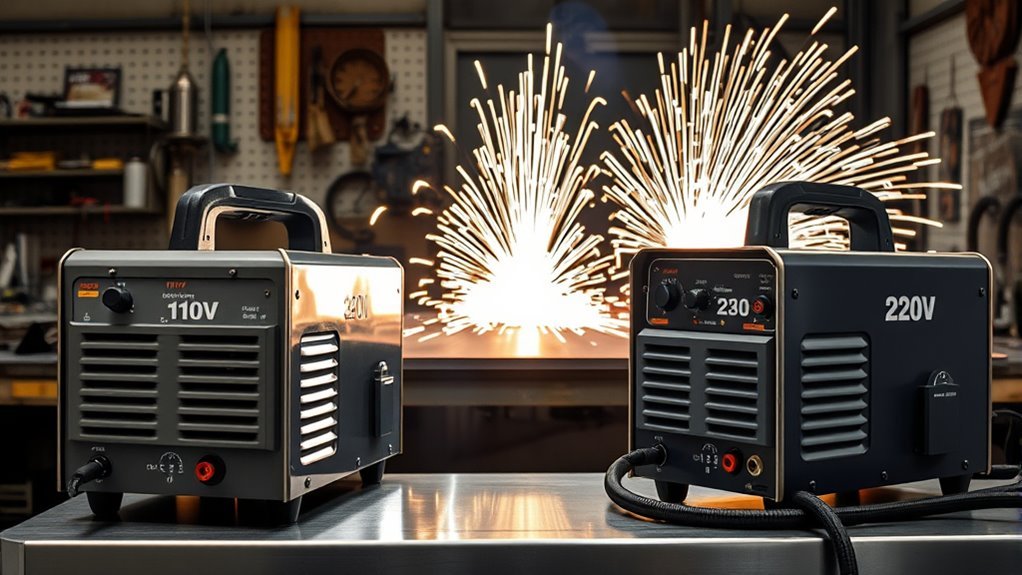
Choosing between a 110V and 220V plasma cutter is not as simple as matching one voltage to one metal thickness. In North America, those labels usually mean 120V and 240V. The better choice depends on the cutter’s output amperage, its rated cut capacity, your branch circuit, the length of your cuts, and the air supply available in your shop.
Quick Answer
Choose 120V for portability and mostly thin sheet or light repair work. Choose 240V when you need full output, longer cuts, or regular work on thicker plate. Voltage alone does not set cutting thickness, so compare each machine’s recommended cut capacity, output amperage, duty cycle, and required circuit before buying.
Key Takeaways
- “110V” and “220V” are common shop terms; most current U.S. equipment is labeled for nominal 120V and 240V power.
- Output amperage and machine design determine cut capacity. Input voltage by itself does not guarantee a specific thickness.
- A dual-voltage cutter may produce less output or a shorter duty cycle on 120V, especially on a 15- or 20-amp circuit.
- There is no universal 240V outlet or 50-amp breaker requirement. Follow the machine nameplate and operator manual.
- Clean, dry, oil-free air, sound consumables, correct travel speed, and safe work practices matter as much as voltage.
At a Glance
| Time Required | About 10–15 minutes to compare your material, outlet, manual, and air-supply needs |
| Difficulty | Easy for machine selection; electrical changes require a qualified electrician |
| Tools Needed | Material-thickness list, cutter specifications, outlet and panel check, and compressor specifications |
| Cost | No cost to compare; a new 240V circuit, receptacle, or panel work is priced by the electrician and site |
How Voltage Affects Plasma Cutter Performance
Most people say 110V and 220V, but current U.S. machines commonly list 120V and 240V on the nameplate. You may also see 208V or 230V on commercial equipment. Always use the voltage range printed by the manufacturer.
Input voltage supplies the power source, but the torch cuts with regulated DC output. That means voltage is only one part of the system. Output amperage, torch voltage, consumable design, air flow, cut speed, and the power supply’s efficiency all affect the finished cut.
Dual-voltage plasma cutters can be useful when you move between a home garage and job sites. Some automatically sense the input voltage. Others require a switch, an adapter, or a specific setup procedure. Never assume a machine is dual voltage unless both input ranges appear on its nameplate and in its manual.
Note: A 240V connection does not turn a small 20- or 30-amp cutter into a 45- or 65-amp cutter. It only lets that machine operate at the output and duty cycle its design allows.
Cutting Power and Efficiency Comparison
The original idea that every 120V cutter is limited to about 2,400 watts and every 240V cutter produces about 6,600 watts is too broad. Available input power depends on the branch-circuit rating and the machine’s input current. Two cutters using the same voltage can have very different output and cut ratings.
| Factor | 120V Operation | 240V Operation |
|---|---|---|
| Best fit | Mobile repair, sheet metal, auto body work, and short cuts | Higher-output cutting, longer cuts, thicker plate, and production work |
| Output | May be reduced on a 15- or 20-amp circuit; some models need a 30-amp 120V circuit for full capacity | Often allows the cutter to reach its full rated output with lower input current for the same power |
| Cut thickness | Model-specific; compact machines are commonly aimed at thin material, but some are rated for 3/8-inch cuts | Model-specific; 45- and 65-amp classes commonly carry recommended ratings around 5/8 and 3/4 inch |
| Duty cycle | Can be lower at maximum output on a dual-voltage machine | May be higher at maximum output, but the manual’s rating controls |
| Circuit | Usually 15, 20, or sometimes 30 amps, depending on the machine | Varies by model; do not assume every cutter needs a 50-amp circuit or NEMA 6-50 receptacle |
For a real example, the Miller Spectrum 375 X-TREME specifications list different output and duty-cycle ratings for 120V and 240V operation. Miller also explains that a suitable 30-amp 120V circuit can let some 30-amp cutters maintain the same cutting capacity available on 240V, while a smaller 120V circuit can reduce capacity.
Choose by the machine’s recommended cut rating and input requirements—not by voltage alone.
Best Options for Home Shops and Hobbyists
A 120V cutter can be a good choice when you mostly work with sheet metal, body panels, light tubing, small brackets, or occasional repair jobs. It is easy to move and can use common shop power when the circuit meets the manual’s requirements.
Choose 240V when you regularly cut 1/4-inch plate or thicker, make long cuts, or need a higher-output machine. A 240V circuit also gives you more choices in the 40- to 65-amp range. Those machines are better suited to fabrication than a compact cutter that spends every job at maximum output.
Pro Tip: A quality dual-voltage inverter cutter can be a smart bridge for a growing home shop. Use it on an approved 120V circuit for light work, then connect it to the manufacturer-approved 240V circuit when you need its full performance.
Weight matters, but do not use an arbitrary 25-pound limit. A built-in air compressor adds convenience and weight, while a larger torch lead can make a slightly heavier machine easier to use around a vehicle or cutting table. Compare the complete setup, not just the power supply.
Products Worth Considering
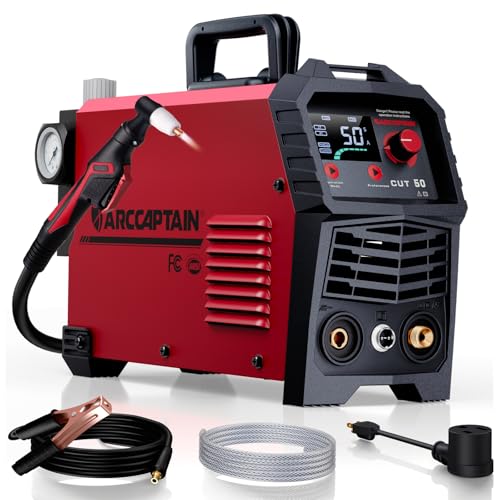
【Powerful Cutting Ability】Switch effortlessly between 110V and 220V for home or workshop use. Achieve professional 1/2" clean cuts on steel, aluminum, and copper with advanced LGBT technology. Perfect for DIY projects and heavy-duty tasks. Recommended maximum cutting thickness: 12mm @ 35A / 110V / 55 PSl; 18mm @ 50A / 220V / 75 PSI. Note: Requires compressed air (compressor sold separately).

[75A Plasma Cutting Performance]: The STC750P plasma cutter machine delivers powerful cuts with advanced IGBT inverter technology and high-frequency pilot arc. Supporting 110V/220V dual voltage, it offers 15-45A at 110V for home garage projects and up to 75A at 220V for professional metal fabrication. Clean cuts up to 5/8" (16mm) and maximum severance thickness up to 1" (25mm) at 75A/70 PSI on 220V with reduced slag and less post-cut grinding

【Non-Touch Pilot Arc Function】The plasma cutter features a high frequency non-touch arc starting mode. It allows for cutting steel surfaces with dirt, rust or coatings. The torch head does not need to touch the metal plate, reducing energy consumption, minimizing electrode burning, and extending service life. NOTE: DO NOT power on until the screen turns off and the fan stops working!
Best Options for Industrial and Contractor Use
Contractors and fabrication shops usually benefit from 240V or higher input because it supports a wider range of professional cutters. A 45-amp machine may carry a recommended cut capacity near 5/8 inch, while a 65-amp machine may be rated around 3/4 inch. Those are output-class examples, not universal voltage limits.
For field work, dual-voltage capability can be valuable, but verify the available circuit before arriving. A plug that physically fits does not prove the circuit can supply the required current. Contractors should also check generator output, extension-cord limits, air-compressor flow, and the manual’s grounding instructions.
For CNC or repeated production cuts, look beyond input voltage. Confirm mechanized pierce capacity, torch compatibility, cut charts, duty cycle at the planned output, consumable system, and the machine interface. A high severance rating does not mean the cutter can repeatedly pierce or produce clean edges at that thickness.
How Voltage Impacts Duty Cycle
The duty cycle is the percentage of a 10-minute period that a machine can cut at a stated output and ambient temperature without overheating. A 60% rating means six minutes of cutting followed by four minutes of cooling under the test conditions.
Higher input voltage does not automatically create better cooling. Fan design, heat sinks, ambient temperature, output setting, and the power supply all matter. However, the same dual-voltage machine may have a better full-output duty cycle on 240V because it can operate more efficiently within its design.
- Hypertherm Powermax30 XP: its published rating is 20% on 120V and 35% on 240V at 40°C.
- Miller Spectrum 375 X-TREME: its ratings change with input voltage, available input current, and output setting.
- Hypertherm Powermax45 SYNC: its 200–240V specification lists 50% at 45 amps, 60% at 41 amps, and 100% at 32 amps.
Read the full rating, not only the percentage. “60% duty cycle” is incomplete unless you know the output amperage and test temperature. Lowering output often increases usable cutting time.
Maximum Cutting Thickness by Voltage
Input voltage does not create a hard thickness limit by itself. Manufacturers rate each system by output and cutting performance. Three terms matter:
- Recommended cut capacity: the thickness the machine is designed to cut at a useful speed and quality.
- Severance capacity: the thickest material the machine can slowly separate, usually with a rougher edge and more cleanup.
- Pierce capacity: the thickness the torch can start through from the face of the plate. It is often lower than edge-start capacity.
| Example Machine Class | Input | Published Capacity Example | What It Shows |
|---|---|---|---|
| 30-amp portable cutter | 120/240V dual voltage | Powermax30 AIR: 5/16-inch recommended, 3/8 inch at a slower published speed, 5/8-inch severance | A dual-voltage 30-amp machine can exceed a blanket 1/4-inch claim |
| 45-amp professional cutter | 200–240V single phase | Powermax45 SYNC: 5/8-inch recommended, 1-1/8-inch hand severance | Recommended and severance ratings are not interchangeable |
| 65-amp professional cutter | 200–480V, configuration dependent | Powermax65 SYNC: 3/4-inch recommended, 1-1/4-inch hand severance | A 3/4-inch recommended cut usually comes from a higher-output class, not merely a 240V plug |
For buying decisions, size the cutter to the material you cut most often. Hypertherm recommends choosing a machine whose recommended capacity covers your normal work and using severance capacity only for occasional thicker cuts.
Which Metals Can You Cut?
Air-plasma cutters can cut electrically conductive metals, including mild steel, stainless steel, aluminum, copper, and brass. Cut speed and edge quality vary by alloy, thickness, gas, amperage, consumables, and torch setup.
It is not accurate to say that stainless steel and aluminum always “require higher energy” than mild steel. Use the manufacturer’s cut chart for the exact metal. Air can cut stainless and aluminum, but it may leave oxidation or a different edge finish than another approved plasma gas.
Remove coatings only when it is safe to do so, and identify unknown metal before cutting. Galvanized, painted, plated, or contaminated metal can release hazardous fumes. Use effective ventilation or local exhaust and follow the material’s safety information.
Warning: Plasma cutting produces intense ultraviolet and infrared radiation, hot sparks, electric-shock hazards, and metal fumes. OSHA’s eye-protection table lists a minimum shade 8 for light plasma arc cutting below 300 amps—not shade 5. Use the shade and PPE required by the cutter manual, protect nearby people, wear flame-resistant clothing and suitable gloves, and keep combustibles away. See OSHA 29 CFR 1910.133 and this guide to face shields and safety glasses.
Electrical Outlet and Circuit Requirements
Check the cutter’s nameplate and installation section before buying an outlet, breaker, adapter, or extension cord. The required branch circuit depends on the machine’s maximum input current, duty cycle, plug, and manufacturer instructions.
- 120V cutters: some operate from a 15- or 20-amp circuit at reduced output. Others require a 30-amp 120V branch circuit for full performance.
- 240V cutters: required circuits may be 20, 30, 40, 50 amps, or another rating. A NEMA 6-50 receptacle is common on some welding and cutting equipment, but it is not universal.
- Dual-voltage adapters: use only the manufacturer-approved plug or adapter. A simple homemade adapter does not change the circuit capacity.
- Extension cords: avoid them when possible. If the manual permits one, use the conductor size and maximum length it specifies to control voltage drop and heat.
- Generators: compare the cutter’s required generator kVA or kW, not only the receptacle shape or advertised peak watts.
Do not install a larger breaker just to stop nuisance trips. The conductors, receptacle, disconnect, grounding, panel capacity, and overcurrent protection must work together. Have a qualified electrician evaluate or install a new 240V circuit.
Air Compressor and Consumables Matter Too
Most portable air-plasma cutters need an external compressor. The compressor must meet the machine’s required flow and pressure while the torch is firing—not only its tank pressure. A small compressor may start the cut correctly and then fall behind during a long pass.
Use clean, dry, oil-free air unless the manual approves another gas. Hypertherm warns that dirty or wet air can reduce cut speed and thickness capability, harm cut quality, and shorten torch-part life. Install the filtration and dryer needed for your climate and compressor.
Inspect the nozzle, electrode or cartridge, swirl ring, shield, torch lead, work clamp, and air filter. Worn or incorrect consumables can cause a wide kerf, bevel, heavy dross, poor starting, or premature shutdown. Higher input voltage cannot correct a damaged nozzle or wet air.
How to Choose the Right Plasma Cutter
Use this order so voltage does not distract you from the specifications that control real performance:
- List your normal material. Record the metal type and thickness you cut most often, plus the thickest piece you only need to sever occasionally.
- Choose by recommended capacity. Do not size the machine around a marketing photo or its maximum severance number.
- Check output and duty cycle. Compare the rating at the amperage and input voltage you plan to use.
- Verify the electrical supply. Match the nameplate and manual to the actual branch circuit. Include any generator or extension-cord use.
- Verify the air supply. Confirm flow, pressure, filtration, and whether a built-in compressor is worth the tradeoff.
- Compare the full ownership cost. Include the circuit upgrade, compressor, dryer, consumables, torch lead, warranty, and local service.
Choose a 120V plasma cutter if:
- You mainly cut sheet metal, auto body panels, light tubing, or small brackets.
- Portability and access to ordinary job-site power are more important than maximum output.
- The machine’s published 120V rating covers your normal material and cut length.
Choose a 240V plasma cutter if:
- You routinely cut plate near or above 1/4 inch and want faster travel with less cleanup.
- You need a 40- to 65-amp class machine, longer duty cycle at high output, CNC capability, or production use.
- Your shop has—or can safely add—the exact circuit required by the selected machine.
Choose a dual-voltage cutter if:
- You move between locations with different power supplies.
- You understand the machine’s reduced-output or duty-cycle limits on 120V.
- The approved plug adapters and circuit requirements fit the places where you work.
Products Worth Considering
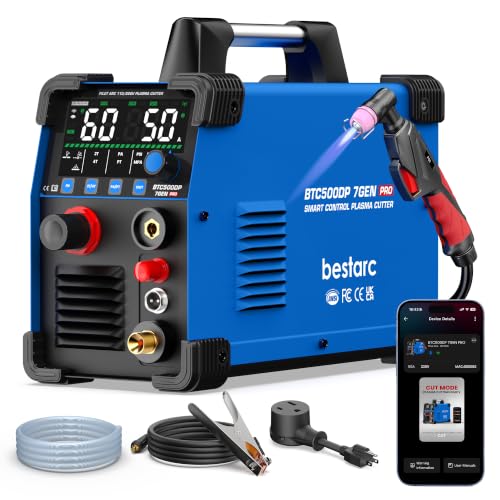
[Smart APP Remote Control Up to 98FT] Control your plasma cutter from up to 98 ft (30 m) away via Bluetooth APP. Adjust cutting current, switch cutting modes, save preferred settings, monitor operating status, and check error codes directly from your phone. Reduce trips back to the machine and work more efficiently—ideal for workshops, auto repair, farms, garages, and DIY projects.

【Powerful Cutting Ability】Dual-voltage plasma cutter 110/220V operation is perfect for home garages, workshops, and hardware shops. Delivers professional performance 1/2" clean cuts on iron, steel, aluminum and copper using Inverter IGBT Technology. Suitable for both DIY and heavy-duty projects. Maximum recommended cutting thickness: 1/2" @ 35A 110V 50 PSI; 2/3" @ 50A 220V 65 PSI. Requires dry, compressed air. Recommended power breakers: 40A @ 110V; 30A @ 220V.

[Powerful Cutting Ability] Dual voltage 110/220V good for home, workshop and hardware shop use. Professional performance 1/2" clean cuts on Iron, Steel aluminum and copper with Inverter IGBT Technology. Very powerful for DIY and heavy duty project. The Maximum cutting thickness is recommended to 1/2" @35A 110V 50PSI; 2/3" @50A 220V 65PSI. Dry and compressed air is required. Power breaker up to 60A@110V 35A; Up to 50A@220V 50A.
Frequently Asked Questions
How does voltage affect the lifespan of a plasma cutter?
Voltage alone does not determine service life. A cutter lasts longer when it runs on the input supply specified by the manufacturer, stays within its duty cycle, receives clean air, has open cooling passages, and uses correct consumables. Repeated undervoltage, overheating, contamination, or poor maintenance can shorten component life.
Are there different safety risks with 120V and 240V cutters?
Both can cause fatal electric shock, burns, eye injury, fire, and harmful fume exposure. A 240V circuit is not the only danger; the plasma power supply also creates high internal and open-circuit voltages. Keep the equipment dry, maintain grounding, disconnect power before service, and follow the operator manual.
Can you switch between 120V and 240V on the same machine?
Only if the machine is specifically rated for both inputs. Many inverter cutters sense voltage automatically, while others use a selector or approved adapter. Shut the machine down and follow the manual before changing connections. Never connect a 120V-only cutter to 240V.
Do 240V plasma cutters cost more to maintain?
Not because of voltage alone. Consumable cost depends on torch design, amperage, starts, air quality, technique, and the material being cut. A larger machine may use more expensive parts, but it may also finish thick cuts faster and avoid running at its limit.
Which voltage plasma cutter is more cost-effective?
For occasional thin-metal work, a 120V cutter can cost less because it may not require electrical work. For frequent fabrication, 240V can be more economical when it supports the output, cut speed, and duty cycle you need. Compare the cutter, circuit, compressor, consumables, and cleanup time as one system.
Does a 240V plasma cutter cut twice as thick as a 120V model?
No. Doubling the input voltage does not double cut thickness. A dual-voltage cutter may gain some output or duty cycle on 240V, but its torch and power-supply design still set the limit. Compare recommended capacity at each input voltage.
Can I run a plasma cutter from a dryer or welder outlet?
Only when the circuit voltage, conductor capacity, breaker, grounding, receptacle, and plug arrangement meet the cutter manufacturer’s instructions and applicable electrical rules. Do not rely on a plug adapter alone. Have an electrician check an existing outlet when its wiring or circuit history is uncertain.
Can I use a long extension cord with a plasma cutter?
Use an extension cord only when the manual allows it. An undersized or overly long cord can cause voltage drop, overheating, weak arc performance, and nuisance shutdowns. Use the conductor size and maximum length specified by the manufacturer, and fully uncoil the cord during use.
Conclusion
A 120V plasma cutter is often the practical choice for portable, light-duty work. A 240V cutter is usually the better fit for higher output, thicker plate, long cuts, and production. The deciding specification is not voltage by itself. Match the machine’s recommended cut capacity, duty cycle, circuit, and air demand to your real projects, then have any new electrical work installed safely.
Sources
- Miller Electric: How to Select and Operate a Hand-Held Plasma Cutter — input-power choices, branch-circuit effects, and selection guidance
- Miller Electric: Spectrum 375 X-TREME Specifications — voltage-specific output and duty-cycle examples
- Hypertherm: Powermax30 AIR Product Information — dual-voltage duty cycle and recommended, slower, and severance cut capacities
- Hypertherm: Powermax45 SYNC Specifications — 45-amp capacity, input, and duty-cycle ratings
- Hypertherm: Powermax65 SYNC Specifications — 65-amp recommended, pierce, and severance capacities
- OSHA 29 CFR 1910.133: Eye and Face Protection — minimum filter-shade guidance for plasma arc cutting