A plasma cutter can look simple from the front panel, but its electrical requirements are easy to misread. The large amperage number usually describes the torch’s DC cutting output, not the current drawn from the wall. Before buying or wiring a machine, check its data plate and operator manual for input voltage, phase, input current, circuit protection, duty cycle, and air-supply needs.
Quick Answer
A plasma cutter’s power requirement is set by its input rating—not the output amperage printed on the front panel. Check the data plate or manual for voltage, phase, input current, and required fuse or breaker. Small dual-voltage units may use 120V or 240V circuits; higher-output machines often need a dedicated 240V or three-phase supply.
Key Takeaways
- Use input current for circuit planning. Output amps describe the torch, while input amps describe the electrical supply.
- Follow the manufacturer’s circuit table. Do not choose a breaker by applying a generic 80% rule to the output-amperage setting.
- Account for the air supply. An external compressor may need its own circuit and can add substantial load.
- Size generators and extension cords from the manual. A low-wattage generator or undersized cord can cause voltage faults and poor cuts.
- Hire a licensed electrician for new circuits. Conductor size, receptacle type, grounding, voltage drop, panel capacity, and local code all matter.
At a Glance
| Time Required | 10–20 minutes to verify specifications; circuit installation time varies |
| Difficulty | Easy for specification checks; advanced electrical work requires a licensed electrician |
| Tools Needed | Machine data plate, operator manual, panel directory, and utility rate; electrician’s test equipment for installation |
| Cost | Free to verify specifications; circuit-upgrade cost depends on panel capacity, distance, materials, permits, and local labor rates |
Warning: Do not install a larger breaker on existing wiring just to stop nuisance trips. The breaker, conductors, receptacle, disconnecting means, grounding, service capacity, and machine requirements must work as one system. Have a licensed electrician evaluate any new or modified high-current circuit.
What Are Plasma Cutter Power Requirements?
Plasma cutters vary greatly in their power needs, so the safest starting point is the machine’s data plate and operator manual. A compact dual-voltage cutter may run from 120V or 240V single-phase power, while a larger shop system may use 200–240V single-phase or 380–480V three-phase power. The exact circuit cannot be chosen from the advertised cutting amperage alone.
Input Amps and Output Amps Are Different
The number in a model name—such as 30A or 45A—usually describes the cutter’s maximum DC output current at the torch. The wall circuit supplies AC input current, which may be a very different number. Hypertherm’s current Powermax45 SYNC operator manual, for example, lists a 9–45A output range but approximately 33A of rated input current at 240V single-phase power.
That distinction corrects a common mistake: a “50-amp plasma cutter” does not automatically draw 50A from a 240V outlet, and its input power is not automatically 12,000 watts. Use the input figures identified as I1, input current, input amperage, or rated input—not the output setting identified as I2.
For electrical planning, read the input-voltage and input-current ratings. For cutting performance, read the output-amperage, duty-cycle, and cut-capacity ratings.
How to Read the Electrical Ratings
Symbols vary by manufacturer, but many plasma-cutter data plates use the following terms:
- U1: Rated input voltage supplied by the building or generator.
- I1: Rated input current drawn from the supply under the stated operating condition.
- U2: Rated output voltage at the cutting arc.
- I2: Rated output current delivered to the torch.
- X: Duty cycle, usually stated as a percentage at a particular output current and ambient temperature.
- PF: Power factor, used when estimating real input power from volts and amps.
- 1~ or 3~: Single-phase or three-phase input power.
If the data plate is unclear, use the installation or power-supply section of the operator manual. You can also review this broader guide to what you need for a plasma cutter, but the model-specific manual remains the controlling source for electrical installation.
Typical Power Arrangements
Small cutters often support 120V, 240V, or automatic dual-voltage operation. Their performance may be restricted on a low-amperage 120V circuit. Mid-size shop cutters commonly use 200–240V single-phase power, while some industrial systems also support higher-voltage three-phase service. These are broad categories—not universal breaker or wiring specifications.
For a real comparison, the Powermax30 AIR manual calls for a circuit capable of 120V/20A or 240V/20A for proper operation. The Powermax45 SYNC manual lists a 50A time-delay fuse for its 200–240V single-phase configurations, even though rated input current changes with supply voltage. This is why the manufacturer’s table matters more than a generic rule of thumb.
Why Circuit Breaker Ratings Matter
A breaker or fuse protects the branch-circuit conductors and equipment from excessive current. If it is undersized or the wrong type, the circuit may trip during arc starts or heavy cutting. If it is oversized for the conductors or receptacle, the wiring can overheat before the protective device opens.
Do not size the circuit by taking the cutter’s output amperage and dividing by 0.8. Plasma cutters are intermittent, duty-cycle-rated loads, and manufacturers may specify time-delay fuses or particular branch-circuit ratings to tolerate normal operating peaks. Local electrical rules and the equipment instructions must both be considered.
Breaker, Fuse, Plug, and Wire Ratings Are Not Interchangeable
- Breaker or fuse: Provides overcurrent protection and must match the approved circuit design.
- Conductors: Must be suitable for the circuit, insulation type, termination temperature, installation method, length, and local code.
- Receptacle and plug: Must match the equipment configuration and circuit rating. A 50A-style plug does not prove that the machine continuously draws 50A.
- Disconnect and grounding: Must meet the machine manual and applicable electrical requirements.
- Panel and service capacity: Must have enough available capacity after other shop loads are considered.
Pro Tip: Photograph the data plate and download the exact operator manual before asking an electrician for a quote. Provide the input-voltage range, phase, maximum input current, recommended fuse or breaker, plug type, and planned cord length.
How to Calculate Voltage and Amperage Requirements
Use the following process to determine whether your workshop can support a plasma cutter:
- Identify the exact model and input configuration. Confirm whether it needs 120V, 200–240V, 380–400V, 480V, single-phase, or three-phase power.
- Find the input-current rating. Use I1 or the manual’s input-current table, not the torch-output setting.
- Find the specified circuit protection. Note the fuse or breaker size and whether a time-delay device is required.
- Check the power cord and receptacle. Confirm the plug type, conductor count, grounding method, and whether an adapter is permitted.
- Add the air-system load. Include an external compressor, dryer, and fume extractor if they share the same panel or generator.
- Have the installation evaluated. A licensed electrician should verify panel capacity, conductor size, voltage drop, receptacle, grounding, and local permit requirements.
Estimating Input Power Correctly
For a rough single-phase estimate, apparent power is:
Volts × input amps ÷ 1,000 = kilovolt-amperes (kVA)
Real input power can be estimated as:
Volts × input amps × power factor ÷ 1,000 = kilowatts (kW)
For example, a machine rated at 33A input on 240V single-phase power has an apparent input of about 7.9kVA. With a listed power factor of 0.99, the rough real-power estimate is about 7.8kW at that rated condition. Actual draw changes with output setting, arc length, duty cycle, and operating state.
For three-phase equipment, the common real-power estimate is 1.732 × line voltage × line current × power factor ÷ 1,000. This calculation is useful for planning, but it does not replace the manufacturer’s circuit-protection table or an electrician’s load assessment.
Do Not Forget the Compressor
Most plasma cutters need clean, dry, oil-free compressed air. The compressor may be one of the largest electrical loads in the shop. The Powermax45 SYNC manual, for example, specifies approximately 450 standard cubic feet per hour at 85 psi—about 7.5 scfm—at the system inlet. A compressor must deliver the required flow and pressure while accounting for hose losses and duty cycle.
A cutter with a built-in compressor simplifies the air setup but still has a model-specific electrical demand. The Powermax30 AIR combines the plasma power supply and compressor, so its generator and circuit ratings already reflect the integrated system.
Note: Thick material does not directly force the wall circuit to draw a fixed extra number of amps. It usually requires a higher output setting, slower travel, longer arc-on time, or a larger machine, which can raise average energy use and thermal load.
Choosing the Right Plasma Cutter for Your Workshop
The right plasma cutter balances cut capacity, electrical availability, air supply, duty cycle, portability, and budget. Buying only by the largest advertised amperage can leave you with a machine that your panel, generator, or compressor cannot support.
Products Worth Considering

Includes 10pcs 56576 Electrode + 10pcs 56811 Tip / Nozzle
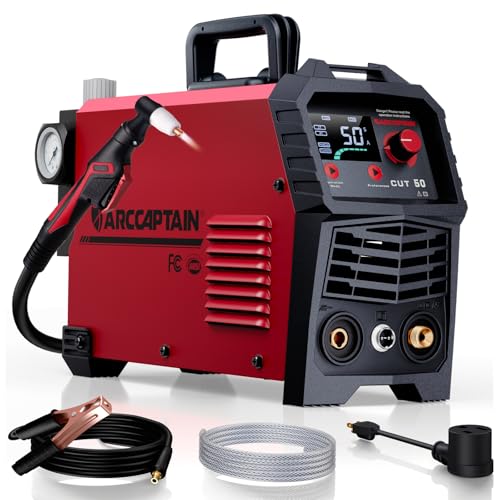
【Powerful Cutting Ability】Switch effortlessly between 110V and 220V for home or workshop use. Achieve professional 1/2" clean cuts on steel, aluminum, and copper with advanced LGBT technology. Perfect for DIY projects and heavy-duty tasks. Recommended maximum cutting thickness: 12mm @ 35A / 110V / 55 PSl; 18mm @ 50A / 220V / 75 PSI. Note: Requires compressed air (compressor sold separately).
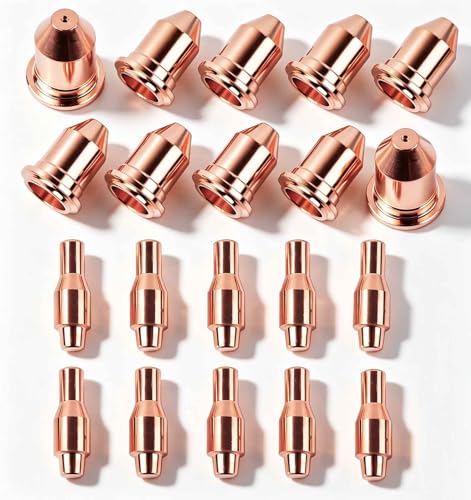
Consumable Kit for Harbor Freight Titanium 45A plasma cutter
Match the Cutter to Real Cutting Thickness
Manufacturers may list several thickness ratings:
- Recommended or quality cut: The thickness the machine can cut at a practical speed with acceptable edge quality.
- Maximum cut: A slower cut near the upper useful limit.
- Severance: A very slow separation cut, not the thickness you should plan to cut routinely.
Choose a machine whose recommended capacity covers the thickest material you cut regularly. Leave extra capacity for painted, rusty, expanded, or stacked material and for jobs that require faster travel or a higher duty cycle.
Check Duty Cycle at the Correct Output
Duty cycle is the percentage of a stated time period—commonly 10 minutes—that the machine can cut at a specified output and ambient temperature before cooling is required. A 50% duty cycle at 45A means five minutes of cutting followed by five minutes of cooling under the stated test conditions. Lower output settings may permit a longer duty cycle.
Confirm the Entire Shop Setup
- Electrical supply: Correct voltage, phase, input current, circuit protection, receptacle, and panel capacity.
- Air supply: Required scfm and pressure, plus filtration or drying.
- Ventilation: Local exhaust or other controls suitable for the metal and coating being cut.
- Portability: Machine weight, torch-lead length, generator compatibility, and compressor requirements.
- Consumables and support: Availability of genuine cartridges, electrodes, nozzles, shields, service information, and repair support.
Impact of Power Consumption on Electricity Bills
A plasma cutter can draw several kilowatts while the arc is on, but hobby and repair work often consists of short cuts separated by measuring, repositioning, grinding, and setup. The most useful cost estimate therefore uses actual arc-on time rather than total time spent in the shop.
Understanding Power Usage Costs
Use this formula:
Input kW × arc-on hours × electricity rate = cutting-energy cost
Suppose a cutter uses approximately 7.8kW at a rated operating point and electricity costs $0.18 per kWh. One full hour of arc-on time would cost about $1.40 for the cutter itself. Twenty minutes of arc-on time would cost about $0.47. Add the energy used by the air compressor, fume extractor, lights, and other equipment for a fuller shop-cost estimate.
Idle consumption is much lower than full cutting power. Manufacturer data list approximately 14W at idle for the Powermax30 AIR and roughly 17–23W for certain Powermax45 SYNC configurations. Those figures are model-specific, so check the manual before using them in a detailed cost model.
Efficient Energy Management Tips
- Use the recommended supply voltage. A dual-voltage machine may provide better output and duty cycle on 240V than on a limited 120V circuit.
- Use the lowest output that makes a clean, complete cut. Excess amperage can widen the kerf and consume electrodes or cartridges faster without improving the result.
- Keep air clean and dry. Moisture, oil, or inadequate flow can shorten consumable life and reduce cut quality.
- Avoid excessive voltage drop. Use the shortest approved extension cord and the conductor size listed in the manual.
- Track arc-on time. It gives a more realistic estimate than counting every hour the power switch is on.
Modern inverter power supplies can be efficient, but do not assume every inverter saves a fixed percentage compared with an older transformer machine. Compare published efficiency, idle power, power factor, duty cycle, and cut speed for the exact models.
Upgrading Electrical Systems for Plasma Cutter Use
An electrical upgrade may be needed when the required voltage is unavailable, the panel lacks capacity, the existing circuit is shared, or the run is too long for acceptable voltage drop. Upgrades should be based on the machine manual and a site-specific electrical assessment—not a universal wire-size chart.
Circuit Breaker Capacity Requirements
A qualified electrician should verify the following:
- The service and panel can support the cutter, compressor, ventilation, welder, and other simultaneous loads.
- The breaker or fuse size and type match the manufacturer’s installation table and local code.
- The conductors are suitable for the circuit rating, termination temperature, installation method, ambient conditions, and run length.
- The receptacle, plug, grounding path, and disconnecting means are compatible with the machine.
- The measured supply voltage remains within the machine’s permitted range while cutting.
Do not assume that 8 AWG always belongs on a 40A circuit or that 6 AWG always belongs on a 50A circuit. Conductor ampacity changes with material, insulation, temperature rating, bundling, installation method, termination limits, and local code. Long runs may also require larger conductors to control voltage drop.
Dedicated Outlet Installation
A dedicated branch circuit is often the cleanest setup because it prevents a compressor, heater, grinder, or other load from sharing the cutter’s available current. Whether it is mandatory depends on the equipment instructions and applicable code.
Some 240V shop cutters use a NEMA 6-50 connection. The Powermax45 SYNC’s North American single-phase power cord, for example, uses a NEMA 6-50P plug. That plug format does not replace the manual’s input-current and protective-device specifications, and adapters should not be used unless the manufacturer permits them and the circuit is correctly configured.
Extension Cords and Voltage Drop
A long or undersized extension cord can reduce input voltage, increase heating, cause fault codes, and limit cutting performance. Use the cord table for the exact machine. As one model-specific example, the Powermax45 SYNC manual recommends 8 AWG copper for up to 50 feet at 200–240V single-phase, 6 AWG for 50–100 feet, and 4 AWG for 100–150 feet. Those sizes are not universal and should not be copied to another machine without checking its manual.
Generator, Solar, and Off-Grid Power
Size an engine-driven generator from the manufacturer’s generator table, not from the cutter’s output amps. Hypertherm lists 5.5kW for full 30A output from the Powermax30 AIR and 10kW for full 45A output from the Powermax45 SYNC. Smaller generators may require a reduced output setting and may not support maximum arc stretch.
A solar-battery system must provide the same stable voltage, phase, continuous power, and short-duration operating peaks as a suitable generator or utility circuit. The inverter’s continuous rating, battery discharge capability, cable losses, and compressor load all matter. A small portable “solar generator” should not be assumed suitable merely because its advertised wattage exceeds a rough average-power estimate.
Safety Considerations for High-Power Equipment
Plasma cutting combines electrical shock, arc radiation, hot metal, fire, compressed air, fumes, gases, and noise hazards. Follow the machine manual, the material’s safety information, and workplace requirements. The Occupational Safety and Health Administration’s welding and cutting guidance summarizes major hazards and control methods.
Warning: Do not cut sealed containers, unknown tanks, pressurized vessels, or metal coated with hazardous substances until the hazards are identified and controlled. Remove combustibles, keep an appropriate fire extinguisher nearby, and provide a fire watch when conditions require one.
- Electrical safety: Keep gloves, clothing, torch parts, and the work area dry. Disconnect input power before opening the machine or servicing internal components.
- Eye and face protection: Use a helmet or face shield with the shade specified by the machine manual and applicable workplace rules. OSHA’s eye and face protection standard includes filter-lens guidance for plasma arc cutting.
- Fume control: Use local exhaust or other effective ventilation. OSHA’s ventilation requirements for welding and cutting call for controls that keep fumes and gases within safe limits and address confined spaces and toxic metals.
- Hearing protection: Measure or assess exposure rather than buying protection “rated for 100 dB.” OSHA and NIOSH use time-weighted exposure criteria, and NIOSH advises choosing protection that reduces exposure to a suitable protected level.
- Protective clothing: Wear flame-resistant clothing, suitable gloves, and footwear that protect against sparks, hot slag, and sharp metal.
- Compressed air: Inspect hoses and fittings, use the specified pressure range, and keep oil and moisture out of the plasma-gas system.
Noise varies with the machine, amperage, cutting process, workpiece, table, room, and distance. NIOSH recommends limiting occupational noise exposure to 85 dBA over eight hours and using hearing protection as part of a broader noise-control plan. At very high exposures, double hearing protection may be appropriate under a formal program.
Comparing Plasma Cutter Models and Their Power Needs
Model specifications change, so compare current manuals rather than relying on an older product name or reseller listing. The Powermax45 XP, for example, was last manufactured in March 2024 and is no longer sold new by Hypertherm; the manufacturer continues legacy support, while the Powermax45 SYNC is the current model in that class.
| Specification | Powermax30 AIR | Powermax45 SYNC |
|---|---|---|
| Input supply | 120–240V, single-phase | 200–240V single-phase; selected higher-voltage three-phase configurations |
| Rated input current | About 29A at 120V or 15A at 240V at the stated 2.5kW output condition | About 40A at 200V, 33A at 240V single-phase, or 10A at 480V three-phase at rated output |
| Output range | 15–30A | 9–45A |
| Manufacturer circuit guidance | Circuit capable of 120V/20A or 240V/20A, with appropriately sized time-delay protection | 50A time-delay fuse for listed 200–240V single-phase configurations; 20A time-delay fuse for listed 380–480V three-phase configurations |
| Duty cycle | 35% at 30A on 240V; 20% at 30A on 120V under stated conditions | 50% at 45A, 60% at 41A, and 100% at 32A at 40°C under stated conditions |
| Recommended cut example | 5/16-inch mild steel at the manufacturer’s stated speed | 5/8-inch mild steel at the manufacturer’s stated speed |
| Full-output generator example | 5.5kW | 10kW |
These figures illustrate why output amps, input amps, and circuit protection must be read separately. They also show that a higher supply voltage can reduce input current for the same class of output, while three-phase versions may draw much less line current than single-phase versions.
Products Worth Considering

50A to 30A Welder Adapter Cord: this adapter cord converts a 50amp 6-50P plug to a 30amp l6-30R locking receptacle, allowing you to easily connect the 30Amp welder and plasma cutter or other devices with a L6-30P plug to 50Amp welder outlet or other devices with a 6-50R outlet without changing the power cable; Max 240V 30 Amp, cannot transform to 120V

50A to 30A Welder Adapter Cord: this adapter cord converts a 50amp 6-50P plug to a 30amp l6-30R locking receptacle, allowing you to easily connect the 30Amp welder and plasma cutter or other devices with a L6-30P plug to 50Amp welder outlet or other devices with a 6-50R outlet without changing the power cable; Max 240V 30 Amp, cannot transform to 120V

Note: Indoor Dry Unless Protected By Additional Means. Before purchasing, please ensure that the plug prong type matches your intended use to guarantee compatibility. The NEMA 6-50R outlet is specifically designed for the NEMA 6-50P plug. Other 50A plug types, such as 10-50P, 11-50P, 14-50P, and 15-50P, are not compatible and should not be used with this outlet
Tips for Efficient Plasma Cutter Operation
Efficient plasma cutting depends on stable input power, correct air flow, sound consumables, suitable travel speed, and an output setting matched to the job. More amperage is not always better, especially on thin material or detailed shapes.
- Verify input power before cutting: Confirm the correct voltage and that high-draw equipment is not overloading a shared circuit.
- Set output for the material: Use enough amperage to achieve full penetration at a controlled travel speed without excessive kerf or dross.
- Respect duty cycle: Allow the system to cool when the rated arc-on period is reached.
- Maintain correct air pressure and flow: Check pressure while gas is flowing, not only while the machine is idle.
- Inspect consumables: Replace electrodes, nozzles, cartridges, or shields according to wear criteria in the manual rather than an invented hourly interval.
- Keep the work clamp connection clean: Attach it to clean metal as close to the cut as practical.
Power-Related Troubleshooting
| Symptom | Possible Cause | Safe Next Step |
|---|---|---|
| Breaker or fuse opens during cutting | Shared load, wrong protective device, low supply voltage, damaged cord, or circuit that does not match the manual | Stop using the machine; compare the circuit with the manual and have an electrician inspect repeated trips |
| Input-voltage fault or unstable generator operation | Generator too small, eco mode causing voltage sag, long cord, poor connection, or incorrect phase | Use the manufacturer’s generator rating, approved cord size, and correct supply configuration |
| Arc starts but will not cut cleanly | Output too low, travel too fast, inadequate air flow, worn consumables, poor work connection, or low input voltage | Check air, consumables, work clamp, output setting, and measured supply voltage |
| Thermal indicator or shutdown | Duty cycle exceeded, blocked airflow, high ambient temperature, or internal fan problem | Leave power on if the manual directs so the fan can cool the unit; clear vents and wait for the indicator to reset |
| Compressor cycles excessively or pressure falls | Compressor undersized, leaks, clogged filter, wet air, or hose restriction | Verify required scfm at pressure, repair leaks, service filtration, and avoid sharing an inadequate compressor |
Frequently Asked Questions
Can plasma cutters operate on solar power systems?
Yes, you can operate a plasma cutter from a properly engineered solar-battery system. The inverter and battery bank must provide the machine’s required voltage, phase, continuous input power, and operating peaks, plus any compressor load. Use the manufacturer’s generator rating as a practical starting point and have the off-grid system designed for the full load.
What is the noise level of a plasma cutter?
There is no single reliable decibel figure for every plasma cutter. Exposure changes with output, process, workpiece, table, room, distance, and measurement method. Assess the actual work area and follow OSHA or local workplace rules. NIOSH recommends controlling occupational exposure to 85 dBA over eight hours and choosing hearing protection that provides suitable attenuation.
How do temperature and humidity affect plasma cutter performance?
Operate the machine within the temperature and humidity limits in its manual. Heat can reduce duty cycle or trigger thermal protection, while cold can affect condensation and components. Humidity is especially harmful when it introduces water into the compressed-air system. Use clean, dry, oil-free air and maintain filters, dryers, and drains.
Are portable plasma cutters suitable for remote locations?
Yes. Compact inverter cutters can be practical for field repair, but portability includes more than machine weight. Confirm generator capacity, voltage, approved extension-cord size, torch-lead length, compressed-air supply, ventilation, fire control, and weather protection. A model with an integrated compressor can simplify remote work.
What maintenance is required for efficient plasma cutting?
Follow the exact schedule in the operator manual. Typical checks include inspecting consumables and the torch, verifying air pressure and flow, draining moisture, cleaning or replacing filters when needed, checking hoses and cables, keeping vents clear, and inspecting the work clamp. Replace consumables based on wear or cut quality—not a universal number of cutting hours.
Can I run a plasma cutter on a standard 120V, 15A outlet?
Only when the manufacturer explicitly permits that configuration. Some dual-voltage cutters can start on a 120V, 15A circuit but restrict output or recommend a 20A circuit for proper operation. The Powermax30 AIR manual, for example, does not recommend a 120V, 15A circuit for normal operation. Never defeat the plug or replace a breaker without confirming the wiring and manual requirements.
What size breaker does a plasma cutter need?
The required breaker or fuse is model- and voltage-specific. Find the input-current and circuit-protection table in the manual, then have an electrician verify the conductor, receptacle, grounding, panel capacity, and local code. Do not use the torch’s output-amperage number as the breaker size.
Can I use an extension cord with a plasma cutter?
Use an extension cord only when the manual permits it. The cord must have the correct voltage rating, conductor size, grounding arrangement, connector, and maximum length. Longer cords usually require larger conductors to limit voltage drop. Uncoil the cord fully, protect it from hot metal and traffic, and stop if the plug or cord becomes hot.
Conclusion
Plasma cutter power requirements cannot be determined from cutting-output amperage alone. Start with the model’s input voltage, phase, rated input current, circuit-protection table, duty cycle, plug, and air requirement. Then compare those figures with your panel, branch circuit, compressor, extension cord, or generator.
A compact 30A-output cutter may operate from a suitable 120V or 240V circuit, while a 45A-output shop unit can require a substantially larger 240V single-phase circuit or a compatible three-phase supply. The correct answer is always model-specific. Following the manual and using a licensed electrician for circuit changes protects the equipment, wiring, and people in the shop.
Sources
- Hypertherm Powermax45 SYNC Operator Manual, Revision 3 — input/output ratings, circuit protection, cords, generators, air, duty cycle, safety, and maintenance.
- Hypertherm Powermax30 AIR Operator Manual — dual-voltage circuit requirements, generator ratings, extension cords, idle power, and operating limits.
- Hypertherm Powermax45 XP Legacy Product Page — March 2024 end-of-manufacture status and continuing support.
- OSHA: Welding, Cutting, and Brazing—Hazards and Solutions — electrical, fume, radiation, burn, and fire hazards.
- OSHA Standard 1926.353: Ventilation and Protection in Welding, Cutting, and Heating — local exhaust, confined-space, and toxic-metal controls.
- NIOSH: Provide Hearing Protection — noise-exposure control and appropriate hearing-protection selection.