A welder’s duty cycle tells you how long you can weld in a 10-minute window before the machine needs cooling time. A 30% duty cycle at 200 amps means you can weld for 3 minutes, then let the welder rest for 7 minutes. This rating matters because too much heat can trip thermal protection, reduce arc stability, and hurt weld quality. Once you understand duty cycle, you can choose better settings, plan longer jobs, and protect your machine.
What’s in This Article
- What Is Duty Cycle on a Welder?
- Why Duty Cycle Matters for Weld Quality
- How Is Welder Duty Cycle Calculated?
- What Changes a Welder’s Duty Cycle Rating?
- How Duty Cycle Differs in MIG, TIG, and Stick
- What Duty Cycle Do You Need for Your Work?
- How to Extend Your Welder’s Duty Cycle
- How Testing Standards Affect Duty Cycle Ratings
- How to Read Duty Cycle Specs Correctly
- Frequently Asked Questions
- Conclusion
Quick Answer
Duty cycle is the amount of time your welder can run in a 10-minute period at a stated amperage. A 60% duty cycle means 6 minutes of welding and 4 minutes of cooling. Higher amps create more heat, so the duty cycle usually drops as output rises.
Key Takeaways
- Check duty cycle at the amperage you plan to use, not only the highest listed output.
- Use the 10-minute rule to plan welding time and cooling time before each job.
- Lower amperage, clean vents, and proper cooling can help your welder run longer.
- Thicker metal, hot air, and blocked airflow can reduce real-world duty cycle.
- Respecting duty cycle helps protect the welder and keep weld quality more consistent.
What Is Duty Cycle on a Welder?
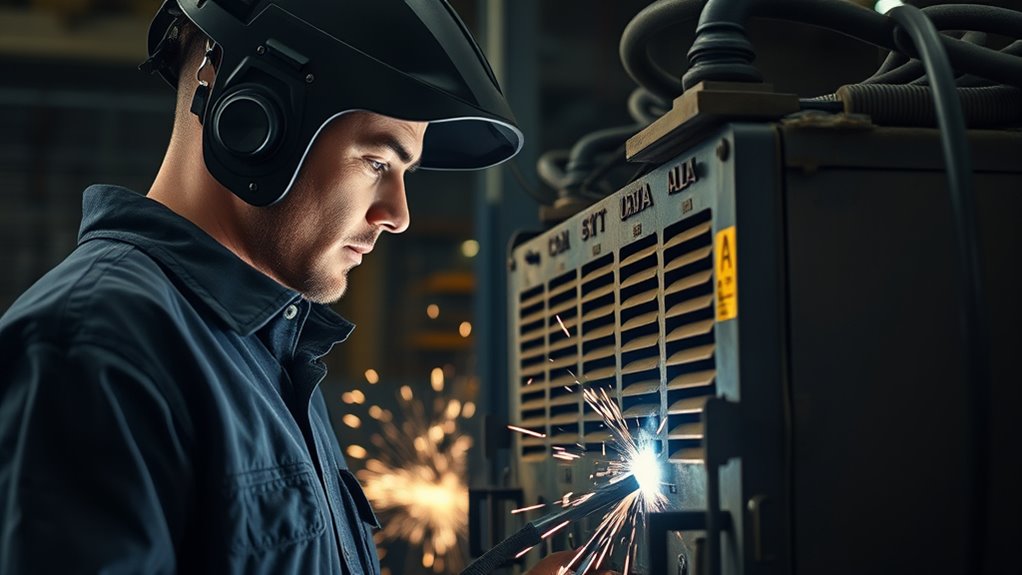
A welder’s duty cycle is the percentage of a 10-minute period that the machine can run at a specific amperage before it needs to cool down. You use this rating to know how long you can weld before the unit must rest.
For example, a 30% duty cycle at 200 amps lets you weld for 3 minutes, then cool for 7 minutes. Higher amperage usually shortens the duty cycle because the machine creates more heat.
That relationship matters because you need a welder that matches your workload, not one that slows your pace. When you understand duty cycle, you can choose equipment that supports steady production and better welder efficiency.
Choose a welder that matches your workload, supports steady production, and improves efficiency.
Knowing the importance of duty cycle can help you judge machine performance under changing conditions. You’re not guessing. You’re managing heat, output, and operating time with care.
Reading the rating helps you work safely, avoid overload, and keep the machine ready for the next pass.
Why Duty Cycle Matters for Weld Quality
Duty cycle directly affects weld quality because it controls how long you can keep stable heat input before the machine overheats. When you exceed that limit, overheating effects can reduce weld penetration and make bead consistency drift.
You may get shallow fusion, uneven bead profiles, and weaker joints that can’t carry load as intended. If your welder has a 30% duty cycle, you can run only briefly at full amperage before pausing to cool.
That limit means you may need to split larger jobs into smaller sections. The interruption can raise the chance of visible inconsistency, especially if you restart poorly or change travel speed.
A higher duty cycle, such as 60% or more, lets you weld longer without stopping. That supports steadier heat input and more repeatable results.
Understanding your flux core MIG welding settings can also help you improve performance and outcomes.
When you respect the rating, you protect weld integrity, keep the arc stable, and produce stronger welds in demanding work.
How Is Welder Duty Cycle Calculated?
To calculate welder duty cycle, measure how long the machine can weld within a standard 10-minute period before it needs to cool.
Then compare welding duration to the full cycle, including cooling periods, and convert that ratio into a percentage.
Use this formula: Duty Cycle = (Welding Time / (Welding Time + Cooling Time)) x 100%.
For example, if you weld for 4 minutes and allow 6 minutes for cooling, your duty cycle is 40%. This means the machine can operate 40% of each 10-minute window without overheating.
You should read ratings at specific amperages, since the same welder may deliver different duty cycles as output changes.
EN60974-1 testing helps verify the rating under standardized conditions. That gives you a more useful number when you plan work, manage heat, and choose equipment that supports longer welding with fewer pauses.
Understanding maximum fillet weld size is also useful when you want welds to stay within safe design limits.
What Changes a Welder’s Duty Cycle Rating?
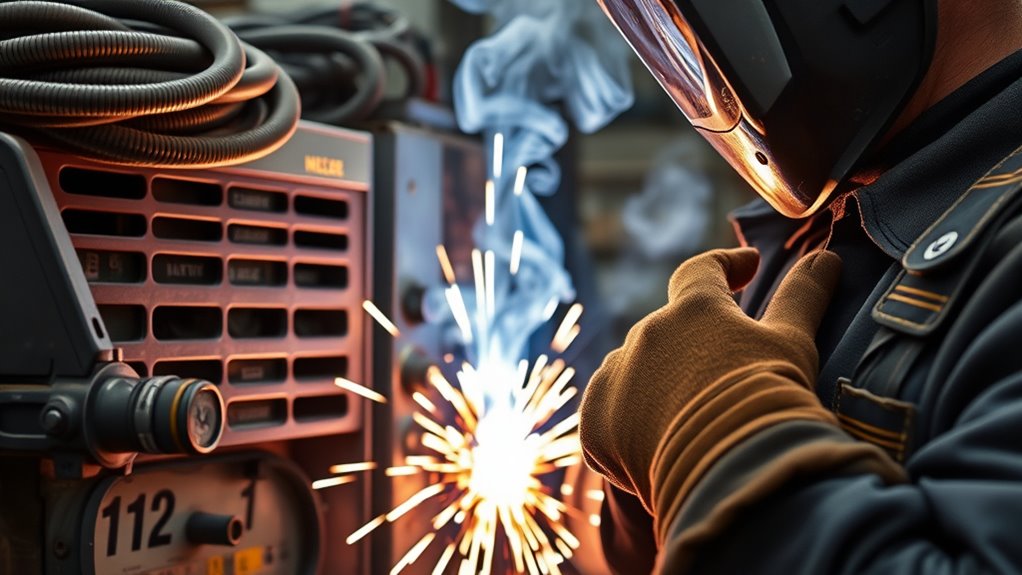
Several operating factors change a welder’s duty cycle rating. Amperage usually has the biggest effect because higher output creates more heat and shortens safe weld time.
You’ll see the amperage effect clearly when one unit runs at about 30% duty cycle at 200A, while the same machine may reach 60% at 145A. Always confirm this on your model’s spec sheet.
Material thickness matters too. Thicker plate needs more heat, so it pushes the thermal load higher.
Your environment also matters. Hot ambient air limits heat rejection, so the welder may recover more slowly.
Cooling efficiency can shift the rating as well. Strong fans, clean vents, and better heat sinks move heat away faster and support longer weld intervals.
Input voltage can influence performance, especially when the welder cannot draw enough stable power for the selected output.
To protect your machine and your work, match settings to the job, manage heat, and respect the limits the manufacturer gives you. Also review the duty cycle specifications for your process before you start.
Warning: Don’t keep welding after the machine shows thermal overload, because excess heat can damage parts and weaken your work.
How Duty Cycle Differs in MIG, TIG, and Stick
MIG, TIG, and Stick welding each handle heat differently, so their duty cycles don’t compare in the same way. Each process affects runtime, cooling needs, and arc control.
| Process | Duty cycle traits |
|---|---|
| MIG | Often higher on production machines because continuous wire feed supports longer runs |
| TIG | Often lower at high output because precise work needs tighter heat control |
| Stick | Variable, with shorter runtime at higher amperage and on thicker material |
In a duty cycle comparison, MIG advantages often come from its continuous wire feed. That can support longer runs and steady output in production work.
TIG welding often uses lower amperage, but it also demands strong heat control for clean welds. Stick welding can work well, but its limits become clearer on thick material where heat builds fast.
When you choose a machine, read the rating as a measure of how long you can keep welding before the unit must cool. That lets you work with more control and less interruption.
Understanding the duty cycle traits of each welding process can help you select the right welder for your project needs.
What Duty Cycle Do You Need for Your Work?
For light welding projects and short repairs, a 20% to 40% duty cycle may work if you weld in short bursts. A 60% duty cycle gives you 6 minutes of arc time in a 10-minute cycle, which can suit hobby work and regular shop tasks.
If you expect long welds or larger fabrication, a 30% duty cycle at high amperage may leave you waiting after only 3 minutes of welding. That can slow production.
In industrial settings, a 100% duty cycle supports uninterrupted operation at the rated output. You still need to follow the manufacturer’s airflow and power requirements.
Understanding machine settings can help you optimize your duty cycle based on the material you’re welding.
When selecting equipment, check the manufacturer’s specifications at the amperage you’ll actually use. Also factor in material thickness and ambient temperature because they can reduce effective duty cycle in real use.
Choosing correctly helps you keep your work moving without pushing the machine beyond its safe range.
Products Worth Considering

【Super Mini & Easy Carry】WINBEGIN ARC125 stick welder is engineered with super mini size, portable, grab easily and exquisite. Dimension: 9"×13.5"×3.5", weight only 5.0 lbs. Comes with adjustable shoulder strap for hands-free carrying. Perfect for high-altitude work, scaffolding, or tight job sites. This mini welder fits in any truck or toolbox.

Advanced control module IGBT, improves the performance of the welding machine.

💪200A POWER & PORTABLE DESIGN: Weld metals up to 1/4" thick (0.06-0.2") including stainless steel, alloy steel, carbon steel, and copper. Compact size (8.6x4.1x5.5") and ultra-lightweight (5 lbs) with shoulder strap make it easy to carry for jobs anywhere – high altitude, indoors, or outdoors. Enjoy extended welding sessions without overheating, backed by a solid 60% duty cycle for professional results.
How to Extend Your Welder’s Duty Cycle
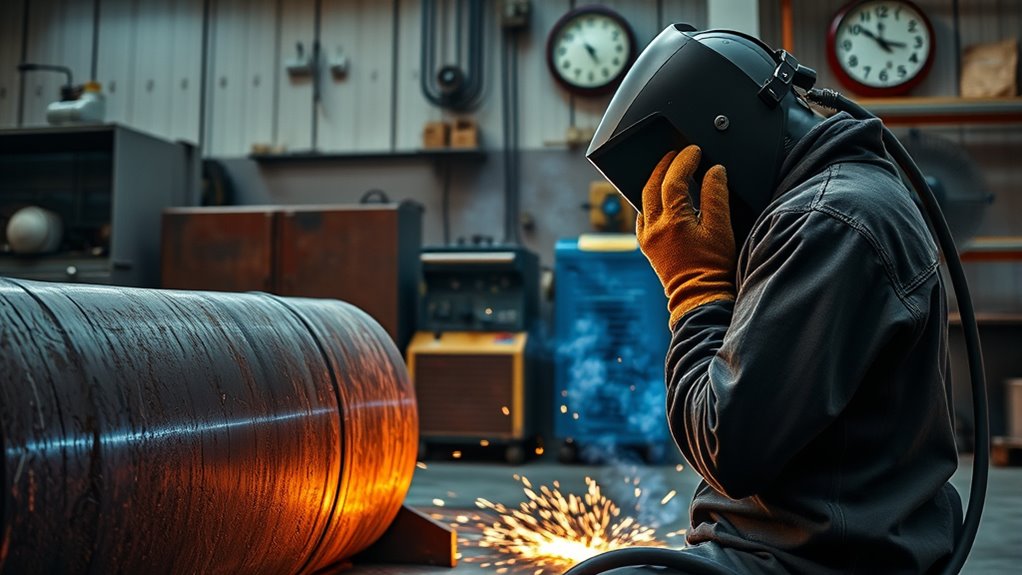
To extend your welder’s duty cycle, keep the machine in good condition by cleaning vents and cooling fans regularly. Schedule maintenance so you can catch worn parts before they cause heat problems.
You should also manage heat load by using the lowest practical amperage, working in a controlled space, and letting the welder rest between passes. These steps improve cooling efficiency and reduce overheating, which helps your welder run longer within its rated cycle.
Monitoring duty cycles also helps you stay within operating limits and protect the machine’s lifespan.
Products Worth Considering


APPLICATIONS: 5 inch EC fan can be used as a dryer fan for a wetsuit/boot/glove dryer; or as a replace fans for 220 volt welder; Great for ice makers, AV cabinets, pond air pump, air hockey table, CMH grow light ballasts, refrigerator compressor cooling or ventilation; circulate air in Basement window and exhaust projects
Proper Machine Maintenance
Schedule regular electrical inspections. Checking cables, terminals, and internal connections helps you catch wear before it causes failures that cut welding time short.
Always operate within the rated duty cycle and match amperage to the material thickness. Oversetting the machine raises thermal stress and shortens available run time.
You’ll also improve performance by keeping the workspace at a stable, moderate temperature. A cooler space supports more efficient cooling.
When you maintain the machine with care, you protect uptime, preserve output, and reduce needless interruptions.
Manage Heat Load
Managing heat load is one of the most direct ways to extend your welder’s duty cycle. Every amp you add increases thermal stress and shortens safe run time.
For disciplined heat control, set the lowest amperage that still achieves fusion, especially on thinner material. This helps preserve thermal efficiency.
| Action | Effect | Result |
|---|---|---|
| Lower amperage | Less heat | Longer duty cycle |
| Cooling breaks | Heat disperses | Safer operation |
| Clean vents | Better airflow | Reduced overload |
Check vents, fans, and thermal protection before each job. Dust or failed safeguards can trap heat fast.
When you respect cooling intervals and match output to the work, you protect your machine from needless strain and keep welding longer with better control.
Pro tip: If your welder keeps reaching thermal shutdown, lower the amps, improve airflow, or use a higher-duty-cycle machine.
How Testing Standards Affect Duty Cycle Ratings
Duty cycle ratings aren’t always directly comparable because the testing standard behind the number can change the result.
You need to examine testing methodologies before you trust a spec sheet. The test conditions can reshape the outcome.
Standard comparisons matter. EN60974-1 testing uses controlled thermal conditions, often listed at 40°C, so the rating reflects a repeatable load.
EN60974-1 testing at controlled thermal conditions helps make duty cycle ratings more useful across brands.
When a manufacturer tests under cooler or favorable conditions, the reported duty cycle can look better than it performs in your shop. That inflated claim may fail during real use.
You protect your buying decision by looking for recognized standards and model-specific charts. This helps you compare machines on a fair basis.
Without that discipline, a higher number can hide weaker real-world endurance. Understanding power supply requirements also matters because input power affects performance and efficiency.
How to Read Duty Cycle Specs Correctly
When you read a duty cycle chart, match the percentage to the exact amperage setting. The rating changes as output increases.
A 30% duty cycle at one current doesn’t mean the same machine can hold that rating at every current. Check the specific line in the spec table.
Use the operator manual to verify the chart and make sure the rating fits your welding process and material thickness. Proper zinc coating removal can also help you make cleaner welds on galvanized steel.
Reading Duty Cycle Charts
A duty cycle chart shows how long your welder can run at a given amperage before it needs cooling time. For accurate chart reading, find your amperage and match it to the duty cycle value.
This gives you the percentage limit at that output, so you can work within amperage limits without guessing.
| Amperage | Duty cycle |
|---|---|
| 150A | 60% |
| 200A | 30% |
A 200A, 30% rating means 3 minutes of welding in a 10-minute cycle. Higher amperage usually cuts duty cycle, so always check the manufacturer’s specs and any listed testing standard.
You’ll make better decisions and protect the machine’s thermal capacity.
Matching Amps To Duty Cycle
Matching amperage to duty cycle starts with reading the spec sheet for your exact welder model. The percentage changes as output rises.
Duty cycle shows how long you can weld in a 10-minute window at one amperage. A 30% rating means 3 minutes of arc time, then cooling.
Check the model-specific duty cycle chart before making amperage adjustments. For example, 200A may allow 30%, while 145A may allow 60% on the same machine.
Match amps to material thickness and task demands so you don’t overload the machine or stall progress.
Lower amperage often improves operational efficiency by extending weld time, while higher amperage shortens it.
When you plan each pass with care, you protect the welder, keep heat under control, and preserve steady work time.
Frequently Asked Questions
What Does a 60% Duty Cycle Mean on a Welder?
A 60% duty cycle means you can weld for 6 minutes in every 10-minute cycle at the rated output. The welder then needs 4 minutes to cool before you continue at the same load.
What Does 25% Duty Cycle Mean on a Welder?
A 25% duty cycle means your welder can run at rated output for 2.5 minutes in any 10-minute period. After that, you need about 7.5 minutes of cooling time.
Why Is the Duty Cycle Important?
Duty cycle matters because it helps you manage heat, protect the machine, and keep weld quality steady. It also helps you choose a welder that matches the length and power level of your work.
Does Duty Cycle Change When You Lower Amperage?
Yes, duty cycle usually improves when you lower amperage because the welder creates less heat. Check your model’s chart because each machine has its own rating curve.
Can You Weld After the Overheat Light Turns On?
You should stop welding when the overheat light turns on. Let the machine cool, check airflow, and restart only after the welder returns to normal operation.
Safety Disclaimer: This article is for informational purposes only and does not replace the operator manual, safety training, or advice from a qualified welding professional. Always follow your welder’s manual, wear proper protective gear, and stop work if the machine overheats or behaves abnormally.
Conclusion
Duty cycle tells you how long you can weld before your machine needs to cool down. Read the rating at the stated amperage, then match it to your material, process, and job length.
Use lower amps when practical, keep vents clean, and plan cooling breaks before the machine forces you to stop. When you respect the limit, your welder runs cooler, your arc stays steadier, and your work becomes more consistent.