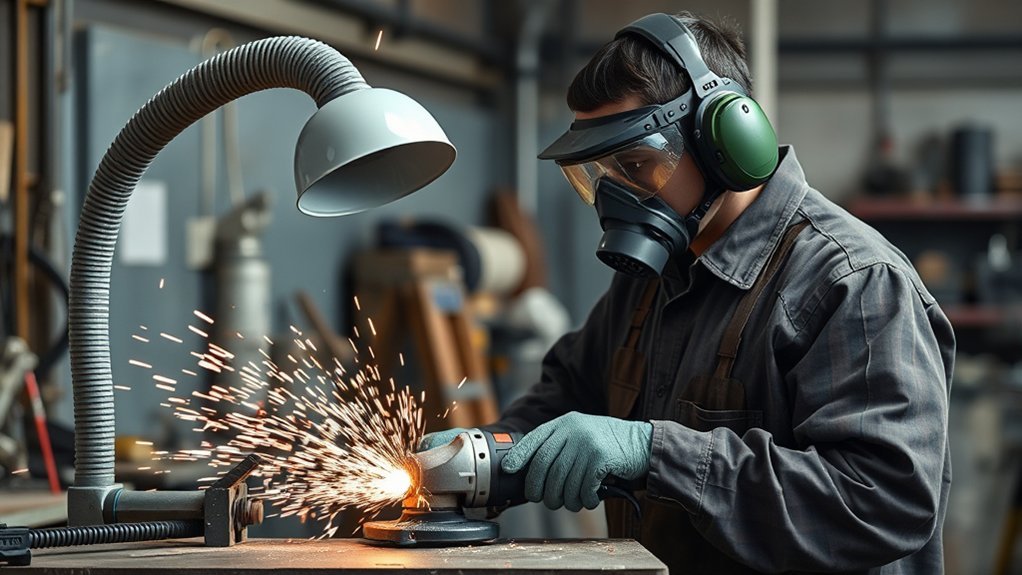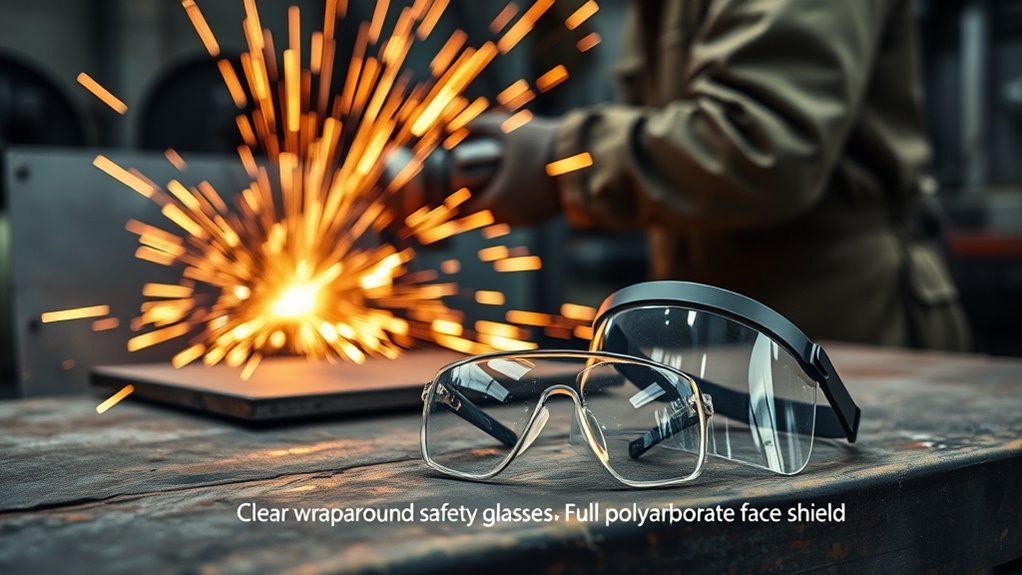
An angle grinder can throw sparks, abrasive grit, broken wheel pieces, wire fragments, and sharp material toward your face with little warning. The safest routine setup is impact-rated safety glasses or goggles under an impact-rated face shield. This guide explains how to choose, fit, inspect, and use that protection without overlooking the grinder controls that prevent debris in the first place.
Quick Answer
Yes. For routine angle grinding and cutting, wear impact-rated safety glasses or goggles as primary eye protection, then add an impact-rated face shield for broader face coverage. A shield alone is not enough because it is secondary protection and can leave the eyes exposed to particles entering around its edges.
Key Takeaways
- Wear impact-rated safety glasses or goggles under a face shield when grinding, cutting, or wire-brushing with an angle grinder.
- Treat the shield as secondary face protection, not as a replacement for primary eye protection.
- Look for ANSI/ISEA Z87.1-compliant equipment and an impact marking such as Z87+ or +.
- Use goggles instead of open safety glasses when fine dust can move around the lenses.
- Keep the wheel guard, side handle, correct accessory, and safe wheel speed in place because PPE cannot prevent every grinder accident.
- Inspect and clean all protective equipment before use, and replace anything that is cracked, deeply scratched, loose, melted, or difficult to see through.
At a Glance
| Time Required | About one minute to inspect and put on the PPE before each use |
| Difficulty | Easy, but the protection must match the debris, dust, and task |
| Tools Needed | Impact-rated safety glasses or goggles, an impact-rated face shield, and a clean lens cloth |
| Cost | Varies by brand, fit, coating, and whether prescription protection is needed; choose by rating and fit rather than price alone |
What’s in This Article
- Why Eye Protection Is Essential When Using Angle Grinders
- What Could Happen If You Don’t Protect Your Eyes?
- When to Use Eye Protection: Safety Glasses Explained
- Choose a Face Shield for Added Protection
- Safety Glasses, Goggles, or a Face Shield?
- Why You Should Use Both Safety Glasses and Face Shields Together
- OSHA and ANSI Requirements for Eye Protection
- How to Properly Fit and Maintain Your Eye Protection Gear
- Angle Grinder Controls That PPE Cannot Replace
- When Should You Replace Your Eye Protection Gear?
- Frequently Asked Questions
- Conclusion
- Sources
Why Eye Protection Is Essential When Using Angle Grinders
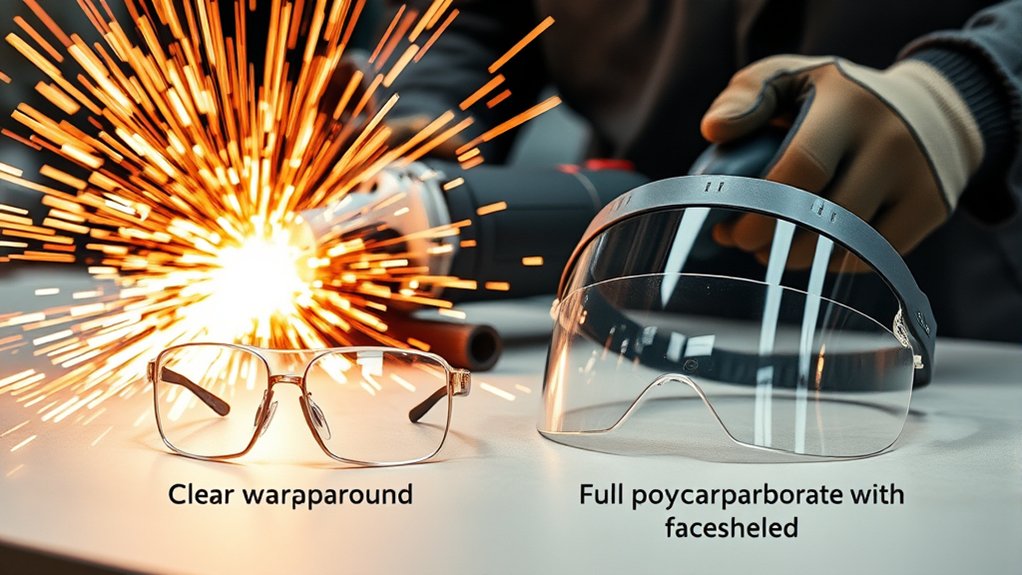
An angle grinder spins an abrasive wheel, cutting disc, flap disc, or wire accessory at high speed. Normal use can throw grit and workpiece particles. A damaged, incorrectly installed, or overspeed accessory can also break and send larger fragments toward the operator or a bystander.
OSHA’s eye-and-face protection standard requires appropriate protection where workers are exposed to flying particles and requires side protection where flying objects are a hazard. Although home users are not covered in the same way as employees at a workplace, the hazard does not change when the grinder is used in a garage.
Impact-rated safety glasses sit close to the eyes and provide the primary barrier against small particles. Goggles can provide closer coverage when dust may move around the edges of glasses. A face shield adds coverage for the forehead, cheeks, nose, mouth, and chin.
A face shield is added face protection. Wear it over impact-rated safety glasses or goggles rather than using it as your only eye protection.
What Could Happen If You Don’t Protect Your Eyes?
Grinding debris can scratch the cornea, lodge under an eyelid, or become embedded in the surface of the eye. Metal particles can also leave a rust ring that may need professional removal. Common warning signs include pain, redness, watering, light sensitivity, a gritty feeling, and blurred vision.
A face injury can also make you flinch or turn suddenly while the wheel is still moving. That reaction may lead to loss of control, kickback, contact with the wheel, or an injury to someone nearby.
The danger does not disappear when the visible sparks stop. Fine dust may remain in the air, on your eyebrows, or inside poorly fitting eyewear. Remove protective equipment carefully so collected grit does not fall into your eyes.
Warning: Stop the grinder if anything enters your eye. Do not rub the eye or try to remove an embedded object. Gently rinse loose dust with clean water. Seek urgent medical care after a high-speed metal strike, for a stuck particle, or when pain, redness, light sensitivity, or blurred vision continues. Follow the eye-injury guidance from the NHS or your local medical provider.
When to Use Eye Protection: Safety Glasses Explained
Impact-rated safety glasses are the primary minimum eye-protection layer for angle grinding. They should fit close to your face, include side protection, and remain secure when you look up, down, or to either side.
Do not treat a short job as a low-risk job. A cutting wheel, grinding wheel, or wire accessory can release a fragment as soon as it reaches operating speed. For routine angle-grinder cutting and grinding, use safety glasses under a face shield rather than relying on the glasses alone.
Common Uses for Safety Glasses
Impact-rated safety glasses help protect against particles created by tasks such as:
- Grinding metal: Abrasive grit, scale, weld material, and base-metal particles can leave the workpiece.
- Cutting metal: Cutting wheels produce sparks and can eject sharp fragments.
- Wire brushing: Individual wires can loosen or break away from a cup or wheel brush.
- Sanding and flap-disc work: Abrasive particles and coating residue can move toward the face.
- Drilling and general shop work: Chips can approach from the front or side.
Safety glasses are not the default choice for liquid chemical splashes. Use appropriately rated splash goggles where liquids can reach the eyes, then add a compatible face shield when wider facial protection is needed.
Limitations of Safety Glasses
Safety glasses protect the eyes but do not cover the rest of the face. Fit also varies from one person to another. A model that sits close to one face may leave large top, side, or bottom gaps on another.
An impact marking does not mean the glasses seal against fine dust. When grinding masonry, coatings, rust, or another material that creates drifting dust, properly selected goggles may provide better coverage.
| Limitation | What It Means for You |
|---|---|
| Gaps in coverage | Dust or particles may enter from the sides, top, or bottom if the fit is poor. |
| Limited face protection | Your cheeks, forehead, nose, mouth, and chin remain exposed to sparks and fragments. |
| No dust seal | Fine airborne dust may call for appropriately rated goggles rather than open spectacles. |
| No liquid-splash seal | Chemical preparation or cleaning may require splash-rated goggles and added face coverage. |
| Lens damage | Deep scratches, cracks, or clouding can interfere with wheel control and safe positioning. |
Choose a Face Shield for Added Protection
A face shield creates a wider barrier between your face and sparks, grit, wire pieces, and larger fragments. Choose a complete shield and headgear assembly intended for industrial eye-and-face protection. A general-purpose craft visor or unmarked clear plastic screen should not be assumed to provide grinder-impact protection.
The shield should cover from the brow area to below the chin and provide useful side coverage without striking your shoulders or chest when you turn your head. It should stay in the lowered position while you work and should not drift upward from vibration.
Products Worth Considering

SUPERIOR PROTECTION — Experience all-around face protection thanks to the curved design of this faceshield. The visor of this face guard is ANSI Z87+ certified, and up to 2x thicker for increased durability. Plus, you can comfortably wear your grinding face shield over prescription glasses.

INTERNATIONAL STANDARDS — Meets ANSI Z87.1 (US), CE EN166 (Europe), CSA Z94.3 (Canada), UKCA (United Kindom)

Full shield design provides built-in chin protection and extended top-of-head coverage; protects against falling or flying objects, impacts, chemical splashes and airborne debris; black matte color
Enhanced Facial Coverage
A properly fitted shield can reduce exposure to areas left open by glasses or goggles. It is particularly valuable during:
- Cutting-wheel use: Thin wheels can fail if they bind, twist, or are side-loaded.
- Heavy weld grinding: Large sparks and hot metal particles may travel toward the face.
- Wire-wheel or cup-brush use: Broken wires can behave like small needles.
- Overhead or awkward-position work: Gravity and nearby surfaces can redirect particles.
- Work near walls, fixtures, or clamps: Debris can bounce toward the operator instead of moving away.
Protection Against Debris
The shield should be clear enough for you to see the wheel edge, workpiece, guard, and spark path without leaning into a dangerous position. For ordinary grinding, a clear shield normally provides the best visibility. Use a tinted or filtered protector only when the specific hazard and manufacturer guidance call for it.
Fogging is also a safety issue. Some protectors carry an X marking for tested anti-fog performance under the ANSI/ISEA system. Even with an anti-fog product, stop and clean or adjust the equipment whenever your view becomes unclear.
Pro Tip: Put on your respirator, hearing protection, glasses or goggles, and face shield together before starting. Turn your head and look down at the workpiece to confirm that the equipment does not collide, shift, break its seal, or block your view.
Safety Glasses, Goggles, or a Face Shield?
The right setup depends on the material and the way debris is produced. The following table shows the practical role of each protector.
| Protector | Main Role | Best Use | Key Limitation |
|---|---|---|---|
| Impact-rated safety glasses | Primary eye protection | Metal grinding and cutting when they fit closely and have side protection | Do not seal against fine dust and do not protect the full face |
| Impact-rated goggles | Primary eye protection with closer coverage | Fine dust, overhead particles, or a face shape that leaves large gaps around glasses | May fog and still leave the cheeks, mouth, and chin exposed |
| Impact-rated face shield | Secondary eye protection and broader face protection | Routine grinding, cutting, heavy sparks, wire brushing, and larger-fragment hazards | Must be worn over primary safety glasses or goggles |
Note: Ordinary eyeglasses, sunglasses, and reading glasses are not substitutes for industrial safety eyewear. Use prescription safety glasses or goggles designed to fit over your prescription lenses without disturbing either pair.
Products Worth Considering

HIGH IMPACT FACE SHIELD - Sellstrom's Advantage Face Shield is ideal for various types of machinery, welding, cutting, grinding, woodworking, and other types of work that present potential hazards to the face

Five-position crown strap

ALL-AROUND IMPACT PROTECTION – Full face shield with wraparound visor blocks flying debris, sparks, and dust. Meets ANSI Z87.1+ standards for certified industrial safety.
Why You Should Use Both Safety Glasses and Face Shields Together
Safety glasses or goggles and a face shield perform different jobs. The first layer protects the eyes directly. The shield adds a wider barrier for the rest of the face and can intercept debris before it reaches the primary eyewear.
- Primary eyewear stays close to the eyes: It helps stop particles that travel around the edges of the shield.
- The shield covers more skin: It reduces direct exposure to the forehead, cheeks, nose, mouth, and chin.
- Two layers reduce single-point failure: If a fragment moves past one protector, the second layer may still intercept it.
- The shield helps protect the eyewear: It can reduce direct strikes and heavy contamination on the glasses or goggles beneath it.
OSHA’s PPE-selection guidance states that face shields should be worn over primary eye protection such as safety glasses or goggles. This is why lifting the shield while the wheel is still moving removes an important part of the protective system.
OSHA and ANSI Requirements for Eye Protection

OSHA and ANSI serve different roles. OSHA sets and enforces workplace requirements. ANSI accredits the process used to develop voluntary consensus standards, and the International Safety Equipment Association administers the Z87 committee for occupational eye-and-face protection.
As of July 2026, the newest edition is ANSI/ISEA Z87.1-2025. It addresses design, testing, markings, selection, care, and use for protectors intended for hazards such as impact, non-ionizing radiation, and liquid splash.
OSHA’s current 29 CFR 1910.133 regulation still identifies the 2010, 2003, and 1989 editions in its incorporated criteria. It also allows protective devices that an employer demonstrates are at least as effective as equipment made to those editions. That means the current 2025 standard is useful when selecting new equipment, but it is inaccurate to say that OSHA’s regulation directly names only the 2025 edition.
What the Z87 Markings Mean
Markings vary by protector and component. Check the product instructions rather than relying on packaging language alone. Common markings include:
- Z87: Indicates compliance with applicable requirements of the ANSI/ISEA Z87.1 standard.
- + or Z87+: Identifies impact-rated components or protectors under the marking system.
- D4: A dust-related marking.
- D5: A fine-dust-related marking.
- X: Indicates tested anti-fog performance.
- U, R, L, W, or S markings: Relate to specific optical-filter or special-purpose properties and should be selected only for the applicable hazard.
Do not assume that every part of a face-shield assembly has the same rating. Check the visor, carrier, and headgear instructions to confirm that the complete assembly is approved for the intended use.
How to Properly Fit and Maintain Your Eye Protection Gear
Protective equipment must remain secure, compatible, and clear throughout the task. Complete this check before the grinder is connected to power or fitted with a battery:
- Inspect the safety glasses or goggles: Look for cracks, deep scratches, bent arms, a stretched strap, damaged vents, or missing side protection.
- Check the fit: The eyewear should sit close to the face without painful pressure or large openings.
- Inspect the face shield: Check the visor, brow guard, hinges, adjustment knobs, and headband.
- Lower the shield fully: It should cover the face without touching the nose, glasses, respirator, or chest.
- Test compatibility: Turn your head, look down, and move through the position you will use while grinding.
- Confirm visibility: Clean away dust, fingerprints, and residue before starting.
- Check stability: Gently shake and tilt your head. Nothing should slide, lift, or lose its seal.
Prescription Glasses and Contact Lenses
People who need corrective lenses should use prescription safety eyewear or a protector made to fit over their regular glasses without moving either pair. OSHA specifically addresses this requirement for employees exposed to eye hazards.
Contact lenses do not provide impact protection and do not remove the need for safety glasses or goggles. Select the same primary and secondary protection that you would use without contacts, and consider whether dust or dryness may make contact-lens use uncomfortable during the task.
Cleaning and Storage
Blow or rinse away loose grit before wiping a lens so trapped abrasive particles do not create new scratches. Use the cleaning method recommended by the PPE manufacturer. Avoid strong solvents unless the manufacturer confirms that they are safe for the lens and coatings.
Store the glasses, goggles, and shield where the lenses cannot rub against tools, grinding dust, or sharp objects. Do not leave them face-down on a workbench.
Angle Grinder Controls That PPE Cannot Replace
Eye and face protection reduces injury severity, but it does not make an incorrectly assembled grinder safe. The OSHA guidance for portable abrasive-wheel tools and grinder manufacturers stress equipment selection, guards, inspection, and proper operation.
- Keep the correct guard installed: Position it between you and the wheel so it helps direct fragments and sparks away from your body.
- Use the side handle: Maintain a two-handed grip unless the tool manufacturer gives different instructions for a specific approved setup.
- Match the accessory to the task: Do not grind with the side of a cutting wheel or attach an accessory the manufacturer does not approve.
- Check the speed rating: The accessory’s rated speed must be at least equal to the grinder’s maximum marked speed.
- Inspect the wheel or accessory: Do not use a wheel that is cracked, chipped, badly worn, wet when it must remain dry, or damaged by a drop.
- Secure the workpiece: Use a suitable clamp or fixture instead of holding a small part in your hand.
- Control the spark path: Point sparks away from your body, other people, combustible materials, cylinders, hoses, vehicles, and finished surfaces.
- Keep out of the wheel plane: Stand to the side while the accessory reaches full speed and stop if you feel unusual vibration.
- Protect bystanders: Keep other people away or require equivalent PPE when they must enter the work area.
- Follow the exact manual: The applicable PPE and guard can change with grinding, cutting, sanding, or wire brushing. A manufacturer angle-grinder manual provides an example of operation-specific warnings.
Warning: Never remove the wheel guard merely to fit an oversized or unsuitable accessory. A face shield cannot compensate for a missing guard, an overspeed wheel, or a cutting disc that is being side-loaded.
Other PPE for Angle Grinding
Eye and face protection is only part of the setup. Depending on the material, tool, and workplace, you may also need:
- Hearing protection appropriate for the noise exposure.
- Close-fitting work gloves suitable for sparks, sharp edges, and the manufacturer’s instructions.
- Long sleeves and protective clothing that will not melt easily or hang near moving parts.
- Safety footwear suitable for hot fragments and falling workpieces.
- Respiratory protection or dust control selected for the material being ground, especially coatings, masonry, stainless steel, or unknown residues.
Remove loose jewelry, secure long hair, and avoid hanging cords, drawstrings, or loose clothing that could reach the rotating accessory.
When Should You Replace Your Eye Protection Gear?
Replace protective equipment whenever damage affects its strength, coverage, fit, or visibility. Do not wait for a cracked component to fail during use.
- Safety glasses: Replace them for cracks, severe scratches, distorted vision, missing side shields, bent frames, or loose arms.
- Goggles: Replace them when the lens is damaged, the strap no longer holds tension, the body is split, or the seal no longer fits your face.
- Face-shield visor: Replace it for cracks, deep scratches, heat damage, chemical damage, permanent clouding, or distortion.
- Headgear: Replace worn hinges, stripped adjustment knobs, broken brow guards, stretched bands, or parts that let the visor fall or lift unexpectedly.
Also follow any service-life or replacement instructions from the manufacturer. A shield may look acceptable from a distance while still giving a distorted view of the wheel or workpiece.
Note: Keep a clean spare set available. That makes it easier to stop and replace damaged equipment instead of finishing the job with poor visibility or incomplete protection.
Frequently Asked Questions
Do You Need a Face Shield When Using an Angle Grinder?
Yes. For routine grinding, metal cutting, and wire brushing, wear an impact-rated face shield over impact-rated safety glasses or goggles. The primary eyewear protects your eyes directly, while the shield adds coverage for the rest of your face.
Can a Face Shield Be Used Instead of Safety Glasses?
No. A face shield is secondary protection. Particles can enter around its edges, and a shield alone is not considered adequate primary eye protection for grinder-impact hazards. Wear rated safety glasses or goggles underneath it.
Does OSHA Require a Face Shield When Grinding?
OSHA requires employers to provide and ensure the use of appropriate eye or face protection based on the hazards. Its rules do not prescribe one identical PPE combination for every grinding task. However, OSHA guidance treats face shields as additional protection worn over primary safety glasses or goggles, and grinder hazards commonly justify using both.
What PPE Do You Need for Angle Grinding?
A typical setup includes impact-rated safety glasses or goggles, an impact-rated face shield, hearing protection, suitable close-fitting gloves, protective clothing, and safety footwear. Dust control or respiratory protection may also be needed. Follow the grinder manual and assess the material, accessory, and workspace.
Are Goggles Better Than Safety Glasses for Grinding?
Goggles can provide better coverage where fine dust, overhead debris, or large gaps around safety glasses are concerns. They are not automatically better for every user because fit, ventilation, fogging, and compatibility matter. Whichever primary protector you choose, wear the face shield over it.
Should You Wear a Face Shield for Cutting Metal With a Grinder?
Yes. Thin cutting wheels can throw sparks and sharp debris and may fracture if they bind, twist, or are used incorrectly. Wear a rated shield over primary eye protection, use the correct guard, secure the work, and never grind on the side of a cutting wheel.
Do Regular Prescription Glasses Count as Safety Glasses?
No. Ordinary prescription glasses are not industrial impact protection. Use prescription safety glasses that meet the applicable standard or goggles designed to fit over your prescription glasses without disturbing either pair.
What Rating Should an Angle-Grinder Face Shield Have?
Choose a complete industrial protector that complies with ANSI/ISEA Z87.1 and is marked or documented for impact protection. A plus sign, such as Z87+ or +, is associated with impact marking. Confirm the rating for the entire shield and headgear assembly in the manufacturer’s documentation.
Can You Wear Contact Lenses While Using an Angle Grinder?
Contact lenses do not provide impact protection. Anyone wearing contacts still needs properly fitted safety glasses or goggles under a face shield. Dust, dryness, or trapped particles may also make contacts uncomfortable, so stop if irritation develops.
Safety Disclaimer: This article provides general safety information and does not replace your tool manual, a workplace hazard assessment, jobsite rules, OSHA requirements, medical advice, or guidance from a qualified safety professional. Use PPE approved for your exact task and stop work when equipment is damaged, visibility is poor, or conditions are unsafe.
Conclusion
Your safest routine choice is to wear impact-rated safety glasses or goggles under an impact-rated face shield whenever you use an angle grinder. The glasses or goggles provide primary eye protection, and the shield protects more of your face from sparks and debris. Check the ratings and fit, keep the shield lowered, inspect the grinder and accessory, and never use PPE as a substitute for the correct guard, wheel, or operating method.
Sources
- OSHA 29 CFR 1910.133 — Eye and Face Protection — workplace requirements for flying-particle hazards, side protection, prescription lenses, and protective-device criteria.
- OSHA Eye and Face PPE Selection Guidance — explains that face shields should be worn over primary safety glasses or goggles.
- International Safety Equipment Association — Eye and Face Protection — identifies ANSI/ISEA Z87.1-2025 as the current eye-and-face protection standard.
- OSHA Safe Use of Portable and Hand-Held Power Tools — covers abrasive-wheel fragments, guards, accessory selection, inspection, speed ratings, and PPE.
- DEWALT Angle Grinder Instruction Manual — manufacturer guidance for operation-specific PPE, accessory ratings, inspection, and bystander protection.
- NHS Eye Injuries Guidance — first-aid precautions and signs that require medical evaluation.