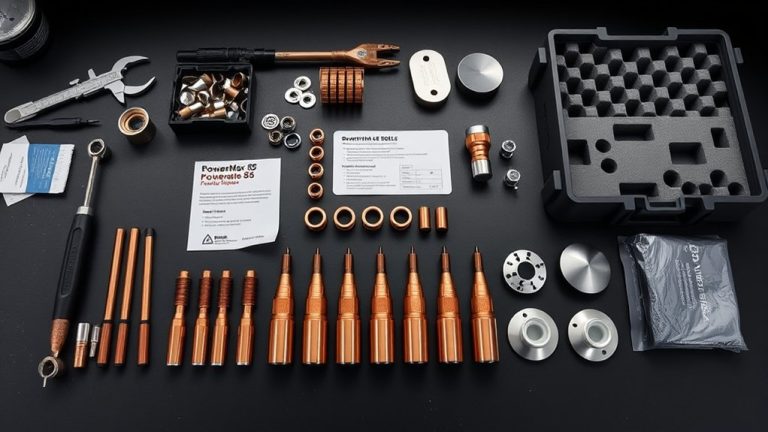
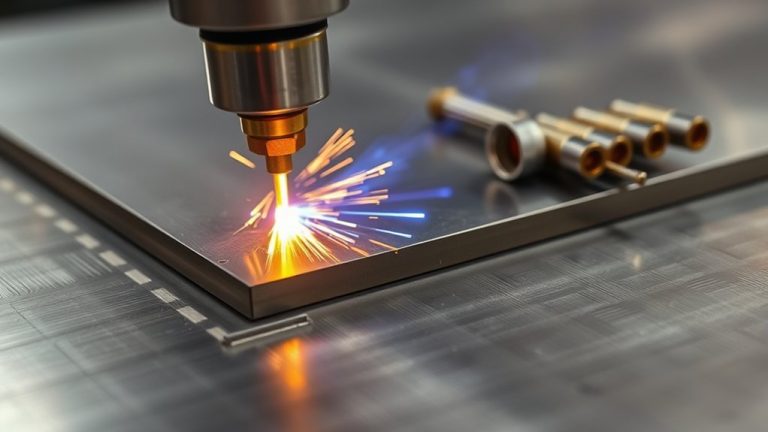
Like fitting gears in a clock, each consumable in your Powermax45 XP has a precise role and sequence. You’ll identify the correct part numbers—220777 CopperPlus electrode, 220941 drag cutting nozzle, 420536 retaining cap, and the swirl ring—then power down, vent gas, and swap worn components with proper alignment and seating. You’ll confirm compatibility, inspect wear patterns, and apply torque by hand. Miss one step, and performance drops—catch the critical checkpoints next.
Product Overview and Scope
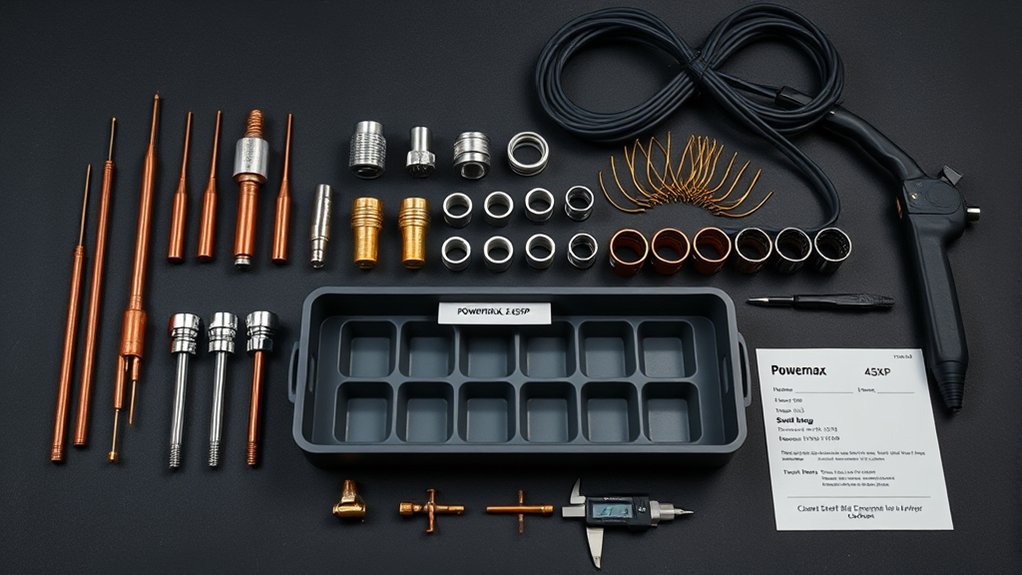
Although compact, the Powermax 45 XP Consumables Kit delivers a complete, purpose-built set of electrodes, nozzles, and retaining caps engineered for the Hypertherm Powermax45 XP plasma system. You’ll deploy it to maintain cutting efficiency on mild steel, stainless, and aluminum within the system’s rated capacity—clean cuts to 16 mm (5/8 in), severance to 29 mm (1-1/8 in).
Each component matches the torch interface and gas flow tolerances, so you avoid fit-up errors and arc instability.
Use this kit when preparing for scheduled changeouts or troubleshooting wear-related bevel, dross, or arc misfires. Follow the user manual for tool-free replacement: power down, vent gas, remove retaining cap, swap electrode and nozzle, re-seat the cap, and verify orifice alignment.
Inspect tips for erosion, discoloration, and bore distortion; replace at specified thresholds to protect consumable lifespan and torch hardware.
After installation, perform test cuts, confirm arc transfer, and adjust amperage and standoff to maintain stable kerf and consistent consumable lifespan.
Key Features and Technologies
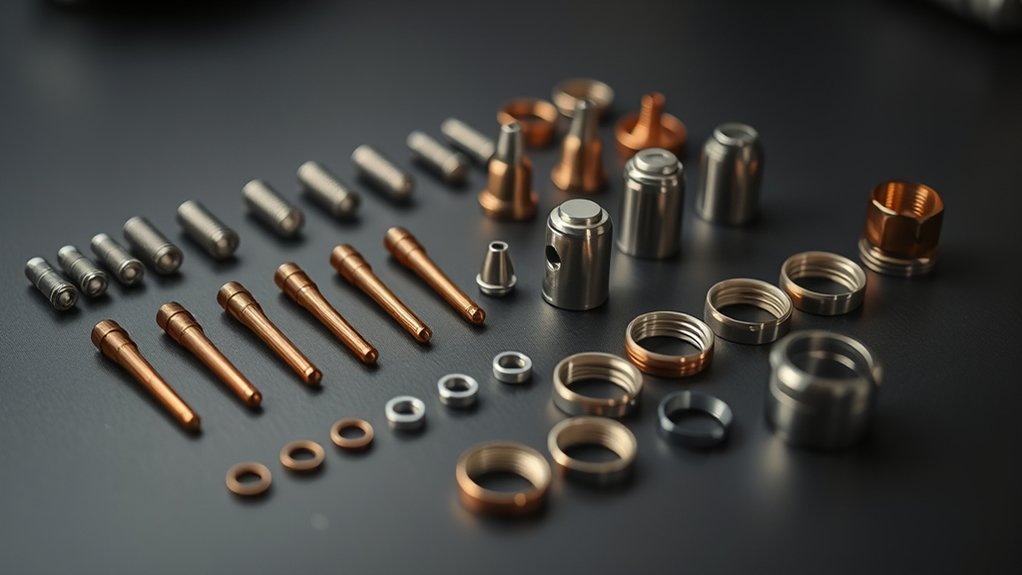
You’ll evaluate the TrueFlow cooling system first to confirm stable thermal control that preserves cut quality and consumable life.
Next, verify the advanced arc-start tech (SpringStart) initializes reliably, minimizing failed starts and preventing unplanned pauses.
Then document settings and results so you can standardize procedures across materials and amperage ranges.
Trueflow Cooling System
One core advantage of the Powermax 45 XP is its TrueFlow Cooling System, which regulates gas flow and heat to stabilize the arc and protect consumables.
To realize TrueFlow benefits, verify clean, dry air supply, confirm correct pressure, and purge the line before cutting. Cooling efficiency depends on unobstructed gas paths; inspect torch vents and the Vented Shield Design for debris and replace damaged shields promptly.
During setup, seat consumables firmly, torque to spec, and verify O-rings are intact to prevent leaks that elevate temperature.
Monitor duty cycle; pause when nearing limits to keep temperatures within the ideal band. By maintaining steady cooling, you’ll reduce double arcing, improve cut edge uniformity, and extend nozzle and electrode life, enabling longer intervals between kit replacements.
Advanced Arc-Start Tech
Even under variable shop conditions, the Powermax 45 XP’s Advanced Arc-Start Tech delivers fast, repeatable ignition and a stable pilot-to-cut transfer.
You’ll benefit from SpringStart Electrode Technology, which eliminates misfires by controlling electrode movement and timing the initial spark for consistent arc stability.
TrueFlow maintains uniform plasma gas delivery through startup, cooling the stack and preserving cut quality.
The Vented Shield Design vents excess energy, preventing double arcing and keeping the arc centered on the kerf.
An Advanced Axial Swirl Ring meters and spins gas precisely, aligning the plasma column, reducing nozzle wear, and increasing cutting efficiency.
To deploy: confirm correct electrode and swirl ring orientation, verify shield vent paths are unobstructed, set gas pressure per material, then test-fire.
Inspect arc column; adjust flow to maintain stability.
Kit Contents and Part Numbers
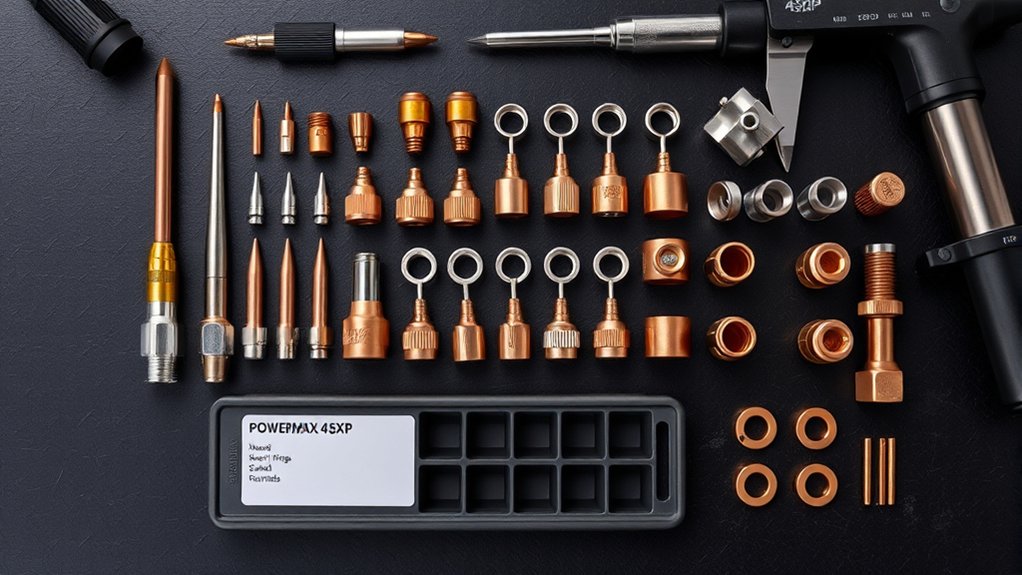
You’ll confirm the kit’s included consumables—CopperPlus electrode, FlushCut nozzle/shield assembly, and FlushCut swirl ring—and match them to your torch (Duramax or Hyamp).
Reference part numbers precisely: 220777 (CopperPlus Electrode), 420633 (FlushCut Nozzle/Shield Assembly), 420634 (FlushCut Swirl Ring).
Record these IDs in your maintenance log to guarantee correct reordering and configuration.
Included Consumable Components
This kit packages the core Powermax45 XP consumables—CopperPlus Electrode 220777, Drag Cutting Nozzle 220941, Retaining Cap 420536, and the matched swirl ring—each engineered for the system’s amperage and gas flow to maintain cut quality and consumable life.
You’ll install and replace parts tool-free, minimizing downtime while sustaining electrode durability and nozzle efficiency across varied metals and thicknesses.
- CopperPlus Electrode 220777: optimized hafnium insert for stable arc starts and consistent pit depth.
- Drag Cutting Nozzle 220941: precise orifice geometry for clean edges and controlled kerf.
- Retaining Cap 420536: maintains stack-up alignment and shields thermal load.
- Matched swirl ring: regulates gas swirl for balanced arc column and cooling.
- Procedure tip: inspect orifice wear, pit depth, and cap threads; replace at defined limits to preserve cut quality and torch life.
Key Part Numbers
Start with the key identifiers you’ll reference when ordering or maintaining the Powermax45 XP: CopperPlus Electrode 220777, FlushCut Retaining Cap 420536, FlushCut Retaining Ring 420540, FlushCut Swirl Ring 420634, and the FlushCut Nozzle/Shield Assembly 420633.
Verify each label before installation to prevent cross-matching errors—part number significance directly affects cut quality and consumable longevity.
Use 220777 to extend electrode service life under 45 A cutting, especially on steel up to 16 mm (5/8 inch).
Pair 420536 and 420540 to secure the stack; confirm torque per torch spec.
Install 420634 to maintain stable gas flow and arc swirl.
Fit 420633 for precision FlushCut with minimal kerf loss.
All listed parts suit compatible Hypertherm handheld and mechanized torches.
Compatibility and System Requirements
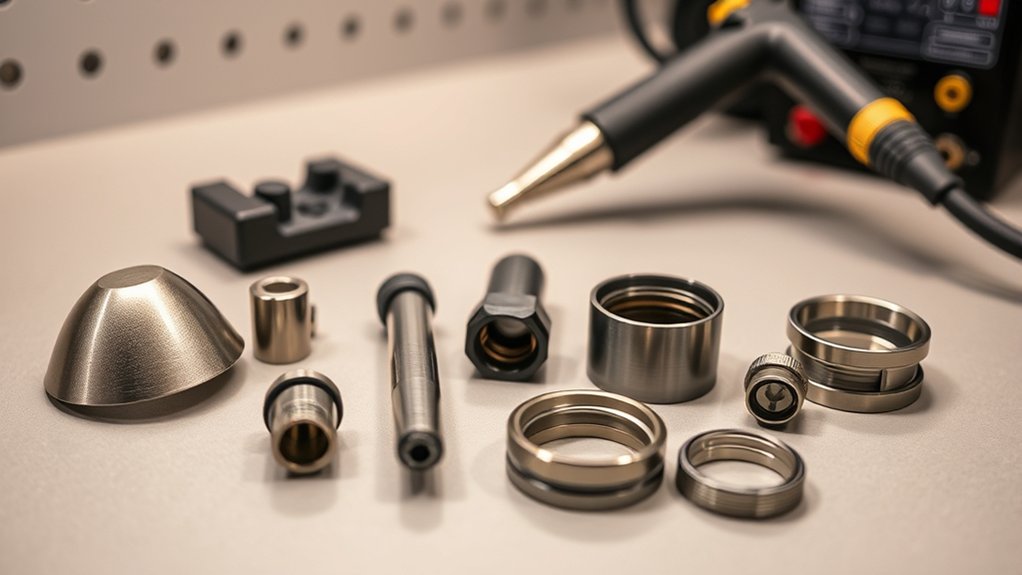
Although designed around Hypertherm’s Powermax45 XP plasma system, the Powermax45 XP Consumables Kit also fits Duramax and Hyamp torches for flexible deployment.
This compatibility overview guarantees you can standardize across common Hypertherm handheld and mechanized setups without tooling changes.
Meet these system requirements before operation to maintain cut quality and consumable life.
- Verify power: supply 200–240 V, single‑phase, 50–60 Hz to the Powermax45 XP input.
- Match torch family: use Duramax or Hyamp torches rated for Powermax45 XP operating currents.
- Confirm material scope: plan production cuts up to 16 mm (5/8 in); reserve up to 29 mm (1‑1/8 in) for severance.
- Use tool‑free change design: guarantee torch head accepts quick‑turn consumables for fast swaps and maintenance.
- Check duty cycle and air delivery: provide clean, dry air per Hypertherm spec and keep within machine duty cycle to avoid overheating.
When these conditions are met, the kit delivers predictable arc initiation, stable kerf, and consistent wear patterns across compatible torch platforms.
Step-by-Step Consumable Installation
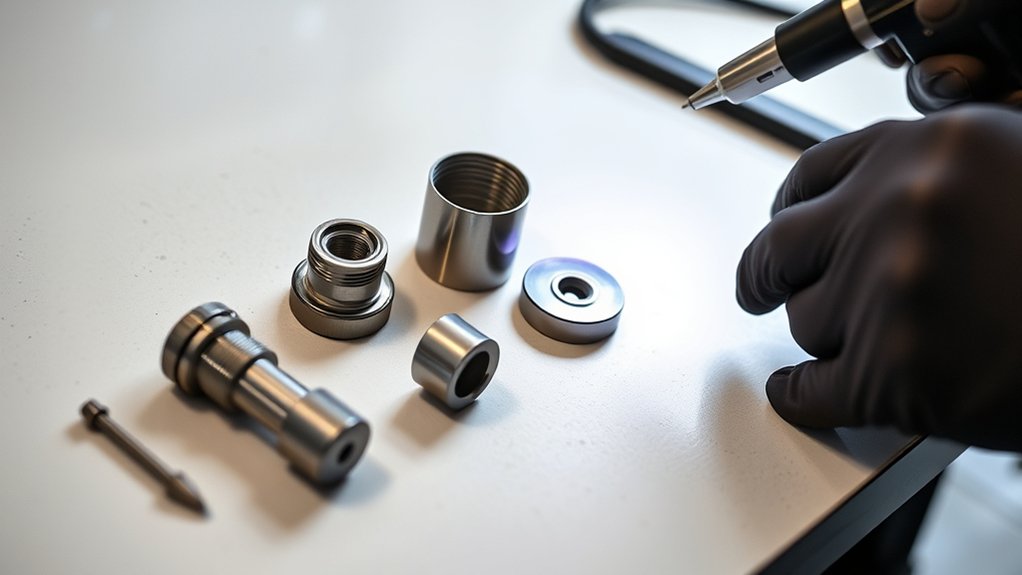
With compatibility confirmed and power isolated, prepare the torch for a safe consumable change. Vent residual air, disconnect the torch, and place it on a clean, static-free surface.
With compatibility checked and power off, vent air, disconnect, and set the torch on a clean, static-free surface.
Reference the manual for your torch head and consumable types (nozzle, electrode, swirl ring, retaining cap, shield).
Remove parts in sequence: release the retaining cap, then withdraw the shield, nozzle, swirl ring, and electrode. Twist or unclip as specified; don’t force threads. Dispose of worn parts per local guidelines.
Inspect mating surfaces for debris.
Installation tips: handle new parts with clean gloves, verify O-ring condition, and lightly seat components to avoid cross-threading. Install in reverse order, ensuring each piece is fully seated and aligned; hand-tighten or clip until positively locked—never over-torque.
Reconnect the torch, restore air, and power up.
Perform a system check per the manual: verify gas flow, torch readiness indicators, and test-fire in air to confirm stable arc and proper airflow before cutting.
Maintenance, Inspection, and Storage
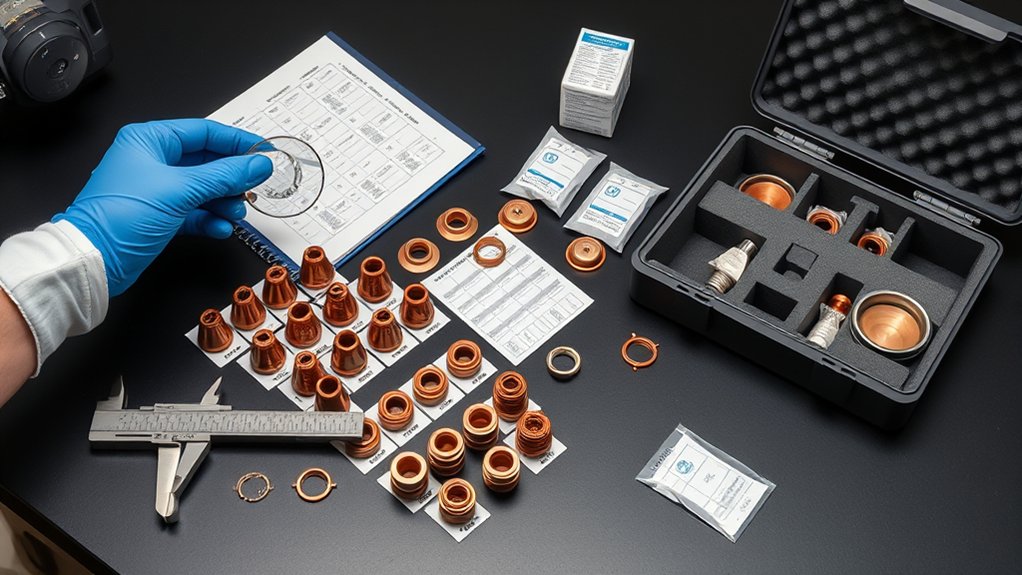
Before each shift, perform a quick visual and tactile inspection of all consumables and torch interfaces to catch wear, cracks, pitting, double-arcing marks, heat discoloration, and damaged O‑rings.
Conduct a systematic wear inspection: nozzle orifice roundness, electrode pit depth, swirl ring integrity, and shield face condition. Keep parts clean; any debris undermines arc stability and cut quality.
Follow the user manual’s maintenance schedule to minimize premature wear and sustain efficiency. Use disciplined storage techniques to protect unused parts and extend service life.
- Wipe consumables with lint‑free cloth; avoid abrasive media that can change dimensions.
- Verify O‑ring lubrication is light and even; replace swollen, nicked, or flattened rings.
- Measure electrode pit depth; replace at the specified threshold to prevent double‑arcing.
- Clean torch threads and seats; remove metal dust with dry air; never use oily solvents.
- Store unused parts in the provided case, in a clean, dry area; label lots and rotate stock.
Dispose of spent components per local regulations to guarantee safe, compliant handling.
Troubleshooting and Best Practices
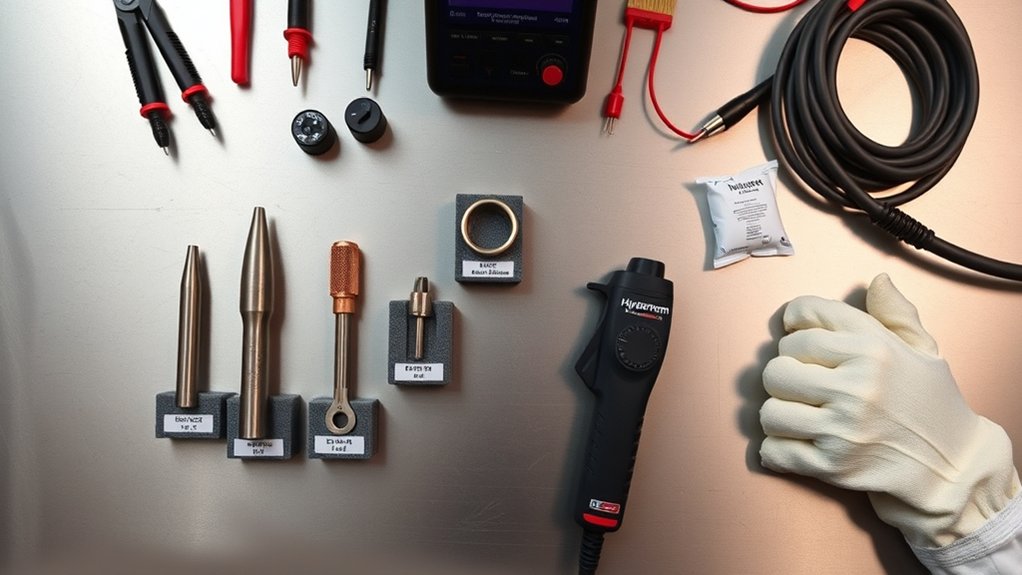
Solid maintenance practices set the baseline; effective troubleshooting keeps cut quality consistent when issues appear. Start with visual checks: replace electrodes with deep pits, nozzles with ovalized orifice, and retaining caps with heat cracks. Reseat all consumables; misalignment causes double arcing and inconsistent kerf. Keep parts clean—wipe with lint‑free cloth, purge air before install, and avoid oily gloves. For 12 mm (1/2 in) and under, use the CopperPlus Electrode to extend life and stabilize arc starts.
Address common issues methodically. If you see bevel, check nozzle wear and torch-to-work distance. If dross increases, verify consumable seating and gas flow. For erratic arc, inspect swirl ring and cap threads for debris. Apply these maintenance tips at each shift change and after tip-outs.
| Symptom | Probable Cause | Corrective Action |
|---|---|---|
| Double arcing | Mis-seated consumables | Reseat; inspect cap threads |
| Heavy dross | Worn nozzle/orifice | Replace; verify standoff |
| Tapered kerf | Electrode pitting | Replace; switch to CopperPlus for ≤12 mm |
Technical Specifications and Support Resources
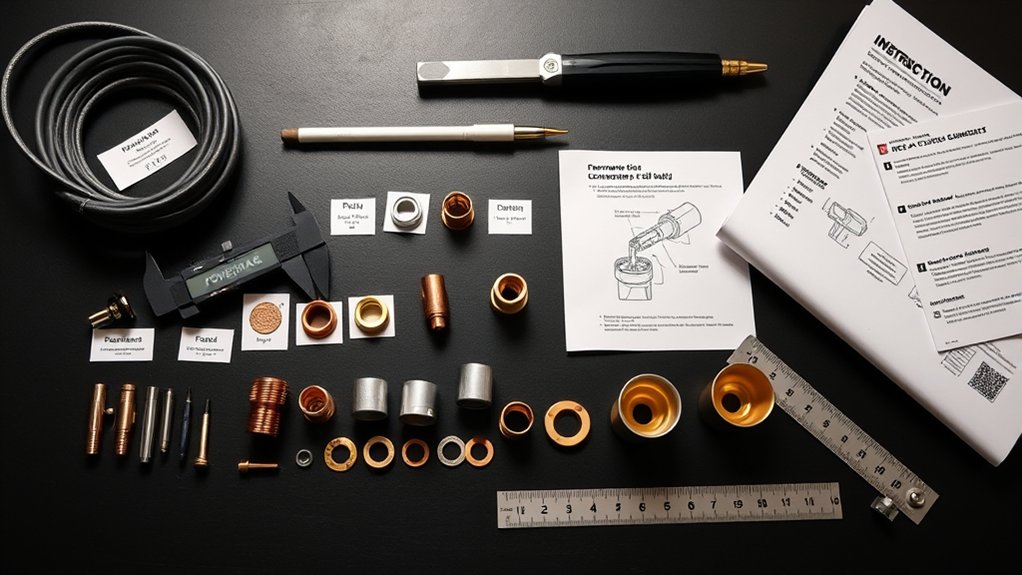
Specifications drive setup and support planning for your Powermax45 XP consumables workflow. To align consumables with system limits and quality targets, verify electrical capacity and thermal margins before configuring cut parameters. Validate inputs, stage the kit, and reference official materials to maintain technical performance and traceability.
- Input power: 200–240 V, 1 PH, 50–60 Hz; max current draw 39 A at 6.5 kW. Validate circuit rating and cord gauge before operation.
- Duty cycle: 50% at 40°C (104°F). Schedule cuts in intervals to prevent thermal limiting and preserve cut quality.
- Tool-free consumable changes: stage nozzles, electrodes, and shields for rapid swaps; lockout power; inspect O-rings and seating surfaces.
- TrueFlow Technology: verify unobstructed cooling paths; keep air supply clean/dry; confirm flow rates to sustain consistent arc and kerf.
- Support resources: use Cut Charts Guides for amperage, speed, and standoff; consult service manuals for maintenance intervals; capture user feedback to refine setups.
Frequently Asked Questions
How Do I Budget Consumable Usage for Large Production Runs?
Build a model: track burn rates per part, calculate wear life, and multiply by batch size. Use production forecasting to project cycles, then apply cost estimation per consumable. Include scrap allowance, machine downtime buffers, and reorder points. Adjust monthly.
Are There Eco-Friendly Disposal Options for Spent Consumables?
Yes. You’ll retire components gracefully: segregate metals, remove residues, document weights, and route to eco friendly recycling. Use certified scrap processors, reclaim copper, recycle packaging, and follow responsible disposal protocols: SDS review, local regulations, RCRA checks, manifests.
What Training Resources Exist for New Operators Beyond the Manual?
You can access online tutorials, OEM webinars, and operator workshops. Enroll in certification courses, practice with simulator modules, follow step-by-step labs, complete safety briefs, validate parameters via job sheets, and join forums for troubleshooting, maintenance drills, and procedural updates.
How Can I Prevent Counterfeit Consumables in My Supply Chain?
Implement authorized sourcing, serialize lots, and validate certificates to prevent counterfeit consumables. Deploy counterfeit detection tests, inspect packaging, and audit vendors. Use tamper-evident seals, track-and-trace, and inbound QC sampling to maintain supply chain integrity and quarantine suspect items.
Are There Insurance or Warranty Implications for Non-Oem Parts?
Yes. You risk denied insurance coverage and rejected warranty claims when using non-OEM parts. Verify policy terms, document part provenance, obtain manufacturer approvals, update maintenance records, and implement traceability. If required, secure endorsements explicitly permitting aftermarket components before installation.
Conclusion
You’re now equipped to configure, calibrate, and care for your Powermax45 XP with confidence. Confirm compatibility, check part numbers (220777, 220941, 420536), and carefully seat each consumable. Power down, purge pressure, and precisely align components to prevent premature wear. Schedule systematic inspections, swap worn parts swiftly, and store spares smartly to sustain performance. When issues arise, troubleshoot with targeted tests and tight tolerances. Follow these procedure-focused practices to secure consistent cuts, safeguard system longevity, and streamline shop success.