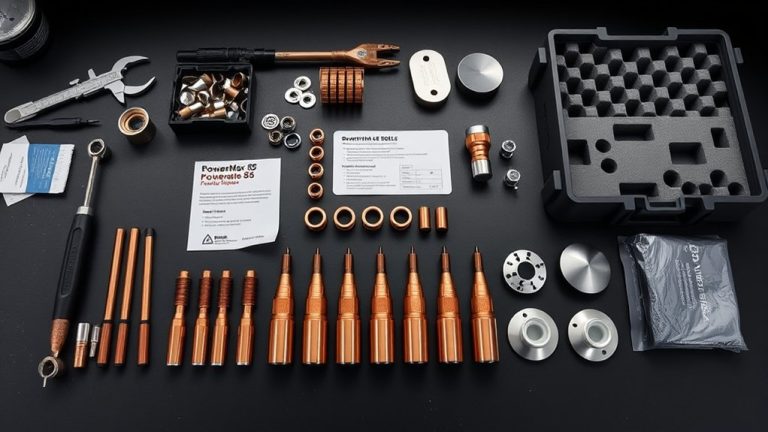
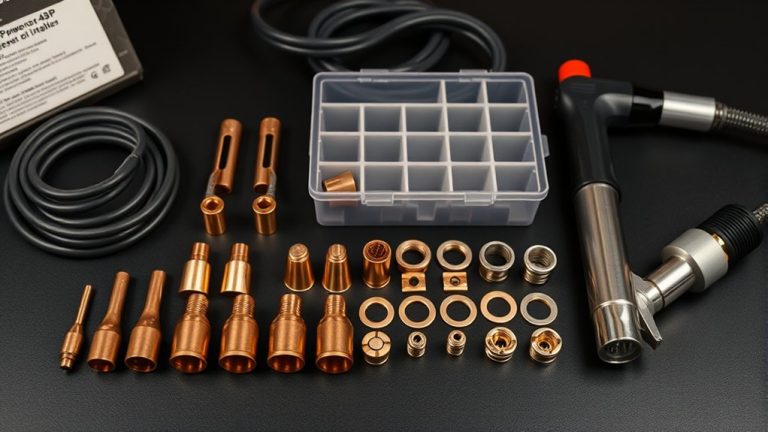
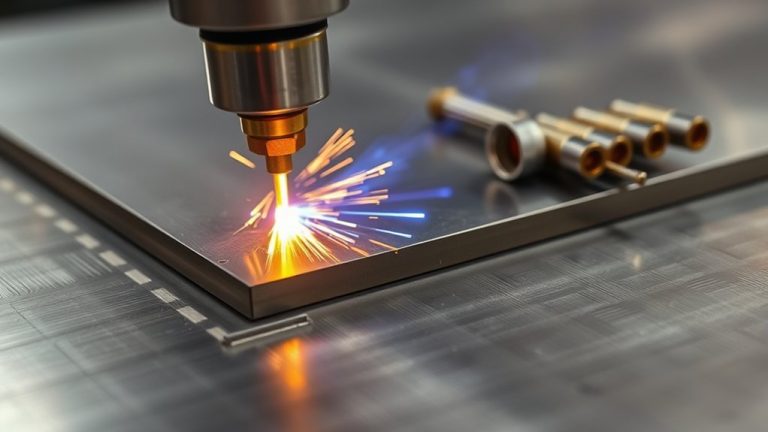
Selecting the right Powermax65 consumables directly impacts cut quality, speed, and cost per part. You’ll weigh CopperPlus vs. standard electrodes, match nozzles to 45 A, 65 A, or FineCut, and choose shields for drag, mechanized, or unshielded work. Proper retaining caps and ohmic components stabilize the arc, while gouging sets shape profile depth. With maintenance intervals and part wear cues dialed in, you’ll boost uptime—next, you need the exact combinations and replacement triggers.
Choosing the Right Consumables for Powermax65
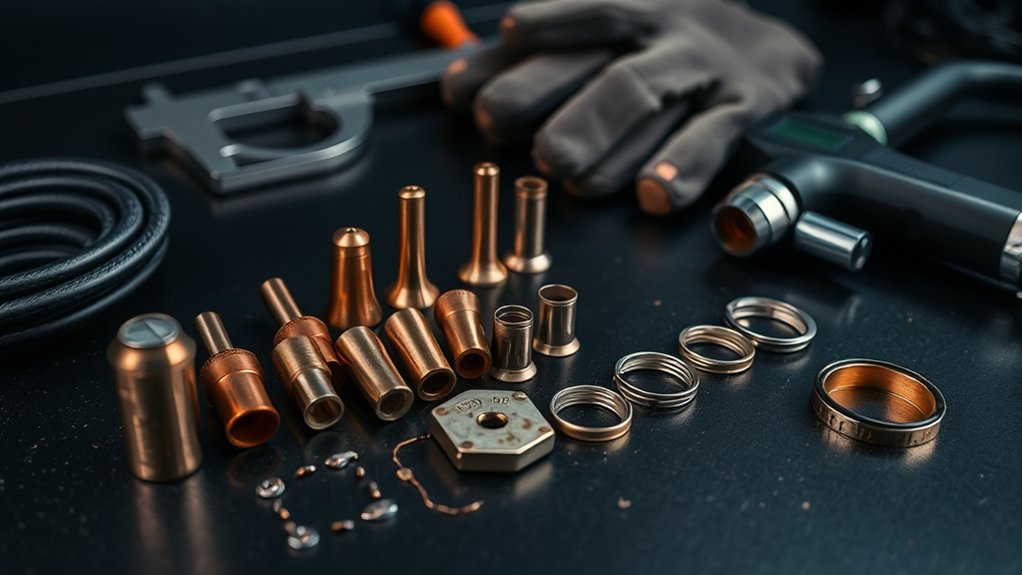
Looking to maximize cut quality and consumable life on your Powermax65? Start by selecting consumables that match your application and amperage. For straight cutting up to 12 mm, use the 65 Amp Drag Cutting Nozzle; it delivers stable arc constriction and clean edges.
For material removal, switch to the 65–85 Amp Gouging Nozzle, which supports controlled metal removal rates and consistent gouge profiles. Maintain electrode compatibility by pairing the correct nozzle and retaining cap with your chosen electrode. Hypertherm’s CopperPlus electrodes provide extended durability, especially on medium thicknesses, reducing changeovers and supporting consistent performance.
Prioritize plasma cutter maintenance: inspect orifice wear, check arc starts, and replace electrodes and nozzles before quality degrades to sustain up to 4.8 kg/hr (10.7 lbs/hr) removal rates.
Use the 65–105 A flushcut retaining cap to improve shielding and precision in flush applications. For unshielded cuts, fit the appropriate deflector to enhance safety, gas flow stability, and cut efficiency.
Electrode Options: Standard vs. CopperPlus
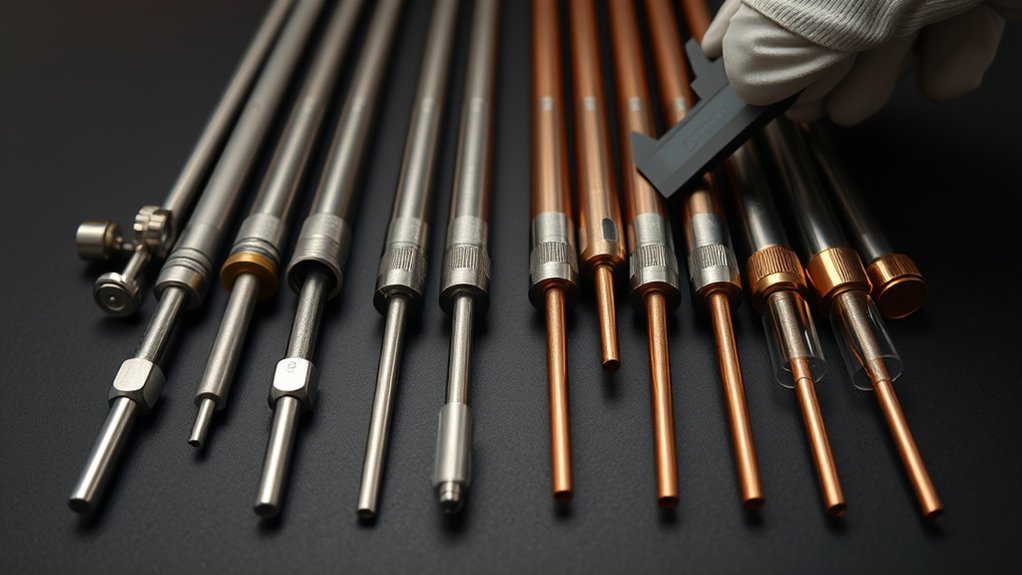
When choosing between standard and CopperPlus electrodes for your Powermax 65, assess longevity and wear—CopperPlus typically lasts longer on 12 mm and under and withstands aggressive gouging.
Evaluate cut quality differences, noting CopperPlus maintains stable arcs and benefits from Ohmic retaining caps for cleaner starts and consistent conductivity.
Run a cost-per-cut comparison that factors replacement frequency, cut speed, and downtime to quantify the real economic advantage.
Longevity and Wear
Although both electrodes can cut effectively, longevity and wear diverge sharply between standard and CopperPlus options on the Powermax 65.
If you’re prioritizing electrode lifespan and wear resistance, CopperPlus is the clear choice. It’s engineered for extended duty on materials 12 mm and under, sustaining higher thermal loads and aggressive metal removal without premature erosion. That translates to fewer changeouts, lower consumable burn rate, and reduced downtime.
Standard electrodes work, but they typically degrade faster, driving more frequent replacements and higher operating costs over time.
CopperPlus maintains consistent performance across longer intervals, preserving arc stability and current transfer as the tip heats and cools repeatedly. By choosing CopperPlus where applicable, you increase consumable longevity and the overall efficiency of your Powermax 65, especially in high-throughput, repetitive cutting.
Cut Quality Differences
Longer electrode life with CopperPlus doesn’t just cut costs—it tightens cut quality on material 12 mm and under.
You’ll see cleaner kerfs, reduced bevel, and fewer dross islands because CopperPlus stabilizes the arc as the tip wears. Standard electrodes lose consistency faster, so edge geometry drifts and post-processing grows.
With CopperPlus, steadier heat input improves contour fidelity and micro-notch control, especially on thin and medium plate.
- Arc stability: CopperPlus lowers fluctuation, improving cut quality and reducing edge waviness.
- Kerf consistency: More uniform electrode performance maintains kerf width across long nests.
- Bevel control: Slower wear preserves nozzle–arc alignment, minimizing taper and angularity.
- Surface finish: Smoother edges mean less grinding and faster fit-up.
Choose CopperPlus when precision, repeatability, and uptime are critical; use standard only for light, intermittent work.
Cost-Per-Cut Comparison
Even if CopperPlus electrodes cost more up front, they typically deliver a lower cost per cut by lasting longer on material up to 12 mm and maintaining higher metal removal rates.
Your cost analysis should include purchase price, electrode lifespan, changeout time, and scrap risk from end-of-life cut quality drift. CopperPlus extends usable life in demanding cuts, so you buy fewer electrodes and stop less often.
Standard electrodes wear faster, especially in high‑volume workflows, driving more frequent replacements and higher cumulative spend.
With CopperPlus, the improved metal removal rate shortens cycle time and reduces downtime tied to consumable swaps. Over a shift, those gains compound.
When you normalize total consumable spend and time losses per part, CopperPlus trends more economical, delivering a consistently lower cost-per-cut for Powermax 65 operations.
Nozzles for 45 A, 65 A, and FineCut Applications
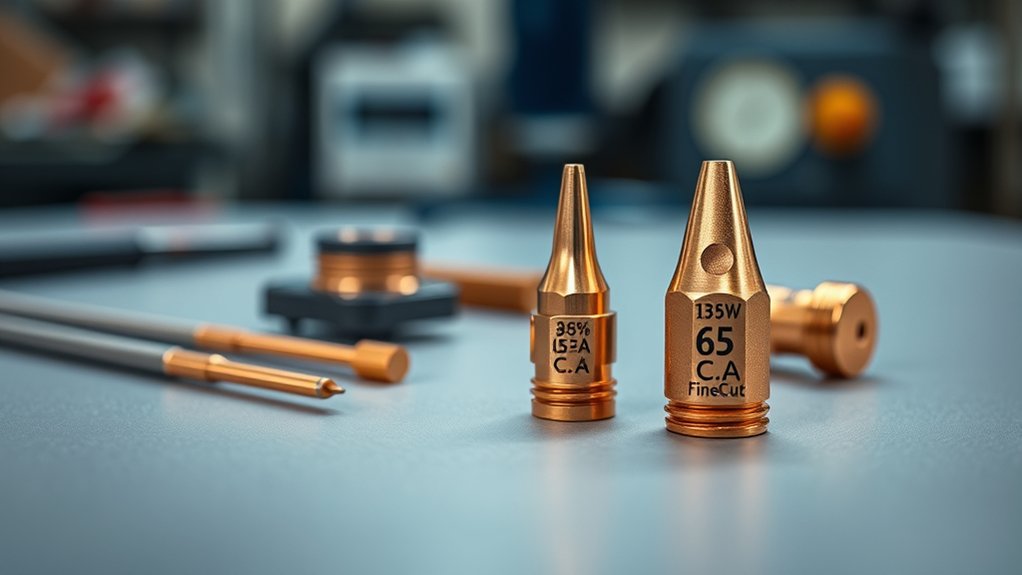
You’ll choose between 45 A drag cutting, 65 A production cuts, and FineCut precision work based on material thickness, speed, and edge quality targets.
Use the 45 A drag nozzle for controlled handheld cuts, the 65 A nozzle for higher throughput in handheld or mechanized setups, and the FineCut nozzle for tight kerfs and minimal dross.
Match each nozzle to its rated amperage, replace it regularly, and pair it with the correct shield to maintain performance and safety.
45 a Drag Cutting
When drag cutting with a Powermax 65, match the nozzle to the amperage and application to maintain cut quality and consumable life. You’ll see clear drag cutting benefits when you pair 45 A or 65 A drag nozzles with the correct current and travel speed.
The nozzle’s built-in standoff maintains arc length, minimizes dross, and improves edge fidelity up to 16 mm (0.63 in). For thin-gauge precision, the Hypertherm 45XP FineCut nozzle tightens kerf and reduces heat input at lower amperage.
Prioritize nozzle maintenance to prevent orifice erosion and gas swirl distortion. Frequent users can leverage the 65 A Drag Cutting Nozzle, part number 220819, in 25-piece bulk for cost efficiency.
1) Select 45 A, 65 A, or FineCut by material thickness.
2) Set amperage to nozzle rating.
3) Maintain steady drag contact; control speed for minimal dross.
4) Inspect nozzles regularly; replace at first sign of wear.
65 a Production Cuts
For production cuts on the Powermax 65, match nozzle type to amperage and target speed to sustain cut quality and throughput.
Prioritize nozzle compatibility and set your feed rate to about 80% of the machine’s maximum to stabilize kerf, maintain edge squareness, and protect consumable life.
Run the 220941 at 45 A when processing thinner stock; the bulk pack of 25 supports sustained uptime and production efficiency.
For thicker materials, use the 220819 at 65 A; five-packs suit routine changeouts while delivering robust arc density and consistent pierce performance.
When your program demands cleaner detail within a production cycle, the 220930 FineCut nozzle works at both 45 A and 65 A.
In all cases, pairing amperage-specific nozzles helps you hold a 4.8 kg/hr (10.7 lb/hr) metal removal rate.
Finecut Precision Work
Two FineCut options—optimized for 45 A and 65 A—deliver a tighter arc via a reduced orifice, enabling crisp kerfs, sharper inside corners, and minimal dross on thin-gauge work.
You’ll gain repeatable precision on intricate geometries where standard nozzles widen the kerf or overheat edges. Hypertherm’s FineCut nozzles come in packs of five, fit Powermax 65 and 85 torches, and excel in FineCut applications that demand low heat input and superior edge fidelity.
- Select amperage: run 45 A for ultra-thin stock; use 65 A when speed and stability matter on slightly thicker sheet.
- Maintain standoff: set minimal, consistent height to preserve arc focus and FineCut benefits.
- Keep consumables fresh: replace at early wear signs to prevent bevel and dross.
- Control cost: with packs around $41.06, plan routine replacements to sustain cut quality and minimize secondary finishing.
Shields and Deflectors: Drag, Mechanized, and Unshielded
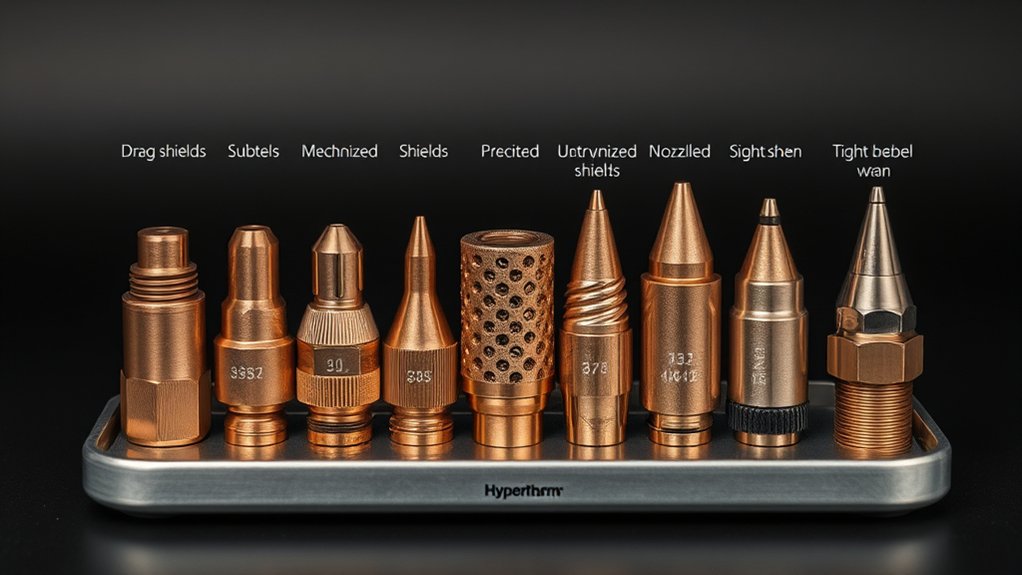
Shields and deflectors define how the Powermax 65 controls arc distance, protection, and cut profile. In handheld work, you’ll see clear drag shield benefits: the standoff ring keeps a precise, repeatable gap, stabilizes kerf geometry, and prevents molten splash from contaminating the nozzle.
You cut faster with cleaner edges because the shield preserves gas flow and nozzle integrity.
For mechanized shield applications, use a dedicated mechanized shield, such as Hypertherm 220817, to protect the nozzle at programmed torch heights. It supports 65A and 85A operations, sustaining consistent edge quality and extending consumable life when integrated with a CNC torch lifter and correct cut parameters.
Unshielded cutting relies on a deflector to streamline the arc. While the 220955 Deflector is built for Powermax85/105, its principle applies: directing the arc improves visibility and enables deeper gouging profiles for aggressive metal removal.
Select the shield or deflector to match your process—handheld, mechanized, or gouging—to maximize efficiency, safety, and cut results.
Retaining Caps and Ohmic-Sensing Components
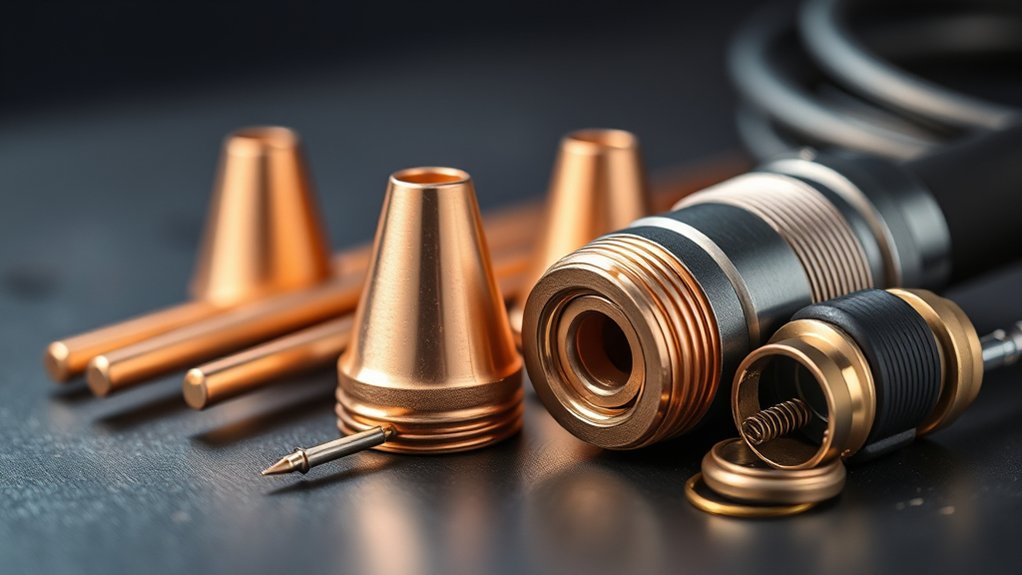
In this section, you’ll assess Ohmic cap benefits—automatic surface sensing that tightens pierce height control, improves cut accuracy, and reduces rework.
You’ll also select the correct retaining cap to secure the nozzle, stabilize the arc, and extend consumable life across handheld and mechanized setups.
Use application-specific options (e.g., Hypertherm 420413 HyAccess, FlushCut 65–105 A) to match material thickness and cut style.
Ohmic Cap Benefits
One key upgrade for consistent Powermax 65 performance is adding ohmic-sensing components—especially an ohmic retaining cap—to stabilize the arc and tighten height control.
You’ll see immediate ohmic cap advantages in arc stability, ignition reliability, and consumable life. An ohmic cap provides a clean, repeatable electrical path for initial contact sensing, so the torch touches off accurately and lifts to the programmed cut height without false triggers.
1) Achieve consistent arc stability: precise touch-off reduces misfires, double-arcs, and bevel.
2) Extend consumable life: stable contact prevents pitting and premature wear on tips and electrodes.
3) Improve cut quality on ≤12 mm materials: cleaner edges and reduced dross from accurate pierce height.
4) Integrate seamlessly with Hypertherm 420413 (Duramax HyAccess): optimized for ohmic sensing, enabling reliable automatic height control and protecting parts and workpieces.
Retaining Cap Selection
Although several components influence cut quality, selecting the correct retaining cap—and pairing it with ohmic-sensing hardware—anchors consistency and arc stability on a Powermax 65.
Choose retaining cap types by amperage and torch style. For tight access at 45–65 A, the Hypertherm 420413 Retaining Cap for Duramax HyAccess torches secures the nozzle and guarantees reliable electrical contact.
For aggressive bevel or side-entry work at 65–105 A, the 420536 Flushcut Retaining Cap maintains stability at higher loads.
Match retaining cap materials to duty cycle and heat load; engineered polymers with embedded conductors manage thermal expansion while preserving contact pressure, improving ohmic sensing.
Inspect threads, seats, and contact rings regularly; replace caps showing heat discoloration, warping, or erosion to prevent overheating.
Proper selection improves cut consistency, pierce reliability, and consumable life.
Swirl Rings and Gas Flow Considerations
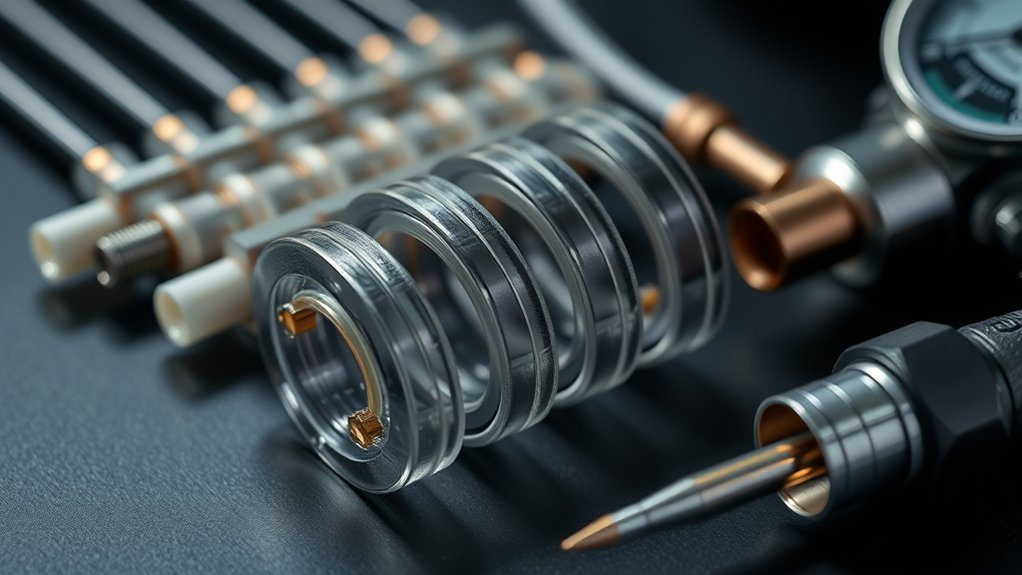
Even small changes at the swirl ring can make or break arc stability, so treat gas control as a critical system, not a consumable afterthought.
You’ll see immediate swirl ring benefits when you pair the correct part with gas flow optimization: the Hypertherm Swirl Ring 45–85 Amps meters and spins the stream to center the arc, reduce nozzle turbulence, and keep the plasma column tight.
Feed it correctly and the Powermax 65 delivers speed, precision, and longer consumable life.
Feed it correctly and your Powermax 65 rewards you with speed, precision, and longer consumable life.
- Verify inlet supply: 189 l/min (400 scfh) at 85 psi for cutting. Undersupply starves the arc; oversupply distorts it.
- Use clean, dry, oil-free air or nitrogen. Moisture or oil widens kerf, increases dross, and accelerates wear.
- Match amperage: install the 45–85 A swirl ring when operating in that range to stabilize flow and extend life.
- Inspect grooves and ports; replace cracked, heat-crazed, or contaminated rings to restore consistent gas delivery and cut quality.
Gouging Consumables: Deep vs. Shallow Profiles
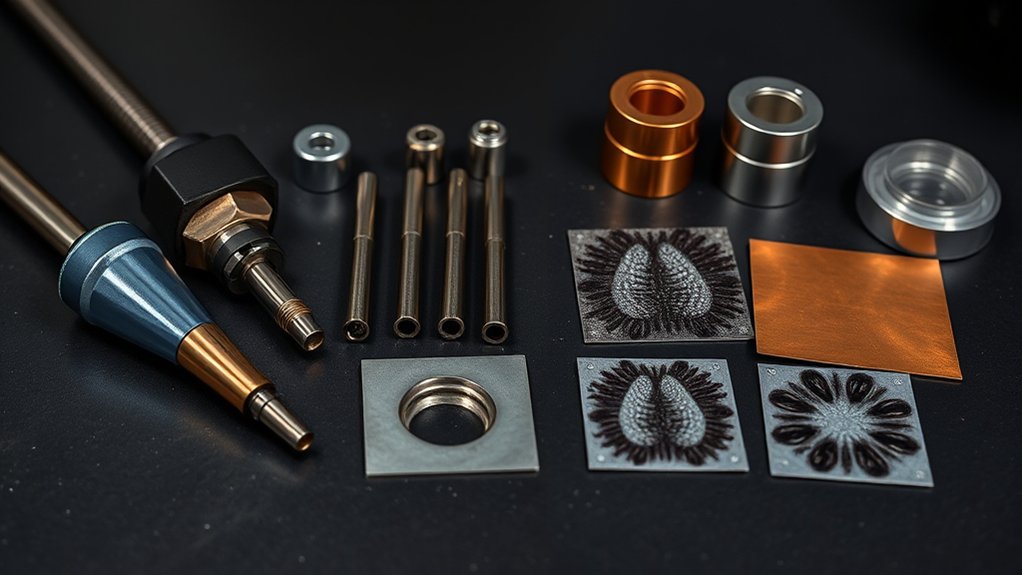
Depth defines intent: choose deep gouge consumables when you need fast, aggressive metal removal, and switch to shallow profiles when precision and minimal material loss matter. With the Powermax 65, both options are compatible, so you can match the gouge to the task.
Use a deep gouge profile when you must remove substantial metal quickly—back-gouging welds, stripping hardfacing, or preparing joints where speed outranks finish. It produces a wider, deeper trough and higher removal rate.
Select a shallow gouge profile when you need controlled excavation—removing tack welds, cleaning cracks, or blending without undercut. It yields a narrow, shallow trench, preserving base material and reducing post-process grinding.
Decide based on required removal rate versus accuracy. If throughput is the constraint, prioritize deep gouge. If geometry and minimal loss are critical, choose shallow gouge.
Evaluate arc stability, torch angle, and travel speed to maintain consistent profile, and confirm consumable wear frequently to keep quality and efficiency high.
Recommended Kits, Bulk Packs, and Starter Sets
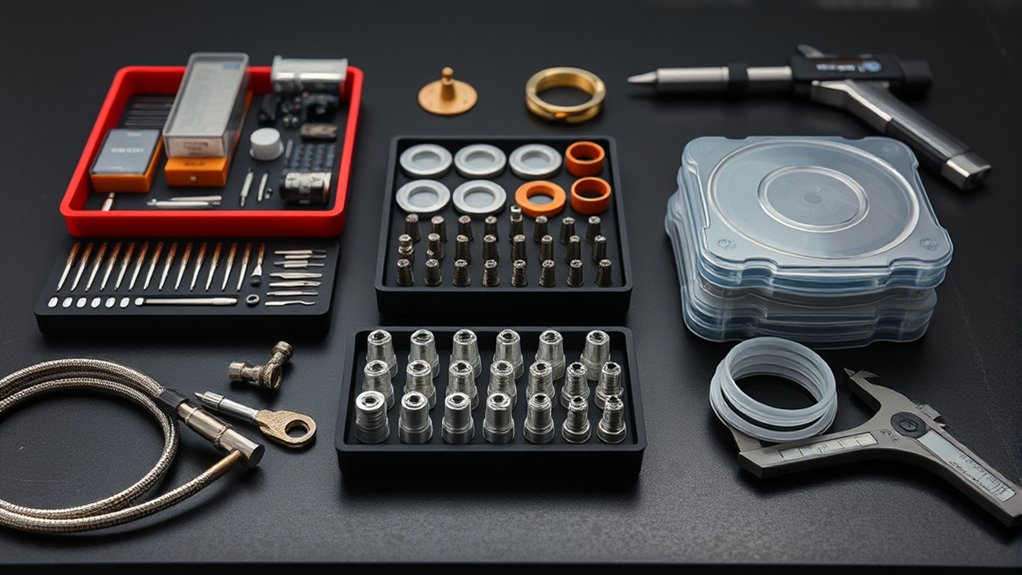
After choosing deep or shallow gouge profiles, equip your Powermax 65 with kits that match your workflow and volume.
Starter kits streamline setup, while bulk options stabilize cost per cut and reduce downtime. Select packages aligned to amperage and task—extended reach, standard cutting, or gouging—so you maintain arc quality and predictable wear.
- Hypertherm 428414 HyAccess 65A Extended Consumables Starter Kit ($182.90): A precise starter kits choice for tight-access work. Includes essential components for peak Powermax 65 performance and consistent arc stability in confined geometries.
- Hypertherm 428446 HyAccess 65A Gouging Starter Pack ($103.38): Purpose-built for 45–65 A gouging. A cost-effective entry set for frequent edge prep, crack removal, and controlled metal removal.
- Hypertherm 228934 Electrode Copper Plus, bulk package (25 pcs, $298.77): Best for material ≤12 mm; extended life lowers electrode changeovers and unit cost.
- Hypertherm 228762 65–85 A Gouging Nozzle, bulk pack (25 pcs, $257.33): Economical for high-volume gouging, sustaining nozzle geometry under sustained load.
Maintenance Schedule and Replacement Indicators
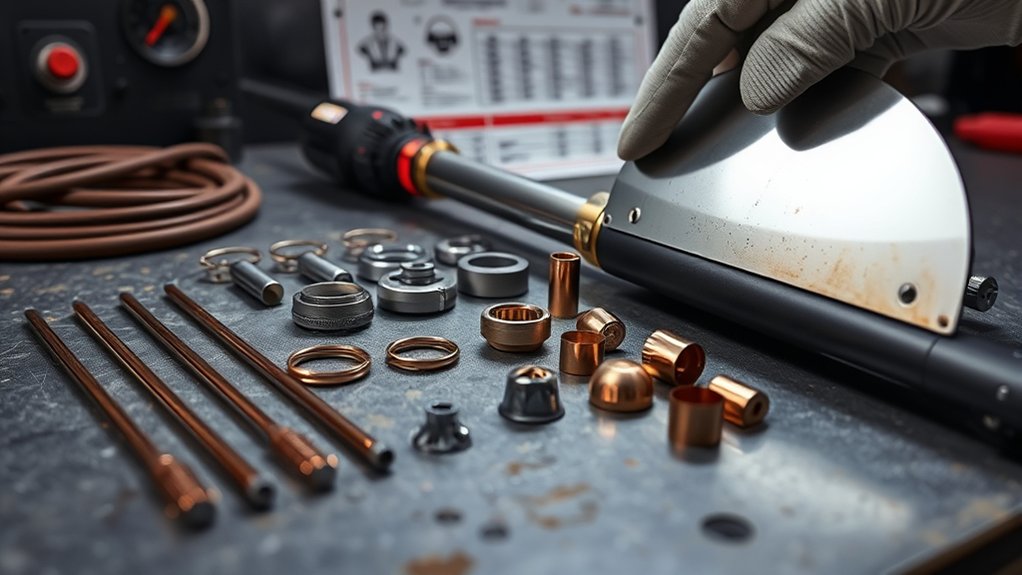
Although cutting demands vary, set a disciplined maintenance cadence to keep your Powermax 65 consistent and efficient.
Define maintenance frequency by tracking two metrics: usage hours and visual condition. Log cutting hours and inspection outcomes after each session; this establishes patterns and prevents unplanned downtime.
Track usage hours and visual condition after each session to spot patterns and avoid downtime.
Use clear replacement signs. Replace the electrode after 20–30 cutting hours or sooner if you see a pronounced pit in the hafnium insert, arc instability, or a measurable drop in cut quality.
Swap the nozzle when the orifice is burnt, ovalized, or deformed—often at 5–20 hours depending on material and amperage. Monitor the retaining cap; change it at the first evidence of cracks, thread wear, or heat discoloration—typically every 5–10 uses.
During each inspection, verify tip concentricity, check for spatter buildup, and confirm consistent arc starting.
Record every change-out date and part life. Proactive replacements preserve kerf accuracy, reduce dross, and maintain repeatable cut speed.
Upgrades, Adapters, and Compatible Accessories
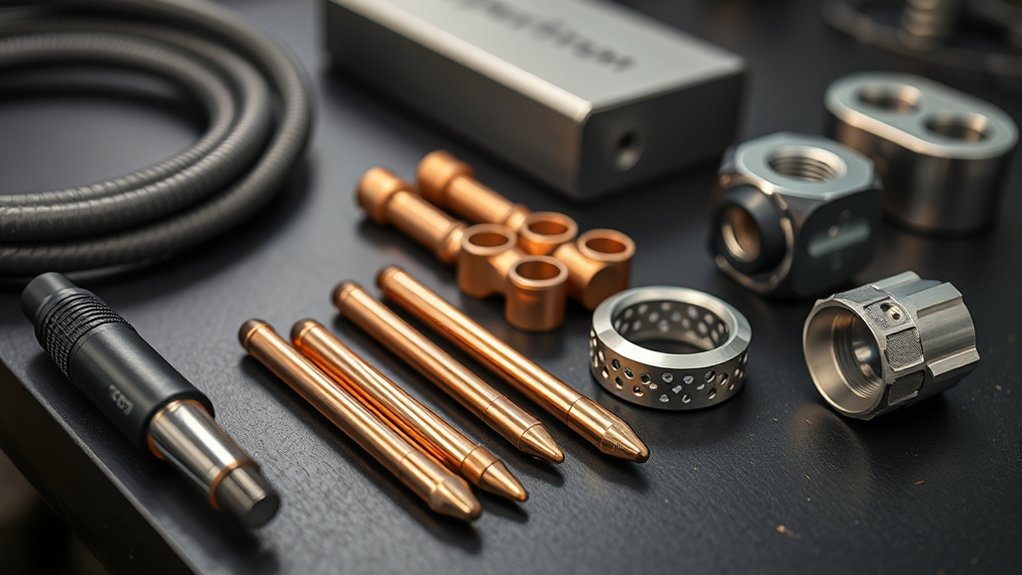
If you want faster changeovers and tighter process control, upgrade your Powermax 65 with Hypertherm’s cartridge consumable platform and the dedicated cartridge adapter that converts standard consumables to the cartridge type.
These cartridge upgrades reduce setup errors, streamline torch maintenance, and help you standardize part inventories. Pair the system with the Hypertherm EtherCAT interface to link the power supply to an EDGE Connect CNC for automated process setup, repeatable cut parameters, and reduced operator intervention.
- Specify compatible torches (hand, mechanized, and robotic) to match duty cycle and lead length; confirm cartridge adapter fitment before deployment.
- Add cutting guides (drag shields, circle guides, straightedge kits) to stabilize standoff, improve kerf consistency, and protect consumables.
- Integrate filtration: moisture separators and fine coalescing filters to maintain dry, clean air—critical for nozzle and electrode life.
- Use genuine Hypertherm electrodes, nozzles, shields, and swirl rings; monitor wear tables and replace on schedule to preserve cut quality, arc stability, and overall system longevity.
Frequently Asked Questions
How Do Ambient Temperature or Humidity Affect Consumable Lifespan?
Ambient temperature and humidity affect consumable lifespan directly. Higher heat accelerates oxidation and nozzle wear; cold thickens gas, destabilizing arcs. Humidity impact promotes corrosion, arc blowouts, and inconsistent ignition. Control temperature effects with stable environments, dry air, desiccant filters, and routine inspections.
Can Mixed-Brand Consumables Void Torch or Machine Warranties?
Yes. You risk denials, you risk disputes, you risk repairs unpaid. Mixed brand risks include tolerance mismatches and electrical instability; warranty implications include limited coverage, burden-of-proof shifts, and exclusions. Verify OEM policies, document usage, and secure written approval before mixing.
What Storage Conditions Prevent Oxidation of Electrodes and Nozzles?
Store parts in sealed, dry containers at 30–50% RH, 20–25°C. Use desiccant packs, oxygen absorbers, and VCI bags for electrode preservation and nozzle protection. Avoid fingerprints, condensation, flux fumes, ozone, and rapid temperature swings. Rotate stock.
How Do Power Supply Voltage Fluctuations Impact Cut Quality and Wear?
Voltage fluctuations degrade cut quality and accelerate wear; you’ll see dross spikes with just ±5% instability. Prioritize voltage stability: use line conditioners, proper grounding, and dedicated circuits to maintain consistent arc energy, tighter kerfs, smoother edges, and longer consumable life.
Are There Recommended Consumables for Fume-Reduction or Low-Noise Cutting?
Yes. You’ll pair fine-cut nozzles, shielded consumables, and drag shields with water tables or downdraft extraction for fume reduction techniques. For low noise options, use lower-amperage tips, higher standoff, slower travel, and segmented ventilation.
Conclusion
You’ve seen how the right electrodes, nozzles, shields, and caps release stable arcs, clean edges, and longer life. But here’s a testable theory: CopperPlus electrodes don’t just last longer—they reduce total heat load enough to measurably improve nozzle life and cut angularity at 65 A. Validate it: log cut meters, kerf angle, dross mass, and nozzle wear across identical jobs. If your data confirms it, you’ll justify genuine parts, disciplined maintenance, and optimized gas flow—on performance, not belief.