Disclosure: As an Amazon Associate, we earn from qualifying purchases. If you click a link on this page and make a purchase, we may receive a small commission at no extra cost to you.
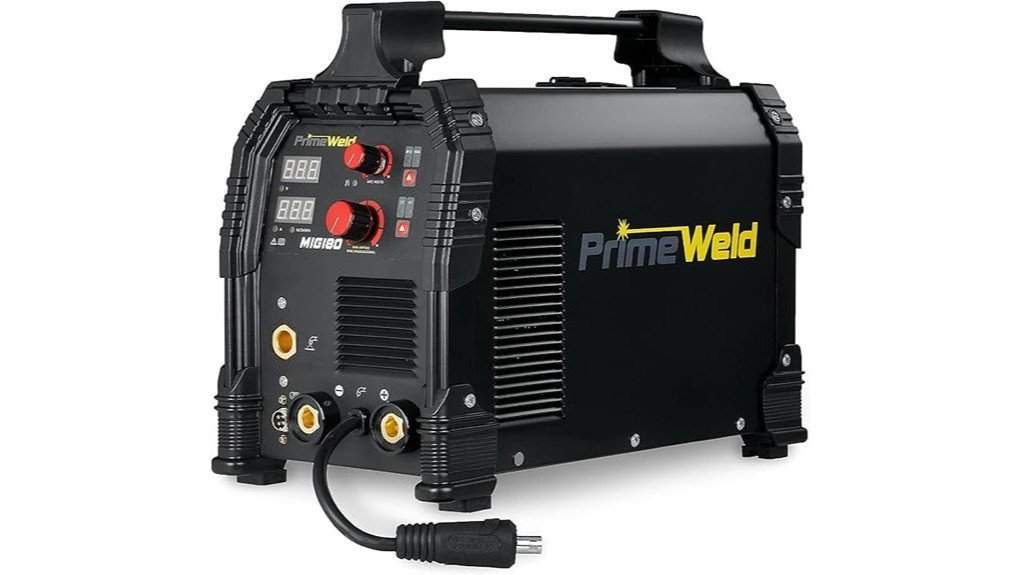
A 180-amp MIG welder sounds simple until you compare outlet requirements, welding processes, duty cycle, and the extra gear needed for aluminum. The PrimeWeld MIG180 Welder combines 120/240V input, gas MIG, flux-core, DC stick, and an included spool gun in one compact package. This review helps you decide whether that mix suits garage fabrication, automotive repair, farm maintenance, or small-shop work. Its strongest advantage is process flexibility, but full output requires a properly sized 240V circuit, and even 120V use calls for more electrical capacity than a typical household receptacle circuit.
Quick Verdict
Rating: 8/10, recommended with caveats
Best For: DIY welders, garage fabricators, automotive repair users, and small-shop owners who want MIG, flux-core, stick, and occasional aluminum capability in one machine.
Bottom Line: The PrimeWeld MIG180 offers useful dual-voltage flexibility, solid published duty-cycle figures, common consumable compatibility, and a spool gun in the box. The tradeoff is that you need the correct circuit, gas, consumables, and process setup before it can deliver its full value.
| Specification | Detail |
|---|---|
| Brand | PrimeWeld |
| Model | MIG180 / MIG 180 |
| Product Type | 180-amp inverter wire-feed welder with aluminum spool gun |
| Input Power | Single-phase 120/240V, 60 Hz |
| Manufacturer Breaker Guidance | 30A for 110/120V and 50A for 220/240V. Confirm the complete circuit, receptacle, plug, and conductor ratings before use. |
| Welding Processes | Gas MIG (GMAW), flux-core (FCAW), DC stick (MMA), and aluminum MIG with the included spool gun |
| 120V Output Range | MIG 30-120A; MMA 30-120A |
| 240V Output Range | MIG 30-180A; MMA 30-170A |
| MIG / Flux Duty Cycle | 30% at 180A, 60% at 160A, and 100% at 100A |
| Stick Duty-Cycle Note | PrimeWeld lists 30% at 180A, 60% at 120A, and 100% at 99A, but its output table lists a 170A MMA maximum on 240V. Check the current manual before planning work near the upper limit. |
| Wire Speed | 79-551 inches per minute |
| Wire Diameter | MIG: 0.023-0.040 in; flux-core: 0.030-0.040 in |
| Wire Spool Capacity | Accepts 2 lb and 10 lb wire spools |
| Gas Control | Built-in gas solenoid with pre-flow and post-flow; published post-flow is 1 second, plus or minus 0.5 second |
| Cooling / Protection | Fan-cooled, IP21 housing, Class F insulation, plus listed overcurrent, overheating, cold-electrode, and power-spike protection |
| Efficiency / Power Factor | At least 80% efficiency and at least 0.73 power factor, according to PrimeWeld |
| Dimensions | 18.4 x 9.7 x 14.2 in |
| Machine Weight | 29.8 lb, approximately 30 lb. Retailer item or package weights may be higher. |
| Included Accessories | MIG torch, 12 ft spool gun, gas hose, regulator, ground clamp, electrode holder, voltage adapter, contact tips, drive rolls, 2 lb spool of 0.030 in MIG wire, and manual |
| Warranty / Support | PrimeWeld lists a 3-year warranty and USA-based customer service, parts, and technical support |
What Is the PrimeWeld MIG180?
The PrimeWeld MIG180 is a dual-voltage inverter welder for buyers who need more range than a basic gasless flux-core unit. It supports gas MIG for cleaner shop work, flux-core for gasless outdoor repairs, and DC stick for jobs where a wire-feed process is less convenient.
The included spool gun is the package’s main aluminum advantage. Soft aluminum wire can buckle or jam while traveling through a long standard MIG liner. The spool gun places the wire close to the torch, shortening the feed path and reducing that risk.
PrimeWeld also supplies many of the setup parts that lower your initial accessory cost, including a regulator, gas hose, drive rolls, contact tips, steel MIG wire, an electrode holder, and a voltage adapter. You still need suitable shielding gas, the correct wire for each metal, personal protective equipment, and a safe electrical circuit.
Key Takeaways
- The MIG180 runs on 120V or 240V, but PrimeWeld specifies a 30A breaker even for 120V use, so an ordinary 15A or 20A household circuit may not be suitable.
- You can use gas MIG, flux-core, DC stick, and aluminum MIG with the included spool gun.
- The published MIG duty cycle is 30% at 180A, 60% at 160A, and 100% at 100A.
- The machine weighs about 29.8 lb and accepts both 2 lb and 10 lb wire spools.
- The package is well equipped, but gas, aluminum wire, safety gear, and some job-specific consumables remain separate purchases.
Who Should Buy It?
Best For
- Garage and small-shop users who want one machine for steel MIG, flux-core, stick, and occasional aluminum MIG.
- DIY fabricators who have access to a correctly installed 240V circuit for the full MIG output range.
- Repair users who value an included spool gun, common Tweco-style consumables, and USA-based support.
Skip If
- You need TIG welding in the same machine.
- You only have a standard 15A or 20A household circuit and cannot add a properly rated circuit.
- You need an industrial production welder for continuous high-output work every day.
Before You Buy: Do not choose this welder based on the 180A label alone. PrimeWeld specifies a 30A breaker for 120V and a 50A breaker for 240V. Never install a larger breaker without confirming that the wiring, receptacle, plug, and equipment are rated for it. Ask a qualified electrician when the circuit is uncertain.
Power, Duty Cycle, and Controls
Dual-voltage input is the MIG180’s most useful power feature. On 120V, the published MIG and stick ranges top out at 120A. On 240V, MIG output rises to 180A and stick output to 170A, giving you more room for thicker steel, larger joints, and higher wire-feed settings.
The MIG and flux-core duty cycle is a strong published figure for a compact machine: 30% at 180A, 60% at 160A, and 100% at 100A. At the 180A rating, a 30% duty cycle represents about three minutes of arc time in a ten-minute cycle under the manufacturer’s test conditions. Ambient temperature, input voltage, cable condition, and airflow can affect actual thermal performance.
The front panel includes a digital power display and process selection. The machine also provides 2T and 4T trigger modes. Use 2T for normal pull-to-weld operation. The 4T mode can reduce trigger fatigue during suitable longer runs, but it does not replace proper heat control or joint technique.
Welding Processes and Capabilities
Gas MIG: Use solid wire and the shielding gas specified for the wire and base metal. This mode is the best fit for cleaner indoor steel fabrication, automotive brackets, sheet-metal repairs, and projects where you want less slag than flux-core welding.
Flux-core: Gasless flux-core wire is useful outdoors because wind can disturb external shielding gas. It normally creates more spatter and slag than gas MIG, so expect more cleanup and confirm the required polarity for the exact wire.
DC stick: The MMA function gives you another option for outdoor repairs, rusty or less-than-perfect steel, and jobs where changing electrodes is simpler than moving a gas cylinder and wire feeder. The official specification table lists a 170A stick maximum on 240V.
Aluminum MIG: The included 12 ft spool gun improves soft-wire feeding by keeping the spool close to the torch. Aluminum still requires dedicated preparation, the correct aluminum wire, suitable shielding gas, clean consumables, and practice. The spool gun makes aluminum possible, but it does not make the process automatic.
Design, Wire Feed, and Consumables
At 18.4 x 9.7 x 14.2 inches and about 29.8 lb, the MIG180 is manageable on a welding cart or for occasional transport. It is portable enough for garage and property repairs, although the full working setup becomes heavier once you add a gas cylinder, cables, wire, and protective gear.
The cabinet accepts 2 lb and 10 lb spools, so you can keep a small spool for occasional use or load a larger spool for regular shop work. Published wire support covers 0.023 to 0.040 in MIG wire and 0.030 to 0.040 in flux-core wire. Match the contact tip, drive-roll groove, liner, polarity, and tension to the wire you install.
PrimeWeld lists an upgraded Tweco 100-style torch with an American-style central connection. Common-style consumables can make routine tip replacement easier than a proprietary torch system, but you should still confirm part fit before ordering replacements.
Included Accessories and Setup Value
The package includes a MIG torch with a 10 ft cable, gas hose, regulator, ground clamp with a 12 ft cable, electrode holder with a 12 ft cable, and a 220V-to-110V adapter. It also includes a 12 ft spool gun with an extra 0.8/0.9 mm contact tip.
Wire-feed parts include V-groove and knurled-groove drive rolls, 0.030 and 0.040 in contact tips, and a 2 lb spool of 0.030 in MIG wire. These parts reduce the number of items you need before your first steel MIG setup.
The box does not eliminate all startup costs. You may still need a gas cylinder, the right gas blend, flux-core or aluminum wire, additional tips, a cart or cylinder restraint, a welding helmet, gloves, protective clothing, and a properly rated extension cord only when the manual permits one.
Pro Tip: Before feeding wire, confirm the drive-roll groove, contact-tip size, polarity, and spool tension. Then run a test bead on scrap from the same metal and thickness. Many unstable arcs and feed problems come from setup mismatch rather than a faulty machine.
How It Performs in Real Use
For Garage Fabrication
The MIG180 is well suited to brackets, carts, small frames, repair tabs, and general steel projects. The 240V input range gives you more adjustment headroom than 120V alone, while the 100% duty-cycle rating at 100A supports longer moderate-output sessions.
For Automotive Sheet Metal
The low end of the MIG range and support for 0.023 in wire can help with thin steel, but technique matters more than the 4T trigger lock. Use short tacks or controlled stitch welds, allow cooling time, and move around the panel to reduce burn-through and distortion. Continuous long beads are usually a poor choice on thin body panels.
For Farm, Trailer, and Outdoor Repairs
Flux-core and stick modes make the machine more useful when shielding gas is inconvenient or wind is present. Remove paint, rust, oil, and galvanizing from the weld area as the job requires, use proper ventilation, and choose a process that matches the material and joint.
For Occasional Aluminum Work
The spool gun is a meaningful advantage if you only weld aluminum from time to time and do not want to buy another gun immediately. Results still depend on alloy, wire choice, oxide removal, gas coverage, fit-up, and heat control. Practice on scrap before working on a finished part.
Setup Tips Before First Use
Read the manual before connecting power, installing wire, or changing polarity. Confirm the input voltage and circuit first, then verify the machine’s plug or adapter, the branch circuit, and any extension cord against the manual and local electrical requirements.
For gas MIG, connect and secure the cylinder, install the correct solid wire, set the required polarity, and check for gas leaks. For self-shielded flux-core, use the polarity stated by the wire maker. For aluminum, install the spool gun and use consumables and gas that match the aluminum wire and base metal.
Place the work clamp on clean metal as close to the weld as practical. Start with the settings chart inside the wire compartment or the manual, then fine-tune voltage and wire speed on scrap. Keep the fan openings clear so the machine can cool.
Compatibility and Safety Notes
The MIG180 can be configured for mild steel, stainless steel, and aluminum when you use the correct process, filler wire, shielding gas, polarity, and preparation. It is not a TIG welder. Do not rely on unrelated retailer wording that describes it as a TIG-capable machine.
Welding exposes you to ultraviolet and infrared radiation, heat, sparks, molten metal, electric shock, fumes, and fire hazards. Wear an appropriate welding helmet, safety glasses, fire-resistant gloves and clothing, and closed-toe leather footwear. Ventilate the work area and keep a suitable fire extinguisher nearby.
Do not weld on containers, tanks, wheels, vehicle fuel systems, coated metals, or structural parts unless you understand the specific hazards and procedures. Disconnect or protect sensitive vehicle electronics as required by the vehicle manufacturer. Ask a qualified welder, electrician, or other appropriate professional when the work exceeds your training.
Pros and Cons
Pros
- Dual 120/240V input supports light work and the full 180A MIG range when the circuit is adequate.
- Combines gas MIG, flux-core, DC stick, and spool-gun aluminum MIG.
- Includes a 12 ft aluminum spool gun, regulator, gas hose, drive rolls, steel wire, and multiple contact tips.
- Accepts 2 lb and 10 lb wire spools and uses common Tweco-style consumables.
- Published 3-year warranty and USA-based parts, technical support, and customer service.
Cons
- The 30A 120V and 50A 240V breaker guidance can require electrical work beyond a typical garage outlet.
- Shielding gas, safety gear, aluminum wire, and some job-specific consumables are not included.
- PrimeWeld’s published stick duty-cycle peak conflicts with its stated 170A MMA maximum, so upper-limit stick specifications should be checked in the current manual.
Customer Support and Warranty
PrimeWeld lists customer service, parts, and technical support in the USA. That support can matter when you need help with drive-roll selection, wire feeding, polarity, torch parts, or process setup.
| Support Feature | Why It Matters |
|---|---|
| USA-Based Support | You have a direct path for setup, troubleshooting, parts, and service questions. |
| 3-Year Warranty | The published warranty is longer than the coverage on many entry-level machines. |
| Official Manual | PrimeWeld provides an owner’s manual and safety instructions for setup and operating guidance. |
Review the current warranty terms and seller return policy before ordering because coverage conditions and return windows can differ. Keep your receipt, machine information, and original documentation in case you need support.
Is It Worth the Price?
The MIG180 offers strong value for the price when you will use more than one process. The spool gun, regulator, gas hose, electrode holder, drive rolls, and starter wire reduce the number of immediate add-ons compared with a bare machine.
You get the most value when you have access to both 120V and 240V power and expect to switch among gas MIG, flux-core, stick, and occasional aluminum work. A buyer who only wants light gasless flux-core from a standard household circuit may be paying for capability that the available wiring cannot support.
It is worth considering for a home garage or small shop, but it is not the best fit for production welding, built-in TIG capability, or buyers who want full output without reviewing their electrical service.
How It Compares to Alternatives
The PrimeWeld MIG160 is a lighter, lower-output option for buyers who prioritize portability and do not need the MIG180’s included aluminum spool gun. The MTS200 is the better PrimeWeld comparison when TIG capability matters, while the MIG180 remains the simpler choice for MIG, flux-core, stick, and spool-gun aluminum work.
The PrimeWeld MIG285 moves toward heavier shop use with more output and Lift TIG capability, but it costs more and weighs more. The MIG180 makes the most sense when you want a compact mid-range machine and the included spool gun matters more than maximum output.
Frequently Asked Questions
What materials can you weld with the PrimeWeld MIG180?
You can configure it for mild steel, stainless steel, and aluminum. The result depends on using the correct process, filler wire, shielding gas, polarity, settings, and surface preparation. Aluminum requires the spool gun and an aluminum-specific setup.
Can the MIG180 run on a normal 120V outlet?
The machine supports 120V input, but PrimeWeld specifies a 30A breaker for 110/120V operation. Many household receptacle circuits are rated for only 15A or 20A, so confirm the entire circuit before use instead of assuming any 120V outlet is suitable.
Does the PrimeWeld MIG180 support TIG welding?
No. The verified process list covers gas MIG, flux-core, DC stick, and aluminum MIG with the spool gun. Choose a different multi-process model if TIG is a required process.
Do you need shielding gas for this welder?
You need the correct shielding gas for standard solid-wire MIG and aluminum MIG. Self-shielded flux-core can run without an external gas cylinder when you use the right wire and polarity. Always follow the wire and machine instructions.
Is the aluminum spool gun included?
Yes. PrimeWeld lists a 12 ft spool gun with an extra 0.8/0.9 mm contact tip in the package. Aluminum wire and the required shielding gas may still need to be purchased separately.
What wire sizes does the MIG180 accept?
PrimeWeld lists 0.023 to 0.040 in wire for MIG and 0.030 to 0.040 in wire for flux-core. Install the matching drive roll, contact tip, liner, and polarity for the wire you select.
Can you use the MIG180 for automotive welding?
Yes, it can be configured for body panels, floors, brackets, and general repair work. On thin panels, use careful fit-up, short tacks or stitch welds, and controlled cooling to limit distortion. Follow vehicle-specific precautions around electronics, fuel systems, coated metals, and structural parts.
Who should skip the PrimeWeld MIG180?
Skip it if you need TIG, continuous industrial production, or a machine that can reach full output from a basic household circuit. It is also a poor fit until you can provide the safe electrical setup, ventilation, gas handling, and protective equipment your work requires.
The Bottom Line
The PrimeWeld MIG180 is a strong choice for garage fabricators and small-shop users who want gas MIG, flux-core, DC stick, and included spool-gun aluminum capability in one compact machine. Its main strength is versatility with a useful accessory package, while its main limitation is the electrical setup needed to use the published output safely. Skip it if you need TIG, industrial production duty, or full power from an ordinary household outlet.
Ready to Buy?
Check the latest price, seller terms, and product details before you decide.