Reboot RBC6000D 60A Plasma Cutter Review
A compact plasma cutter can save time on brackets, panels, and repair parts, but only when its power, air, and starting method fit your shop. The Reboot RBC6000D is a 120V/240V touch-arc cutter rated up to 60 amps, with a listed machine weight of 8.69 pounds. Its main strengths are portability, dual-voltage operation, and a simple PT31 torch setup. Its main tradeoffs are the need for a capable external compressor, a suitable electrical circuit, and realistic expectations when cutting thicker steel.
This review uses the current Reboot and Amazon listing details to help you decide whether the RBC6000D fits DIY fabrication, automotive repair, metal art, and light workshop use. It does not assume industrial production performance or treat listed maximum thickness as a guaranteed clean cut in every setup.
Quick Verdict
Quick Verdict
Verdict: Recommended with caveats
Best For: DIY fabricators, automotive hobbyists, home garages, metal art, and occasional farm or property repairs.
Bottom Line: The Reboot RBC6000D gives you useful 120V/240V flexibility, a light machine body, and up to 60A output on 240V. It is a practical value choice for occasional cutting, but it is not the best fit for daily production work or buyers who need a non-touch pilot arc.
Key Specifications
| Specification | Detail |
|---|---|
| Brand | Reboot |
| Model | RBC6000D, 2025 upgraded version |
| ASIN | B0DTHVYQ48 |
| Product Type | IGBT inverter plasma cutter |
| Arc Style | Touch arc, RBC6000D style |
| Input Voltage | 120V / 240V dual voltage with automatic detection |
| Amperage Range | 10 to 35A at 120V; 30 to 60A at 240V |
| Listed Cutting Capacity | Up to 1/2 inch (12 mm) steel at 120V/35A; up to 5/8 inch (16 mm) at 240V/60A |
| Operating Pressure Guidance | 70 to 75 PSI |
| Compressor Requirement | Air supply rated at 90 PSI and 60 L/min or higher |
| Listed Metals | Steel, stainless steel, aluminum, and copper |
| Listed Machine Weight | 8.69 lb / 3.95 kg |
| Product Dimensions | 11.73 x 4.37 x 8.86 inches |
| Consumable Type | PT31 |
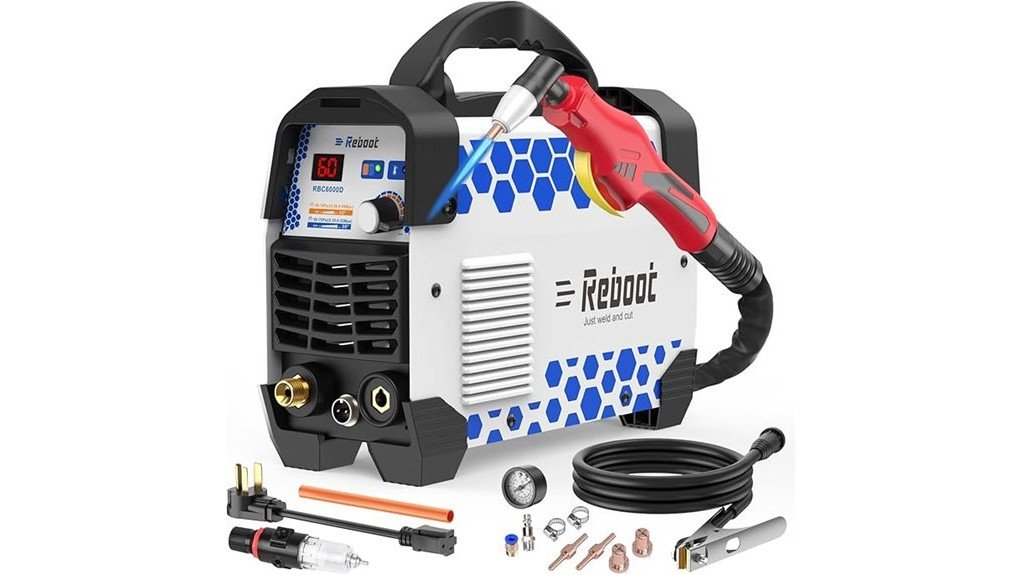
| Included Components | RBC6000D machine, PT31 torch and tips, earth ground clamp, and English manual |
| Protection | Listed overheating and overload protection |
| Warranty Note | The listing states a 1-year warranty; confirm current terms with the seller before purchase |
Before You Buy: This ASIN is the RBC6000D touch-arc model, not the RBC6000DL non-touch pilot-arc version. It also needs an external compressor and a suitable electrical circuit, so check your shop power, outlet, breaker, plug setup, and air capacity before ordering.
What Is the Reboot RBC6000D?
The Reboot RBC6000D is a portable air plasma cutter for conductive metals. It uses an IGBT inverter, compressed air, and a PT31 touch-arc torch to cut steel, stainless steel, aluminum, and copper. The machine is aimed at DIY users and small workshops rather than continuous industrial production.
Its dual-voltage system lets you run a lower 10 to 35A range on 120V or a higher 30 to 60A range on 240V. That makes it useful when you need basic portability but still want access to stronger output in a properly equipped shop.
The listing also identifies this as the 2025 upgraded RBC6000D with a pre-installed air regulator. You still need a separate air compressor that can supply at least 90 PSI and 60 L/min, while the cutter’s operating guidance is 70 to 75 PSI.
Who Should Buy It?
Best For
- DIY users cutting brackets, sheet metal, signs, and repair parts
- Automotive hobbyists removing damaged panels or trimming fabrication pieces
- Home shops that have both a suitable compressor and access to 120V or 240V power
Skip If
- You need non-touch pilot-arc starting for frequent work on rusty, painted, or expanded metal
- You cut thick plate every day and need verified production duty-cycle charts
- Your compressor or electrical circuit cannot meet the listing requirements
Feature-by-Feature Review
Dual-Voltage Power and Amperage
The RBC6000D automatically supports 120V and 240V input. On 120V, its listed output range is 10 to 35A. On 240V, the range rises to 30 to 60A. This lets you use common household power for lighter jobs and move to 240V when you need more cutting current.
Voltage alone does not guarantee a good cut. Your branch circuit must support the machine, and the listing calls for a 50A breaker on 120V or a 40A breaker on 240V. Treat those figures as manufacturer guidance, not permission to change wiring yourself. Follow the manual and use a qualified electrician when your outlet, plug, conductor size, or breaker is uncertain.
Touch-Arc Operation and Controls
This version uses a touch-arc PT31 torch. You start the cut by bringing the torch tip into contact with the workpiece as directed by the manual. That setup is simple and uses widely available PT31-style consumables, but it is not the same as a non-touch pilot arc.
The front controls provide amperage adjustment and air-pressure guidance. This basic layout can be easier for a first plasma cutter than a machine with several advanced modes. The tradeoff is that the listing does not provide a detailed cut chart for every material and thickness.
Cutting Capacity and Material Range
Reboot lists up to 1/2 inch steel at 120V/35A and up to 5/8 inch at 240V/60A. Those are upper-end capacity figures, not a promise that every cut will be fast, square, and nearly slag-free. For cleaner work, stay below the maximum, use fresh consumables, and make a test cut on scrap from the same material.
The cutter is listed for steel, stainless steel, aluminum, and copper. Each metal conducts heat differently, so travel speed and edge quality can change even at the same thickness. Coatings, rust, paint, mill scale, and poor grounding can also affect arc stability.
Air Regulator and Compressor Needs
The pre-installed air regulator reduces setup work, but the machine does not include a built-in compressor. Reboot calls for an air source rated at 90 PSI and 60 L/min or more, with operating guidance of 70 to 75 PSI at the cutter.
Clean, dry, steady air matters as much as amperage. Moisture and oil can shorten consumable life and cause rough or unstable cuts. A water separator or dryer near the machine is a useful shop upgrade when your compressor produces wet air.
Portability and Shop Storage
The listing describes an 8.69-pound machine body with dimensions of 11.73 x 4.37 x 8.86 inches. That size is easy to carry between a bench, vehicle project, farm shed, or outdoor repair area. It also takes less shelf space than many larger shop cutters.
Portability does not make the full setup cordless or compressor-free. You still need power, an air hose, a ground connection, and safe clearance around the work. Plan around the complete cutting system, not only the machine’s weight.
Included Parts and Consumables
The listing includes the RBC6000D machine, PT31 torch and tips, earth ground clamp, and English manual. PT31 consumables are common, which can make routine replacement easier than with a less familiar torch system.
The current listing also states a 1-year warranty and US-based support. Warranty coverage, exclusions, and service steps can change, so save your order record and confirm the current written terms before relying on a support claim.
Setup Tips Before First Use
- Confirm the exact model. Make sure you received the RBC6000D touch-arc version shown on the listing, not another Reboot variant with a different torch or starting method.
- Check the electrical supply. Match the input voltage, outlet, breaker, plug, and extension-cord guidance to the manual. Avoid light household extension cords.
- Prepare clean air. Use a compressor with enough flow, drain the tank, and add moisture control when needed.
- Inspect consumables. Seat the PT31 electrode, nozzle, and retaining parts correctly before applying power.
- Attach the ground clamp to clean metal. Remove paint, rust, or scale at the clamp point when practical.
- Start on scrap. Set pressure and amperage, then adjust travel speed before cutting the finished part.
Pro Tip: Mark a small test grid on scrap and record the voltage, amperage, pressure, and travel speed that give the cleanest edge. That simple reference saves time when you cut the same metal again.
Electrical, Air, and Cutting Safety
Plasma cutting creates intense light, hot sparks, fumes, molten metal, noise, and an electrical circuit through the workpiece. Wear plasma-rated eye and face protection, flame-resistant clothing, leather gloves, hearing protection, and closed footwear. Keep bystanders shielded from the arc.
Cut only in a ventilated area and remove flammable materials from the spark path. Be especially cautious with coated, painted, plated, or unknown metals because heat can release hazardous fumes. Never cut a closed container, fuel tank, pressure vessel, or part that may hold a flammable residue.
Keep the machine and connections dry. Turn off and unplug the cutter before inspecting the torch or changing consumables. Follow the Reboot manual for grounding, air-pressure adjustment, post-use cooling, and maintenance. When your circuit or material is uncertain, stop and get qualified help.
How It Performs in Real Use
Sheet Metal and Brackets
The lower amperage range is useful for trimming sheet metal, making tabs, and cutting brackets. A steady hand or straightedge can improve line quality. Thin metal can warp if you pause too long, so keep the torch moving and practice on scrap.
Automotive Repair
For body panels, exhaust brackets, and repair sections, the compact machine is easier to move around a vehicle than a large shop cutter. Remove nearby trim, wiring, fuel lines, and flammable insulation before cutting. The spark stream can travel farther than expected.
Metal Art and Property Repairs
The RBC6000D can suit signs, decorative shapes, gate repairs, and farm equipment maintenance when the material fits its output range. The PT31 touch-arc setup is straightforward, but detailed curves and pierces will consume tips faster than long straight cuts.
Thicker Steel on 240V
The 240V setting unlocks the full 30 to 60A range and the listing’s 5/8-inch upper capacity. Expect slower travel, more dross, and greater consumable wear near the maximum. Buyers who regularly need clean cuts at that thickness should compare larger pilot-arc machines with published duty-cycle and cut-chart data.
Pros and Cons
Pros
- 120V/240V automatic dual-voltage operation
- Up to 60A output on 240V for a wider cutting range
- Compact 8.69-pound listed machine weight
- Pre-installed air regulator and clear pressure guidance
- Common PT31 torch consumables and useful starter components
Cons
- Touch-arc starting is less convenient than non-touch pilot arc for some surfaces and jobs
- Requires a capable external compressor and a suitable high-current circuit
- No detailed duty-cycle table or material-by-material cut chart is confirmed in the listing
Is It Worth the Price?
The Reboot RBC6000D sits in the budget-oriented DIY class. It offers strong value when you need dual voltage, up to 60A output, a compact body, and common PT31 consumables without paying for a larger professional system.
You get the most value when you already own a suitable compressor and have a compliant electrical setup. The machine is less attractive when you must also upgrade your air system or wiring, or when a non-touch pilot arc is central to your work.
Do not judge value by maximum thickness alone. Consumable cost, air quality, circuit requirements, support terms, and how often you cut are more important over the life of the machine.
How It Compares to Alternatives
The Lotos LTP5000D is worth comparing if you want a known 50A dual-voltage option with pilot-arc capability. The PrimeWeld CUT60 is a stronger comparison for buyers who want a more established 60A shop machine and broader documentation. The YESWELDER CUT-55DS line may suit users who want a digital interface or non-high-frequency options, depending on the exact version.
The Reboot RBC6000D makes the most sense when low machine weight, straightforward touch-arc operation, PT31 consumables, and 120V/240V flexibility matter more than advanced modes or production-focused specifications.
Frequently Asked Questions
Is this the RBC6000D touch-arc or pilot-arc model?
This ASIN is listed as the RBC6000D touch-arc style. Do not confuse it with the RBC6000DL non-touch pilot-arc model, which has a different starting method and may use different setup guidance.
Can the Reboot RBC6000D run on a normal 120V outlet?
The machine supports 120V, but that does not mean every household outlet is suitable. The listing gives specific breaker guidance, so confirm the manual, receptacle, plug, conductor size, and circuit capacity before use.
What size air compressor does it need?
Reboot lists an air source rated at 90 PSI and at least 60 L/min. The cutter’s operating guidance is 70 to 75 PSI, so your compressor must maintain adequate flow rather than only reaching the pressure briefly.
How thick can the RBC6000D cut?
The listing states up to 1/2 inch steel at 120V/35A and up to 5/8 inch at 240V/60A. Actual edge quality depends on metal type, air quality, consumable condition, grounding, and travel speed, so plan below the maximum when you need a cleaner cut.
What metals can it cut?
Reboot lists steel, stainless steel, aluminum, and copper. Plasma cutting works on electrically conductive metal, but settings and cut quality vary by alloy, coating, thickness, and surface condition.
Which consumables fit this plasma cutter?
The listing identifies PT31 consumables and includes a PT31 torch with tips. Match replacement electrodes, nozzles, cups, and torch parts to the manual and the exact RBC6000D torch before ordering.
Does it include everything needed to start cutting?
The listing includes the machine, PT31 torch and tips, earth ground clamp, and English manual. You still need a suitable external air compressor, air connection, compliant power source, PPE, and metal-safe work area.
Who should choose a different plasma cutter?
Choose another model if you need non-touch pilot arc, frequent cutting on mesh or heavily coated metal, published production duty-cycle data, or clean daily cuts near 5/8 inch. A larger professional unit may cost more but fit those jobs better.
The Bottom Line
The Reboot RBC6000D is a practical compact cutter for DIY fabrication, automotive repair, metal art, and occasional property work. Its dual-voltage input, 60A maximum output, light listed weight, and PT31 consumables are useful strengths, while touch-arc starting and demanding air and circuit needs are the main limitations.
Buy it when your shop already has the right compressor and electrical supply, and when occasional thin-to-medium metal cutting is the goal. Skip it for daily production, non-touch pilot-arc work, or repeated clean cuts near the listed maximum thickness.
Ready to Buy?
Check the latest price, package details, and current warranty terms before you decide.