Plasma cutters turn compressed gas into a focused, high-temperature plasma arc that cuts conductive metal fast, cleanly, and with strong control.
Choose too little amperage, and your cuts slow down, edges get rough, and consumables wear faster. This guide explains how plasma cutting works, what parts matter, and how to match a system to your metal thickness, power, and shop needs.
Quick Answer
A plasma cutter uses an electric arc and high-speed gas to melt and blow away conductive metal. For routine work, match the machine’s amperage to the thickness you cut most often, not the thickest piece you may cut once. Clean, dry air, the right consumables, and proper safety gear have a major effect on cut quality.
Key Takeaways
- Plasma cutters work only on electrically conductive metals, such as mild steel, stainless steel, aluminum, copper, and brass.
- Amperage sets the practical cutting range, but gas quality, torch setup, and duty cycle also affect results.
- Clean-cut capacity means usable edge quality, while severance capacity means the machine can separate thicker metal more slowly.
- Handheld systems suit repair and field work, while mechanized and CNC systems suit repeatable production cutting.
- Noise, arc glare, fumes, and electric shock risks make hearing protection, ventilation, and proper personal protective equipment essential.
What’s in This Article
- Understanding Plasma Cutting Technology
- Essential Components of a Plasma Cutter
- Materials and Thickness Capabilities
- Types of Plasma Cutting Systems
- Choosing the Right Plasma Cutter for Your Needs
- What Affects Plasma Cut Quality?
- Basic Plasma Cutter Maintenance
- Frequently Asked Questions
- Final Thoughts
Understanding Plasma Cutting Technology

Among modern metalworking methods, plasma cutting offers one of the fastest ways to cut conductive metal with good precision.
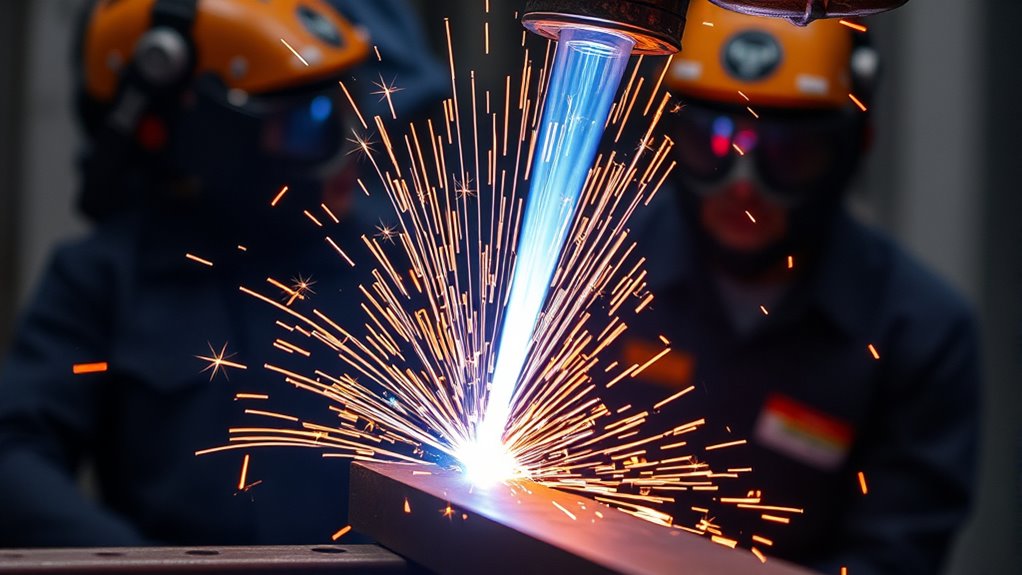
The process uses gas ionization to create a conductive arc that can reach about 40,000 °F (~22,000 °C). That heat melts the metal while a high-speed gas jet blows molten material out of the kerf.
Plasma cutting uses superheated ionized gas to slice metal with speed and accuracy that mechanical methods can’t match.
When you pull the trigger, the cutter forces air or process gases through a tight nozzle. Common gases include air, oxygen, nitrogen, and argon-hydrogen blends.
The machine energizes that gas to form a narrow plasma jet. Depending on the system and gas setup, you can cut thin sheet metal, plate, or thick industrial stock.
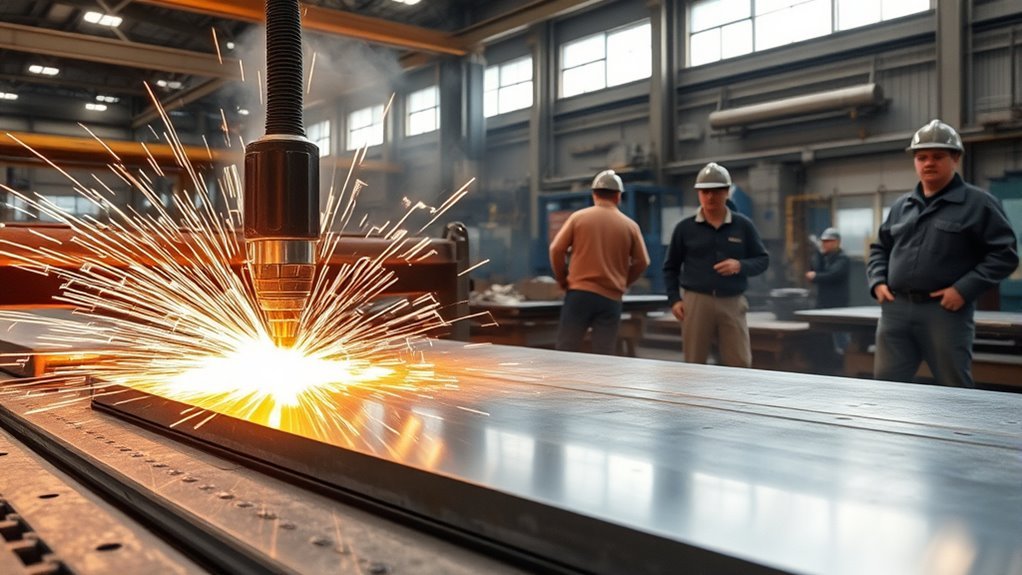
You’ll see three common setups: handheld units, mechanized tables, and full computer numerical control (CNC) systems. Fine-feature torches, arc-voltage height control, and computer-aided manufacturing (CAM) nesting can improve edge quality and reduce waste.
Essential Components of a Plasma Cutter
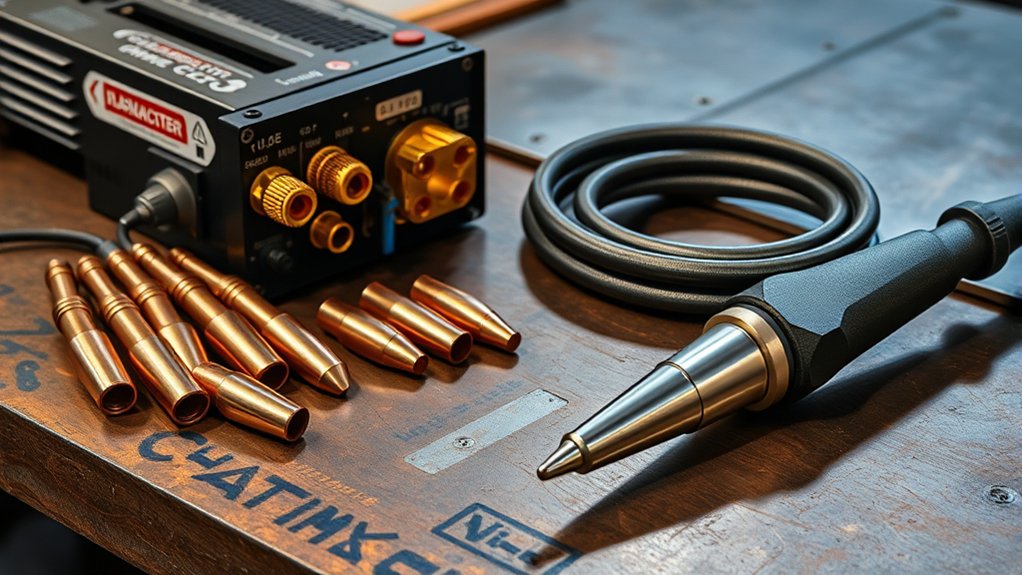
A plasma cutter works as a system, not just as a power supply. Each part affects arc stability, cut speed, edge quality, and consumable life.
| Component | Function |
|---|---|
| Power Source | Provides controlled direct current (DC) output to start and sustain the plasma arc |
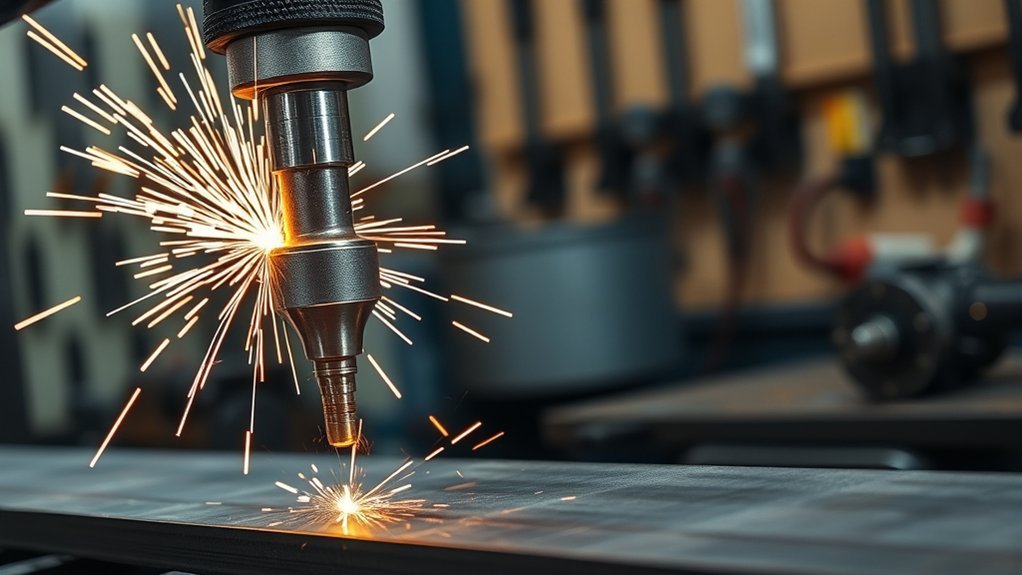
| Plasma Torch | Houses consumables, such as the electrode, nozzle, and shield, and constricts gas to form the jet |
| Gas/Air Supply & Filtration | Delivers clean, dry gas because air quality affects cut quality and consumable life |
| Work Lead (Ground Clamp) | Completes the electrical circuit through the workpiece |
| Cutting Table | Supports the work while water or downdraft designs help manage fumes and dross |
| CNC & Drives (mechanized) | Controls X-Y motion and torch height from CAD/CAM toolpaths for repeatable precision |
Materials and Thickness Capabilities
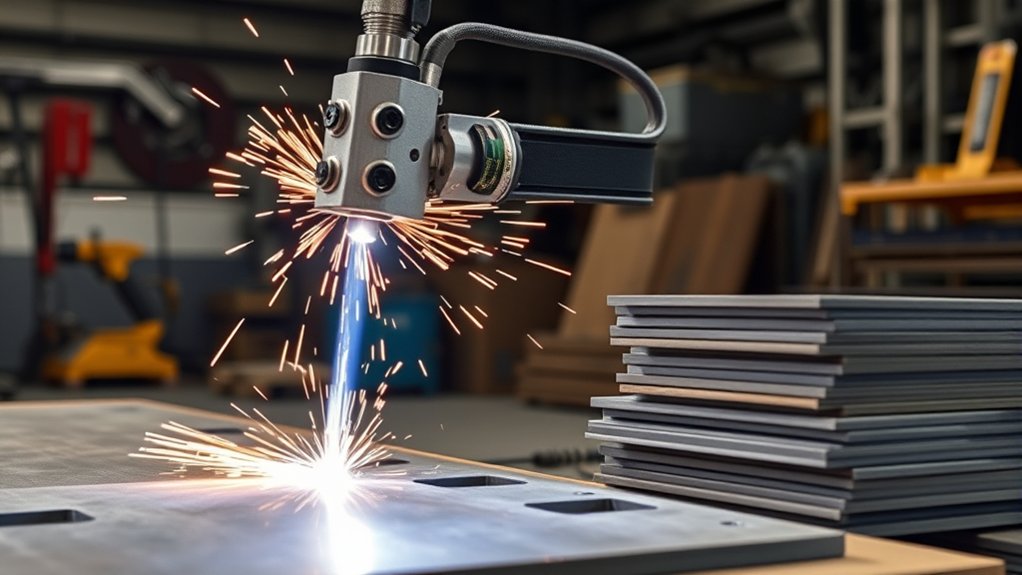
Plasma cutters cut any electrically conductive metal. Common materials include mild steel, stainless steel, aluminum, copper, and brass.
Cut capacity depends on amperage, gas, torch type, travel speed, and whether you use a handheld or mechanized setup. The table below gives practical, commonly published ranges for mild steel.
Aluminum and stainless steel often need more care at the same amperage if you want fine-feature quality. Heat input, gas choice, and surface condition can all change the final edge.
| Amperage Class | Typical Clean/Recommended Cut | Severance (edge-quality) | Common Use |
|---|---|---|---|
| 30–45 A (handheld) | ~6–16 mm (1/4–5/8″) | up to ~25 mm (≈1″) | Light fabrication, auto repair, field work |
| 65 A (handheld/mech) | ~20 mm (3/4″) | to ~32 mm (1-1/4″) | General fab, ag equipment |
| 85 A (handheld/mech) | ~25 mm (1″) | ~32–38 mm (1-1/4–1-1/2″) | Heavy fab, maintenance |
| 105 A (mechanized capable) | ~32 mm (1-1/4″) | ~38–45 mm (1-1/2–1-3/4″) | Production cutting, plate |
| ~200 A mechanized | ~25–30 mm production clean; edge to ~38 mm | ~50–57 mm (≈2–2-1/4″) | High-throughput plate cutting |
| High-power HD (300–600 A) | Clean beyond 50 mm with a specialty process | Specialized systems up to ~160 mm | Heavy industry, specialized jobs |
Reading the table: “Clean/Recommended” means you can cut that thickness with good edge quality and speed. “Severance” means the machine can separate thicker metal, usually with slower travel and rougher edges.
Types of Plasma Cutting Systems
Products Worth Considering

85A Power for Thick Metal: Adjustable 15-85A output delivers up to 1 in. clean cuts and 1.5 in. severance at full output. Put it to work on plate fabrication, trailer repairs and farm equipment projects. Cutting capacity varies with material, air supply and travel speed; severance is a maximum separation rating.
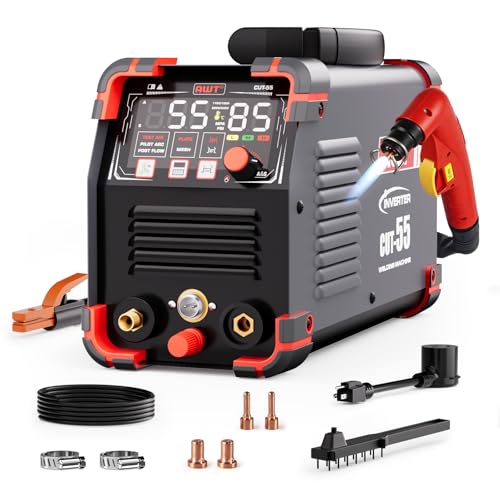
【55A HIGH-FREQUENCY NON-TOUCH PILOT ARC】The AWT CUT-55 plasma cutter utilizes 55-amp high-frequency non-contact arc-starting technology,enabling ignition without direct metal contact to minimize consumable wear.It delivers cleaner,more precise cuts effortlessly on painted,rusted,or uneven surfaces.

S45 PLASMA CONSUMABLES: These S45 series consumables are designed for stable arc and clean cutting performance. Delivers reliable results for a wide range of metal cutting tasks, from light to medium-duty work.
Handheld
Portable Versatile
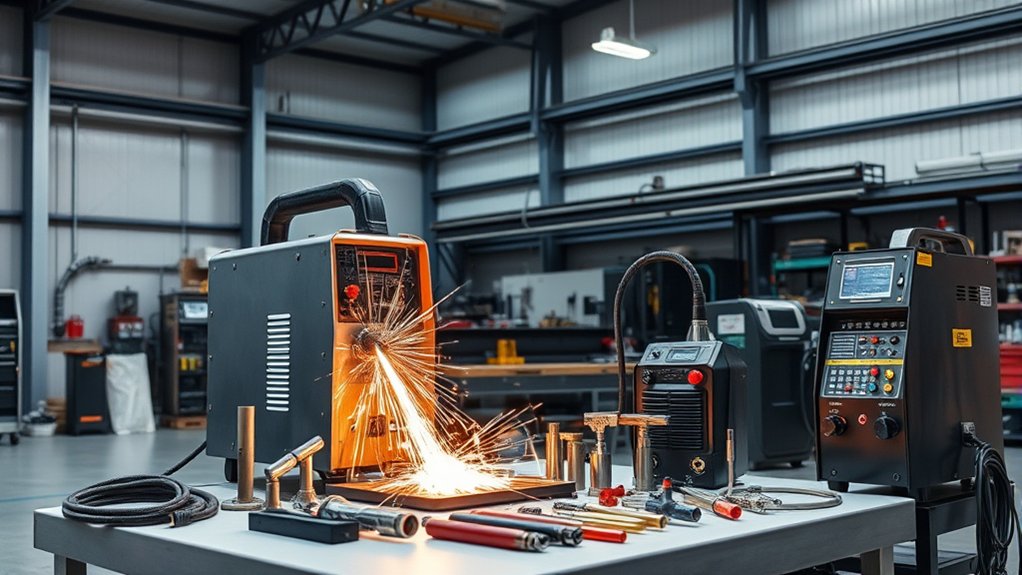
Handheld plasma cutters suit repair, field work, light fabrication, and metal art. With the right amperage, many handheld systems can clean-cut up to about 25 mm in mild steel.
Mechanized & CNC
Production Precision
Mechanized and CNC systems use controlled motion for repeatable cuts, better nesting, and more consistent torch height. They suit shops that cut many parts or need tighter repeatability.
Specialized systems handle tube, pipe, bevel cutting, drilling combos, and other production needs. Some high-definition plasma processes can also tighten the kerf and reduce edge angle.
Choosing the Right Plasma Cutter for Your Needs
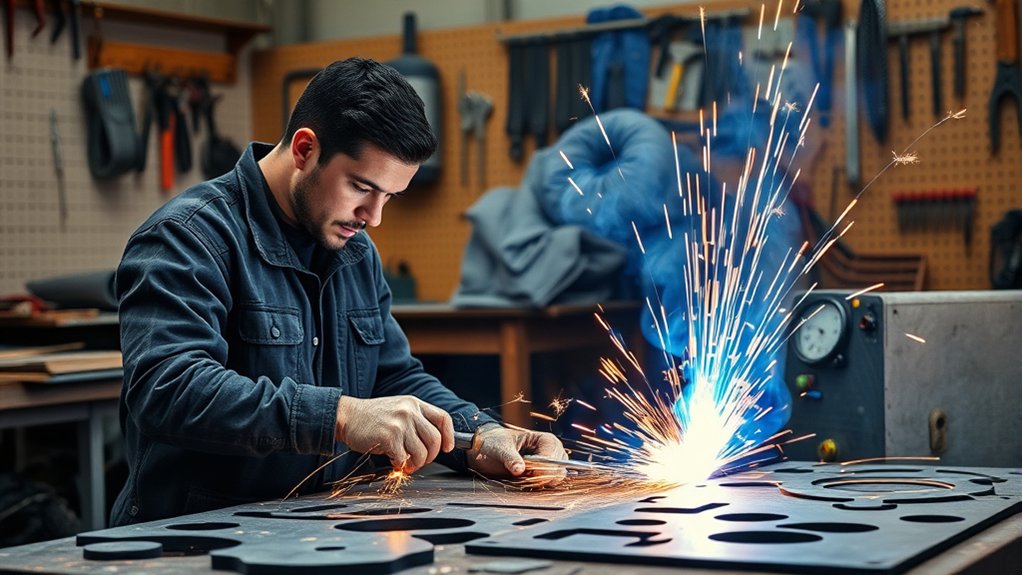
Start with the metal you cut most often. A machine that only meets your rare severance job may cost more than you need, while a machine that’s too small will slow your work.
- Material & Thickness: Size amperage to your typical clean-cut thickness, not only your thickest possible cut.
- Duty Cycle: For sustained production, target a 60–100% duty cycle at your working amperage.
- Power: Small units often run on single-phase 120/230 V. Industrial systems may need three-phase 380–480 V, depending on your region.
- Air Quality: Use dry, oil-free air to extend consumable life and improve edge quality.
- Portability vs. Precision: Choose handheld systems for mobility and CNC tables for repeatable accuracy and throughput.
- Operating Costs: Budget for consumables, gas, filters, and fume control, such as a downdraft or water table.
- Compliance: Look for CSA in the Americas and/or CE in the European Union. Some models also carry UL or ETL listings. Follow your local code requirements.
Match amps to your routine thickness: 30–45 A for thin stock, 65–85 A for 12–25 mm, about 105 A for roughly 32 mm, and mechanized 200 A+ for heavy plate production.
- Noise: Typical plasma cutting produces about ~90–115 dB(A) near the arc. Wear hearing protection.
- Fume: Use local extraction, downdraft tables, or water tables. Stainless steel and galvanized metal fumes need extra care.
- Wet Environments: Don’t use handheld equipment in wet conditions. Submerged or underwater cutting belongs to controlled, mechanized water-table processes with specific procedures.
- PPE: Wear eye and face protection rated for arc glare, flame-resistant clothing, gloves, and safety boots.
Warning: Plasma cutting can expose you to noise, fumes, arc radiation, hot metal, and electric shock, so follow the machine manual and shop safety rules before you cut.
Products Worth Considering

60A TOUCH ARC PLASMA CUTTER: RBC6000D is a fifth-generation high frequency touch arc starting mode; Torch head need to touch the metal plate (BREAKER: 50A for 120V, 30A for 240V)

Complete Consumables Kit: Includes electrodes, nozzles, shield cups, and spacer guides to meet daily replacement and maintenance needs for plasma cutting.

HIGH QUALITY: Plasma cutter accessories are made of high-quality metal and advanced ceramics, offering excellent durability and reliable performance, greatly extending their service life.
What Affects Plasma Cut Quality?
Cut quality depends on more than amperage. Torch height, travel speed, gas pressure, consumable condition, and workpiece cleanliness all change the edge.
If you move too slowly, you may get heavy dross and a wider heat-affected zone. If you move too fast, the arc can lag, bevel, or fail to cut through.
Good setup starts with the correct consumables for your amperage and material. Then set pierce height, cut height, and travel speed according to the machine manual.
Pro tip: If cut quality drops suddenly, check consumables and air moisture before you blame the power source.
Basic Plasma Cutter Maintenance
Routine maintenance helps you keep cut quality stable and avoid early consumable failure. Most basic checks take only a few minutes before each job.
- Drain moisture from the air system and confirm that filters stay clean.
- Inspect the electrode, nozzle, shield, and retaining cap before long cuts.
- Keep torch leads away from sharp edges, hot metal, and pinch points.
- Clean the work clamp contact area so the circuit stays reliable.
- Follow the manufacturer’s service schedule for internal cleaning and inspection.
Frequently Asked Questions
How long do consumables last?
No single “hours” number works for every shop. Consumable life depends on pierce count, cut length, gas quality, height control, amperage, and operator technique.
Use dry air, correct pierce height, correct cut height, and the right amperage-nozzle pairing. Replace worn electrodes and nozzles before they cause poor starts or rough edges.
Can plasma cutters be used in wet environments?
Don’t operate standard handheld units in wet conditions because shock risk rises fast. Submerged mechanized cutting on water tables uses specific equipment, insulation, procedures, and ventilation.
Use extra caution when cutting aluminum on water tables because hydrogen can build up under some conditions.
What safety certifications should I look for?
Check for CSA in the Americas and/or CE in the European Union. Some models also carry UL/ETL listings.
Always match the machine to your local electrical and workplace safety codes. When in doubt, ask a qualified electrician before you install industrial equipment.
How loud are plasma cutters?
Expect roughly ~90–115 dB(A), depending on current, table type, gas, material, and distance from the arc. Hearing protection is usually required in real shop conditions.
Can plasma cutters be used with CNC machines?
Yes. CNC integration gives you precise, repeatable motion, fine-feature cutting, automatic torch height control, and efficient nesting for less scrap.
What is the difference between clean-cut and severance cut?
A clean cut gives you better edge quality, faster speed, and less cleanup. A severance cut only means the machine can separate the metal, often with more dross and a rougher edge.
Do you need an air compressor for a plasma cutter?
Many air plasma cutters need a compressor that can supply enough clean, dry air at the required flow and pressure. Some small portable units include a built-in compressor, but they usually have lower output.
Final Thoughts
The right plasma cutter gives you clean, fast cuts when you match the machine to your routine material thickness. Start by choosing the right amperage, duty cycle, power input, and air setup.
Before you buy or cut, check your material range, shop power, ventilation, and safety gear. A well-matched system will help you cut faster, reduce cleanup, and keep consumable costs under control.