Disclosure: As an Amazon Associate, we earn from qualifying purchases. If you click a link on this page and make a purchase, we may receive a small commission at no extra cost to you.
A small 110V welder can be useful when you need to repair a bracket, gate, garden tool, or piece of angle iron without moving a full-size machine. The RILAND Stick Welder offers a 30-120A output range in a compact package with hot start, arc force, and anti-stick assistance. Its low weight and household-voltage input suit garage repairs and beginner practice, but its 110V power limit makes it a poor choice for thick structural work. This review explains its verified specifications, electrical requirements, practical strengths, and important limits.
Quick Verdict
Rating: 8.2/10
Best For: Beginners, home DIYers, and mobile repair work on light steel projects
Bottom Line: The RILAND 120A welder provides a useful current range, portable design, and several arc-control features at the budget end of the market. Its main tradeoffs are limited 110V output, conflicting listing measurements, and the lack of a clearly verified manufacturer warranty period.
| Specification | Detail |
|---|---|
| Brand | RILAND |
| Product type | Portable MMA/ARC inverter stick welder |
| Model family | MMA 120E/120MINI, 110V version |
| Amazon ASIN | B0D6GB2HPT |
| Input power | Single-phase AC 110V ±15%, 50/60Hz |
| Output range | 30-120A |
| Output voltage range | 21.2-24.8V |
| No-load voltage | 70V for the manual’s 110V model |
| Duty cycle | 60% under the manual’s rated test conditions |
| Maximum supply current | 20.9A maximum, 14.9A effective |
| Electrode range | 1.6-3.2mm rods according to the Amazon listing |
| Arc assistance | Hot start, arc force, and anti-stick assistance |
| Efficiency | 85% |
| Enclosure rating | IP21, not intended for use in rain or wet areas |
| Insulation class | Class F |
| Advertised weight | 4.4 lb in the product title and feature copy; Amazon technical details list 7.02 lb |
| Amazon-listed dimensions | 6.89 x 7.28 x 11.81 inches |
| Listed materials and color | Metal housing, blue finish |
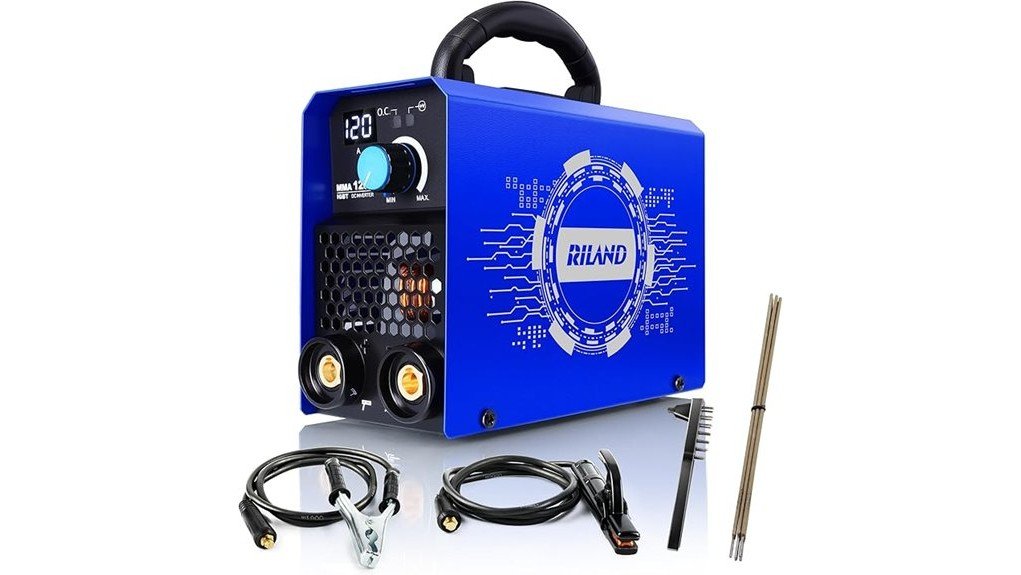
| Listed package contents | Electrode holder, ground clamp, brush, power cord, manual, basic face mask, and five welding rods |
| Returns and warranty | Amazon lists a 30-day refund or replacement period. A specific manufacturer warranty term was not verified. |
Key Takeaways
- Compact 110V design: You can run the machine from a suitable 110V branch circuit without installing a 240V outlet.
- Useful adjustment range: The 30-120A range covers small electrodes and many common home-repair jobs.
- Beginner assistance: Hot start, arc force, and anti-stick functions can make arc starts and short-arc control less frustrating.
- Portable package: The product is marketed as a 4.4-pound welder, although another Amazon specification field lists 7.02 pounds.
- Clear power limits: It is better suited to light repairs and practice than continuous work on thick steel.
- Return policy is not a warranty: Amazon’s 30-day refund or replacement window should not be confused with long-term manufacturer coverage.
What Is the RILAND Stick Welder?
The RILAND Stick Welder is a small direct-current MMA machine designed for coated stick electrodes. An inverter circuit helps reduce the size and weight compared with older transformer welders, while the front control lets you adjust output from 30A to 120A.
It is made for home maintenance, beginner practice, outdoor repairs in dry conditions, and workshop jobs where portability matters more than high output. The Amazon listing names iron, low-carbon steel, stainless steel, cast iron, angle iron, rebar, square tubing, and sheet metal among its supported materials and applications.
Material compatibility does not mean every repair is equally easy. Thin sheet can burn through with poor technique, cast iron usually needs a suitable specialty electrode and careful heat control, and critical structural welds require more skill and equipment than this compact machine is designed to provide.
Who Should Buy It?
Best For
- Beginners who want a simple stick welder for practicing beads and joints on scrap steel
- Homeowners handling light repairs on gates, brackets, garden equipment, and angle iron
- Users who value a compact machine that can be moved between a garage, shed, and dry outdoor work area
Skip If
- You regularly weld thick plate, heavy structural steel, or long high-amperage beads
- You need MIG, flux-core, or TIG capability in the same machine
- You require independently documented certification numbers or a clearly stated long-term warranty
Before You Buy: The manual lists a maximum input current of 20.9A for the 110V model. A lightly loaded 15A circuit may not support full output without voltage drop or tripping, so check the machine nameplate, your outlet, and your branch-circuit capacity before welding at higher settings. The listing also contains conflicting weight fields.
Design and Portability
Portability is the strongest reason to consider this machine. RILAND markets the welder at 4.4 pounds, making it easier to carry than many multiprocess welders. The Amazon technical table lists a higher 7.02-pound item weight, so you should treat the lower figure as an advertised machine-weight claim rather than a guaranteed boxed weight.
The Amazon-listed dimensions are 6.89 x 7.28 x 11.81 inches. That footprint is small enough for a garage shelf, vehicle tool compartment, or compact workbench. The metal outer housing offers more protection than an exposed plastic shell, but the machine should still be kept away from rain, grinding dust, impact, and welding spatter.
The package listing includes an electrode holder, ground clamp, brush, power cable, manual, five rods, and a basic face mask. That is enough to inspect and set up the machine, but the included mask should not replace a properly fitted welding helmet with the correct lens shade and suitable eye, face, and head coverage.
Welding Performance and Output
The 30-120A output range gives you more control than a fixed-output handheld welder. Lower settings support smaller electrodes and lighter material, while the upper range is intended for larger rods and thicker joints within the limits of a 110V input.
The manufacturer listing highlights stable operation near 40A for thin sheet. Low current can reduce heat input, spatter, and distortion, but stick welding remains difficult on very thin metal. A small MIG or TIG machine usually provides finer control when sheet-metal appearance and burn-through resistance are the main priorities.
The manual lists a 60% duty cycle. Duty cycle is normally measured over a ten-minute test period under stated conditions. A 60% figure means the machine may weld for about six minutes and then require cooling for the remaining period at the tested output. Actual working time can change with amperage, room temperature, airflow, input voltage, and electrode technique.
Hot Start, Arc Force, and Anti-Stick Assistance
Hot start briefly increases current during ignition. This helps establish the arc before the electrode has time to freeze against the workpiece. It is especially useful when you are learning how quickly to lift the rod after striking.
Arc force changes current response when the arc becomes very short. If the electrode moves too close to the puddle, the machine can add current to help keep the arc from going out. This does not correct poor rod angle or travel speed, but it can reduce interruptions while you build consistent hand control.
Anti-stick assistance is intended to reduce current when the rod sticks. You still need to break the electrode free safely and inspect the coating before restarting. These functions make operation easier, but they do not replace clean metal, a secure ground connection, dry electrodes, and the correct amperage setting.
Electrode Compatibility and Material Limits
The Amazon listing states support for electrodes from 1.6mm to 3.2mm. Smaller rods are usually easier to run from household power because they require less current. A smaller 6013-type electrode is a practical starting point for basic mild-steel practice, provided you follow the electrode maker’s current and polarity instructions.
A 3.2mm basic electrode can require current near the top of this machine’s range. The manual’s parameter table places some 3.2mm basic electrodes between roughly 80A and 125A, depending on position. Since this welder stops at 120A, performance with larger low-hydrogen rods may depend heavily on input voltage, joint design, electrode condition, and technique.
Stainless steel can be welded with the correct stainless electrode and suitable polarity. Cast iron is more demanding and often requires specialty rods, controlled heat, and careful cooling. Do not rely on a general compatibility claim for a safety-critical or high-value cast repair.
How It Performs in Real Use
Beginner Practice
The adjustable current knob, hot start, and arc force functions make this a more approachable practice machine than a basic fixed-setting welder. You can start on clean scrap plate, run short beads, and adjust current in small steps until the arc sounds steady and the bead wets into both sides of the joint.
Light Garage Repairs
The machine is best matched to small brackets, mild-steel frames, garden tools, angle iron, and similar non-critical repairs. Its compact body is easy to place near the work, which reduces the temptation to use overly long welding leads or move a heavy workpiece.
Thin Material
The 30A lower limit and advertised stability at 40A give you some room to reduce heat. Even so, thin sheet needs short welds, good fit-up, clean edges, and time to cool between passes. Practice on scrap of the same thickness before touching the final part.
Mobile and Outdoor Work
The light machine is convenient for fences, equipment, and property repairs where an outlet is available. The IP21 enclosure and manual warnings mean it should only be operated in dry conditions. Keep the unit off wet ground and protect it from rain, snow, dust, and direct welding spatter.
Setup Tips and Common Mistakes to Avoid
- Check the power source: Compare the welder nameplate with the outlet and circuit before use. Avoid sharing the circuit with heaters, compressors, or other high-draw tools.
- Clean the workpiece: Remove paint, rust, oil, scale, and coatings from the weld zone and ground-clamp area.
- Confirm polarity: Electrode requirements vary. Use the polarity stated by the electrode manufacturer and the connection guidance in the RILAND manual.
- Match rod size to the job: Smaller electrodes are easier to run at lower current. Do not select a large rod only because it fits the holder.
- Keep rods dry: Damp or damaged electrode coating can cause an unstable arc, porosity, and poor starts.
- Avoid excessive cable length: The manual warns that extra-long cable can reduce available output voltage.
- Watch the warning indicator: Stop welding if the abnormal or overheat light comes on. Let the fan run and allow the machine to cool.
Pro Tip: Start on scrap with a smaller electrode and set the amperage near the rod manufacturer’s recommended midpoint. Change one setting at a time, then compare arc stability, bead shape, and slag release before moving to your repair.
Electrical and Welding Safety
The Amazon listing states that the welder includes overcurrent, overvoltage, overload, and short-circuit protection. The manual also describes an abnormal indicator for overheat, overcurrent, and other fault conditions. These protections help protect the power source, but they do not remove the risk of electric shock, burns, fumes, fire, or eye injury.
The seller states that the product is UL and FCC certified. The available manual does not show certificate numbers, UL file information, or an FCC identifier. Buyers who require documented compliance for a workplace, insurance policy, or inspection should request the applicable records from the seller before purchase.
Use a suitable welding helmet, safety glasses, dry leather gloves, flame-resistant clothing, and protective footwear. Keep a fire extinguisher nearby, remove flammable materials, and provide local exhaust or forced ventilation when natural airflow is not enough.
Stainless steel, galvanized steel, painted metal, and coated parts can create hazardous fumes. Keep your head out of the plume and do not weld unknown containers, tanks, pipes, or parts that may hold fuel, gas, chemicals, pressure, or combustible residue.
Never operate the welder in rain, snow, standing water, or a damp work area. Disconnect input power before inspection or maintenance, replace damaged cables, and leave internal repairs to qualified service personnel. Review OSHA welding, cutting, and brazing guidance before setting up a home or workplace welding area.
Pros and Cons
Pros
- 30-120A adjustment range supports several small and medium electrode sizes
- Hot start, arc force, and anti-stick assistance can reduce common starting problems
- Compact housing is easy to carry, store, and position near a repair
- Runs from 110V power without requiring a dedicated 240V receptacle
- Listed kit includes the basic leads, brush, manual, five rods, and a simple face shield
Cons
- 110V input limits output and makes the machine less suitable for thick or continuous fabrication
- The Amazon listing contains conflicting weight information
- A long-term manufacturer warranty period and certification file numbers were not verified
Is It Worth the Price?
The RILAND Stick Welder sits in the budget, portable-welder category. Its value comes from giving you adjustable stick-welding output, arc-assistance features, and a basic accessory package without the size or wiring demands of a larger shop machine.
It is a strong value for the price when your work is limited to practice, maintenance, and small repairs. You get less value if you expect to weld thick material, make long production passes, or switch between MIG, TIG, and stick processes.
Factor protective equipment, suitable electrodes, metal-preparation tools, and possible electrical upgrades into your total cost. The basic accessories may help you begin setup, but a quality welding helmet and appropriate work leads are more important than a low purchase price.
How It Compares to Alternatives
RILAND’s 160A and 200A dual-voltage stick welders are better comparisons when you need 240V capability and more output headroom. They are larger and may cost more, but the added voltage option is useful for thicker steel and larger electrodes.
A multiprocess machine such as a 110V/220V MIG, Lift TIG, and stick welder makes more sense if you need cleaner thin-sheet work or several welding processes. The RILAND 120A model is the simpler choice when portability, basic stick welding, and low initial cost matter most.
Package Contents, Returns, and Support
The Amazon technical table lists one brush, one electrode holder, one ground clamp, one power cord, one user manual, one basic face mask with a welding lens, and five welding rods. Package contents can change, so check the current listing and inspect everything before connecting power.
Amazon showed a 30-day refund or replacement option at the time of this review. That is a retailer return period, not proof of a 30-day manufacturer warranty. The product page links to warranty information but does not display a clear warranty duration in the visible specification section.
Test the controls, fan, display or indicators, electrode holder, ground clamp, and cable connections soon after delivery. Do not open the machine or attempt internal repairs, since unauthorized modification may create a shock hazard and can affect warranty eligibility.
Frequently Asked Questions
Can the RILAND Stick Welder run from a normal household outlet?
It is designed for single-phase 110V input. The manual lists 20.9A maximum supply current and 14.9A effective current, so full-output use may be better suited to a properly wired 20A branch circuit. Check the nameplate, outlet, breaker, and local electrical requirements before use.
What electrodes can it use?
The Amazon listing states a 1.6-3.2mm electrode range. Smaller rods are generally easier to run from 110V power. Always follow the electrode manufacturer’s amperage, polarity, storage, and material guidance.
Is a 3.2mm 7018 electrode a good choice for this welder?
A 3.2mm basic electrode can require current near the top of the machine’s 120A range. It may work for some joints and positions, but a smaller rod is usually easier for beginners and weak household circuits. Keep low-hydrogen electrodes stored as directed by their manufacturer.
Can it weld thin sheet metal?
The listing promotes stable operation at about 40A for thinner material. Stick welding can still burn through light sheet, so use clean fit-up, a small electrode, short welds, and scrap practice. MIG or TIG may be easier when precise heat control is the priority.
Can it be used for overhead welding?
The manual includes overhead parameters for some 3.2mm electrodes, so the power source is capable of that welding position. Overhead welding exposes you to falling slag and spatter and is not a good first project for a beginner. Use full protective gear and experienced guidance.
Does it have a 30-day warranty?
Amazon lists a 30-day refund or replacement period for the product. That is a retailer return policy, not a verified manufacturer warranty term. Review the current warranty link and seller information before ordering.
Can I use an extension cord with this welder?
An undersized or extra-long cord can cause voltage drop, weak output, overheating, and nuisance breaker trips. Use the shortest cord that meets the welder’s electrical load and local code, or have a qualified electrician confirm the setup. Never use a damaged, coiled, or household light-duty cord.
The Bottom Line
The RILAND 120A Stick Welder is worth considering when you need an affordable, compact machine for beginner practice and light steel repairs from a suitable 110V circuit. Its adjustable output and arc-assistance features are useful strengths, but buyers who need thick-material capacity, multiple welding processes, documented certification records, or a clear long-term warranty should choose a more substantial machine.
Ready to Buy?
Check the latest package details, seller information, return terms, and price before you decide.