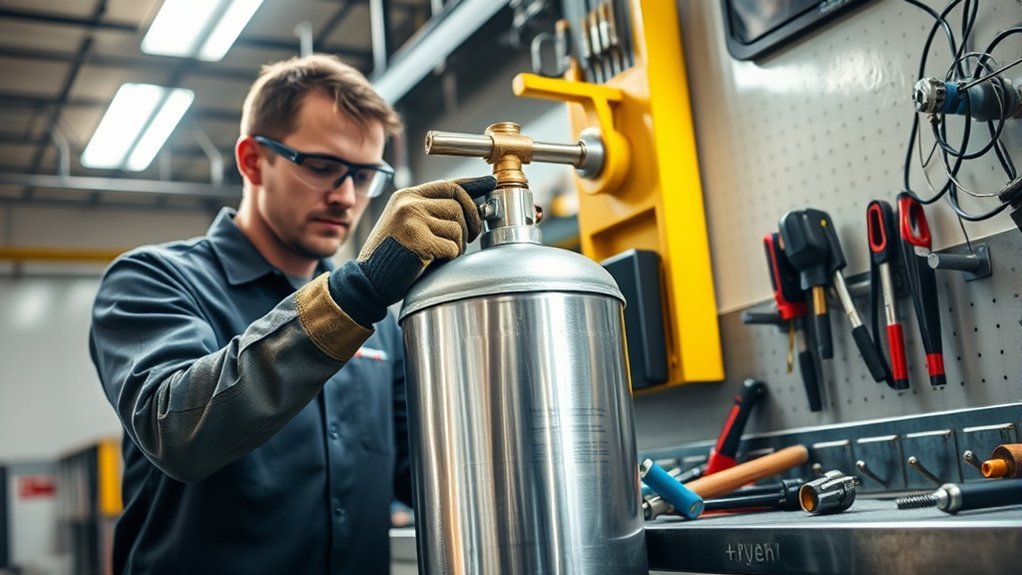
Shielding gas cylinders make welding cleaner and steadier, but they are also high-pressure containers. Treat every cylinder as a stored-energy hazard, even when it is “empty.” Before you weld, confirm the gas, secure the cylinder, inspect the valve and regulator, and keep the work area ventilated.
Quick Answer
Handle welding shielding gas cylinders by keeping them upright, capped when not in use, secured with a chain or strap, and away from heat, oil, sparks, and traffic. Read the cylinder label and SDS, use the correct regulator, test connections for leaks, and never repair a leaking valve yourself.
Key Takeaways
- Store cylinders upright, secured, dry, ventilated, and protected from heat, impact, and tampering.
- Keep oxygen away from fuel gases, oil, grease, and combustible materials.
- Move cylinders with a proper cart, with valve caps installed and regulators removed unless the cylinder is secured for service.
- Check the label and SDS before use. Never rely only on cylinder color.
- If a leak cannot be stopped safely by closing the valve, isolate the area and contact the supplier or emergency responders.
At a Glance
| Time Required | 5 to 10 minutes for a pre-use check; longer for storage setup or leak response |
| Difficulty | Basic for trained workers; higher risk in confined spaces, vehicles, or fuel-gas work |
| Tools Needed | Cylinder cart, chain or strap, valve cap, correct regulator, compatible hoses, approved leak-detection solution, PPE, and SDS access |
| Cost | Usually low if your shop already has restraints and PPE; leak solution, caps, chains, or carts may add cost |
Warning: Many shielding gases are odorless and can displace oxygen. Do not use or store cylinders in pits, tanks, trailers, small rooms, or confined spaces unless the area is tested, ventilated, and approved under your workplace safety procedure.
Importance of Proper Cylinder Storage
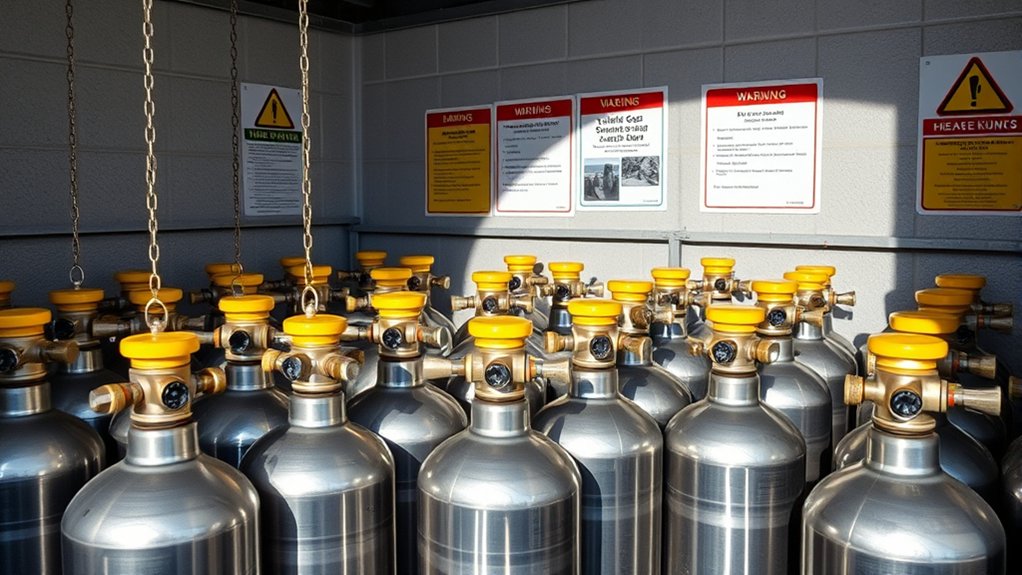
Proper cylinder storage prevents tipping, valve damage, gas release, fire hazards, and oxygen-deficient air. OSHA’s compressed gas standard requires employers to determine that cylinders under their control are in safe condition by visual inspection, and OSHA’s welding rules require cylinders to be marked so the gas can be identified.
Store shielding gas cylinders in a dry, well-ventilated area where they cannot be hit by vehicles, falling objects, grinders, welding sparks, or foot traffic. Keep cylinders upright and secure them with a chain, strap, stand, rack, or wall bracket. Do not leave a free-standing cylinder unattended, even for a short job.
- Keep valve protection caps hand-tight when cylinders are not connected for use.
- Close the valve on empty cylinders and mark them as empty according to your shop system.
- Keep cylinders away from radiators, heaters, direct flame, welding sparks, and hot slag.
- Do not store cylinders in lockers, cupboards, sealed vehicles, or other unventilated spaces.
- Protect labels and stamped markings so the gas and cylinder status remain clear.
If you store oxygen and fuel-gas cylinders, keep oxygen away from fuel gas, oil, grease, and combustibles. For oxygen-fuel gas storage, OSHA requires oxygen cylinders in storage to be separated from fuel-gas cylinders or combustible materials by at least 20 feet, or by a noncombustible barrier at least 5 feet high with a fire-resistance rating of at least one-half hour.
Note: The 20-foot oxygen separation rule applies to oxygen and fuel-gas storage. Common MIG/TIG shielding gases such as argon, helium, and argon/CO2 blends have different hazards, mainly pressure and oxygen displacement, but they still need upright, secure, ventilated storage.
Know Which Gas You Are Handling
Do not treat every welding gas cylinder the same. The main hazards change by gas type, gas blend, pressure, and location. Always read the cylinder label and the safety data sheet before connecting a regulator.
| Gas or Cylinder Type | Main Hazard | Safe Handling Focus |
|---|---|---|
| Argon and argon-rich mixes | High pressure and oxygen displacement | Ventilate low areas and confined spaces; use oxygen monitoring when required. |
| Carbon dioxide and argon/CO2 mixes | High pressure, cold discharge, and oxygen displacement | Secure the cylinder, avoid confined areas, and keep the regulator matched to the gas service. |
| Helium and helium blends | High pressure and oxygen displacement | Use good ventilation and never inhale gas from a cylinder or hose. |
| Oxygen cylinders | Oxidizer that can make fires burn hotter and faster | Keep away from oil, grease, fuel gases, and combustible material. |
| Acetylene and fuel gases | Flammable gas and explosion risk | Store valve-end up, keep away from ignition sources, and follow fuel-gas regulator rules. |
Best Practices for Transporting Shielding Gas Cylinders
Moving a cylinder is one of the easiest times to damage a valve. Use a cylinder cart or purpose-built hand truck, secure the cylinder to the cart, and keep the valve cap installed while moving it. Never drag, roll, slide, drop, or lift a cylinder by the cap.
A full cylinder can become dangerous fast if the valve is broken. Move it like stored pressure, not like scrap metal.
- Close the cylinder valve before moving the cylinder.
- Remove the regulator before moving the cylinder unless it is secured on approved service equipment.
- Install the valve cap when the cylinder is designed to accept one.
- Keep cylinders away from welding sparks, hot slag, flame, and electrical circuits.
- Do not use cylinders as rollers, work supports, grounding points, or arc-striking surfaces.
- Do not transport loose cylinders in a passenger compartment. Use a ventilated, secured method that follows your supplier and local transport rules.
Pro Tip: Keep the supplier’s emergency phone number and the SDS available before transport. If a valve is damaged during movement, you do not want to search for instructions while gas is escaping.
Products Worth Considering

Strong Weight Capacity: Our dual welding cylinder cart supports up to 440 lbs of static weight and 350 lbs of dynamic weight with ease. Whether transporting gas cylinders around the worksite or storing them, it provides stable support, suitable for home garages, workshops, repair shops, etc.

Assembled Finished Dimensions: the Welding cart measures about 8" x 10" Base 41" High with Solids Rubber 8" Tires, fits an 8-inch welding tank; Providing ample space for your welding fuel cylinders while maintaining a compact and manageable size; The entire product can be easily disassembled for compact storage, saving space and ensuring convenience

MULTIFUNCTIONAL USE: Ideal for a wide range of welders such as MIG welders,TIG welders, Stick Welders, plasma cutters, as well as welding tools. This versatile cart is designed for both indoor and outdoor applications, enhancing your welding versatility.
How to Read Cylinder Labels and Identify Hazards
Read the cylinder label before every setup. Cylinder color can vary by supplier, country, and gas service, so it should never be your only way to identify a gas. The label should help you confirm the gas name or mixture, hazard class, signal word, pictograms, precautionary statements, supplier details, and handling precautions.
Understanding Label Components
Before you connect a regulator, check these label details:
- Product identifier: Confirms the gas or gas blend, such as argon, carbon dioxide, helium, oxygen, or argon/CO2.
- Signal word: Usually “Danger” or “Warning,” depending on the hazard severity.
- Hazard statements: Explain key risks, such as compressed gas, oxidizer, flammable gas, or simple asphyxiant.
- Pictograms: Show visual hazard warnings that match the gas classification.
- Precautionary statements: Tell you how to store, use, ventilate, and respond to exposure or leaks.
- Supplier information: Gives the company contact for questions, leaks, or cylinder return instructions.
If the label is missing, torn, unreadable, or does not match the SDS or work order, do not use the cylinder. Mark it as “contents unknown” or follow your shop’s quarantine procedure, then contact the supplier.
Recognizing Hazard Symbols
Hazard symbols help you act quickly, but they do not replace the full label or SDS. Use them as a first warning, then confirm the exact gas and instructions.
| Symbol or Label Clue | What It Means | What You Should Do |
|---|---|---|
| Gas cylinder pictogram | Gas under pressure | Secure upright, protect the valve, and keep away from heat. |
| Flame pictogram | Flammable gas | Keep away from sparks, flame, hot work, and static ignition sources. |
| Flame over circle pictogram | Oxidizer, such as oxygen | Keep away from oil, grease, fuel gas, and combustibles. |
| Skull and crossbones pictogram | Acute toxicity | Do not use without trained procedures, ventilation, and emergency planning. |
| “Simple asphyxiant” or oxygen-displacement warning | Gas can reduce breathable oxygen | Ventilate and use atmospheric testing where oxygen deficiency is possible. |
Importance of Safety Data Sheets
A Safety Data Sheet gives the handling information that a small cylinder label cannot fit. Under OSHA’s Hazard Communication Standard, required SDS information must be readily accessible to employees during their work shift. For cylinder handling, the most useful SDS sections are hazards identification, handling and storage, exposure controls, accidental release measures, firefighting measures, and transport information.
- Use the SDS to confirm PPE, ventilation, leak response, and first-aid instructions.
- Check whether the gas is flammable, oxidizing, toxic, corrosive, or a simple asphyxiant.
- Use the supplier’s emergency contact instructions if a valve, regulator, or fitting leaks.
- Keep SDS access available wherever cylinders are stored, transported, or connected.
Safety Tips for Using Welding Equipment
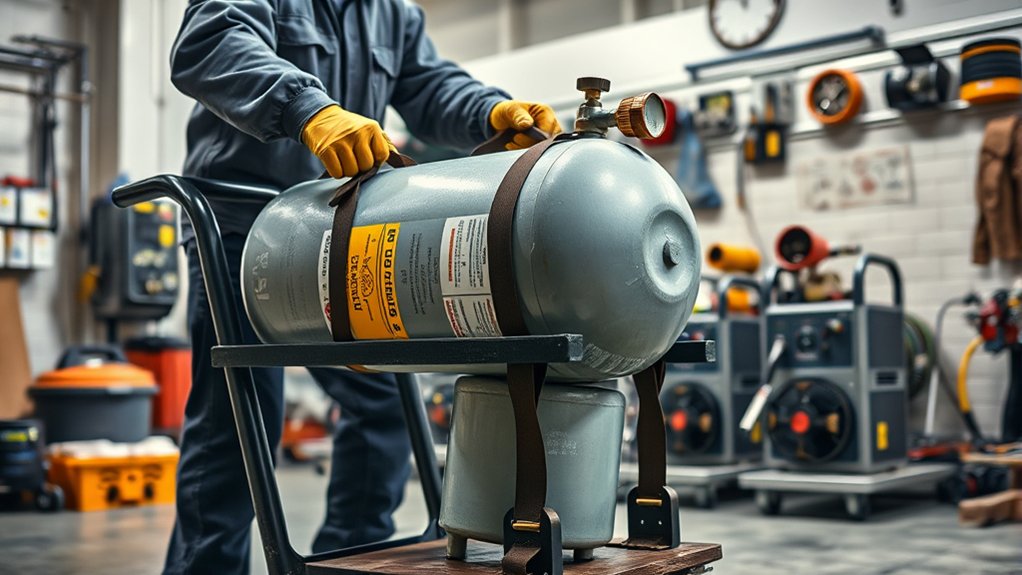
Safe cylinder handling continues after storage and transport. Before welding, inspect the torch, regulator, hose, flowmeter, fittings, and cylinder valve. Make sure the regulator is rated for the gas and pressure you are using. Never force a fitting, modify a connector, or use adapters that your supplier or equipment manual does not approve.
Use approved friction lighters for torch ignition. Do not use matches, cigarettes, or open flames to test or light gas equipment. Keep oxygen regulators, valves, couplings, hoses, and gloves free from oil and grease because oxygen can make contaminated materials ignite more easily.
Open cylinder valves slowly and stand to the side of the regulator outlet, not in front of it. If a valve is stuck, do not hit it with a hammer or use a wrench unless the valve design specifically requires a supplied wrench. If it will not open by hand or by the correct valve key, contact the supplier.
How to Inspect Cylinders and Regulators Effectively
A short inspection before each use prevents many problems. Look for cylinder damage, valve issues, label problems, wrong gas, wrong regulator, loose fittings, worn hoses, oil contamination, and missing caps before you open the valve.
Products Worth Considering

CGA580 Inlet Connection: Welding gas regulators connects easily to argon and Co2 tanks, note that a CGA-320 adapter is required for use with Co2 cylinders. This product comes standard with the CGA-580 connector only

Outstanding Design: The groove on the back of the round pressure gauge (ciferblat) serves as a safety relief valve. When pressure becomes excessively high, it releases pressure to prevent explosions

Argon/CO2 Regulator with Flowmeter: Designed for MIG and TIG welding with argon, CO2, and argon/CO2 mixed gas tanks; CGA-580 inlet fits standard gas cylinders
Visual Inspection Checklist
- Confirm the cylinder label is readable and matches the gas needed for the weld process.
- Look for dents, deep rust, fire damage, gouges, bulges, or signs the cylinder was dropped.
- Check that the valve outlet is clean, dry, and free from oil, grease, tape pieces, dirt, and damaged threads.
- Make sure the cylinder is upright and secured before removing the valve cap.
- Confirm the regulator, flowmeter, and hose are compatible with the gas and pressure.
- Inspect hoses for cracks, burns, kinks, soft spots, loose clamps, or damaged fittings.
- Check flashback arrestors and check valves where your process requires them.
Valve and Cap Functionality
Valve caps protect the valve during storage and movement. Install the cap whenever the cylinder is not connected for use and the cylinder design accepts a cap. Do not lift the cylinder by the cap, and do not pry under the cap or valve to move a stuck cylinder.
| Inspection Item | What to Check | Safe Action |
|---|---|---|
| Cylinder valve | Damage, dirt, stuck handwheel, or leaking outlet | Do not use if damaged. Close it if safe and contact the supplier. |
| Valve cap | Missing, cracked, cross-threaded, or loose cap | Install hand-tight before storage or movement. |
| Regulator | Gas service, pressure rating, clean threads, and intact gauges | Use only the correct regulator for the gas and cylinder connection. |
| Hose and fittings | Cracks, burns, cuts, loose fittings, or oil contamination | Replace damaged parts before opening the cylinder. |
Leak Detection Methods
Leak testing should be done with a product made for gas leak detection or a non-oil-based soapy water solution approved by your shop. Never use a flame to find a leak.
- Secure the cylinder upright and confirm the valve is closed.
- Attach the correct regulator and tighten fittings according to the equipment instructions.
- Stand to the side of the regulator and open the cylinder valve slowly.
- Apply leak solution to the valve outlet, regulator connection, hose fittings, and other joints.
- Watch for growing bubbles, hissing, odor warnings, frost, or pressure drop.
- If a leak appears, close the valve if it is safe, depressurize the system, and fix only user-serviceable fittings.
- If the leak is from the cylinder valve, safety device, or cylinder body, tag the cylinder and contact the supplier. Do not repair it yourself.
Warning: Never use oil-based soap on oxygen equipment, and never use grease or oil on oxygen valves, regulators, gloves, or fittings.
What to Do in Case of a Gas Leak?
If you suspect a gas leak, stop welding and treat the situation as urgent. Your exact response depends on the gas, leak size, room layout, and whether ignition or oxygen deficiency is possible.
- Stop work and warn nearby people. Keep untrained people away from the cylinder.
- Close the cylinder valve only if it is safe. Do not reach into a gas cloud, fire, or unsafe confined space.
- Remove ignition sources if the gas is flammable. Do not switch electrical equipment on or off in a suspected flammable atmosphere unless your emergency plan allows it.
- Ventilate from a safe location. Open doors or use approved ventilation only if it does not put you in the leak path.
- Move the cylinder outdoors only if trained and safe to do so. Keep it away from ignition sources and secure it upright.
- Tag and isolate the cylinder. Mark it as leaking or defective and restrict access.
- Call the supplier or emergency responders. Follow the SDS and supplier instructions.
- Do not repair cylinder valves, safety devices, or cylinder bodies. Those repairs belong to qualified cylinder personnel.
If anyone feels dizzy, confused, short of breath, weak, or unusually tired near a gas cylinder, move them to fresh air only if it is safe for you to do so, then get emergency help. Odorless gases can create oxygen-deficient air before anyone notices a smell.
What to Do if a Cylinder Falls Over
If a cylinder falls, do not rush to grab the valve. First, stop work and check for hissing, visible valve damage, broken fittings, frost, or movement. Keep sparks, flame, and hot work away from the area.
- If the cylinder is not leaking and the valve is protected, secure it before trying to upright it.
- If the valve, cap, or regulator is damaged, keep people away and contact the supplier.
- If gas is leaking, follow your leak response plan and do not attempt repairs.
- If a regulator was attached during the fall, remove it only after the cylinder valve is closed, the system is depressurized, and it is safe to work.
- Do not put a dropped cylinder back into service until it has been inspected and cleared under your supplier or workplace procedure.
Training Resources for Safe Cylinder Handling
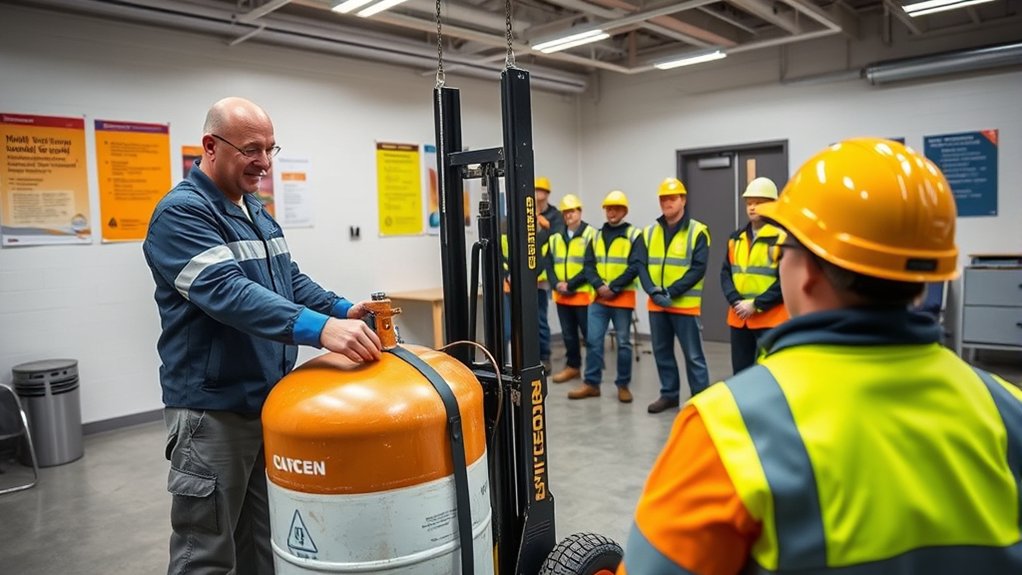
Safe cylinder handling depends on training, not guesswork. Workers should know how to identify gases, read labels, find SDS information, secure cylinders, move them with carts, connect regulators, test for leaks, and respond to emergencies.
OSHA Hazard Communication training is required at initial assignment and when a new chemical hazard is introduced into the work area. Many shops also use annual refreshers, toolbox talks, or hands-on demonstrations so workers remember the steps under real shop conditions.
- Train workers to read cylinder labels, pictograms, and SDS sections.
- Show the correct way to cap, secure, and move cylinders.
- Teach regulator compatibility and why fittings should not be forced or modified.
- Practice leak checks with approved leak-detection solution.
- Explain oxygen displacement, especially in pits, trailers, tanks, and small rooms.
- Review emergency contacts, evacuation routes, and supplier return procedures.
Note: Local fire codes, insurance rules, supplier instructions, and workplace policies may be stricter than the general guidance here. Use the most protective rule that applies to your job.
Frequently Asked Questions
What personal protective equipment is needed when handling gas cylinders?
Wear safety glasses or goggles, work gloves, safety shoes, and clothing suited to the shop hazard. For welding setup, also use the PPE required for the process, such as a welding helmet, flame-resistant clothing, and hearing protection. If oxygen deficiency, toxic gas, or confined-space exposure is possible, PPE alone is not enough. You need ventilation, atmospheric testing, and a trained emergency plan.
How often should safety training be conducted for workers?
Train workers before they handle cylinders, when their job changes, and when a new gas or new chemical hazard is introduced. Annual refreshers are a strong shop practice, but they do not replace training for new hazards, new equipment, or updated procedures.
Are there specific regulations governing cylinder storage in my location?
Yes. OSHA rules, DOT transport rules, fire code, local ordinances, supplier requirements, and workplace policies may all apply. At a minimum, confirm gas identity, secure cylinders upright, protect valves, separate incompatible gases, and keep storage areas ventilated and protected from heat and impact.
What should I do if a cylinder falls over?
Stop work, keep people back, and check for leaks, valve damage, broken fittings, or frost. Do not grab or twist a damaged valve. If the cylinder is leaking or damaged, isolate the area and contact the supplier or emergency responders. If it appears intact, secure it before uprighting it and inspect it before reuse.
Can shielding gas cylinders be reused after a leak?
Do not reuse a leaking cylinder just because the leak stopped. Tag it, remove it from service, and follow the supplier’s return or inspection instructions. A leak from a user-serviceable fitting may be corrected by trained personnel, but a leak from the cylinder valve, safety device, or cylinder body must be handled by qualified cylinder personnel.
Can I store shielding gas cylinders in a garage or small shop?
You can store cylinders in a small shop only if they are upright, secured, ventilated, protected from heat and impact, and allowed by local rules. Avoid sealed closets, enclosed vehicles, basements, pits, or small rooms where leaked gas could collect or displace oxygen.
Conclusion
Safe shielding gas cylinder handling comes down to a few disciplined habits: identify the gas, secure the cylinder, protect the valve, use the correct regulator, check for leaks, ventilate the area, and respond quickly if something is wrong. Do not rely on color, memory, or shortcuts. Read the label and SDS, follow your supplier’s instructions, and keep leaking or damaged cylinders out of service until qualified personnel clear them.
Sources
- OSHA 29 CFR 1910.101, Compressed gases general requirements — visual inspection and general compressed gas handling requirements.
- eCFR 29 CFR 1910.253, Oxygen-fuel gas welding and cutting — cylinder marking, storage, oxygen separation, valve caps, transport precautions, and leak response.
- OSHA 29 CFR 1910.1200, Hazard Communication — label elements, SDS access, and employee training requirements.
- OSHA 29 CFR 1910.146, Permit-required confined spaces — oxygen-deficient and oxygen-enriched atmosphere thresholds and confined-space atmospheric testing requirements.