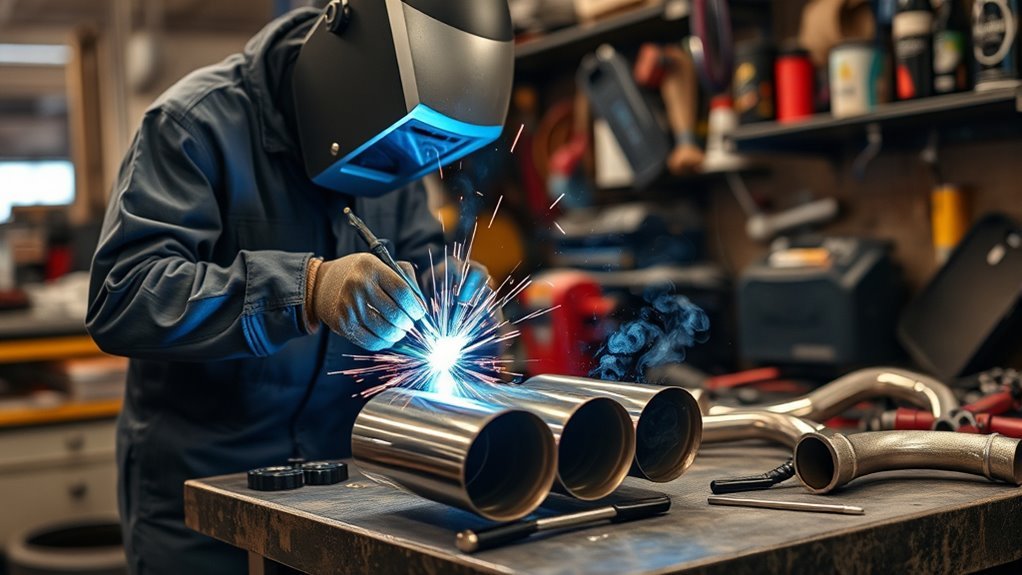
Welding exhaust headers at home is possible when you work slowly, keep the tubing clean, and control heat from the first tack to the final bead. For most DIY stainless headers, start with 304 stainless tubing around 0.065 inch wall thickness, match the filler to the base metal, back-purge the inside of the tubes with argon, and inspect every weld before the header goes back on the vehicle.
Quick Answer
To weld exhaust headers at home, clean and mock up the tubes, tack the flanges and collector, back-purge stainless tubing with argon, then TIG weld short sections with matching stainless filler. Use ER308L for 304 stainless and ER316L for 316 stainless. Let the header cool naturally, then check for pinholes, undercut, warping, and leaks.
Key Takeaways
- TIG welding gives the cleanest control on thin stainless header tubing, especially around tight bends and collectors.
- Use matching stainless filler: ER308L for 304 stainless, ER316L for 316 stainless, and ER70S-6 only for mild steel parts.
- Back-purge stainless tubes with argon to reduce internal oxidation, also called sugaring.
- Short welds, spaced tacks, and natural cooling help keep flanges flat and tubes aligned.
- Final inspection matters: look for pinholes, undercut, poor penetration, sugaring, and warped flanges before installation.
At a Glance
| Time Required | 4–10 hours for a simple repair or merge; 12–30+ hours for a full custom header set |
| Difficulty | Advanced DIY, best for someone already comfortable with TIG welding thin tubing |
| Tools Needed | TIG welder, argon cylinder, purge line, regulator, stainless filler, tungsten, grinder, saw, clamps, magnets, square, flap discs, PPE, and leak-test supplies |
| Cost | Usually $150–$600+ in tubing, filler, gas, abrasives, flanges, and collectors, not including the welder |
Warning: Welding is hot work. Remove the header from the vehicle when possible, keep fuel, oil, brake cleaner, rags, wiring, and solvents away from the arc, use proper eye and skin protection, and keep a rated fire extinguisher nearby. OSHA also warns that welding fumes and gases can be hazardous, so use adequate ventilation and avoid confined-space welding without proper controls.
Choose Materials for Exhaust Headers
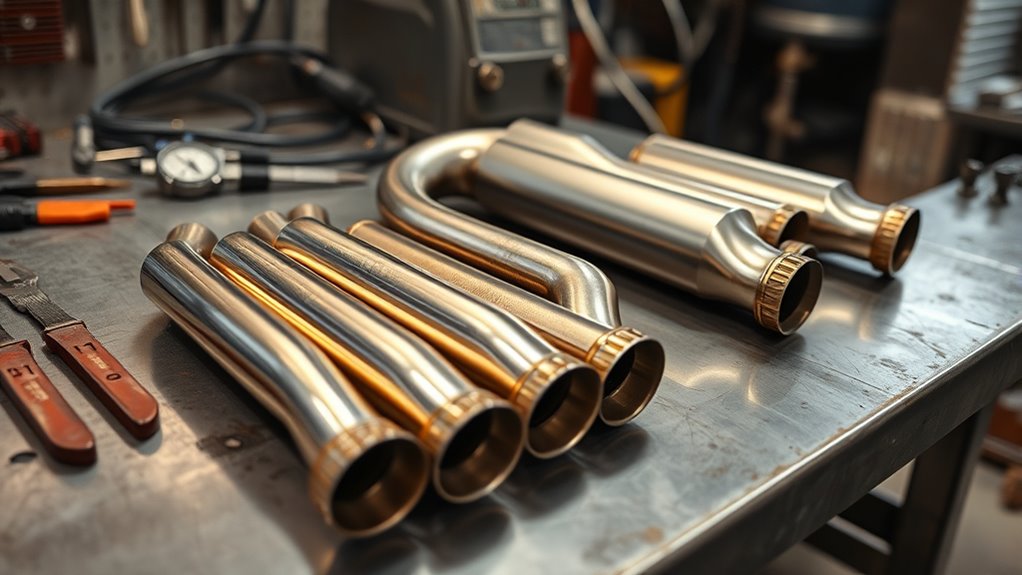
For a home-built exhaust header, material choice affects fit, weld quality, service life, and heat resistance. 304 stainless steel is the best all-around choice for most street and performance headers because it is widely available, corrosion resistant, and welds well with TIG.
316 stainless steel adds more corrosion resistance and can be useful in harsh environments, but it costs more and is not always needed for a typical car header. For high-heat racing or turbo use, 321 stainless is a premium option because it handles repeated heat cycles better, but it is more expensive and harder to source.
Mild steel can work for a budget repair, but it rusts faster and usually needs coating. If you use mild steel, do not use stainless filler as a shortcut unless you understand the dissimilar-metal tradeoffs.
| Material | Best Use | Recommended TIG Filler |
| 304 stainless | Most home-built stainless headers | ER308L |
| 316 stainless | More corrosion resistance | ER316L |
| 321 stainless | High-heat race or turbo headers | ER347 or filler recommended by the tubing supplier |
| Mild steel | Budget repair or coated header build | ER70S-2 or ER70S-6 |
For tube thickness, 0.065 inch wall is a practical starting point because it gives you enough metal to weld without making the header too heavy. Thinner wall tubing can save weight, but it burns through faster and needs better TIG control.
Before buying parts, check whether the header design is legal for your vehicle and location. On street vehicles, header changes can affect catalytic converters, oxygen sensors, emissions equipment, and inspection rules.
Products Worth Considering
![SKYMIRO 1.5 In Exhaust Flex Pipe, 304 Stainless Steel [1 1/2"] ID x 72" Universal Flexible Exhaust Tubing](https://m.media-amazon.com/images/I/41Ub2qDuAVL._SL500_.jpg)
Premium 304 Stainless Steel: Our exhaust flex pipe is constructed with authentic 304 stainless steel for superior corrosion resistance, outperforming galvanised and aluminised alternatives in harsh exhaust environments
![SKYMIRO 1.5" Exhaust Flex Pipe, 304 Stainless Steel [1 1/2"] ID x 17" Length Universal Flexible Exhaust Tubing](https://m.media-amazon.com/images/I/31ohYzHhf7L._SL500_.jpg)
Premium 304 Stainless Steel: Our exhaust flex pipe is constructed with authentic 304 stainless steel for superior corrosion resistance, outperforming galvanised and aluminised alternatives in harsh exhaust environments
![KANEDEER 1.25" [1 1/4"] ID x 16.5" Length Universal Exhaust Flex Pipe](https://m.media-amazon.com/images/I/31r-yh4f6HL._SL500_.jpg)
SIZE: 1.25" [1 1/4"] ID x 16.5" Length, pre-cut and stainless steel exhaust flex pipe
Gather Tools and Safety Gear
Set up the job before you strike an arc. You need a stable bench, good lighting, clean clamps, and enough room to move around the header without dragging the torch or filler rod across dirty surfaces.
- TIG welder with DC output and foot pedal or fingertip control
- 100% argon shielding gas and a second argon line for back-purging stainless tubing
- ER308L, ER316L, or other filler matched to your tubing
- 1/16-inch or 3/32-inch tungsten, sharpened lengthwise
- Gas lens, ceramic cups, purge plugs, aluminum tape, and small vent holes for purge flow
- Stainless-only wire brush, flap discs, belt grinder, tube notcher, saw, file, and deburring tools
- Flanges, collectors, bends, straight tubing, clamps, layout marks, and a square
- Welding helmet, gloves, flame-resistant clothing, hearing protection, safety glasses, and respiratory protection when ventilation is not enough
Note: Do not clean parts with chlorinated brake cleaner before welding. Heat and ultraviolet arc energy can create dangerous decomposition products. Use a suitable welding-safe cleaner, follow the cleaner manufacturer’s instructions, and let the parts dry fully before welding.
Products Worth Considering

Applicable Engine: Mini bike exhaust pipe replacement for Lifan 79cc engine, Lifan 105cc engine, Chinese Lifan 152-3 engine (not fit for 98cc engines or for Predator 79cc engines)

Complete 123-Piece Set:All necessary TIG torch accessories and consumables for WP-17, WP-18, and WP-26 torches.

Trusted Quality: Backed by over a decade of professional expertise in automotive repair tools, our products are chosen by numerous technicians and DIY enthusiasts.
Prep the Flanges and Tubes
Start by cleaning the flange surfaces and tube ends so the weld can fuse into bare metal, not oil, scale, paint, or shop dust. Header welds are small, so even a little contamination can cause porosity or a weak bead.
Then square the tube fit with a belt grinder, tube notcher, file, or sanding drum. The tighter the joint, the less filler you need, and the easier it is to control heat.
Mock up the header, mark each joint, and tack the parts in place so you can verify fit before final welding. Do not rely on your hands to hold alignment during final welds. Heat will pull the tubes if they are not locked down.
Clean Flange Surfaces
Before you weld, clean the flange faces and tube ends with acetone or denatured alcohol, then let them dry. Use a dedicated stainless wire brush or clean abrasive for stainless work. A brush used on mild steel can smear carbon steel contamination onto stainless tubing.
Inspect each flange for warping, pits, high spots, and burrs. Dress the surface until the tube sits flat and the flange can seal against the cylinder head. If the flange is already bowed, welding will usually make the problem worse.
Square Tube Fit-Up
With the flange faces clean and flat, set each tube against the flange and check the angle from more than one direction. Use a square, straightedge, and reference marks so every primary tube lands where it should.
Lightly bevel thick flange edges only where needed. On thin header tubing, do not grind away so much material that the edge collapses when you start the arc.
Keep gaps small and even. Large gaps force you to add more filler, which adds heat and raises the chance of distortion.
Mark and Mock Up
Mark the tubes and flanges so you can disassemble and reassemble the header without losing alignment. A paint marker, scribe, or layout tape works well, but keep marking material away from the final weld area.
- Clean every joint and remove burrs from the inside edge.
- Dry-fit the flange, primary tubes, collector, and bends.
- Check clearance around the steering shaft, frame, starter, spark plug boots, and engine mounts.
- Tack each joint after the route is confirmed.
A careful mock-up saves time because it shows fit problems before the header is fully welded.
Fit the Collector and Tight Bends
Fit the collector before final welding so you know the primary tubes meet at the right angle. Tack the collector in place, then check the header from the flange side, collector side, and top view.
Dress the collector and tube edges until the joints seat tightly. A clean collector fit gives you stronger welds and less internal turbulence. It also makes the final weld easier because the torch angle stays more consistent.
For tight bends, use smooth mandrel bends whenever possible. Small-radius bends can help with packaging, but sharp changes can hurt flow and make weld access harder. Leave enough room for the TIG cup, filler rod, and your hand position.
Pro Tip: Bolt the flange to a thick scrap head, fixture plate, or flat steel bar during tack-up and welding. The fixture helps keep the flange flat while the welds shrink.
Tack Weld the Header to Prevent Warping
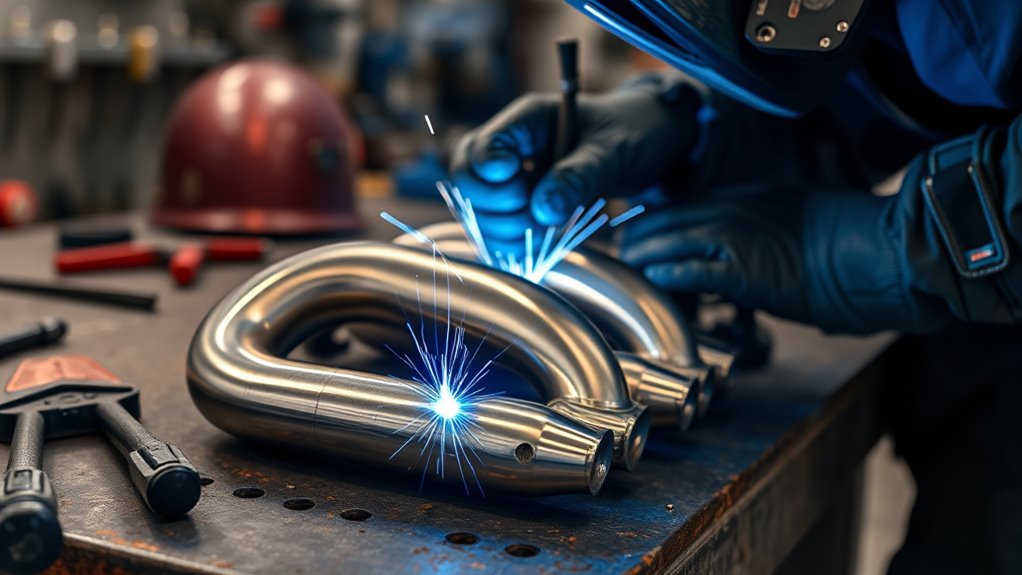
Tack weld the flanges, primary tubes, and collector before you run any full bead. Small tacks lock the layout in place and help the header resist movement as heat builds.
Place tacks at several points around each joint instead of one large tack on one side. This spreads shrinkage and keeps the tube from pulling out of square.
- Add one tack, then let it cool for a moment.
- Check alignment before adding the next tack.
- Add tacks opposite each other to balance shrinkage.
- Stop and correct the fit before the joint is fully welded.
Good tack welding gives you a fixed reference point, but it still leaves room to adjust the assembly before final welding.
Set TIG Heat and Filler Wire
For stainless exhaust header tubing around 0.065 inch wall, start with a controlled TIG setup and adjust with the pedal. A common starting range is about 40–70 amps on DCEN, depending on fit-up, tube thickness, and how fast you move. Use lower heat for thin edges and small gaps, and use more heat only when the joint needs it.
Use ER308L filler for 304 stainless and ER316L filler for 316 stainless. Use ER70S-6 only when you are welding mild steel exhaust parts. Keep filler rod clean and store it where it will not pick up oil or grinding dust.
Run 100% argon as the torch shielding gas. A gas lens helps protect the weld puddle when you need more tungsten stick-out around tight bends.
| Setting | Good Starting Point |
| Polarity | DCEN |
| Amperage | 40–70 amps for about 0.065 inch wall tubing, adjusted with pedal control |
| Shielding gas | 100% argon |
| Tungsten | 1/16 inch or 3/32 inch, sharpened lengthwise |
| Filler | ER308L for 304 stainless, ER316L for 316 stainless |
Before each weld, clean the tungsten if it touches the puddle. A contaminated tungsten makes the arc wander and can leave defects in a small header weld.
Back Purge the Stainless Tubes
When you TIG weld stainless header tubes, the outside of the weld is protected by torch gas, but the inside of the tube also needs protection. Without back-purging, oxygen inside the tube can oxidize the root side and leave a rough, dark, crusty surface called sugaring.
To back-purge, seal the tube ends with purge plugs, foil tape, or a temporary dam. Feed argon into the lowest practical point and leave a small vent hole so air can escape. Use low, steady flow. Too much purge flow can create turbulence and pull air back into the tube.
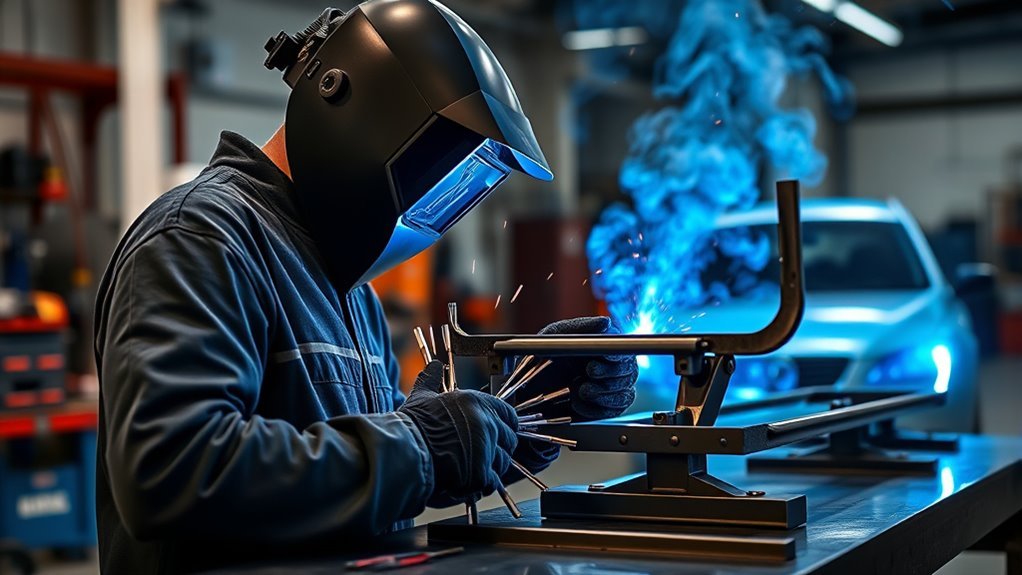
Start the purge before welding and give the tube time to fill with argon. Keep the purge running while tacking and welding the joint. Copper backers can support a thin edge or gap, but they do not replace a proper purge inside a stainless tube.
A shiny outside bead does not guarantee a clean inside weld. For stainless exhaust headers, back-purge the tube so the root side stays protected too.
Weld the Header in Small Sections
Work one short section at a time to keep heat under control. Long, continuous beads can pull the flange, move the collector, and make thin tube edges sag.
- Tack the segment.
- Verify alignment.
- Back-purge the tube if it is stainless.
- Weld a short pass.
- Move to another area so the first weld can cool naturally.
Keep the arc tight and add filler smoothly. Do not chase a large puddle around the joint. A small, steady puddle gives you better penetration control and cleaner bead shape.
Let the header air-cool naturally. Do not quench stainless tubing with water, and do not blast one hot area aggressively just to move faster. Uneven cooling can add stress and make warping harder to control.
Use Copper Backers on Problem Spots
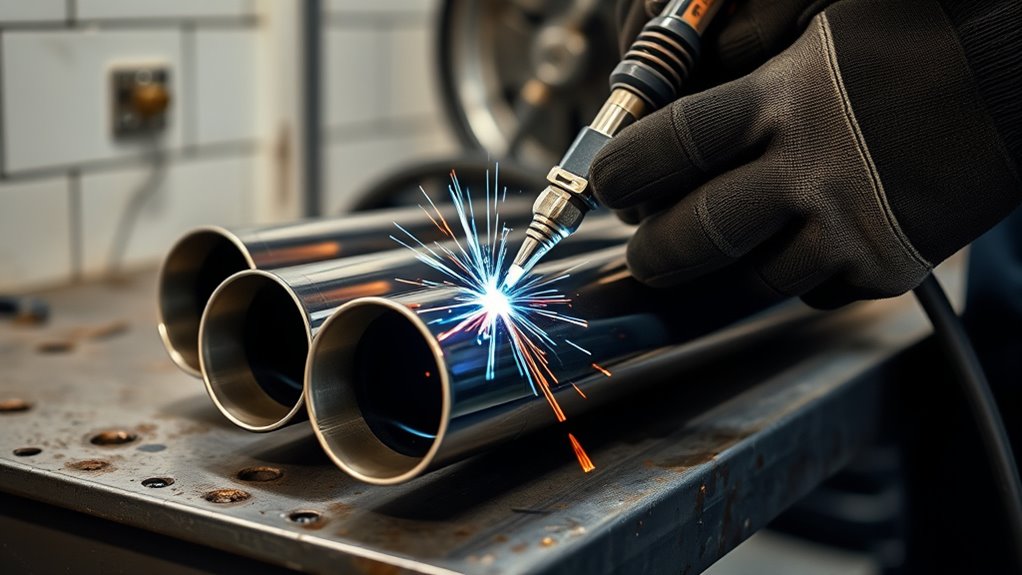
For a thin spot, small gap, or pinhole repair, hold a copper backer behind the joint. Copper absorbs heat and the weld metal will not fuse to it, so it can support the puddle while you close a small opening.
Keep the copper tight against the joint. If there is a gap between the copper and tube, the edge can still collapse. Move slowly and use short pulses of heat so you do not make the hole larger.
Use copper as a repair aid, not as a way to hide poor fit-up. If a joint has a large gap, it is usually better to refit or remake the tube end before final welding.
Clean and Finish the Welds
After welding, inspect the beads before grinding. A pretty ground surface can hide undercut, pinholes, or lack of fusion, so check the welds while you can still see the bead profile.
- Look for pinholes, cracks, undercut, sugaring, and overheated gray weld color.
- Check the flange with a straightedge to see if it stayed flat.
- Remove sharp spatter or high spots, but do not grind the tube wall thin.
- Wipe the joints clean before final installation.
If you smooth the welds, use light pressure and stop often. Header tubing is thin, and aggressive grinding can create weak spots. Focus on removing sharp edges and obvious flow restrictions, not making every bead disappear.
Leak-Test and Final Check
Before installing the header, check for leaks. Cap one end, add low-pressure air, and brush soapy water over each weld. Bubbles show a leak that needs repair. Keep pressure low because a header is not a pressure vessel.
Also check the flange bolt holes, collector angle, oxygen sensor bungs, plug clearance, and gasket surface. If the flange moved during welding, have it machined flat or correct it before installation.
After the first heat cycle on the vehicle, let the exhaust cool and recheck the fasteners. Stainless moves with heat, and a small leak is easier to fix early than after the gasket burns.
Troubleshoot Common Header Welding Problems
| Problem | Likely Cause | Fix |
| Pinholes | Dirty metal, poor fit-up, or not enough filler | Clean, add a copper backer if needed, and reweld with short controlled heat |
| Sugaring inside the tube | No back purge or poor purge seal | Seal the tube better, vent it correctly, and purge with argon before welding |
| Warped flange | Too much continuous heat or weak fixturing | Bolt the flange to a fixture, weld in a staggered pattern, and machine flat if needed |
| Undercut | Too much heat, long arc, or not enough filler at the edge | Shorten the arc, reduce heat, and feed filler into the edge of the puddle |
| Arc wandering | Dirty tungsten or contaminated joint | Regrind the tungsten, clean the joint, and check gas coverage |
Get Better at Header Welding
The fastest way to improve is to practice on scrap pieces from the same tubing before welding the real header. Cut a few sample joints, clean them the same way, purge them the same way, and test your settings.
Watch the puddle, not the filler rod. If the puddle gets wide and lazy, you are probably adding too much heat. If the bead sits high with poor tie-in, you may need a little more heat, slower travel, or better fit-up.
Keep your work clean, your tungsten sharp, and your weld sequence patient. Header welding rewards small adjustments more than speed.
Frequently Asked Questions
Can you weld an exhaust header at home?
Yes, you can weld an exhaust header at home if you have the right tools, clean material, a safe work area, and enough welding skill for thin tubing. TIG is the best choice for stainless headers. MIG can work on mild steel exhaust repairs, but it usually leaves more cleanup and less control on thin stainless tubing.
What is the golden rule in welding exhaust headers?
The golden rule is to control contamination and heat. Clean the joint, keep the fit-up tight, use the right filler, back-purge stainless tubing, and weld in short sections. Most header problems start when the weld area is dirty, too hot, poorly fitted, or not supported.
Is it better to weld exhaust headers with 110V or 220V?
For thin header tubing, a quality 110V TIG machine can work if it has stable low-amp control and enough duty cycle. A 220V machine gives more headroom, steadier output, and better duty cycle, which helps on longer jobs. Input voltage alone does not make the weld better. Setup, fit-up, purge, and skill matter more.
What is the best welding method for exhaust headers?
TIG is the best method for stainless exhaust headers because it gives precise heat control, clean starts and stops, and better control around collectors and tight bends. MIG is faster for mild steel repairs, but it is harder to keep clean on thin stainless header tubing.
Do you need to back-purge stainless exhaust headers?
Yes, back-purging is strongly recommended for stainless exhaust headers. It protects the inside of the weld from oxygen while the root is hot. Without purge gas, the inside can oxidize and turn rough, which can reduce corrosion resistance and disturb exhaust flow.
What filler rod should you use for stainless exhaust headers?
Use ER308L filler for 304 stainless tubing and ER316L filler for 316 stainless tubing. If you are welding 321 stainless, ask the tubing supplier or use a compatible high-temperature stainless filler such as ER347 where appropriate. Use ER70S-6 for mild steel, not as the default filler for stainless headers.
Conclusion
If you take your time, you can build a cleaner, stronger exhaust header at home. Start with the right tubing, clean every joint, fixture the flange, tack carefully, and TIG weld in short sections. For stainless headers, use matching stainless filler and back-purge the inside of the tubes with argon. Once the welding is done, inspect the beads, check the flange, leak-test the header, and fix small defects before installation. Careful prep matters as much as the final weld.
Sources
- OSHA 1910.252 General Requirements — welding fire prevention, eye protection, ventilation, and hot-work safety.
- CDC/NIOSH Welding Fumes and Manganese — welding fume exposure and ventilation concerns.
- Nickel Institute: Stainless Steel — 304 and 316 stainless weldability, corrosion resistance, and high-temperature properties.
- American Welding Society Standards — welding standards and code context.
- Weld Purging Technical Overview — argon purge principles and stainless root-side oxidation control.