Yes, you can run a plasma cutter from a generator, but the two machines must be matched carefully. The generator must provide the cutter’s required voltage, phase, frequency, current capacity, and stable output while also supporting any separate air compressor. Start with the exact plasma-cutter manual and generator specifications rather than estimating from cutting amperage alone.
Quick Answer
You can use a plasma cutter with a generator when the cutter manufacturer permits generator operation and the generator meets the required voltage, phase, frequency, continuous output, receptacle, and load-response specifications. Include a separate compressor’s running and starting demand, use the correct cord, and never rely on cutting-output amps to choose generator size.
Key Takeaways
- Use the cutter manufacturer’s generator rating whenever one is published.
- Input voltage and amperage are not the same as the cutting amperage shown on the front panel.
- For single-phase AC, volts multiplied by amps gives volt-amperes, not automatically watts.
- Include the running and motor-starting load of a separate air compressor.
- Low waveform distortion is helpful, but it cannot make an undersized or incorrectly wired generator compatible.
- Keep fuel-powered generators outdoors, dry, and away from doors, windows, vents, sparks, and cutting fumes.
At a Glance
| Time Required | About 15–30 minutes to compare manuals, ratings, cords, outlets, and air-supply loads before testing |
| Difficulty | Intermediate; electrical alterations, hardwiring, or uncertain grounding require a qualified electrician |
| Tools Needed | Both manuals, equipment nameplates, calculator, correct listed cord and plug, air regulator, and a suitable meter when used by a qualified person |
| Cost | No added cost when the equipment already matches; otherwise a heavier cord, separate compressor supply, or larger generator may be needed |
What’s in This Article
- Understanding Plasma Cutter Power Requirements
- The Importance of Clean Power for Plasma Cutters
- Evaluating Generator Wattage for Plasma Cutting
- Total Harmonic Distortion and Plasma Cutter Performance
- Selecting the Right Generator for Your Plasma Cutter
- Managing Power Fluctuations and Voltage Regulation
- Ensuring Generator and Plasma Cutter Compatibility
- Troubleshooting Common Power Issues
- Expert Tips for Better Generator Performance
- What Size Generator Do You Need?
- Extension Cords, Breakers, and Grounding
- Portable Generator and Plasma Cutting Safety
- Frequently Asked Questions
- Conclusion
- Sources
Understanding Plasma Cutter Power Requirements
Start with the plasma cutter’s input specifications. The output setting on the front panel—such as 30A, 40A, or 60A—describes cutting current at the torch. It does not tell you how much AC power the machine draws from a generator.
Find these details on the rating plate and in the operator manual:
- Input voltage: Common portable machines may accept 120V, 240V, or both.
- Phase: Most portable cutters are single-phase, while some larger systems require three-phase power.
- Frequency: The cutter and generator must agree, commonly at 50 or 60 Hz.
- Input current: Use the value specified for the selected input voltage and rated output.
- Breaker or fuse rating: Match the manual and applicable electrical code.
- Generator requirement: Use the manufacturer’s engine-drive or generator rating when provided.
- Air requirement: Include the required pressure, flow, and air quality.
- Duty cycle: Confirm how long the cutter may operate at a stated output and ambient temperature.
Several portable cutters can operate on either 120V or 240V. Miller notes that available input power and circuit capacity can affect the cutting output of a dual-voltage machine. Miller’s plasma cutter selection guide explains why the available circuit must be considered before choosing or operating a machine.
Do not assume that a cutter’s duty cycle allows you to use a generator below the published requirement. Some manufacturers permit reduced cutter output on a smaller generator, but only when their generator chart or manual says so.
Warning: Do not use adapters or homemade wiring to change phase, bypass a breaker, create a 240V supply from unrelated receptacles, or alter a generator’s neutral bond. Have a qualified electrician handle any hardwired connection or uncertain electrical configuration.
The Importance of Clean Power for Plasma Cutters
Clean, stable power means more than one Total Harmonic Distortion number. A plasma cutter also depends on acceptable voltage, frequency, waveform quality, generator condition, and response when the cutting load changes.
Poor generator output may contribute to:
- Hard arc starts or intermittent pilot arcs
- Overvoltage or undervoltage fault codes
- Arc dropouts during piercing or long cuts
- Reduced cutting output
- Excess heat inside the cutter
- Unstable operation when another load starts
Some generator manufacturers publish a THD rating, while others do not. If the plasma cutter manual gives a maximum THD, waveform, voltage, or frequency requirement, follow that limit. When no limit is published, use a generator that the cutter manufacturer approves or recommends and ask the manufacturer before using a questionable power source.
A low-THD inverter generator is not automatically suitable. It must still have enough continuous output, the correct receptacle and voltage, and sufficient load-response capability. Likewise, a conventional generator is not automatically unsuitable if the cutter manufacturer approves it and its output remains within specification.
Warning: Do not connect sensitive cutting equipment to a generator with unknown voltage, frequency, condition, or compatibility. An ordinary surge strip or consumer power conditioner cannot correct insufficient capacity or unsafe wiring.
Evaluating Generator Wattage for Plasma Cutting
The safest sizing method is to use the generator requirement published for your exact plasma cutter. When the manual does not provide one, input voltage and current can help you estimate the electrical load, but you must use the right units.
Correct Generator Sizing Math
For a single-phase AC load:
Apparent power in kVA = volts × input amps ÷ 1,000
If the cutter’s power factor is known:
Real input power in kW = volts × input amps × power factor ÷ 1,000
For a balanced three-phase load:
Apparent power in kVA = 1.732 × line voltage × line current ÷ 1,000
For example, a single-phase cutter drawing 30A at 240V represents 7.2 kVA of apparent load. It does not automatically draw 7.2 kW. If its power factor were 0.90, the calculated real input would be about 6.48 kW. That calculation still does not replace the cutter manufacturer’s generator recommendation, which accounts for machine behavior that a simple formula may miss.
Note: Some cutter rating plates list values such as I1max and I1eff. Do not guess which one should be used for generator sizing, breaker selection, or conductor sizing. Follow the definitions and instructions in that machine’s manual.
Generator Compatibility Factors
Generator compatibility depends on more than its advertised wattage. Check:
- Continuous kW or kVA rating
- Correct output voltage and frequency
- Single-phase or three-phase output
- Continuous current available from the required receptacle
- Breaker and receptacle ratings
- Voltage regulation under load
- Any cutter-manufacturer waveform or THD limit
- Altitude and temperature derating
- Neutral and grounding configuration
- Generator age, maintenance, and engine condition
The generator must also respond to rapid changes when an arc starts, a pierce begins, or an extended arc is used. Hypertherm notes that certain operations can produce input-current spikes and provides model-specific generator guidance for those conditions. Hypertherm’s Powermax45 SYNC generator guidance is one example.
Power Output Considerations
Use the generator’s continuous rating as the main limit. Peak or starting watts are available only briefly and should not be treated as continuous plasma-cutting capacity.
If a separate air compressor uses the same generator, add its running load and account for its motor-starting demand. Compressor startup may cause a much larger temporary load than its normal running wattage. Avoid having the compressor motor start at the same moment the plasma arc is initiated whenever possible.
Do not use a fixed 20–25% headroom rule as a substitute for the manual. Reserve capacity is helpful, especially for other tools, heat, altitude, aging equipment, and rapid load changes, but the published manufacturer rating remains the better starting point.
Total Harmonic Distortion: Impact on Plasma Cutter Performance
Total Harmonic Distortion, or THD, describes how much an AC waveform differs from an ideal sine wave. High distortion can be one sign of poor generator power, but THD is not the only compatibility test.
A generator can have a low advertised THD value and still cause trouble if:
- Its continuous rating is too low
- The required receptacle cannot supply enough current
- Voltage falls sharply under load
- Frequency changes excessively
- The generator is poorly maintained
- A compressor or other tool overloads it
- The cutter manufacturer does not approve that power source
If the generator does not publish its waveform or THD information and the cutter manual warns against unstable or dirty input power, contact both manufacturers before connecting the machines.
Harmonic Distortion Effects
Excessive waveform distortion may contribute to unstable operation, extra internal heating, nuisance fault codes, or reduced output. The exact effect depends on the cutter’s input design, so a universal THD limit should not be applied to every plasma cutter.
Automatic voltage regulation can help a generator maintain voltage as loads change, but AVR does not guarantee low distortion, correct frequency, adequate capacity, or cutter compatibility. Treat each specification separately.
Plasma Cutter Efficiency
Stable input power helps the cutter operate as designed, but it does not increase the machine’s rated efficiency or cutting capacity. Cut quality still depends on air pressure, airflow, consumables, travel speed, torch height, work-clamp contact, and the material being cut.
Use these practices to protect performance:
- Follow the manual: Use any published generator table or minimum engine-drive rating.
- Stay within continuous capacity: Do not plan around peak watts.
- Match the input: Confirm voltage, phase, frequency, breaker, plug, and receptacle.
- Control other loads: Account for the compressor and avoid overlapping motor starts.
- Maintain both machines: Service the generator and replace worn plasma consumables.
The most reliable generator-size number is the one published for your exact plasma cutter—not a guess based on cutting-output amps.
Selecting the Right Generator for Your Plasma Cutter
Choose the generator only after confirming the cutter’s exact input and engine-drive requirements. The following manufacturer examples show why cutting amperage alone cannot determine generator size.
| Plasma Cutter | Rated Cutting Output | Published Generator Guidance | Important Detail |
|---|---|---|---|
| Hypertherm Powermax30 AIR | 30A | 5.5 kW for full 30A output | Includes a built-in air compressor |
| Miller Spectrum 375 X-TREME | 30A | Engine-drive compatible at 4 kW or more | Accepts 120V or 240V input |
| Miller Spectrum 625 X-TREME | 40A | 8,000 W recommended generator power | A separate compressor load must also be considered |
| Hypertherm Powermax45 SYNC | 45A | 12.5 kVA/10 kW for full 45A output | The separate kVA and kW ratings show why the units are not interchangeable |
These figures apply only to the listed models and operating conditions. A different 30A, 40A, or 45A cutter may have a different generator requirement.
Before buying a generator, confirm:
- The plasma cutter manufacturer permits generator operation.
- The generator supplies the exact required voltage, phase, and frequency.
- Its continuous rating meets or exceeds the published cutter requirement.
- The required receptacle can provide the cutter’s input current.
- The plug, cord, breaker, and grounding arrangement are correct.
- Any separate compressor and other loads fit within the remaining capacity.
- Both machines remain adequately rated after altitude and temperature derating.
Pro Tip: When the cutter manual includes a generator table for reduced cutting current, use that table. Lowering the front-panel current without manufacturer guidance does not prove that an undersized generator is safe.
Products Worth Considering

[Powerful Cutting Ability] Dual voltage 110/220V good for home, workshop and hardware shop use. Professional performance 1/2" clean cuts on Iron, Steel aluminum and copper with Inverter IGBT Technology. Very powerful for DIY and heavy duty project. The Maximum cutting thickness is recommended to 1/2" @35A 110V 50PSI; 2/3" @50A 220V 65PSI. Dry and compressed air is required. Power breaker up to 60A@110V 35A; Up to 50A@220V 50A.
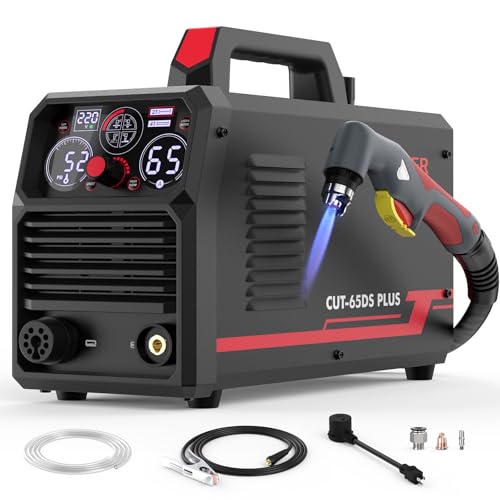
4 FUNCTIONS IN 1 MACHINE: Plate cutting, grid cutting, gouging, and marking give you more ways to handle fabrication, repair, and shop work. Plate Cutting delivers clean cuts on steel, stainless steel, and other conductive metals. Grid Cutting helps maintain a stable arc across grating and perforated metal. Gouging removes welds, rust, and damaged material. Marking creates clear guide lines for layout, hole positioning, and assembly.
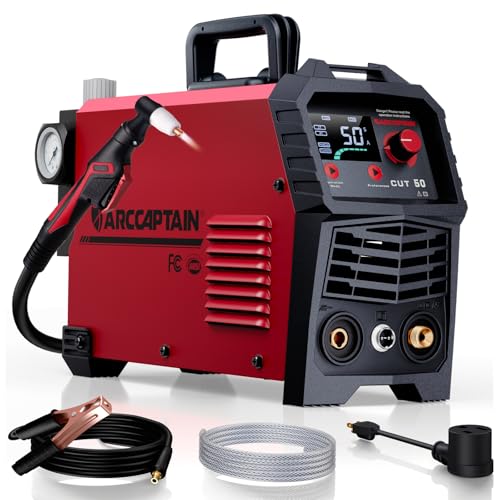
【Powerful Cutting Ability】Switch effortlessly between 110V and 220V for home or workshop use. Achieve professional 1/2" clean cuts on steel, aluminum, and copper with advanced LGBT technology. Perfect for DIY projects and heavy-duty tasks. Recommended maximum cutting thickness: 12mm @ 35A / 110V / 55 PSl; 18mm @ 50A / 220V / 75 PSI. Note: Requires compressed air (compressor sold separately).
Managing Power Fluctuations and Voltage Regulation
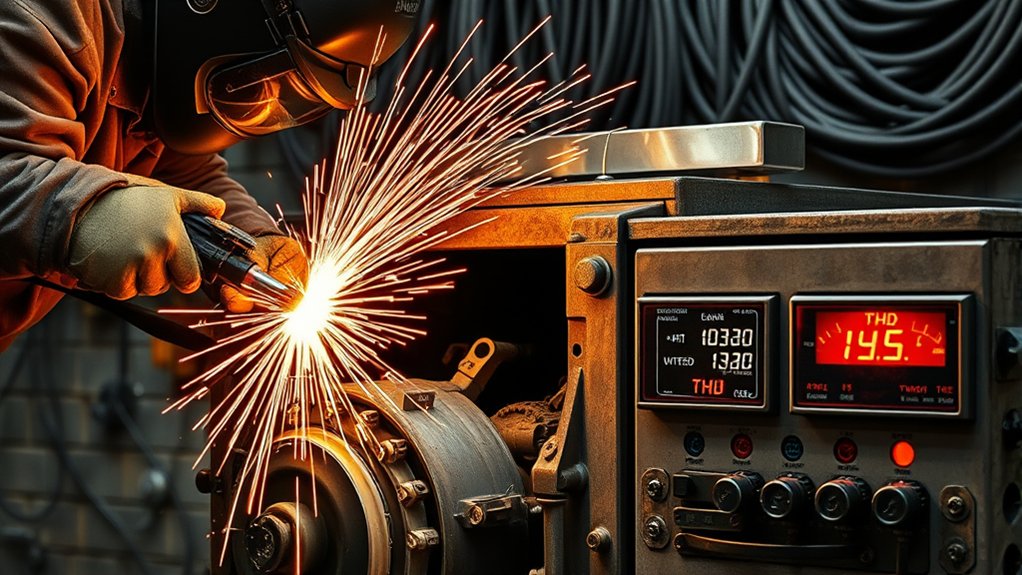
A generator may look stable with no load but drop voltage or change frequency once the cutter begins drawing power. It can also overshoot when a heavy load suddenly stops. Good load regulation helps the plasma cutter maintain a steady arc.
Use this startup sequence unless either manual instructs you differently:
- Place the generator outdoors on a dry, level surface.
- Inspect fuel lines, outlets, cords, plugs, and grounding components.
- Start and warm the generator according to its manual.
- Allow the output to stabilize before connecting or switching on the cutter.
- Charge a separate compressor tank before beginning the first test cut.
- Disconnect unnecessary grinders, lights, chargers, and other loads.
- Begin with a short test cut on scrap at an output allowed by the cutter manual.
- Watch for generator bogging, fault codes, unstable arcs, and compressor-start overlap.
Economy or automatic-idle modes may respond too slowly for some cutting loads. Do not disable those features automatically, but turn them off when the generator or cutter manual recommends it or when the manufacturer identifies them as the cause of a load-response problem.
A standard multimeter can check basic voltage and frequency when used safely by a qualified person. It generally cannot provide a complete analysis of THD or transient behavior. That work requires suitable power-quality test equipment and training.
Ensuring Compatibility Between Generator and Plasma Cutter
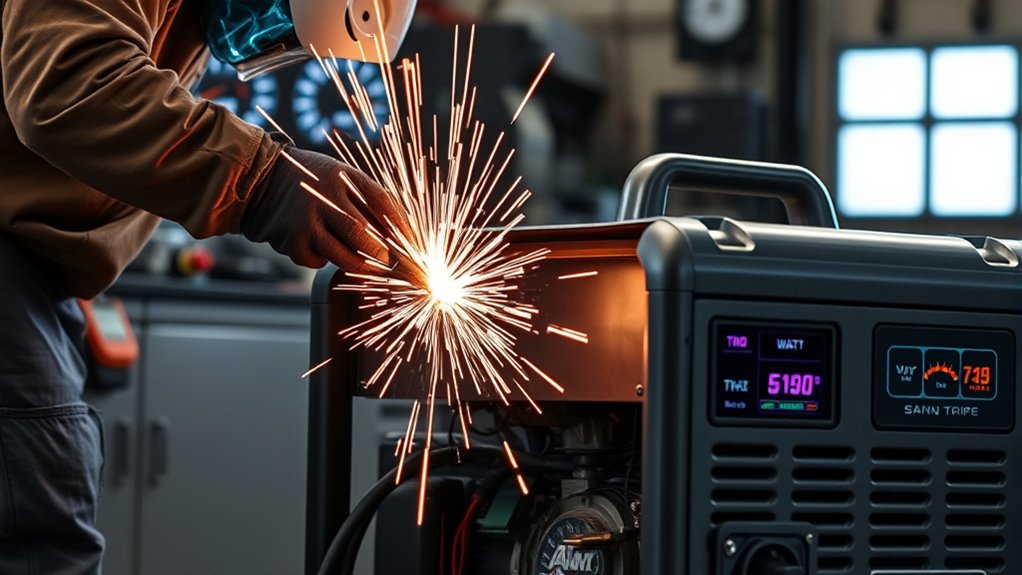
Do not judge compatibility by plug shape, generator type, or cutter age. Compare the complete specifications and follow the cutter manufacturer’s written guidance.
| Power Source | Possible Use | Main Requirement |
|---|---|---|
| Low-distortion inverter generator | Portable inverter plasma cutter | Still needs adequate continuous output, correct voltage, and manufacturer approval |
| AVR-equipped conventional generator | A cutter approved for engine-driven power | Voltage, frequency, waveform, and load response must stay within specification |
| Three-phase generator | A compatible three-phase cutter | Line voltage, phase, protection, wiring, and connection method must match exactly |
| Battery power station or solar inverter system | A cutter specifically compatible with its AC output | Continuous kW/kVA, surge behavior, waveform, 120V or 240V output, battery capacity, and grounding must all work |
| Unknown, damaged, or poorly regulated generator | Not recommended | Verify and repair the power source before connecting the cutter |
Step-by-Step Compatibility Check
- Find the exact cutter model and manual. Similar-looking models may have different input requirements.
- Record input specifications. Note voltage, phase, frequency, rated input current, breaker, plug, and any generator rating.
- Check the generator output. Use its continuous rating and the rating of the specific receptacle you plan to use.
- Add the air supply. Include a separate compressor’s running and starting demand unless the cutter has an integrated compressor.
- Confirm cords and grounding. Use only approved conductors, plugs, adapters, and bonding arrangements.
- Apply derating. Check both manuals for reduced output at altitude, high temperature, or other operating conditions.
- Perform a controlled test. Start with scrap metal, no unnecessary loads, and stop if the generator or cutter behaves abnormally.
A receptacle or adapter that physically accepts the plug does not prove that the voltage, phase, current, neutral, or grounding arrangement is correct.
Troubleshooting Common Power Issues With Plasma Cutters

Generator-related problems often appear as hard starts, breaker trips, fault codes, arc dropouts, or reduced output. However, air pressure, consumables, work-clamp contact, and cutting technique can produce similar symptoms.
Work through these checks in order:
- Read the fault code: Use the cutter manual instead of guessing from the symptom.
- Confirm generator capacity: Compare the cutter and compressor loads with continuous generator output.
- Remove extra loads: Disconnect chargers, grinders, lights, and other equipment.
- Check the extension cord: Confirm conductor size, length, plug condition, and manufacturer approval.
- Observe compressor timing: Note whether the fault begins when the motor starts.
- Inspect outlets and breakers: Look for overheating, damage, loose fit, or an incorrect rating.
- Check the air system: Verify pressure, flow, dryness, and filters.
- Inspect consumables and the work clamp: Replace damaged parts and clean the connection point.
- Test on approved utility power: When practical, this can help separate a generator problem from a cutter problem.
- Use professional testing: Have a qualified technician evaluate voltage, frequency, waveform, grounding, or internal faults.
| Symptom | Power-Supply Checks | Other Likely Checks |
|---|---|---|
| Generator bogs when cutting starts | Capacity, economy mode, engine condition, compressor motor starting, excess loads | Excessive output setting or incorrect cutting mode |
| Breaker trips | Wrong circuit rating, overload, damaged cord, poor connection, generator fault | Internal cutter fault requiring service |
| Arc starts and then stops | Voltage drop, inadequate receptacle current, compressor startup, unstable output | Low air pressure, poor work-clamp contact, worn consumables |
| Overvoltage or undervoltage code | Generator regulation, frequency, cord voltage drop, wrong voltage setting | Cutter input or control fault |
| Heavy dross or rough edge | Confirm full cutter output and stable power | Travel speed, torch height, air quality, material, consumables |
If the generator operates near its limit during every cut, stop using that combination until the manufacturer confirms a safe reduced-output setting or you obtain a properly sized power source.
Expert Tips for Optimal Plasma Cutter Performance on Generators
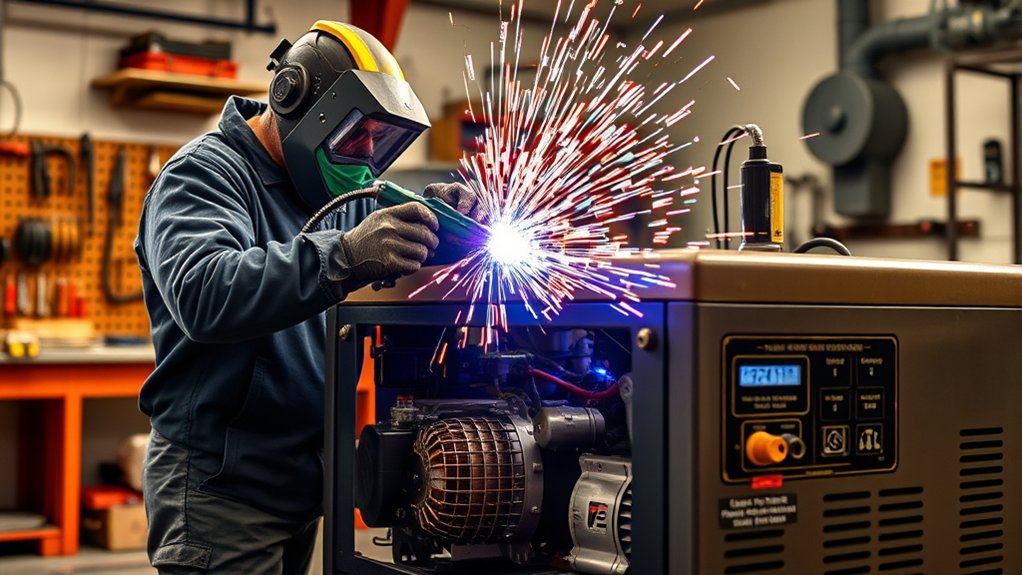
Good field performance depends on power, air, consumables, and safe setup working together.
- Charge the compressor tank first: This reduces the chance that its motor will start during arc initiation.
- Use a separate power source for the compressor when practical: This prevents its motor load from consuming generator reserve.
- Consider an integrated-compressor cutter: Its published generator rating already accounts for the built-in air system.
- Use dry, oil-free air: Follow the pressure and flow specifications in the cutter manual.
- Keep cords short: Use the conductor size required for the actual distance.
- Service the generator: Low oil, dirty filters, stale fuel, worn plugs, and restricted cooling can reduce output.
- Check altitude and temperature: Engine power and cutter duty cycle may decrease in difficult conditions.
- Inspect consumables often: Worn electrodes or nozzles can make a good power source look faulty.
- Use a clean work-clamp connection: Attach it to bare, conductive metal as directed by the cutter manual.
Note: Air-supply faults frequently resemble generator problems. Verify pressure, flow, dryness, filters, consumables, and the work connection before replacing electrical equipment.
What Size Generator Do You Need for a Plasma Cutter?
There is no universal generator size for all 30A, 40A, 50A, or 60A plasma cutters. Use this order of preference:
- Manufacturer engine-drive rating: This is the best answer when available.
- Manual generator table: It may show full and reduced cutting output for different generator sizes.
- Input kVA and power data: Use the correct single-phase or three-phase calculation when no generator rating is given.
- Additional load calculation: Add the separate compressor and every other connected device.
- Manufacturer confirmation: Ask before using a power source with uncertain waveform, output, or grounding.
For the earlier 240V, 30A single-phase example, the calculated apparent load is 7.2 kVA. That is only a starting calculation. It does not prove that a 7.2 kVA generator can operate the cutter successfully because the machine’s power factor, transient behavior, operating mode, and manufacturer requirements still matter.
A small 120V cutter may run from a 4–6 kW generator when the manufacturer permits it. Another cutter with the same output amperage may need more. Larger 240V or three-phase systems can require substantially higher ratings.
Products Worth Considering

【L14-30P to 6-50R Welder Generator Adapter Cord】: Designed specifically to solve the power interface mismatch between generators and welders, 4 prong NEMA L14-30 plug 30Amp 125/250V twist lock generator to 3 prong 6-50R for welder, rated for 250V max rate 7500 watts. Perfect for connecting welders, plasma cutters, or other 250V high-demand equipment in garages, workshops. Direct connection without circuit modification, quickly resolving the outdoor power supply problem for welders.

50 Amp Welder Adapter: our welder power adapter helps you connect welding machines or plasma cutters to stove, oven, dryer or other 10-50 power socket; Connect 10-50P plug to 3 prong 50amp outlet, and connect 6-50R receptacle to 3 prong welder plug; Support max 50 Amp overload, 250V, max wattage 12500 watts

【Non-Touch Pilot Arc Function】The ARCCAPTAIN 55A plasma cutter features a pilot arc function. It utilizes a high-frequency non-touch arc starting mode. The torch head does not need to touch the metal plate, reducing energy consumption during non-cutting work, minimizing electrode burning, and extending service life. NOTE: Do not switch voltages until the screen turns off and the fan stops.
Extension Cords, Breakers, and Grounding
Long or undersized extension cords create voltage drop and heat. A generator may have enough total capacity while the cutter still receives inadequate voltage through the cord.
Use only a cord that:
- Meets the plasma cutter manual’s conductor-size table
- Is rated for the circuit voltage and current
- Uses the correct grounding conductor
- Has listed plugs and connectors
- Is suitable for the work environment
- Is as short as practical
- Has no cuts, crushed areas, loose pins, overheating, or repairs that violate its listing
Hypertherm warns that extension cords can reduce the input voltage reaching a plasma power supply and provides model-specific conductor-size tables in its operator manuals. OSHA also requires grounding-type extension cords where grounding is needed and calls for damaged cords to be removed from service. OSHA’s flexible-cord guidance explains common cord hazards.
The plasma cutter’s work clamp is part of the cutting circuit. It is not a substitute for the equipment-grounding conductor in the input cord.
Portable-generator grounding and neutral bonding depend on the generator design and how it is connected. Under specified conditions, OSHA permits the generator frame to serve as the grounding electrode when it supplies mounted equipment or cord-and-plug-connected equipment through receptacles bonded to that frame. A setup connected to fixed wiring, a transfer system, or a separately derived electrical system may have different requirements. Review OSHA’s portable-generator grounding provisions, the generator manual, and local electrical rules.
Warning: Never add or remove a neutral-ground bond, grounding electrode, transfer connection, plug, breaker, or hardwired circuit based on guesswork. Incorrect bonding can create shock hazards or place current on metal parts. Use a qualified electrician when the configuration is uncertain.
Portable Generator and Plasma Cutting Safety
A correctly sized generator can still be dangerous when it is placed or operated incorrectly.
- Keep fuel-powered generators outdoors: Never operate one inside a garage, shop, trailer, basement, shed, or other enclosed space.
- Maintain distance: OSHA advises placing generators at least 20 feet from doors, windows, and vents, with exhaust directed away from occupied areas.
- Keep the generator dry: Do not operate electrical equipment in rain or standing water. Use only a manufacturer-approved weather arrangement that preserves airflow.
- Allow cooling space: Keep the required clearance around the generator and do not block its intake or exhaust.
- Refuel safely: Shut the generator down and allow it to cool before adding fuel.
- Control sparks and fire: Remove combustible material from the cutting area and keep hot slag away from the generator and fuel.
- Ventilate cutting fumes: Use suitable local exhaust or other controls for the material, coating, and work area.
- Wear proper PPE: Use flame-resistant clothing, gloves, hearing protection, suitable footwear, and eye and face protection with the shade specified by the cutter manual and applicable requirements.
OSHA requires suitable eye protection for cutting operations and additional ventilation or respiratory controls where hazardous fumes can accumulate. See its guidance on ventilation and protection in welding, cutting, and heating.
Warning: Never plasma-cut a sealed container or a used drum, barrel, tank, pipe, or vessel merely because it appears empty. Residue can ignite, explode, or release toxic vapor. OSHA requires used containers to be thoroughly cleaned, isolated, and properly vented or purged before hot work.
Frequently Asked Questions
Can I use solar power to run a plasma cutter?
Yes, but the solar panels do not normally power the cutter directly. You need a battery and inverter system that supplies the required continuous kW or kVA, voltage, phase, receptacle current, waveform, and short-duration load response. Many portable power stations provide only 120V, so verify whether your cutter needs 240V and whether its manufacturer permits inverter power.
Do I need an inverter generator for a plasma cutter?
Not always. An inverter generator may provide well-regulated, low-distortion output, but it still must meet the cutter’s capacity, voltage, receptacle, and manufacturer requirements. An approved conventional generator with suitable regulation may also work. Use the plasma cutter manual rather than choosing by generator type alone.
Will a 5,000-watt generator run a plasma cutter?
It may run a small cutter that is specifically rated for a generator of that size, especially at reduced output. It will not run every portable cutter. Compare the exact model’s engine-drive requirement, input voltage, receptacle current, and compressor load before connecting it.
Can the plasma cutter and air compressor use the same generator?
Yes, when the generator has enough continuous capacity and load-response capability for both machines. Include the compressor’s motor-starting demand, not just its running watts. Charge the tank before cutting and avoid having the compressor start while the cutter begins an arc.
How do weather conditions affect plasma cutter performance?
High temperature and altitude can reduce generator engine output and may reduce the cutter’s duty cycle. Rain and standing water increase electrical risk. Keep both machines dry, provide the required cooling clearance, and apply any temperature or altitude derating listed in their manuals.
What are the best safety practices when using a plasma cutter?
Wear suitable eye and face protection, gloves, flame-resistant clothing, hearing protection, and proper footwear. Remove combustibles, ventilate fumes, inspect cables, use a clean work connection, keep the generator outdoors, and never cut a sealed or previously flammable container without the required professional cleaning and hot-work controls.
How often should I maintain my generator for plasma cutting?
Follow the generator’s service schedule and shorten inspection intervals when it operates in dust, heat, or heavy jobsite use. Check oil, filters, cooling airflow, spark plugs, fuel condition, outlets, and cords before depending on it for a steady cutting load.
Are there portable options for plasma cutters and generators?
Yes. Portable dual-voltage cutters and cutters with built-in compressors can simplify field work. Match them with a generator that has the manufacturer-required continuous rating, correct receptacle, stable output, and enough capacity for every connected load.
Conclusion
You can operate a plasma cutter from a generator when the exact cutter is approved for generator power and every input requirement is met. Begin with the manufacturer’s engine-drive rating, then verify voltage, phase, frequency, receptacle current, continuous kW or kVA, cords, compressor demand, grounding, and operating conditions.
Do not size the generator from cutting amps, assume volts multiplied by amps always equals watts, or rely on one universal THD number. Keep fuel generators outdoors, inspect the complete setup, and stop if the generator bogs, the cutter faults, or any cord or connection overheats. When wiring or grounding is uncertain, have a qualified electrician review the setup before you cut.
Sources
- Hypertherm Powermax45 SYNC Generator Considerations — manufacturer guidance on generator ratings, output adjustment, and demanding arc conditions.
- Hypertherm Powermax30 AIR Specifications — published 5.5 kW engine-drive requirement and integrated-compressor information.
- Miller Spectrum 625 X-TREME Specifications — published recommended generator power and input-equipment details.
- OSHA Portable Generator Safety Reminder — outdoor placement, 20-foot separation, moisture, and carbon-monoxide precautions.
- OSHA 29 CFR 1926.404 — portable-generator grounding, bonding, and electrical-protection requirements.
- OSHA 29 CFR 1910.252 — hot-work fire prevention and used-container cleaning, isolation, and venting requirements.