As an Amazon Associate, Garage Welding may earn from qualifying purchases. This does not change the price you pay.
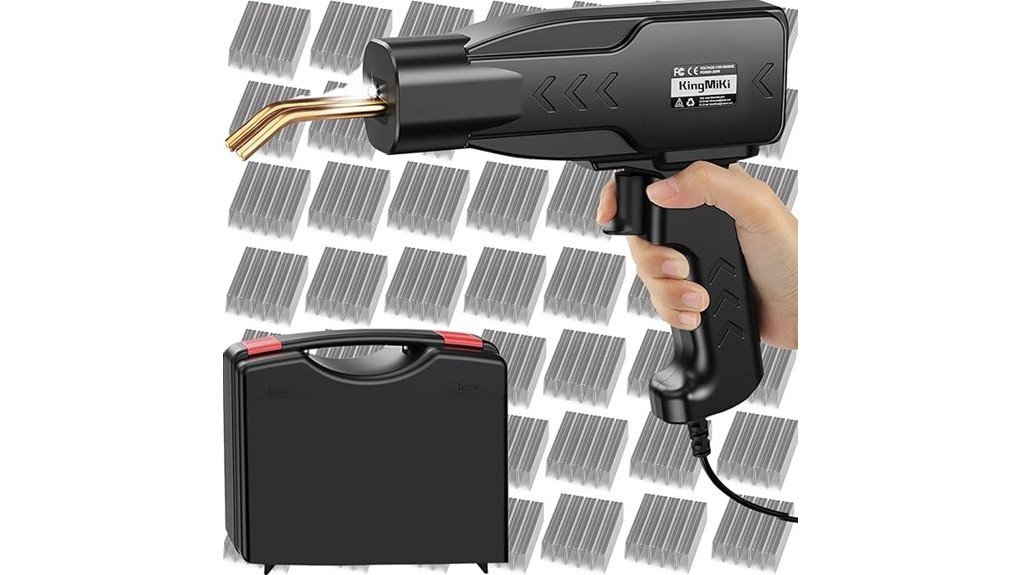
The 220W plastic welder is a compact, hot-stapler-style repair tool for cracked bumpers, brackets, bins and toys. It is worth considering if you want a higher-wattage heater for thicker household or automotive plastics at a low cost. Skip it if you want detailed instructions out of the box or heavy-duty production use, because buyers often describe a learning curve.
Quick specs at a glance
| Item | Per the listing |
|---|---|
| Type | Plastic welder, hot-stapler style |
| Power | 220 W |
| Size | About 9.76 x 8.39 x 2.83 inches |
| Weight | About 1.68 lb |
| Named uses | Bumpers, fenders, garden tools, storage bins, toys |
| Check before buying | Voltage, included staples and tips |
Check Current Price on Amazon →
What the 220W rating means for you
Wattage tells you how much power the heater can draw, not how well it welds. A higher rating generally helps the tip recover heat faster when it meets a cold, thick plastic part. That matters on bumper covers and garden equipment, where a low-powered tool may cool down as soon as it touches the work.
It is still a hot-stapler repair: it embeds metal staples to hold cracks together. If you want to melt in plastic filler instead, a hot-air tool with rods suits better, as in the ABS welding rods guide.
How to check it suits your repair
- Identify the plastic. Find the molded code on the back of the part. If there is none, test in a hidden area.
- Match the damage. Cracks and splits suit staples; missing chunks do not.
- Check thickness. Thicker parts benefit from higher heat; thin, flexible plastic can warp.
- Confirm voltage and plug. Check the listing for the supply and cord length.
- Plan for consumables. Look at what staples and tips are included and how to buy more.
- Consider the finish. Staples show unless placed on a hidden side and covered with filler and paint.
Pros and limitations
Pros
- High 220 W rating for heat recovery on thicker parts.
- Compact and light at about 1.68 lb.
- Works for a range of household and automotive plastic cracks.
- Low cost compared with hot-air plastic welders.
Limitations
- Instructions can be limited, so expect to learn by practice.
- Not suited to heavy-duty or structural repairs.
- It stitches cracks; it does not fill missing material.
- Return terms on the listing may be short, so check them before you order.
Getting good results as a beginner
- Find scrap plastic of the same type and practice staple placement first.
- Clean the area, drill stop holes at crack ends and hold the crack closed.
- Let the tool reach full temperature, then press staples in a row across the crack.
- Do not over-heat. If the plastic bubbles, smokes heavily or turns black, lower the power.
- Smooth the edges, let it cool, then sand and paint if needed.
Always use eye protection and gloves, and ventilate the room. Keep the hot tool on a stand, unplug it when finished, and wipe the tip while warm with a suitable cloth.
Alternatives and related guides
- BELEY plastic welding kit for a lower-wattage hot stapler set with a larger staple supply.
- Cordless plastic welder kit for battery-powered repairs.
- 1600W hot-air welder for filler-rod plastic welding.
Frequently Asked Questions
Does a 220W plastic welder work on every plastic?
No tool does. Staple-style welders like this can hold cracks in many common plastics, but results depend on the plastic type, thickness and how brittle it is. Check the molded code on the part, test on scrap, and avoid unknown plastics or parts that carry safety loads.
Are replacement staples sold separately for this plastic welder?
Staples for this style of hot stapler are widely sold, but staple shape and size must match the tool. Check the listing for the staple type included, and compare dimensions before ordering generic refills. If you cannot confirm a match, buy refills from the same listing or seller.
How can I get better results with limited instructions?
Practice on scrap plastic of the same type, start at a lower power, and let the tip heat fully. Press staples in gently across a crack at intervals, then smooth. Read the manual that comes with the tool, and look for maker videos for the exact model.
Is it safe to use indoors?
Use it with good ventilation. Heating plastic releases fumes that should not be breathed, and some plastics such as PVC give off irritating compounds. Wear safety glasses and gloves, keep the hot tip away from flammable materials and rest it on a stand when you pause.
Conclusion
The 220W plastic welder is a simple, low-cost way to stitch cracked plastic when you are willing to practice. Match the plastic, test on scrap and ventilate the area.
See This 220W Plastic Welder on Amazon →