As an Amazon Associate, Garage Welding may earn from qualifying purchases. This does not change the price you pay.
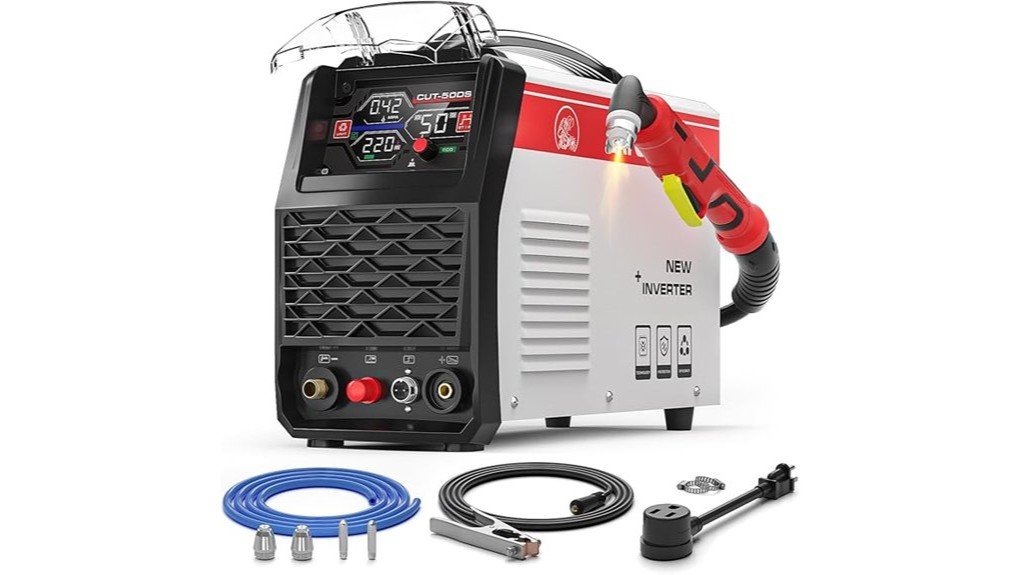
The ANDELI plasma cutter is a 50-amp, pilot-arc machine aimed at hobbyists and small shops that want to cut sheet and plate without an oxy-fuel setup. Per the Amazon listing, it has a non-touch pilot arc, an LED display and an ECO mode, and it is rated for up to 3/4 in. of steel on 220 V. It makes sense if you cut mostly light to medium steel; skip it if you need to cut thick plate all day.
ANDELI Plasma Cutter at a Glance
| Item | What the listing says | What to verify |
|---|---|---|
| Type | 50A plasma cutter with non-touch pilot arc | Torch connector and consumable style |
| Maximum cut | Up to 3/4 in. on 220 V | The listing’s “clean cut” thickness is usually lower than the maximum |
| Display | LED display | Whether it shows current and air status |
| ECO mode | Lower output setting, described as 60% power | What it does to cut thickness |
| Power | Voltage options depend on the listing version | Your outlet and breaker |
| Air supply | Compressed air required | Your compressor’s CFM and dryness |
Check the current price on Amazon →
What It Is and Who It Suits
A pilot-arc plasma cutter starts a small arc inside the torch, so you do not have to touch the tip to the metal to begin a cut. That helps on rusty, painted or slightly uneven surfaces, where touch-start machines can struggle to ignite. The listing also mentions a mesh or expanded-metal mode, which keeps the arc alive across gaps in grating or mesh.
A 50A class machine suits fabricators who cut sheet, angle, tube and plate up to roughly the quarter-inch to half-inch range cleanly. It is a reasonable first plasma cutter for garage work, farm repairs and vehicle restoration, provided you can supply clean, dry air.
Plasma also cuts aluminum and stainless steel, but the practical thickness is lower than for mild steel, and the listing figures are for steel. Check the manufacturer’s cut chart for your exact model before relying on it for those metals.
How to Check It Fits Your Shop
- Power: confirm whether your version runs on 120 V, 240 V or both. Maximum thickness is quoted at the higher voltage, and a 120 V circuit limits the output current.
- Circuit: match the plug to a properly rated, grounded outlet and breaker. Do not use an adapter to force a plug onto a circuit it was not designed for. Have an electrician install a proper receptacle if needed.
- Air compressor: plasma needs a steady supply of clean, dry air at the pressure given in the manual. A small pancake compressor may run out of volume mid-cut. Add a moisture trap or dryer, because wet air shortens consumable life and ruins cuts.
- Consumables: check which electrode and nozzle style the torch uses, and whether spares are easy to find. See our guides on plasma cutting torches and plasma nozzles and consumables before you buy.
- Metal thickness: compare your typical work with the clean-cut rating, not the maximum severance rating.
View the ANDELI plasma cutter on Amazon →
Pros and Limitations
Pros
- Non-touch pilot arc makes starting easier on dirty or painted metal.
- 50A output is enough for most garage-scale steel cutting.
- A display and a low-power mode give more control than basic units.
- Plasma is faster and leaves less heat-affected area than a cutting torch on thin metal.
Limitations
- Maximum thickness is a best-case figure; edge quality drops near the limit.
- It needs an air compressor and dry air, which are extra costs.
- Beginners usually need practice to control travel speed and torch height.
- Lower-priced machines may offer less duty cycle than industrial ones; check the duty cycle in the manual before long production runs.
Using a Plasma Cutter Safely
- Wear a shade #8 to #9 lens for lower-current plasma cutting (check the filter chart for your amperage), leather gloves, a flame-resistant jacket and hearing protection.
- Cutting produces fumes and sparks. Ventilate the area, keep flammables away and do not cut galvanized, plated or painted metal without proper ventilation and a suitable respirator. See our half-facepiece respirator review and welding gloves review.
- Never cut containers that held fuel or chemicals.
- Drain your compressor tank and air line regularly.
- Leave the cooling fan running after a cut and let the unit rest if the thermal light comes on.
Related Guides
- PCS plasma cutting torch review covers replacement torch considerations.
- S45 plasma torch accessory kit explains what a consumable kit contains.
- AMP K4000 torch review is another cutting torch to compare.
Verdict
The ANDELI plasma cutter looks like a sensible entry-level option for people who want pilot-arc starting and a 50A rating at a modest size. Buy it if you have a suitable circuit and compressor and mostly cut metal under half an inch. Check the current listing for the exact voltage version, accessories and return window.
Check ANDELI plasma cutter availability →
Frequently Asked Questions
What thickness can the ANDELI plasma cutter cut?
The listing rates it for up to 3/4 inch of steel on 220 volts, which is a maximum severance figure. Clean, dross-free cuts are usually possible only at a lower thickness. Check the cut chart for your version, and expect thinner limits on 120 volts and on aluminum or stainless.
Do I need an air compressor for this plasma cutter?
Yes. Plasma cutters of this type use compressed air as the plasma gas, so you need a compressor with enough volume and a moisture trap or dryer. Wet or oily air shortens electrode and nozzle life and causes poor cuts. Check the required pressure in the manual.
What is a non-touch pilot arc?
A pilot arc creates a small arc inside the torch before you cut, so the tip does not have to touch the metal to start. It makes cutting easier on rusty, painted or uneven surfaces and lets you cut expanded metal without losing the arc.
Can I cut galvanized steel with it?
Plasma can cut galvanized steel, but it releases zinc fumes that can make you sick. Work outdoors or with strong ventilation, wear an appropriate respirator, and keep other people away from the plume. Grind off coatings where practical.