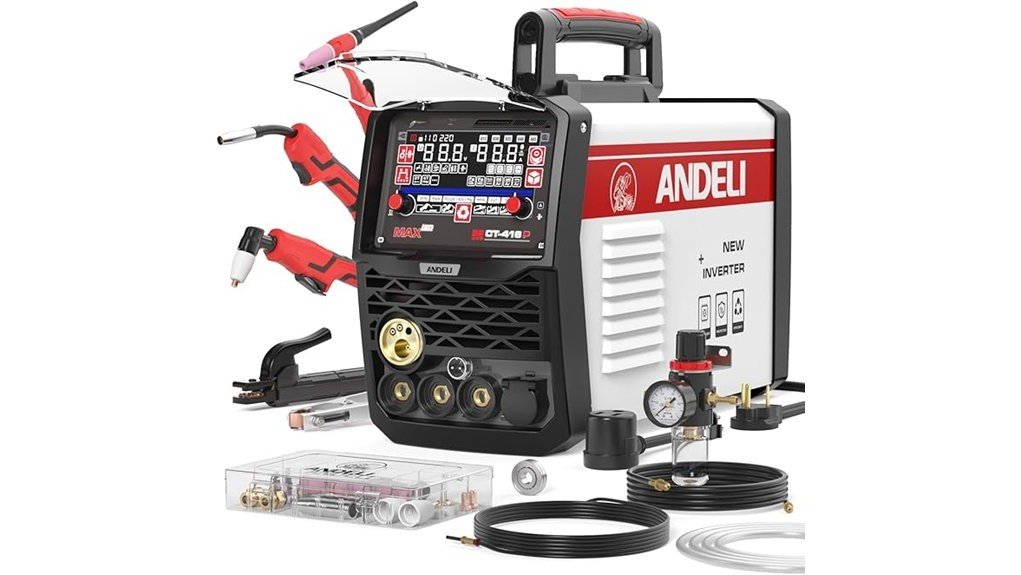
Buying separate machines for MIG, TIG, stick welding, and plasma cutting can take up space and stretch a home-shop budget. The ANDELI MCT-416P Plasma Cutter Welder Combo puts those core functions into one dual-voltage unit with up to 160A welding output and a 40A plasma cutter. Its broad process range and large control screen make it appealing for mixed repair and fabrication work, but the setup is more involved than using a basic single-process welder. This review explains the verified features, practical limits, included equipment, and buyer checks that matter before you order.
Quick Verdict
Rating: 8.5/10, recommended with caveats
Best For: DIY fabricators, hobby welders, farm and garage users, and small shops that need several processes in one machine.
Bottom Line: The MCT-416P offers strong process flexibility, dual-voltage operation, a 5-inch display, and a useful accessory package. Its main tradeoff is complexity: you still need the correct gas, consumables, air supply, circuit, and setup for each process, and current warranty or package details should be confirmed before purchase.
Key Specifications
| Specification | Detail |
|---|---|
| Brand | ANDELI |
| Model | MCT-416P |
| ASIN | B0F6JRXLM8 |
| Product type | Multiprocess welder and plasma cutter combo |
| Listed process modes | HF TIG, HF CUT, Pulse MIG, synergic MIG, manual MIG, stick/MMA, and flux-core MIG support |
| Trigger modes | 2T and 4T |
| Input voltage | 110V / 220V dual voltage |
| Maximum welding output | Up to 160A for MIG, TIG, and stick modes |
| Plasma output | 10A to 40A adjustable HF cutting output |
| Listed clean-cut capacity | Up to 0.39 in. (10 mm) on 110V and 0.60 in. (15 mm) on 220V |
| Listed maximum cut | Up to 0.60 in. (15 mm) on 110V and 0.71 in. (18 mm) on 220V |
| Display | 5-inch LED control display with parameter selection |
| Memory function | Automatic save and recovery of welding parameters |
| Listed protection | Auto shut-off and overheat protection |
| Certification claim | CE certification stated on the current listing |
| Approximate weight | About 36 lb, as listed in the source article |
| Best use | Home garages, repair work, light fabrication, farm maintenance, metal art, and small workshops |
What Is the ANDELI MCT-416P?
The ANDELI MCT-416P is a compact inverter-based machine that combines several welding modes with a 40A high-frequency plasma cutter. The “6-in-1” label refers to its selectable functions rather than six separate tools. The listed modes include HF TIG, HF CUT, Pulse MIG, synergic MIG, manual MIG, stick/MMA, and flux-core operation, with some modes grouped under the same welding platform.
The main selling point is workflow flexibility. You can cut plate or sheet, prepare a joint, tack parts with MIG, use stick for repair work, or switch to HF TIG for more controlled welding without moving to a separate power source. You still need process-specific torches, gas, consumables, compressed air, and safety equipment.
Who Should Buy It?
Best For
- DIY users who regularly switch between cutting, MIG, TIG, and stick tasks.
- Small shops that need broad capability but have limited storage space.
- Garage, farm, and repair users with access to both suitable power and compressed air.
Skip If
- You only need one process and prefer simpler controls and fewer accessories.
- You need documented industrial duty-cycle performance for daily production work.
- You cannot provide the correct circuit, grounding, ventilation, gas, or dry compressed-air setup.
Before You Buy: Treat the listed maximum cut figures as upper limits, not guaranteed everyday clean-cut thicknesses. Cut quality depends on input voltage, metal type, air pressure and dryness, torch condition, consumables, travel speed, and operator technique. Also confirm the current warranty and exact package contents because published seller terms can differ.
Feature-by-Feature Review
Multiprocess Design and Mode Selection
The MCT-416P gives you more process choices than a basic three-in-one welder. Gas MIG and flux-core MIG cover common fabrication and repair work. Pulse, synergic, and manual MIG modes give you different levels of control, while HF TIG supports non-contact arc starts and stick/MMA handles electrode welding. The plasma cutter adds material-prep capability in the same cabinet.
This range is most useful when your projects change often. The tradeoff is a steeper learning curve because each mode needs the correct leads, polarity, consumables, settings, and safety checks.
Dual-Voltage Power and 160A Welding Output
Dual-voltage 110V/220V operation lets you use the machine in more locations. A compatible 110V circuit is convenient for lighter work and quick repairs, while 220V gives the machine more headroom for higher output and stronger plasma-cutting performance. The listing states up to 160A for MIG, TIG, and stick welding.
Check the manual for circuit size, plug or adapter requirements, grounding, and extension-cord limits. An undersized cord or circuit can cause voltage drop, poor arc behavior, overheating, or breaker trips.
Pulse, Synergic, and Manual MIG Controls
Pulse MIG can help manage heat input and spatter when the wire, gas, torch setup, and base metal are matched correctly. Synergic MIG simplifies initial setup by linking selected parameters, while manual MIG gives experienced users more direct control. This combination makes the machine approachable for learning but still adjustable when preset behavior does not suit the joint.
The listing promotes aluminum MIG capability and includes a graphene liner and drive roll. Aluminum still requires compatible wire, shielding gas, feed components, polarity, and technique. Confirm the supported wire types and feeder setup in the manual rather than assuming every aluminum job can be started with the box contents alone.
HF TIG for Controlled Arc Starts
HF TIG starts the arc without scraping the tungsten on the workpiece. That can reduce tungsten contamination and help you place the arc more accurately on clean, properly prepared metal. TIG is useful for thinner material, visible joints, stainless work, and projects where bead control matters more than speed.
Maximum amperage does not show the full performance picture. Duty cycle, torch rating, material thickness, gas flow, tungsten, filler, and joint design affect results, so follow the manual’s limits and cooling guidance.
40A HF Plasma Cutting
The HF CUT mode adjusts from 10A to 40A and uses non-contact arc ignition. The listing states a clean cut of up to 0.39 inch on 110V and 0.60 inch on 220V, with maximum severance figures of 0.60 inch and 0.71 inch, respectively. These numbers show why 220V is the better choice when cutting capacity is a priority.
Plasma performance depends heavily on the air system. You need clean, dry, correctly regulated compressed air, a good work clamp connection, sound consumables, and steady torch movement. Rust, paint, mill scale, and coatings can affect grounding, cut quality, and fumes even when the torch can initiate through surface contamination.
5-Inch Display and Parameter Memory
The 5-inch LED panel shows process, material, wire or electrode, thickness, and setting information. A larger display can reduce menu confusion when you move between MIG, TIG, stick, and cutting modes. The control layout uses selectable parameters rather than forcing you to remember every starting value.
Parameter memory can restore previous settings after a mode change or shutdown. Still verify polarity, gas, wire, electrode, torch, and material thickness because saved values cannot detect a changed physical setup.
Included Accessories and What You May Still Need
The current listing identifies a 15AK MIG torch, WP-17 TIG torch, PT-31 plasma torch, ground clamp, electrode holder, TIG accessory kit, drive roll, 110V-to-220V adapter cable, graphene liner, gas connector, PU gas hose, air-filter regulator, gloves, dust cover, and user manual. That is a broad starter package for a combo machine.
You may still need gas cylinders, consumables, a suitable air compressor, a helmet, protective clothing, and metal-preparation tools. Compare the current package photos and written list because bundles can change.
Pro Tip: Before your first project, label the leads and store each process kit in a separate bin. Keeping MIG, TIG, stick, and plasma parts grouped reduces setup mistakes and makes it easier to spot missing consumables.
How It Performs in Real Use
Home Garage Fabrication
For shelves, carts, brackets, gates, and small frames, MIG will usually be the fastest process to set up and learn. The plasma function can cut blanks and remove damaged sections before welding. The 5-inch display and synergic starting points are helpful when you change wire size or material thickness, but test settings on scrap before welding the final part.
Automotive and Body Repair
The combo layout can help with non-structural patch work, brackets, and removal of damaged metal. Thin sheet needs careful heat control. Follow vehicle service information, protect electronics and lines, and leave structural, restraint-system, and high-voltage repairs to qualified professionals.
Farm, Trailer, and Equipment Maintenance
Stick welding is useful for outdoor repair conditions, while MIG is faster for clean shop work. Plasma cutting can remove bent brackets or prepare replacement pieces. For trailers and load-bearing equipment, the joint design and weld quality matter more than machine convenience, so use approved repair procedures and qualified inspection where failure could cause injury.
Metal Art and Mixed-Material Projects
Artists can move from rough cutting to controlled TIG or MIG work without changing machines. Aluminum and stainless projects still require the correct consumables, gas, cleaning, and technique.
Setup Tips and Safety Checks
- Match the process first: Confirm the selected mode, polarity, torch, work lead, filler, wire, electrode, and gas before energizing the machine.
- Use the correct circuit: Follow the manual for voltage, breaker, grounding, adapter, and extension-cord requirements. Do not defeat electrical protection.
- Prepare clean metal: Remove rust, paint, oil, plating, and unknown coatings from the joint area when safe to do so. Identify coatings before heating or cutting them.
- Control fumes and fire risk: Use suitable ventilation, remove combustibles, keep a fire watch, and never weld or cut a sealed, pressurized, or previously fuel-filled container without an approved procedure.
- Set up dry air for plasma cutting: Drain the compressor, use the supplied or suitable filter-regulator, and verify pressure according to the manual.
- Protect yourself: Wear an appropriate welding helmet, safety glasses, gloves, flame-resistant clothing, and hearing protection. Use respiratory protection only under a proper hazard assessment and program.
- Test on scrap: Confirm arc behavior, penetration, bead profile, and cut speed on matching scrap before working on the final piece.
Pros and Cons
Pros
- Combines MIG, HF TIG, stick, flux-core, and 40A plasma cutting functions.
- 110V/220V input supports both home-garage and higher-output shop setups.
- Pulse, synergic, and manual MIG modes give you both guided and adjustable control.
- Large 5-inch display and memory function can reduce repeated setup work.
- Accessory package includes dedicated MIG, TIG, and plasma torches plus core leads and fittings.
Cons
- More complicated to configure and maintain than a single-process welder.
- Maximum cutting claims depend on ideal voltage, air, consumables, and technique.
- Warranty wording and bundle details may vary between sales pages, so they require confirmation before purchase.
Is It Worth the Price?
The MCT-416P offers strong value for buyers who would otherwise purchase a welder and plasma cutter separately. Its appeal comes from capability per square foot: you get several welding modes, dual voltage, a 40A cutter, a large display, and a broad accessory kit in one platform.
It is worth considering if you regularly use at least two welding processes and also need occasional cutting. It is less compelling if you only run one process, need a highly specialized TIG or plasma setup, or require documented production-duty performance. Compare the current package, support terms, consumable availability, and manual specifications rather than judging value by the process count alone.
How It Compares to Alternatives
The PrimeWeld CT520D is worth comparing when you want plasma cutting with TIG and stick welding but do not need MIG. The LOTOS LTPDC2000D follows a similar cutter, TIG, and stick approach. The YESWELDER MIG-205DS is a better comparison for buyers focused on multiprocess MIG welding rather than an integrated plasma cutter.
The ANDELI MCT-416P makes the most sense when you specifically want MIG, HF TIG, stick, flux-core, and plasma cutting in one cabinet. A dedicated machine may still be easier to tune, service, or replace when one process dominates your workload.
Frequently Asked Questions
Is the ANDELI MCT-416P suitable for beginners?
It can suit a careful beginner who wants room to learn several processes. The large display and synergic MIG mode can simplify starting settings, but you still need to learn polarity, gas, wire, electrode, air, and electrical setup before switching modes.
What welding and cutting processes does it support?
The listing identifies HF TIG, HF CUT, Pulse MIG, synergic MIG, manual MIG, stick/MMA, and flux-core support. It also provides 2T and 4T trigger modes for different welding workflows.
Does it run on both 110V and 220V?
Yes, the MCT-416P is listed as a dual-voltage 110V/220V machine. Check the manual and your local electrical requirements before connecting it, especially when using an adapter or extension cord.
How thick can the plasma cutter cut?
The listed clean-cut capacity is up to 0.39 inch on 110V and 0.60 inch on 220V. Listed maximum severance is up to 0.60 inch on 110V and 0.71 inch on 220V, but everyday results depend on air quality, metal, consumables, speed, and technique.
Can it weld aluminum?
The listing promotes pulse MIG aluminum capability and includes a graphene liner and drive roll. Successful aluminum welding still requires compatible wire, shielding gas, feed setup, polarity, torch configuration, surface cleaning, and settings, so verify the exact procedure in the manual.
Does the plasma cutter need an air compressor?
Yes. Plasma cutting needs a suitable compressed-air supply with correct pressure and dry, clean air. The package lists an air-filter regulator, but the compressor itself is not identified as included.
What comes in the box?
The listing names MIG, TIG, and plasma torches, a ground clamp, electrode holder, TIG accessory kit, drive roll, voltage adapter cable, liner, gas and air fittings, gloves, dust cover, and manual. Confirm the current written package list and photos because seller bundles can change.
Is it a good choice for professional production work?
It is better positioned for flexible garage, repair, farm, hobby, and small-shop work than for a dedicated production line. Buyers who weld or cut at high output for long shifts should compare duty-cycle data, service support, consumable supply, and dedicated industrial machines.
The Bottom Line
The ANDELI MCT-416P is a strong fit for buyers who want one dual-voltage machine for MIG, HF TIG, stick, flux-core welding, and plasma cutting. Its main strengths are process range, the 5-inch display, parameter memory, and included torches, while its main limitation is the setup complexity and dependence on separate gas, air, consumables, and correct electrical service. Skip it if one dedicated process covers nearly all your work or if you need verified industrial production performance.
Ready to Buy?
Check the latest price, warranty wording, package contents, and product details before you decide.