As an Amazon Associate, Garage Welding may earn from qualifying purchases. This does not change the price you pay.
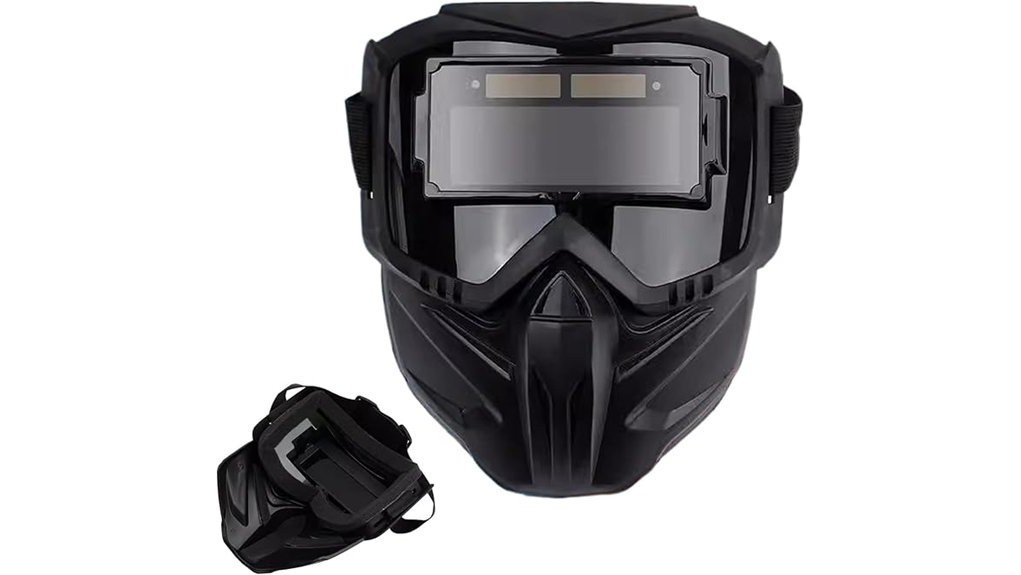
This true color welding helmet is a budget-style auto-darkening hood that the Amazon listing describes as lightweight, with a large viewing window and a soft elastic headband. It suits hobbyists and garage fabricators who weld mild steel with MIG, stick or TIG and want a clear view without paying for a premium brand. Skip it if you need a specific brand warranty, a wide shade range for plasma cutting, or a helmet that has been independently tested.
True color welding helmet at a glance
| Item | Detail |
|---|---|
| Type | Auto-darkening welding helmet |
| Viewing area | 3.94 x 2.95 in (about 100 x 75 mm), per the listing |
| Reaction time | Listed as 0.1 ms light-to-dark; compare against the number printed on the filter |
| Optical class | Listed as 1/1/1/2 |
| Lens technology | “True Color” clear-view filter, per the listing |
| Headgear | Soft elastic strap with a thick foam eye-protection sponge |
| Weight | The product details give two different figures (1.2 lb and 9.4 oz). Check the current Amazon page before you rely on either. |
| Shade range and power | Not stated clearly; check the page for shade settings and battery/solar details |
What a true color helmet gives you
Older auto-darkening filters often show the weld through a green or yellow tint. True color filters aim for a more neutral, whiter image, which can make it easier to see joint edges, puddle shape and the metal itself before and after the arc. Whether any one budget helmet delivers that view well is something only your own eyes will tell you, so look for a return option.
The optical class numbers (1/1/1/2 here) describe lens clarity, light diffusion, variations in luminous transmittance and angle dependence. A lower number is better, and 1/1/1/1 is the best class. 1/1/1/2 is generally considered fine for hobby and regular shop use.
How to check this helmet suits your welding
- Check the shade range. MIG and stick on mid amperages commonly need around shade 10 to 13. Low-amp TIG often uses a lower shade. Plasma and oxy-fuel need different filters, so do not assume a fixed auto-darkening hood is right for them.
- Confirm the filter has sensitivity and delay controls if you do low-amp TIG, and confirm whether it has a grind mode.
- Look for the ANSI Z87.1 marking (and EN 379 if you are outside the US) on the helmet and filter. If the page does not say, ask the seller.
- Check how it is powered. Solar-assisted filters with a replaceable or built-in battery are common; know what yours uses.
- Try it with your safety glasses on. Fit with prescription glasses varies by helmet shape.
- Weigh it. Neck fatigue after a long session is common with heavy hoods, so a lighter helmet and a well-adjusted headband matter.
Pros and limitations
Pros
- Large viewing window for its price class, per the listing.
- True color style lens for a more neutral view.
- Padded headband and forehead sponge aimed at comfort.
- Light weight compared with many full-size professional helmets.
Limitations
- No recognized brand behind it, so warranty and support may be limited.
- Specs in the product details are inconsistent (weight), so verify before buying.
- Not a substitute for a helmet rated for the process you use.
- Replacement cover lenses and headgear may be hard to source later.
Using a welding helmet safely
- Test the auto-darkening function on a scrap piece before every session by striking an arc with the helmet on.
- Replace the outside cover lens when it is pitted or hazy.
- Keep the helmet down before you strike the arc and keep it down until the work has cooled enough that there is no glare.
- Cover your arms and neck. Helmets protect eyes and face from arc light, but UV can burn exposed skin.
- Ventilate and use a suitable respirator for fumes, especially on galvanized or stainless steel. A helmet does not filter fumes.
- If the lens flickers, stays light or darkens slowly, stop welding and fix or replace it.
Alternatives and related guides
- High-definition welding helmet – another budget auto-darkening hood to compare
- TRQWH large-view welding helmet – a large-window alternative
- YesWelder lens cover – spare outside covers, if they match your helmet
- Helmet rear sweatband – comfort add-on for long sessions
Frequently Asked Questions
What does the 1/1/1/2 optical class on a welding helmet mean?
It is a four-part rating of lens clarity: optical class, light diffusion, variations in luminous transmittance and angle dependence. Each is scored from 1 (best) to 3. A 1/1/1/2 filter is good for general use, while top-tier helmets are often rated 1/1/1/1.
Is a true color helmet better than a standard auto-darkening helmet?
Not always. True color filters aim for a more neutral view that many welders find easier on the eyes, but results vary by lens quality, shade setting and lighting. Judge by how clearly you see the joint and puddle, and keep the return window in mind.
Can I wear safety glasses under an auto-darkening helmet?
Yes, and you should. Wear ANSI Z87.1 safety glasses under any welding helmet for grinding and chipping. Fit with prescription glasses depends on the helmet shape and headgear, so try it on if you can and check the return policy.
Is this helmet good for plasma cutting or grinding?
Check the filter’s shade chart. Many fixed-range welding filters do not cover the lighter shades needed for some plasma work, and grinding should be done with a face shield or a helmet with a grind mode. Never rely on a helmet outside its listed shade range.
Conclusion
This helmet is a reasonable entry-level option if you want a big window and light feel and are willing to confirm its specs before you buy. For serious daily production work, consider a helmet from an established brand with a documented warranty.