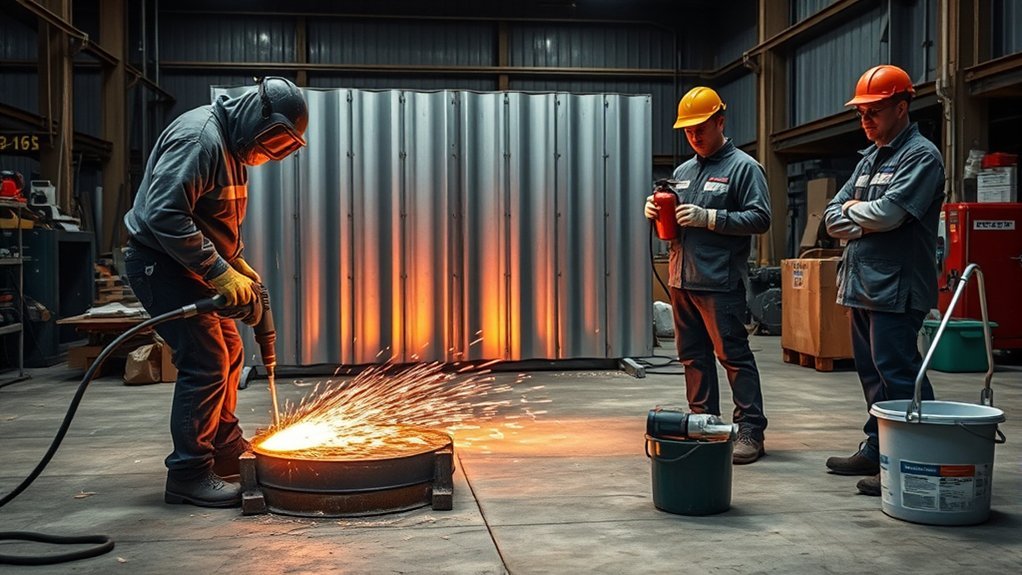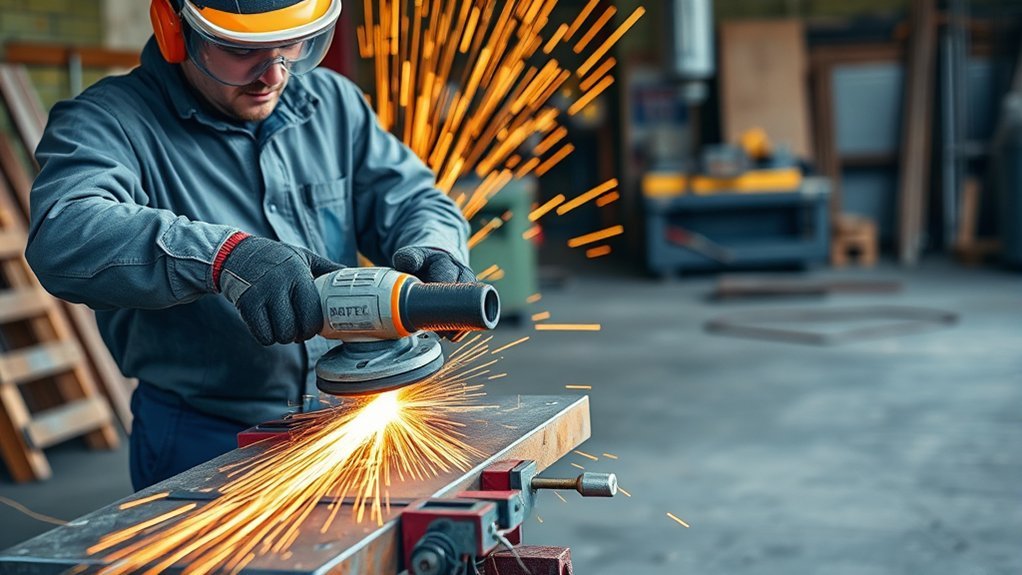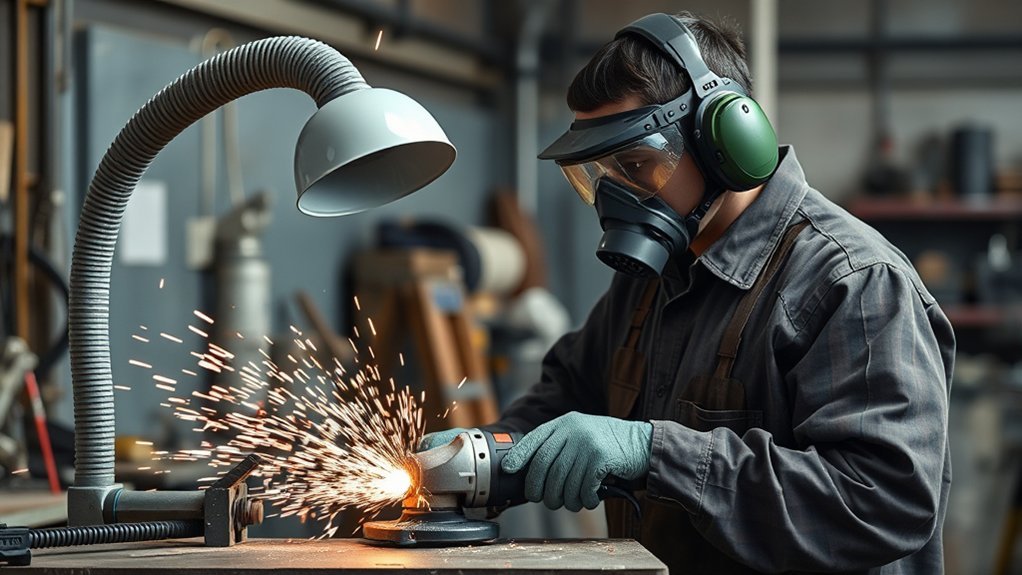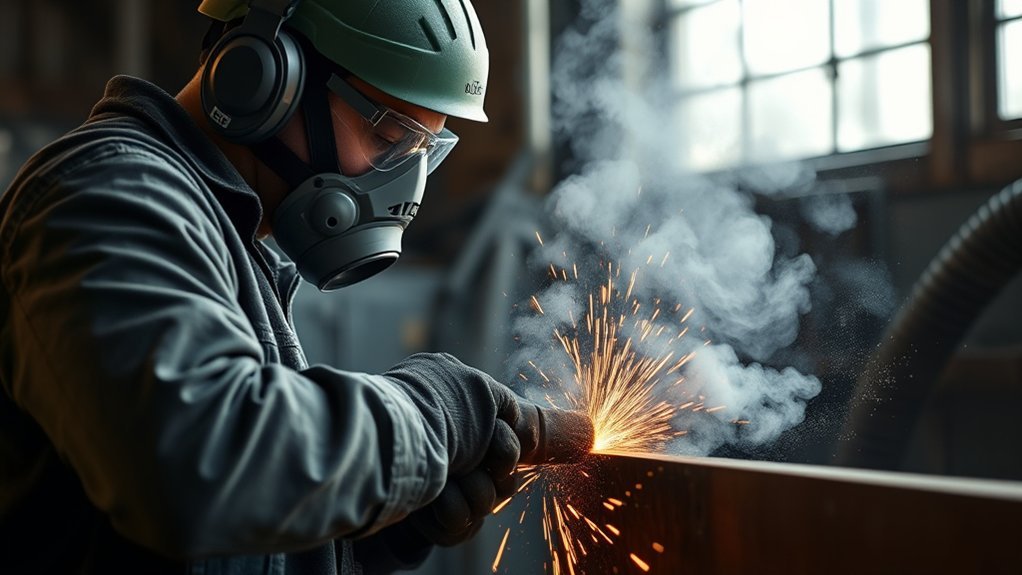
Angle grinders can release fine particles before you see a dust cloud. Depending on the workpiece, that airborne material may contain metal, respirable crystalline silica, fiberglass, resin, paint, plating, or other hazardous substances. Choosing respiratory protection starts with identifying the material and controlling dust at the wheel—not simply buying the highest-rated mask.
Quick Answer
Wear properly selected respiratory protection whenever angle grinding can expose you to hazardous airborne particles and source controls cannot keep exposure low enough. Use an approved, well-fitting respirator matched to the material and local standard. A respirator supplements a shroud, extractor, ventilation, or approved wet method; it does not replace those controls.
Key Takeaways
- Identify the base material, coating, plating, oil, resin, and other contamination before grinding.
- Do not confuse an uncertified nuisance-dust mask with an approved disposable filtering-facepiece respirator.
- N95, P100, FFP2, FFP3, P2, and P3 belong to different approval systems; use the class required in your location and risk assessment.
- Particulate filters capture particles but do not protect against most gases or vapors.
- Perform a user seal check every time you put on a tight-fitting respirator. Required workplace use may also involve medical clearance, formal fit testing, training, and a written program.
- Use a grinder shroud, suitable dust extractor, ventilation, or a manufacturer-approved wet method to control dust at its source.
At a Glance
| Time Required | Allow time before every job to identify the material, set up extraction, inspect the respirator, and complete a seal check. |
| Difficulty | Moderate. Filter selection becomes a professional task when coatings, silica, toxic metals, heavy exposure, or unknown materials are involved. |
| Tools Needed | Approved respirator and filters or cartridges, grinder guard, compatible shroud, suitable dust extractor, eye and face protection, hearing protection, gloves, and protective clothing. |
| Cost | Varies by hazard and equipment. Do not select respiratory protection or extraction equipment by price alone. |
Risks of Angle Grinder Dust
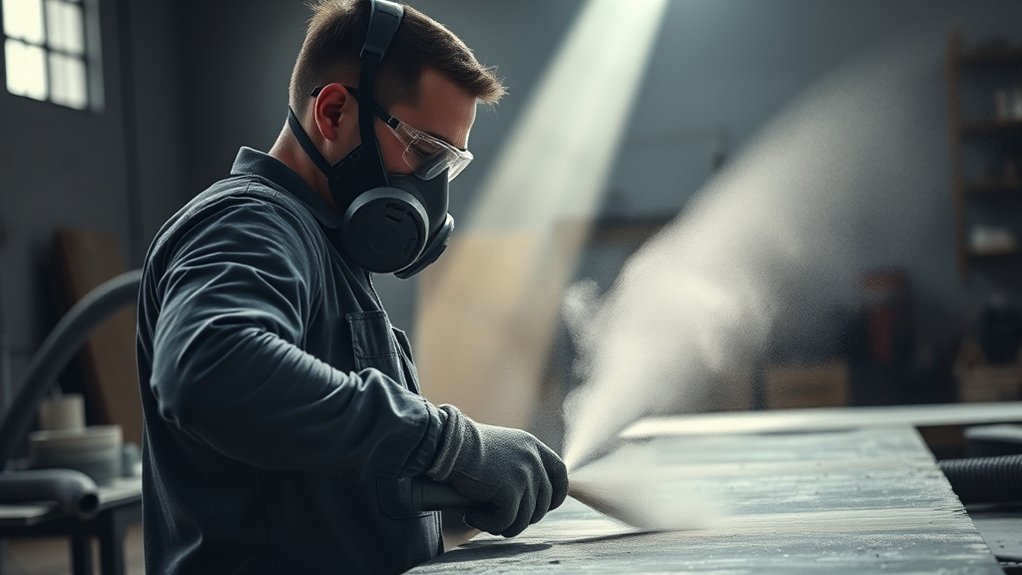
Angle grinding can create inhalable and respirable particles. The smallest respirable particles can travel deep into the lungs and may remain airborne even when the work area does not look dusty.
The absence of a visible dust cloud does not prove that the air is safe to breathe.
The hazard changes with the base material, wheel, coating, contamination, task duration, ventilation, and amount of dust captured at the source. Grinding bare carbon steel is not the same exposure as grinding stainless steel, concrete, fiberglass, painted steel, or an unidentified building product.
Metal Dust
Grinding can release particles from carbon steel, stainless steel, aluminum, titanium, nickel alloys, plated parts, and other metals. The exact risk depends on the alloy and any material on its surface. Stainless steel and specialty alloys may contain metals that require tighter exposure controls than ordinary carbon steel.
Some finely divided metal dusts also present a fire or explosion hazard. Aluminum, magnesium, titanium, and several other metal dusts can become much easier to ignite when they are fine and suspended in air. Do not assume that an ordinary household vacuum or shop vacuum is suitable for collecting every type of metal dust.
Fiberglass and Composite Dust
Grinding fiberglass, carbon-fiber composites, body filler, or resin-based material can release fibers, cured-resin particles, fillers, and dust from surface coatings. These contaminants may irritate the skin, eyes, nose, throat, and lungs.
Use source extraction that is approved for the material, protect exposed skin, and prevent settled composite dust from spreading to clean areas. Check the product’s Safety Data Sheet when one is available.
Masonry and Silica Dust
Concrete, mortar, brick, engineered stone, natural stone, and many tiles can release respirable crystalline silica when ground. Repeated or high exposure can cause silicosis and is also associated with lung cancer, chronic obstructive pulmonary disease, and kidney disease. Review the OSHA respirable crystalline silica standard when it applies to U.S. construction work.
For silica-containing material, use a compatible shroud and dust-collection system or a wet method specifically designed for the grinder and task. A respirator may still be required based on the task, duration, location, exposure assessment, and applicable rule.
Paint, Coatings, and Plated Metals
Paint, primer, galvanizing, chrome plating, powder coating, adhesives, sealants, oil, and chemical residues can add hazards that are not present in the base metal. Grinding may create contaminated particles and, if enough heat is produced, other decomposition products.
Identify the coating before work. Check labels, maintenance records, the Safety Data Sheet, building age, and testing information. A particulate filter alone does not protect against most gases or vapors.
Warning: Do not grind material that may contain asbestos. Stop work and arrange professional identification or abatement advice. Also stop before disturbing unknown coatings, lead-based paint, or highly toxic metals until the hazards and required controls have been identified.
Possible Health Effects
Grinding dust can cause immediate irritation or contribute to disease after repeated exposure. Risk rises with the toxicity of the material, airborne concentration, task duration, frequency, and effectiveness of the controls.
- Metal particles: May irritate the respiratory system, while specific metals can create additional toxic or sensitizing effects.
- Respirable crystalline silica: Can permanently scar lung tissue and cause serious long-term disease.
- Fiberglass and composite dust: Can irritate the airways, eyes, and skin.
- Lead-containing dust: Can be inhaled or carried from the work area on clothing, shoes, tools, and surfaces.
- Paints, resins, and coatings: May add particles, gases, or vapors that require different respiratory protection.
When You Need Respirator Protection
Respiratory protection is needed when a hazard assessment, exposure data, product instructions, or applicable safety rule shows that engineering and work-practice controls cannot reduce exposure enough on their own. Home users should also wear suitable protection whenever the material or dust level could harm them, even when workplace regulations do not apply.
Respirator use becomes more likely when:
- You are grinding concrete, mortar, brick, stone, tile, fiberglass, or another material that produces fine respirable dust.
- The metal contains hazardous alloying elements or has paint, plating, galvanizing, filler, resin, oil, or an unknown coating.
- You are working indoors, in an enclosed area, or near other people.
- The job lasts long enough for dust to build up on clothing, tools, or nearby surfaces.
- Dust remains near your face despite a shroud, extraction, ventilation, or an approved wet method.
- A workplace exposure assessment or task-specific rule requires an assigned protection factor.
Visible dust is a warning sign, but visibility should not be used as the only test. Fine respirable particles may be present before a cloud becomes obvious.
Note: Air-purifying respirators must not be used in oxygen-deficient or immediately dangerous atmospheres. Do not enter a confined or poorly characterized space based only on wearing a cartridge respirator.
Choosing the Right Respirator for Angle Grinding
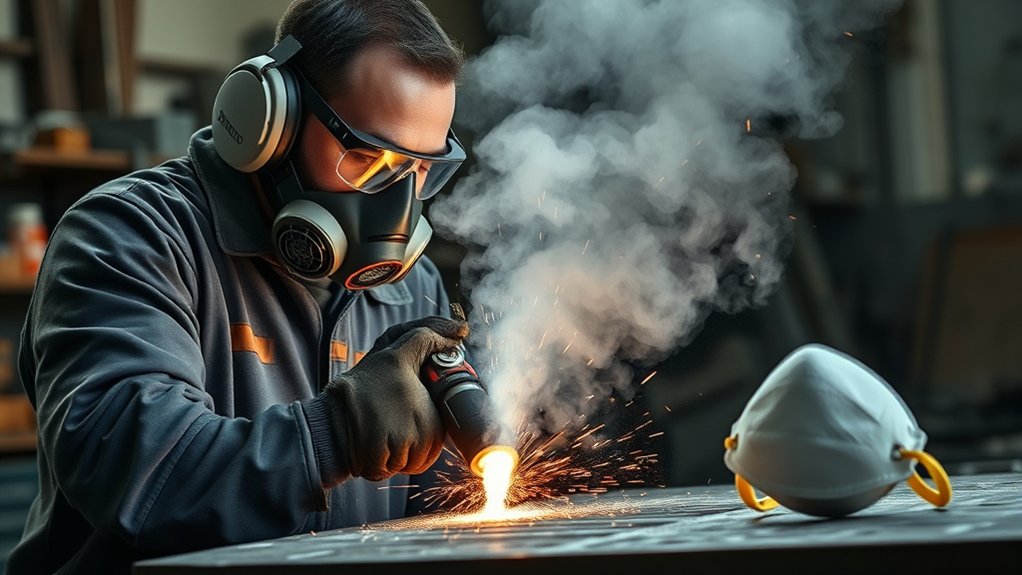
Start with the contaminant rather than the mask. Identify whether the air contains particles, gases, vapors, or a combination. Then select a complete respirator configuration approved for that hazard and capable of providing the required protection.
Products Worth Considering

ODOR REDUCTION for use with certain non-harmful sprays/vapors from stains, varnishes, coatings and sealants

NIOSH-APPROVED: 3M Particulate Filter 2097, P100 provides at least 99.97% filtration efficiency against solids and liquid aerosols, as well as oil-based particulates
NIOSH-APPROVED: Organic Vapor/P100 combination cartridge helps reduce expose to certain organic vapors and provides at least 99.97% filtration efficiency against solids, liquid aerosols, and oil-based particulate
Disposable Respirator vs. Loose Dust Mask
A loose nuisance-dust mask is not the same as an approved filtering-facepiece respirator. A certified filtering facepiece, such as a NIOSH-approved N95, is designed to seal to the face and filter particles when selected, fitted, and worn correctly.
A disposable filtering-facepiece respirator may be suitable for some controlled, lower-risk particulate tasks. It is not automatically adequate for silica, lead, toxic metals, heavy exposure, gases, vapors, or work requiring a higher assigned protection factor.
Respirator Filter Rating Systems
Filter names differ by country and approval standard. Check the approval markings on the complete respirator and follow local occupational-safety requirements.
| Marking | System | What It Means | Important Limitation |
|---|---|---|---|
| N95 | U.S. NIOSH | Filters at least 95% of the test particles used for approval and is not resistant to oil. | Not automatically suitable for every grinding material or exposure level. |
| R95 or P95 | U.S. NIOSH | Adds some or strong oil resistance while providing at least 95% filtration under the approval test. | Oil resistance does not provide gas or vapor protection. |
| P100 | U.S. NIOSH | Filters at least 99.97% of the approval-test particles and is strongly resistant to oil. | Higher filter efficiency cannot make up for a leaking face seal or the wrong cartridge. |
| FFP2 or FFP3 | UK and European filtering-facepiece classifications | FFP3 is the higher particulate class within this system. | Do not assume that an FFP label is an exact substitute for a NIOSH class. |
| P2 or P3 | Replaceable-filter classifications used in several jurisdictions | P3 is the higher particulate class within the applicable system. | The facepiece, filter, assigned protection factor, and local standard must all match. |
See the NIOSH filtering-facepiece respirator guidance for current U.S. filter classifications.
Particulate Filters vs. Gas and Vapor Cartridges
Particulate filters are made for airborne particles such as dust, mist, and certain fumes. They do not remove most gases or vapors. A painted, solvent-contaminated, resin-coated, or chemically treated surface may require a gas or vapor cartridge, a combination cartridge, or another respirator type selected for the specific contaminant.
Do not choose a cartridge by color alone, and do not rely on smell as proof that the cartridge is working. In occupational use, gas and vapor cartridges may require an objective change schedule that replaces them before breakthrough.
Material-Based Starting Guide
| Material or Condition | Main Concern | Respirator Consideration | Source Control |
|---|---|---|---|
| Bare carbon steel | Metal particles and existing contamination | Approved particulate respirator when exposure cannot be controlled; required class depends on exposure. | Local extraction, ventilation, and controlled cleanup. |
| Stainless steel or specialty alloy | Fine particles containing alloying metals | Use the SDS, exposure assessment, and occupational guidance to select the filter and required protection factor. | Effective local exhaust close to the wheel. |
| Aluminum, magnesium, or titanium | Inhalation exposure and possible combustible-metal dust | Use suitable particulate protection selected for the exposure. | Use collection equipment approved for the metal; do not default to an ordinary shop vacuum. |
| Concrete, mortar, brick, stone, or tile | Respirable crystalline silica | Follow the applicable silica rule, task table, exposure assessment, and assigned protection factor. | Compatible shroud and extractor or an approved continuous-water system. |
| Fiberglass or composite | Fibers, cured resin, fillers, and coating dust | Use particulate protection unless the SDS identifies an additional gas or vapor hazard. | Source extraction, surface containment, and careful vacuum cleanup. |
| Painted, plated, galvanized, oily, or resin-coated material | Contaminated particles plus possible gases or vapors | Identify the coating first. A particulate filter may not be enough. | Remove or control the coating using an approved procedure and capture contaminants at the source. |
| Unknown material or suspected asbestos | Unidentified toxic fibers, dust, coatings, or residues | Do not select a respirator by guesswork. | Stop work and obtain professional identification or advice. |
Essential Respirator Features for Grinding
A suitable respirator must be approved as a complete configuration. Do not mix an unapproved facepiece, filter, cartridge, adapter, or retainer combination simply because the parts appear to fit.
- Correct approval: Look for the certification required in your country and verify the complete configuration.
- A reliable face seal: The model and size must fit the wearer without gaps.
- Correct filters or cartridges: Match them to the identified particles, gases, vapors, or combined hazard.
- Required protection factor: The respirator type must provide enough protection for the measured or expected exposure.
- Compatible eye protection: Glasses, goggles, and face shields must not interfere with the seal.
- Comfort and stability: The respirator should remain in position while the wearer moves, talks, and controls the grinder.
- Available replacement parts: Filters, valves, straps, seals, and retainers must be obtainable and replaced with approved parts.
A half-face reusable respirator is common for particulate grinding hazards, but it does not protect the eyes. A full-face respirator may provide a higher protection factor and eye coverage when properly selected and quantitatively fit tested. A powered air-purifying respirator may reduce breathing resistance, while a loose-fitting PAPR can accommodate some facial hair because it does not depend on a tight face seal.
Products Worth Considering

LARGE LENS: Helps provide wide view for excellent peripheral vision. Scotchgard protector on lens for improved pain and stain resistance

NIOSH-APPROVED: NIOSH, a USA federal government regulatory agency, has tested and approved the 6800 with 3M cartridges, filters or supplied air systems to help reduce inhaling certain airborne contaminants

The MOARON MJ-4006 Full face cover is CE Certified and ASTM E2952-17 Tested to ensure your protection during woodworking, painting, construction, sanding, renovation, demolition etc
How to Fit and Maintain Your Respirator
A high-efficiency filter cannot protect you if contaminated air leaks around the facepiece. Correct selection, formal fit testing, an every-use seal check, inspection, cleaning, and storage all matter.
Fit Test vs. User Seal Check
A fit test checks whether a specific make, model, style, and size can form an adequate seal on one person. A user seal check is a quick check performed each time that respirator is put on. A seal check does not replace a formal fit test.
For required respirator use in a U.S. workplace, OSHA’s respiratory-protection standard generally requires:
- A medical evaluation before the employee is fit tested or required to wear the respirator.
- Fit testing before initial use of a tight-fitting respirator.
- Another fit test when the facepiece make, model, style, or size changes.
- Fit testing at least annually and again when physical changes could affect the seal.
- Training, inspection, maintenance, storage, recordkeeping, and a written respiratory-protection program when respirators are required.
Other jurisdictions have their own requirements. The UK Health and Safety Executive fit-testing guidance also emphasizes testing the actual facepiece type and size supplied to the wearer.
How to Check the Seal Before Grinding
- Read and follow the respirator manufacturer’s donning and seal-check instructions.
- Place the sealing surface against clean skin without hair, clothing, or eyewear trapped underneath it.
- Position the straps as instructed and tighten them evenly. Overtightening can distort some facepieces.
- Perform the manufacturer’s positive-pressure, negative-pressure, or approved filtering-facepiece seal check.
- Move your head, speak, and check that other PPE does not disturb the seal.
- Do not begin grinding if you cannot obtain a successful seal.
Warning: Facial hair, stubble, scars, jewelry, head coverings, or eyewear between the skin and sealing surface can cause leakage. A loose-fitting PAPR may be an option when a tight-fitting facepiece cannot be used, but it still must be selected for the hazard.
Inspection, Cleaning, and Storage
Inspect a reusable respirator before and after use. Look for:
- Cracks, tears, distortion, or hardened facepiece material
- Stretched, twisted, or damaged straps
- Missing, dirty, warped, or damaged inhalation and exhalation valves
- Damaged cartridge connections, retainers, gaskets, or filter covers
- Filters or cartridges that are wet, crushed, contaminated, expired, or incorrectly installed
Clean reusable facepieces according to the manufacturer’s instructions. Mild cleaning solution may be appropriate for many models, but solvents, harsh chemicals, and excessive heat can damage the facepiece. Allow all parts to dry before reassembly.
Store the clean respirator in a sealed bag or container away from dust, sunlight, heat, moisture, solvents, and physical distortion. Gas and vapor cartridges may continue adsorbing contaminants from surrounding air during storage, so follow the manufacturer’s sealing and storage instructions.
Pro Tip: Keep new, compatible particulate filters sealed in their original packaging and record when reusable cartridges are opened or installed. Never use a filter or cartridge past its expiration date or approved service life.
When to Replace Filters and Cartridges
Replace particulate filters when the manufacturer instructs you to do so or when they become damaged, wet, visibly soiled, contaminated, or difficult to breathe through. A filter may need replacement before it looks heavily loaded.
Gas and vapor cartridges follow different rules. In occupational use, replace them according to the employer’s written, objective change schedule or an approved end-of-service-life indicator. Do not wait until you smell or taste the contaminant.
How Dust Control Improves Respirator Protection
Respirators are the last line of defense. Capturing dust at the wheel reduces what reaches the breathing zone, keeps the work area cleaner, improves visibility, and can extend particulate-filter life.
- Use the grinder guard required by the manufacturer.
- Fit a shroud designed for the grinder, wheel diameter, guard, and task.
- Connect the shroud to a dust extractor that provides the airflow and filtration required by the tool and material.
- Inspect hoses, seals, filters, collection bags, and automatic filter-cleaning systems.
- Use additional exhaust ventilation indoors when source extraction cannot prevent dust accumulation.
- Keep bystanders outside the controlled work area.
- Vacuum or use another approved cleanup method instead of dry sweeping or blowing dust with compressed air.
Controls for Silica-Containing Material
For U.S. construction work covered by OSHA Table 1, handheld grinder controls vary by task. Mortar-removal grinding requires a commercially available shroud and dust-collection system. OSHA specifies at least 25 cubic feet per minute of airflow per inch of wheel diameter, a filter with at least 99% efficiency, and a cyclonic pre-separator or filter-cleaning mechanism. The required assigned protection factor varies with the task and duration.
For other handheld grinder uses on silica-containing material, OSHA Table 1 permits specified water-delivery or dust-collection methods under defined conditions. Indoor or enclosed work may require additional exhaust and, for longer tasks, respiratory protection. Follow the complete rule rather than relying on a summary.
Using Wet Methods Safely
Use water only when the grinder, wheel, electrical supply, and procedure are designed for wet operation. Do not improvise by spraying water on an ordinary dry-use electric grinder. Follow the tool manufacturer’s instructions, use appropriate electrical protection, control slurry, and prevent slip hazards.
Safe Dust Cleanup
Use a vacuum and collection method suitable for the material. Silica cleanup may require HEPA-filtered equipment. Combustible-metal dust may require specialized collection equipment and procedures designed to avoid ignition, static discharge, and incompatible-material mixing.
Do not use compressed air to clean dusty clothing or surfaces unless an approved system captures the released dust. Keep contaminated work clothing, filters, and debris out of living areas and follow disposal requirements for the material.
Best Practices for Using an Angle Grinder Safely
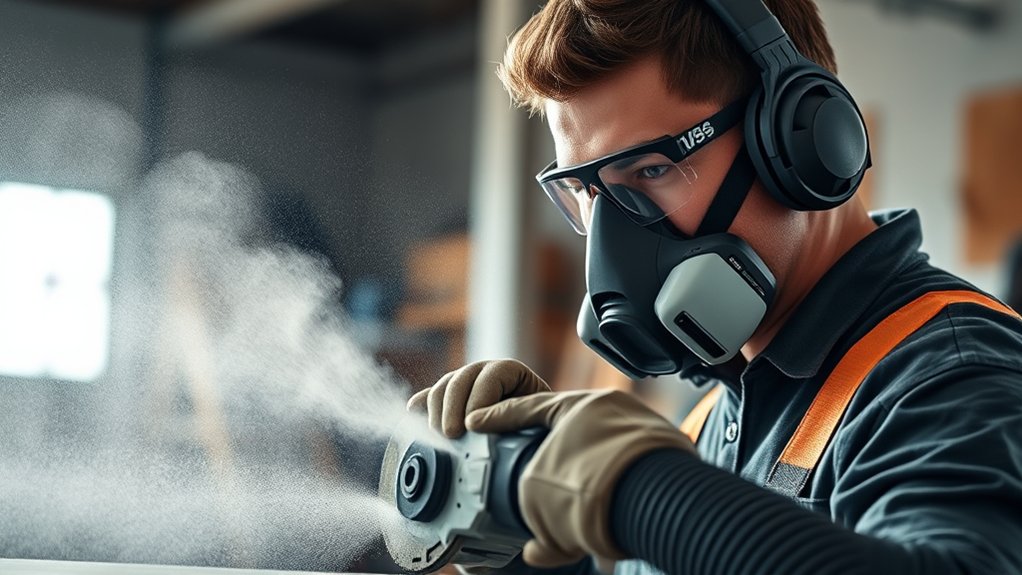
Respiratory protection is only one part of safe grinding. Inspect the tool, wheel, workpiece, controls, and personal protective equipment before the wheel touches the material.
Safety Gear Essentials
- Wear safety glasses with side protection and a face shield suitable for sparks and flying fragments.
- Use hearing protection when noise exposure requires it.
- Wear gloves that protect your hands while allowing secure control of the tool.
- Use non-melting, non-flammable clothing that covers exposed skin.
- Wear suitable footwear and keep sparks away from laces, cuffs, and openings.
- Keep the grinder guard installed and correctly positioned.
- Use a side handle when the grinder is designed for one.
- Confirm that the wheel is approved for the grinder speed and intended material.
Work Area Preparation
Remove combustible materials, clutter, and unnecessary people. Check where sparks will travel, including behind or below the workpiece. A spark stream can reach hidden combustible material or damage nearby glass, vehicles, wiring, hoses, and finished surfaces.
Secure the workpiece with clamps or a vise. Position power cords and extractor hoses where they cannot contact the wheel or create a trip hazard. Provide enough lighting to see the wheel, workpiece, guard, and surrounding area.
| Task | Why It Matters | Preferred Method |
|---|---|---|
| Identify the material | Determines dust, coating, fire, and respirator hazards | Check labels, SDS information, records, coatings, and test results |
| Ventilation | Limits dust accumulation | Use source extraction plus general exhaust where needed |
| Workspace clearing | Reduces fire, contamination, and trip hazards | Remove clutter, combustibles, and unprotected bystanders |
| Securing the workpiece | Improves control and reduces movement | Use suitable clamps or a vise |
| Respirator check | Confirms condition, configuration, and seal | Inspect all parts and perform the manufacturer’s seal check |
| Dust cleanup | Prevents settled dust from becoming airborne again | Use equipment and procedures approved for the collected material |
Signs Your Respirator or Protection Level Is Inadequate
Stop grinding and leave the contaminated area when the respirator leaks, breathing becomes difficult, you detect possible breakthrough, or work conditions change. Correct the problem before returning.
- Failed seal check: Air movement around the sealing surface means the respirator is not seated correctly or does not fit.
- Visible damage: Cracks, tears, stiff material, missing valves, damaged straps, or distorted seals require repair or replacement.
- Increased breathing resistance: A loaded particulate filter may need replacement.
- Gas or vapor breakthrough: Leave the area immediately and follow the cartridge change and incident procedure. Do not treat odor as the normal replacement schedule.
- Eye or skin irritation: The hazard may require eye protection, a full-face respirator, protective clothing, better containment, or a different control method.
- Heavy dust outside the respirator: Improve source capture and reassess the required protection factor.
- Facial or dental changes: Weight change, facial scarring, dental work, or surgery can change respirator fit and may require another fit test.
- Unknown atmosphere: Stop work if the contaminant, concentration, or oxygen level is not known.
Note: Dizziness, unusual shortness of breath, chest discomfort, confusion, or sudden illness during respirator use requires immediate withdrawal from the area and appropriate medical attention.
Frequently Asked Questions
Do you need a respirator when using an angle grinder?
Use suitable respiratory protection when grinding can expose you to hazardous particles and extraction, ventilation, or other controls cannot reduce exposure enough. The correct respirator depends on the material, coating, airborne concentration, task duration, local standard, and required protection factor.
Do you need a P2 or P3 mask for sanding or grinding?
P2 and P3 are classes used under particular approval systems, with P3 providing higher particulate filtration within the applicable system. Do not select between them from the material name alone. Use the exposure assessment, required protection factor, facepiece type, manufacturer instructions, and rules that apply in your country.
Is an N95 respirator enough for grinding?
A NIOSH-approved N95 may be suitable for some controlled particulate exposures when it fits correctly, but it is not automatically sufficient for silica, lead, toxic metals, heavy dust, oily aerosols, gases, vapors, or tasks requiring a higher protection factor. Identify the hazard before selecting it.
Do I need a dust shroud for an angle grinder?
A compatible dust shroud is strongly recommended for dust-producing grinding and may be required by a workplace control method. Connect it to an extractor with the airflow and filtration specified for the grinder, wheel, material, and task. A shroud does not eliminate every need for respiratory protection.
Should I use a respirator when grinding bare metal?
Use one when the exposure assessment, dust level, alloy, task duration, or work environment calls for it. Confirm that the metal is truly bare and free from paint, plating, galvanizing, oil, lead, cadmium, beryllium, or other hazardous contamination.
Do particulate filters protect against paint or solvent vapors?
No. Particulate filters are designed for particles and do not remove most gases or vapors. A specific gas or vapor cartridge, combination cartridge, or atmosphere-supplying respirator may be required after the contaminant and concentration have been identified.
Can facial hair affect a respirator seal?
Yes. Hair or stubble between the skin and sealing surface can allow contaminated air to leak inside. Tight-fitting respirators require a clear sealing area. A properly selected loose-fitting powered air-purifying respirator may be an alternative for some users and hazards.
Can I grind suspected asbestos while wearing a respirator?
No. Do not grind, sand, cut, or otherwise disturb suspected asbestos-containing material. Stop work and arrange assessment or removal by a properly trained and qualified asbestos professional.
When to Get Professional Safety Advice
Get professional safety advice before grinding material that may contain asbestos, lead, cadmium, beryllium, hexavalent chromium, toxic coatings, unknown residues, or significant quantities of combustible-metal dust. Professional help is also appropriate when you cannot identify the contaminant, estimate the exposure, select a cartridge, or determine whether an air-purifying respirator is allowed.
Workplaces must follow the occupational exposure limits, respiratory-protection rules, silica requirements, hazardous-substance controls, and training duties that apply in their jurisdiction. A qualified industrial hygienist, safety professional, occupational-health provider, or respirator-program administrator can help assess the task.
Safety Disclaimer: This article provides general information and does not replace a material-specific exposure assessment, respirator manufacturer instructions, medical evaluation, professional safety advice, workplace respiratory-protection program, or applicable law. Do not grind hazardous or unidentified material until the risks and controls are confirmed.
Conclusion
You may need a respirator whenever angle grinding produces hazardous airborne particles that source controls cannot reduce enough. The safest choice depends on the material, coating, exposure level, task duration, approval system, face fit, and required protection factor.
Identify the hazard before work, capture dust at the wheel, wear the complete approved respirator configuration, and check the seal every time. Stop when the material is unknown, the respirator leaks, the atmosphere is uncertain, or the controls do not keep dust contained.
Sources
- OSHA Respiratory Protection Standard, 29 CFR 1910.134 — respirator selection, medical evaluation, fit testing, seal checks, use, maintenance, and workplace programs
- OSHA Respirable Crystalline Silica Standard, 29 CFR 1926.1153 — silica exposure limits, handheld grinder controls, housekeeping, and required respiratory protection
- NIOSH Filtering Facepiece Respirators — N95, N99, N100, R-series, and P-series filter classifications
- NIOSH Fit Testing Guidance — qualitative and quantitative fit testing and factors that affect respirator fit
- UK Health and Safety Executive Fit Testing Basics — selection and fit testing of tight-fitting respiratory protective equipment
- US EPA Asbestos Safety Guidance — avoiding disturbance of suspected asbestos-containing materials and using trained professionals