Allturn Plastic Welder Review
A cracked bumper tab, split trash can, or broken plastic housing may not justify the cost of a replacement part. The Allturn Plastic Welder PWG-100 combines a hot stapler with cutting and smoothing tips so you can reinforce a crack and finish the surrounding plastic with one kit. Its 100W output, 800-staple assortment, and fast heating make it practical for DIY repairs, but it still requires correct plastic identification and careful heat control. This review explains what comes in the case, how the tool performs, and when you should choose a more specialized repair method.
Quick Verdict
Rating: 8.2/10, recommended with caveats
Best For: DIY bumper tabs, interior trim, bins, housings, and other non-critical thermoplastic repairs
Bottom Line: The Allturn PWG-100 gives you fast staple heating and a broad accessory kit in a portable case. Its main tradeoff is limited heat control, plus a five-minute continuous-use limit for the M6 smoothing and M8 cutting tips.
Key Specifications
| Specification | Detail |
|---|---|
| Brand | Allturn |
| Model / Part Number | PWG-100 |
| ASIN | B096RPQN58 |
| Product Type | 2-in-1 plastic hot stapler and surface-finishing kit |
| Power | 100W |
| Power Source | 110V AC, Type A US plug |
| Listed Staple Heat-Up | 1 to 2 seconds, up to 1,380°F |
| Listed Smoothing-Tip Heat-Up | About 5 seconds, up to 900°F |
| Dimensions | 9 x 7.3 x 1.97 inches |
| Listed Weight | 3.33 pounds |
| Housing Material | Nylon and TPR |
| Color | Yellow |
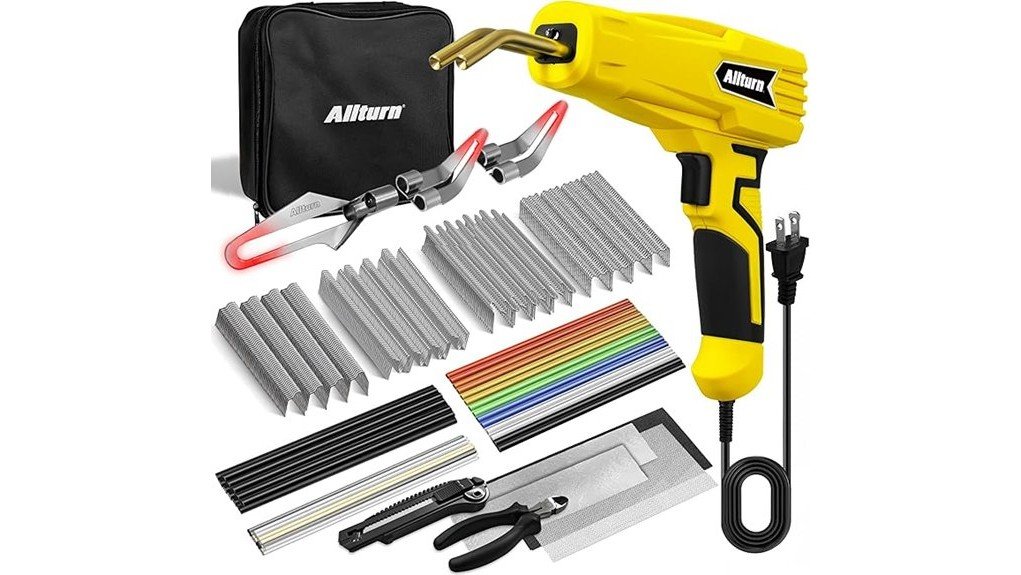
| Staples | 800 total: 200 flat, 200 wavy, 200 M-type, and 200 V-type |
| Welding Rods | 38 multi-type rods |
| Included Tips | One M8 cutting tip and two M6 smoothing tips |
| Other Accessories | Pliers, art knife, sandpaper, wire mesh, and portable case |
| Safety Features | Internal overheat protection and a UL-certified power cord |
| Accessory-Tip Limit | Use the M6 and M8 auxiliary tips for no more than five continuous minutes, then allow cooling |
What Is the Allturn PWG-100?
The Allturn PWG-100 is a corded plastic repair gun that uses electrically heated metal staples to bridge cracks. Once a staple is embedded and cooled, it acts as internal reinforcement. You can then use the included M6 smoothing tips or M8 cutting tip to shape the surface, blend compatible filler rod, or remove excess plastic.
The kit is aimed at home garages, hobby workshops, and light repair work. Its biggest selling point is the combination of four staple shapes, 38 welding rods, finishing tools, and a carrying case, so you do not need to buy basic consumables before your first practice repair.
Who Should Buy It?
Best For
- DIY users repairing bumper tabs, trim panels, bins, or plastic housings
- Buyers who want hot stapling and surface finishing in one portable kit
- Occasional light shop work where fast setup matters more than adjustable temperature
Skip If
- You need adjustable heat, documented duty-cycle data, or continuous production use
- The damaged part is structural, pressurized, fuel-related, electrical, or safety-critical
- You cannot identify the plastic or obtain a compatible filler rod
Before You Buy: This tool does not make every plastic part repairable. Confirm the resin type and avoid using a DIY weld as the only repair on fuel tanks, pressure vessels, coolant components, airbag-area trim, battery housings, load-bearing parts, or other safety-critical items.
Feature-by-Feature Review
100W Hot Stapling Performance
The listing states that the staple can reach its maximum temperature in about one to two seconds. That quick response is useful when you are placing several staples across a crack because you spend less time waiting between placements. The trigger-style design also lets you heat only while pressing the switch, which helps you work in short, controlled bursts.
Fast heat can also damage thin plastic. Press the staple only deep enough to anchor it without breaking through the visible face. Practice on scrap material before working on a finished panel.
M6 Smoothing and M8 Cutting Tips
Two M6 smoothing tips help flatten raised plastic and blend a compatible welding rod into the repair. The M8 cutting tip can trim or separate softened plastic. Allturn lists a maximum smoothing-tip temperature of 900°F after about five seconds, so these tips can respond quickly even though the tool does not provide a stated adjustable temperature dial.
The manufacturer treats these as auxiliary accessories and recommends no more than five minutes of continuous use. That limit is reasonable for spot repairs, but it makes the kit less suitable for long seams or production work.
800-Staple Assortment
The case includes 200 flat, 200 wavy, 200 M-type, and 200 V-type staples. Different shapes help you follow straight cracks, curves, and corners without forcing one staple style onto every repair. The large quantity also gives you room to practice before using the tool on a visible vehicle or household part.
Replacement staples should match the gun’s electrode spacing and the repair thickness. The technical listing refers to 0.8-diameter staples, so confirm dimensions before ordering a refill.
Welding Rods and Finishing Tools
The 38 multi-type rods can add material to a gouge or bridge a small missing section, but a rod must be compatible with the base plastic. The included pliers, knife, sandpaper, and wire mesh cover basic trimming and reinforcement tasks. The portable case keeps small staples and tips separated from other garage tools.
Housing, Cord, and Overheat Protection
The PWG-100 has a nylon and TPR housing, a 110V AC power supply, and a Type A US plug. Amazon lists the complete item at 9 x 7.3 x 1.97 inches and 3.33 pounds. An internal overheat protection device stops operation when the unit gets too hot, while the power cord is listed as UL certified.
Overheat protection is a backup, not a reason to ignore cooling breaks. Stop if the housing becomes unusually hot, the tool cycles off, the cord is damaged, or the plastic begins to burn instead of softening cleanly.
How It Performs in Real Use
Bumper Tabs and Interior Trim
For a cracked bumper mounting tab or hidden trim panel, staples can reinforce the back of the crack while keeping the visible side cleaner. The repair is easiest when you can remove the part, support it on a stable surface, and approach the damaged area from behind.
Bins, Housings, and Garage Items
Trash cans, tool housings, and non-critical plastic containers are good practice projects because appearance is often less important than function. The four staple styles help on flat areas and corners, while the smoothing tips can reduce sharp edges after trimming.
Gaps and Missing Material
Staples reinforce a crack, but they do not replace missing plastic. For a small gap, you may need a compatible rod and wire mesh in addition to staples. A mismatched rod can peel away or create a weak joint, so test the bond before relying on the repair.
Repeated Repairs
The kit is convenient for several short repairs in one session, but you need cooling pauses. The five-minute limit on the M6 and M8 tips means a long seam should be divided into stages. For frequent professional work, a temperature-controlled airless welder may offer better control and consumable support.
How to Use It Correctly
- Identify the plastic. Look for a molded resin code or manufacturer marking. Do not assume the included rod matches every part.
- Clean and dry the area. Remove dirt, grease, paint flakes, and loose plastic before heating.
- Align and support the crack. Hold the part in its original shape so the staple does not lock in a twist.
- Choose a suitable staple. Match the staple shape to the surface and crack geometry.
- Work from the hidden side when possible. Heat in short bursts and avoid pushing the staple through the finished face.
- Let each staple cool. Do not pull or flex the joint while the surrounding plastic is still soft.
- Trim and finish carefully. Cut the staple legs, then use a compatible rod or smoothing tip only where needed.
- Inspect the repair. Check for distortion, incomplete bonding, sharp metal, or a crack that continues beyond the repaired area.
Pro Tip: Practice the staple depth and smoothing-tip pressure on scrap plastic of similar thickness. A short practice run is cheaper than pushing a hot staple through the visible side of a bumper or trim panel.
Compatibility, Safety, and Maintenance
Use eye protection, heat-resistant gloves, and strong ventilation. Heated plastic can burn skin and release irritating fumes. Stop immediately if the material chars, flames, produces heavy smoke, or gives off a strong unknown odor.
- Inspect the cord, plug, electrodes, and tips before each use.
- Keep the hot tool away from solvents, fuel, upholstery, paper, and other flammable material.
- Do not touch or change a tip until the tool is unplugged and fully cool.
- Clean residue from cooled tips without damaging the threads or electrical contacts.
- Store staples, blades, and hot accessories in the case after they cool.
- Follow the product guide and the repaired part manufacturer’s instructions.
Do not use this kit to approve a vehicle for road use or to restore a component whose failure could cause injury. Have structural body parts, restraint-system trim, pressurized tanks, fuel-system parts, high-voltage battery enclosures, and critical coolant components inspected or replaced by a qualified professional.
Pros and Cons
Pros
- Fast one-to-two-second listed staple heating
- 800 staples divided among four useful shapes
- Includes M6 smoothing tips, an M8 cutting tip, and 38 rods
- Comes with pliers, mesh, sandpaper, a knife, and a portable case
- Internal overheat protection and a UL-certified power cord
Cons
- No stated adjustable temperature control
- M6 and M8 auxiliary tips have a five-minute continuous-use limit
- Repair strength depends on plastic identification, technique, and damage location
Is It Worth the Price?
The Allturn PWG-100 offers strong value for the price when you expect to complete several non-critical plastic repairs. The 800 staples, four staple shapes, 38 rods, auxiliary tips, hand tools, and storage case reduce the number of extras you need to buy before getting started.
It provides less value when your work requires precise temperature control, long continuous welds, or documented professional repair procedures. For one cosmetic item, replacement or adhesive repair may be simpler. For repeated bumper-tab, trim, housing, or bin repairs, the kit’s combination of reinforcement and finishing tools is more useful.
How It Compares to Alternatives
The Polyvance Mini-Weld Model 7 is a more specialized airless plastic welder with a broader professional repair ecosystem, making it worth comparing for frequent automotive work. The JounJip Deluxe Plastic Welding Kit uses an 80W iron rated up to 525°F and focuses more on rod-based airless welding than rapid hot stapling.
The ATOLS 1000-staple kit may appeal to buyers who want more staple quantity. The Allturn PWG-100 makes the most sense when you want a balanced 2-in-1 kit with hot stapling, smoothing, cutting, rods, and a case rather than the largest consumable count or a dedicated professional welder.
Frequently Asked Questions
Can the Allturn PWG-100 weld every type of plastic?
No. The listing markets it for thermoplastics, but results depend on the exact resin, thickness, contamination, and filler compatibility. Identify the material and test a hidden or scrap area before starting the repair.
How fast does the staple heat?
Allturn lists a one-to-two-second heat-up time and a maximum staple temperature of 1,380°F. Use short trigger presses because thin plastic can soften or distort quickly.
What is included in the kit?
The listing includes the 100W welder, 800 staples in four shapes, 38 rods, one M8 cutting tip, two M6 smoothing tips, pliers, an art knife, sandpaper, wire mesh, and a portable case.
Can you use the smoothing and cutting tips continuously?
Not for long sessions. Allturn recommends using the M6 smoothing and M8 cutting tips for no more than five continuous minutes, followed by a cooling period before you resume.
Can it repair a car bumper?
It can reinforce some compatible thermoplastic bumper cracks and mounting tabs, especially when you can work from the back. Damage near sensors, restraint systems, structural mounts, or large torn areas should be inspected by a qualified repair professional.
Are replacement staples easy to find?
Hot-stapler refills are widely sold, but shape alone does not guarantee fit. Confirm the staple diameter and electrode spacing for the PWG-100 before ordering replacements.
Does it have overheat protection?
Yes. The listing states that an internal protection device stops the tool when it overheats and allows operation again after cooling. You should still follow the stated accessory-tip limit and unplug the tool if it behaves abnormally.
What warranty does Allturn provide?
The current listing provides a warranty-information link but does not clearly state a warranty length in the visible product details. Review the seller’s current warranty terms and Amazon return policy before buying.
The Bottom Line
The Allturn PWG-100 is a practical choice for DIY users who want quick crack reinforcement and basic plastic finishing tools in one case. Buy it for bumper tabs, trim, bins, and other compatible non-critical thermoplastic parts; skip it for continuous professional work or repairs involving structural, pressurized, fuel, electrical, or safety-critical components. Its strongest advantages are fast staple heating and a complete accessory assortment, while its main limitations are fixed heat behavior and the five-minute auxiliary-tip duty limit.
Ready to Buy?
Check the latest price, seller details, accessory list, and warranty information before you decide.