When you compare an angle grinder vs. oscillating tool for cutting metal, the choice comes down to power, access, and finish quality. An angle grinder cuts thick steel, bolts, rebar, and heavy hardware much faster. An oscillating tool is slower, but its narrow blade is easier to place for thin metal, short flush cuts, tight corners, and work near finished surfaces.
Quick Answer
Choose an angle grinder for fast cuts through thick steel, bolts, rebar, bar stock, and heavy brackets. Choose an oscillating tool for controlled, shallow, or flush cuts in thin sheet metal, small fasteners, pipe, and tight spaces. The grinder wins on speed and depth; the oscillating tool wins on access and precision.
Key Takeaways
- Use an angle grinder when speed, cut depth, and heavy-duty metal removal matter most.
- Use an oscillating tool for short, shallow, flush, or carefully placed cuts in thin metal.
- Do not compare RPM with OPM directly. The tools use different cutting motions, so accessory type and material matter more than the speed number alone.
- Use the correct cutting accessory and guard. A grinder cut-off wheel, grinding wheel, flap disc, and wire brush are not interchangeable.
- Control the workpiece, sparks, heat, and noise. Clamp and support the metal, keep the kerf from pinching the wheel, wear proper PPE, and clear flammable material before cutting.
At a Glance
| Best For | Angle grinder: thick metal and fast cutoffs. Oscillating tool: thin metal, short flush cuts, and confined spaces. |
| Difficulty | Angle grinder: moderate and more reactive. Oscillating tool: easier to place for light cuts, but still requires secure workholding and PPE. |
| Tools Needed | Tool, metal-rated blade or wheel, the required guard and flange, clamps, eye and face protection, hearing protection, gloves, and a spark-safe work area. |
| Main Risk | Angle grinder: sparks, kickback, wheel failure, hot metal, and noise. Oscillating tool: hot blades, broken teeth, vibration, and slow cutting that encourages excess pressure. |
How Do Angle Grinders and Oscillating Tools Work?
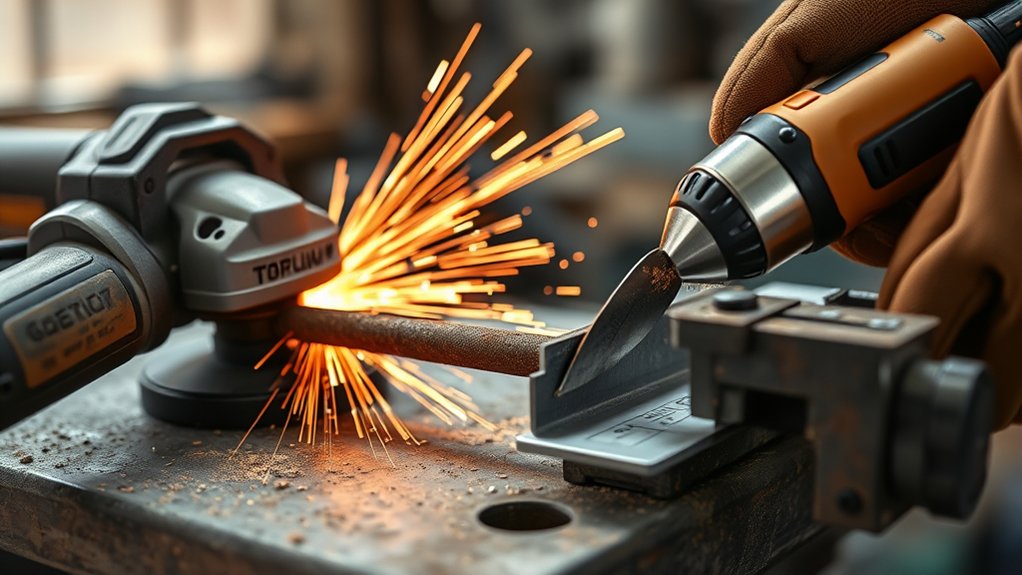
An angle grinder cuts with a rapidly rotating abrasive cut-off wheel or another accessory approved for the tool. Small grinders often have high no-load speeds. For example, DeWalt rates the 4-1/2-inch DWE402 at 11,000 RPM. That speed helps a thin cut-off wheel slice through bolts, rebar, threaded rod, steel bar, brackets, and tubing quickly.
An oscillating multi-tool moves its blade side to side through a small arc instead of spinning it. This short stroke is easier to place near walls, trim, flooring, and other finished surfaces. Many models also have variable speed. Makita rates the XMT03Z at 6,000 to 20,000 oscillations per minute, allowing the operator to match speed to the blade and material.
RPM and OPM are different measurements, so the larger number does not tell you which tool cuts faster. A grinder removes metal continuously around the edge of a wheel. An oscillating tool removes small chips with short blade strokes. In practice, the grinder is usually much faster on thick metal, while the oscillating tool is easier to guide on short, shallow cuts.
Note: Manufacturer speed figures are normally no-load ratings. Cutting speed under load depends on the metal, accessory, tool power, battery charge, and how well the workpiece is supported.
Cutting Speed vs. Precision: What’s the Difference?
Choose speed when the metal is thick, the cut is not highly visible, and the edge can be deburred afterward. An angle grinder is usually the better choice for removing seized bolts, trimming rebar, cutting steel bar, shortening brackets, or making demolition cuts in open areas.
Choose precision and access when the cut is short, shallow, close to another surface, or inside a confined space. An oscillating tool can flush-cut a small nail or screw, notch light-gauge metal, trim thin pipe near a wall, or reach a spot where a round grinder wheel cannot fit.
Pro Tip: Mark the cut line, make a shallow starter groove, and check your position before committing to the full cut. If an oscillating blade barely advances with light pressure, stop and switch to a grinder, reciprocating saw, band saw, hacksaw, shear, or nibbler that better matches the job.
Angle Grinder vs. Oscillating Tool: Quick Comparison
| Criteria | Angle Grinder | Oscillating Tool |
|---|---|---|
| Best use | Fast cuts in thick or hard metal | Controlled cuts in thin metal or tight spaces |
| Typical jobs | Bolts, rebar, bar stock, angle iron, brackets, and heavy tubing | Nails, screws, thin sheet, light trim, copper pipe, and small notches |
| Cut quality | Fast, but often rougher and more likely to need deburring | Easy to place, but blade marks and heat can still affect the edge |
| Cut depth | Deeper, limited by wheel diameter, guard clearance, and safe wheel use | Shallow to moderate, limited by blade length and tooth reach |
| Workspace | Open area with room for two-handed control and spark containment | Corners, walls, trim, and confined spots |
| Main safety concern | Sparks, wheel breakage, kickback, noise, and hot debris | Hot blade, broken teeth, vibration, and excess pressure |
Material Suitability: Which Tool for Which Task?
Metal thickness matters, but it is not the only factor. Also consider the length of the cut, how close you are to finished surfaces, whether sparks are acceptable, and whether the workpiece can be clamped and supported without pinching the accessory.
Thin Sheet Metal and Trim
An oscillating tool works well for short notches, small openings, and careful trimming in light-gauge sheet or soft metal trim. A grinder can cut thin sheet much faster, but it throws sparks and can overheat, distort, or burr a narrow edge if you pause in one spot. For long straight cuts in sheet metal, power shears, aviation snips, or a nibbler may give better control.
Nails, Screws, and Bolts
Use an oscillating tool with a bi-metal or carbide-tooth blade for small nails, screws, and light fasteners, especially when you need a flush cut. Use an angle grinder with a metal cut-off wheel for larger bolts, thick threaded rod, seized hardware, or hardened fasteners when there is room to control the tool and sparks.
Pipe, Tubing, and Brackets
An oscillating tool can trim thin copper pipe, light tubing, or a small bracket close to a wall. A grinder is faster for steel tubing and heavier brackets, but it needs room for the wheel, guard, and both hands. Never cut a pipe, tube, tank, or line until you have confirmed that it is depressurized, drained, and free of flammable or hazardous contents.
Rebar, Angle Iron, and Plate
Choose an angle grinder, chop saw, portable band saw, or another metal-cutting saw. An oscillating tool is generally too slow for these materials and can overheat or strip teeth when forced. Support the material so the offcut can move away without closing the kerf around the cut-off wheel.
Coated, Galvanized, and Unknown Metal
Paint, plating, rust, adhesives, and other coatings can create hazardous dust or fumes when heated or abraded. Identify the material and coating before cutting, review the product safety information when available, use ventilation or dust control, and wear respiratory protection when the hazard assessment requires it. OSHA’s angle grinder safety guidance lists inhaled dust or fumes among the hazards that must be controlled.
Warning: Before cutting into a wall, floor, vehicle panel, machine housing, or closed assembly, check for hidden wiring, fuel lines, plumbing, batteries, pressurized lines, and combustible material on the far side. A controlled tool can still cut into a hidden hazard.
Best Tool by Common Metal-Cutting Job
| Job | Better Choice | Why |
|---|---|---|
| Cut rebar or steel rod | Angle grinder | Much faster and better suited to deep cuts |
| Flush-cut a nail or small screw | Oscillating tool | Flat blade can reach close to the surface |
| Make a small notch in thin sheet | Oscillating tool | Easy to start and stop at a marked line |
| Cut a large bolt or seized fastener | Angle grinder | Fast cutoff with less blade wear |
| Trim pipe close to a wall | Oscillating tool for thin pipe; compact saw for thicker pipe | Better access and less risk to the nearby surface |
| Make a long straight cut in sheet | Shears, nibbler, or metal-cutting saw | Usually straighter and more efficient than either tool |
Products Worth Considering

Super Power : Equipped with a 4 Amps motor along with a 500 W maximum power output, the unique power output of this 4-1/2 angle grinder can produce a no-load speed of 11000 RPM, giving it fast cutting and grinding capacity
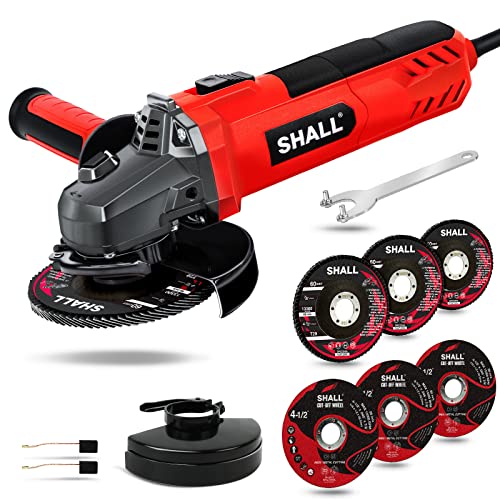
Note: There are 3 cutting discs wrapped in the clear plastic film, pls tear off the film to take them out.
Best Safety Practices for Angle Grinders and Oscillating Tools

Both tools can cause serious injury if the accessory is damaged, the workpiece moves, or the cut binds. Angle grinders need extra care because a high-speed wheel can throw sparks and fragments. OSHA requires guarding for portable abrasive wheels and says the grinder spindle speed must not exceed the wheel’s marked maximum operating speed.
Warning: Never remove the grinder guard to gain access. Use the wheel type, guard, flange, and mounting method required by the grinder and accessory manufacturers. Clamp the work, keep sparks away from fuel, solvents, paper, sawdust, oily rags, batteries, and combustible dust, and stop if the wheel or blade binds.
Essential Safety Gear
- Eye and face protection: wear safety glasses with side protection. For grinder work, add a face shield over the glasses.
- Hearing protection: use properly fitted earplugs or earmuffs when the tool or work area is loud.
- Hand protection: use close-fitting work gloves suited to sharp and hot metal while keeping them clear of the moving accessory.
- Clothing: wear fitted clothing and sturdy footwear. Remove jewelry and secure loose sleeves, cords, and long hair.
- Respiratory protection: control dust and fumes at the source. Use a suitable respirator only as part of a complete hazard-control plan and according to the product instructions.
NIOSH recommends controlling occupational noise below an eight-hour average of 85 dBA. Louder exposure requires shorter exposure time and stronger controls.
Inspect the Tool and Accessory
- Disconnect the plug or remove the battery before installing, adjusting, or changing an accessory.
- Confirm that the grinder wheel is approved for the tool size, material, and task.
- Make sure the wheel’s marked maximum speed equals or exceeds the grinder’s rated no-load speed.
- Use the cutting guard and flange required for a cut-off wheel; do not assume a grinding setup is suitable for cutting.
- Inspect the wheel for cracks, chips, warping, contamination, moisture damage, or signs that it was dropped. Follow any storage date or use-by marking supplied by the manufacturer.
- Check an oscillating blade for missing teeth, cracks, looseness, and a damaged mounting interface.
- Do not use an accessory that fits only through improvised adapters, extra washers, or forced mounting.
Support the Workpiece and Plan the Cut
- Clamp the workpiece so it cannot shift, spin, vibrate, or fall.
- Support both the main piece and offcut, but leave room for the kerf to open rather than close around the wheel.
- Direct sparks and hot fragments away from your body, other people, glass, hoses, cords, vehicles, and flammable material.
- Check what is behind and below the cut before starting.
- Allow cut metal, the wheel, and the blade to cool before touching or storing them.
Use the Correct Cutting Technique
For a grinder, use both hands whenever the design allows, keep the guard between you and the wheel, and stand out of the wheel’s plane. Let the tool reach full speed before touching the metal. Use light pressure and keep a cut-off wheel straight in the kerf. DeWalt’s grinder instructions warn that changing the angle after a cut starts can bend the wheel and lead to breakage.
For an oscillating tool, start at a moderate speed, use light pressure, and let the teeth work. Rocking the blade slightly can spread wear across more teeth, but do not lever the blade sideways. Stop if the blade discolors, loses teeth, smells hot, or stops advancing.
- Do not force either tool.
- Do not use the side of a cut-off wheel for grinding.
- Do not twist or curve a grinder cut while the wheel is buried in the kerf.
- Do not set either tool down until the accessory stops moving.
- Stop immediately if the tool chatters, binds, surges, or develops unusual vibration.
Control Sparks, Fire, and Fumes
Angle grinder sparks can travel beyond the immediate cut. OSHA guidance says to clear debris and flammable material and not to use a grinder where combustible dust has accumulated. In a workplace, follow hot-work rules, permit requirements, fire-watch procedures, and site-specific controls. At home, move combustibles well away, shield areas that cannot be moved, and inspect the work area after cutting for smoldering material.
Choosing the Right Disc or Blade for Metal
The accessory matters as much as the tool. A powerful grinder with the wrong wheel can fail violently. An oscillating tool with the wrong blade can overheat, shed teeth, or stall without making useful progress.
Angle Grinder Discs for Metal
- Metal cut-off wheel: for slicing bolts, rod, sheet, tubing, and bar stock. Use only for cutting and with the required cut-off guard and flange.
- Grinding wheel: for beveling, shaping, and removing heavier burrs. Do not use it as a thin cut-off wheel unless the manufacturer specifically rates it for both operations.
- Flap disc: for smoothing burrs, blending edges, and light surface finishing after a cut.
- Wire wheel or brush: for rust, scale, or paint removal. It is not a cutting accessory, and loose wires can become projectiles.
Match the wheel diameter, arbor, speed rating, material rating, and guard type to the grinder manual. Never install a circular-saw wood blade or toothed blade unless the grinder manufacturer has approved that exact guarded system for the tool.
Oscillating Tool Blades for Metal
- Bi-metal blade: suitable for small nails, screws, thin sheet, copper, and light-gauge metal.
- Carbide-tooth blade: a better choice for tougher fasteners and harder metal when the blade manufacturer lists that use.
- Segment blade: useful for controlled edge cuts and wider access around a fastener or trim piece.
- Plunge blade: useful for notches, small openings, and flush cuts.
Check the blade package for the metals it can cut and the tool interface it fits. Wider blades can track straighter on a flat surface, while narrow blades reach tighter corners. Reduce pressure and pause to cool the blade if cutting slows or heat builds.
Note: “Metal-rated” is not a single performance level. A blade that cuts copper pipe or a finish nail may not be suitable for stainless steel, hardened bolts, or thick structural steel. Follow the blade manufacturer’s material list.
Pros and Cons of Angle Grinders vs. Oscillating Tools
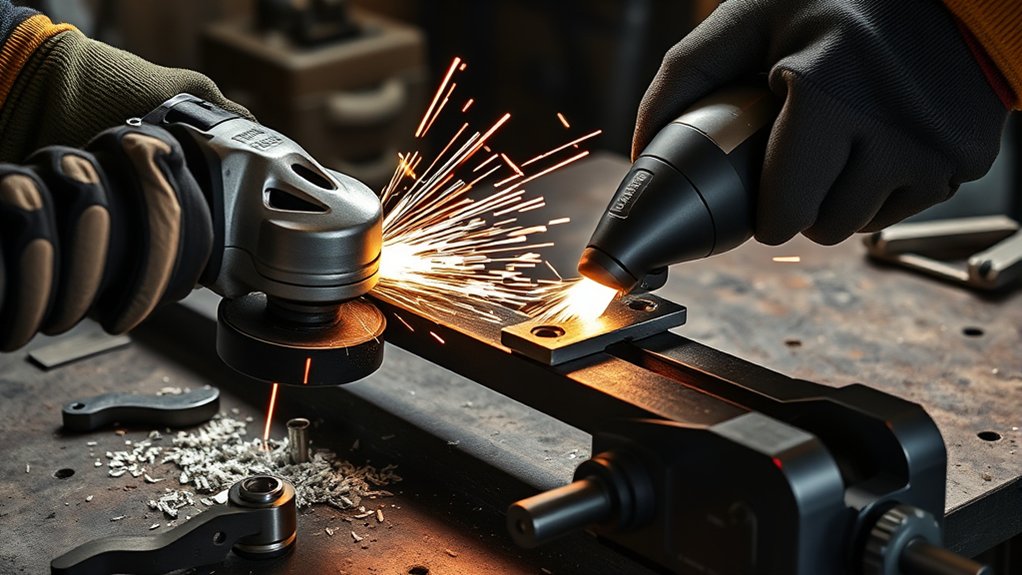
Both tools are useful, but they solve different problems. The grinder is a high-output metalworking tool. The oscillating tool is an access and detail tool that can also cut light metal with the right blade.
Angle Grinder Pros
- Cuts thick metal much faster than an oscillating tool.
- Handles bolts, rebar, steel angle, brackets, rod, and repair work.
- Can cut, grind, deburr, blend, and clean metal with approved accessories.
- Works well when the cut edge will be finished afterward.
Angle Grinder Cons
- Creates sparks, noise, heat, and flying debris.
- Can kick back or break a wheel if the cut binds or the wheel twists.
- Needs more open space, two-handed control, and stronger workpiece support.
- Can leave burrs, heat marks, and a wider kerf.
Oscillating Tool Pros
- Gives good control for short, shallow, and flush cuts.
- Fits corners and areas close to walls or finished surfaces.
- Has less aggressive tool reaction than a grinder when used correctly.
- Works well for small fasteners, thin sheet, light trim, and thin pipe.
Oscillating Tool Cons
- Cuts thick metal slowly.
- Blades can overheat and wear quickly when forced.
- Has limited cut depth compared with a grinder or saw.
- Is not efficient for long straight cuts through heavy steel.
Real-World Applications: When to Use Each Tool
Use the grinder when the job needs cutting power and you can create a controlled spark zone. Use the oscillating tool when the job needs careful placement, a flush blade position, or access that a round wheel cannot provide.
Use an Angle Grinder for These Jobs
- Cutting rebar, steel rod, bolts, and threaded rod.
- Cutting thick brackets, angle iron, or plate in an open work area.
- Removing seized hardware where sparks and heat can be controlled.
- Trimming metal that will be ground or filed smooth afterward.
- Grinding welds, removing burrs, or shaping rough edges with the correct accessory.
Use an Oscillating Tool for These Jobs
- Cutting thin sheet metal in a tight area.
- Flush-cutting a small nail, screw, copper pipe, or light bracket.
- Trimming metal near drywall, flooring, cabinets, tile, or painted surfaces.
- Making short plunge cuts or small notches.
- Cutting where a round grinder wheel and guard will not fit.
When Another Metal-Cutting Tool Is Better
Neither tool is ideal for every cut. Choosing a purpose-built saw or sheet-metal tool can improve cut quality and reduce accessory wear.
- Portable band saw: good for controlled, relatively square cuts in pipe, bar, and structural shapes.
- Reciprocating saw: useful for demolition cuts in pipe, tubing, and assemblies where a grinder’s spark stream is difficult to control.
- Metal-cutting circular saw or chop saw: better for repeated straight cuts when the material and saw are properly supported.
- Shears or nibbler: better for long cuts in thin sheet metal and usually produces fewer abrasive sparks.
- Hacksaw: slower, but quiet and practical for small jobs where power-tool access or sparks are a concern.
How to Choose the Right Tool for Your Project
Ask these questions before selecting the tool:
- How thick and hard is the metal? Thick steel, large bolts, and rebar favor a grinder or metal-cutting saw.
- How long and deep is the cut? Short, shallow cuts favor an oscillating tool. Long or deep cuts favor a grinder or saw.
- How much room is available? Tight corners and flush positions favor an oscillating tool.
- Can sparks and hot debris be controlled? If not, clear and protect the area or choose a lower-spark method.
- How clean must the edge be? An oscillating tool may be easier to place, but either cut can still require filing or deburring.
- Can the work be clamped and supported safely? Do not cut loose stock or hold a small workpiece in your hand.
The simple rule is grinder for power, oscillating tool for placement. When a job needs both, make the main cut with the grinder and finish the edge with a file, deburring tool, flap disc, or carefully placed oscillating blade.
Products Worth Considering

EZARC oscillating saw blade with carbide teeth can easily handle the toughest metal applications with 30 × life vs Bi-Metal blades
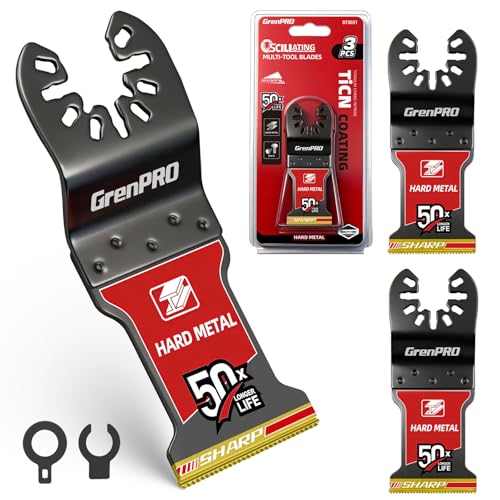
【Ultra Durable & Long-Lasting】GRENPRO oscillating tool blades adopt 50CRV, welded carbide HCS, TiCN coating and UV-printed surface. Upgraded titanium-enhanced bi-metal & laser welding offer 50× longer life and 2× higher durability, ideal for heavy-duty metal cutting

【Titanium Enhanced】Bi-metal oscillating tool blade with Titanium coated teeth for heat resistance, long life. With strong wear resistance, this multitool blade lasts 2 times longer than usual blades, giving you more durability than you'd expect
Common Mistakes to Avoid
- Using the wrong accessory: cutting wheels, grinding wheels, masonry wheels, wire brushes, and wood blades have different uses and safety requirements.
- Using the wrong guard or flange: a cut-off wheel may require a different guard and mounting hardware than a grinding wheel.
- Forcing the cut: excess pressure overheats oscillating blades and increases the chance that a grinder wheel will bind.
- Supporting the metal incorrectly: a closing kerf can pinch a cut-off wheel and cause kickback.
- Skipping clamps: moving metal causes chatter, rough cuts, and loss of control.
- Cutting near flammables: sparks and hot fragments can ignite dust, paper, solvents, fuel vapors, and oily rags.
- Removing the guard: the guard must stay installed and positioned between you and the wheel.
- Ignoring speed ratings: the wheel’s maximum speed must equal or exceed the grinder’s rated speed.
- Using a dull or damaged blade: worn oscillating blades create heat, wander, and encourage unsafe pressure.
- Touching the cut too soon: the accessory, workpiece, burrs, and offcut can remain hot and sharp after the tool stops.
Frequently Asked Questions
What speed should you use to cut metal with an oscillating tool?
Use the blade and tool manufacturer’s recommended range. For thin metal, begin at a moderate speed with light pressure. Increase speed only if the blade cuts cleanly without excessive heat, vibration, or tooth damage. The best setting varies by tool, blade, metal, and cut depth.
Is an oscillating tool better than a grinder?
It is better for short flush cuts, thin metal, tight spaces, and work near finished surfaces. A grinder is better for thick steel, large bolts, rebar, and fast cutoffs. Neither is the best choice for every metal-cutting job.
Are oscillating tools good for cutting metal?
Yes. With a bi-metal or carbide-tooth blade, an oscillating tool can cut thin sheet, small fasteners, copper pipe, light trim, and short notches. It is inefficient for thick steel, long cuts, and heavy fabrication.
What angle grinder speed should you use for cutting metal?
Use the grinder at the speed intended by its manufacturer and install only a cut-off wheel rated for at least that speed. Do not reduce safety to a generic RPM number. Check the grinder label, wheel label, guard requirements, flange requirements, and manual before cutting.
Can an oscillating tool cut bolts?
It can cut small bolts, screws, and nails with the right metal-rated blade. For large bolts, thick threaded rod, or hardened fasteners, an angle grinder, band saw, or another purpose-built metal-cutting tool is usually faster.
Which tool is easier for a beginner to control?
An oscillating tool is usually easier to place because its cutting action is less aggressive and the blade is easy to see. It is not risk-free. Beginners still need a secure workpiece, a metal-rated blade, eye protection, and careful hand placement. Angle grinders require added attention to guards, wheel ratings, kickback, sparks, and two-handed control.
Can you use a grinding wheel to cut metal?
Use a wheel only for the operations marked by its manufacturer. A standard grinding wheel is made for grinding, while a thin cut-off wheel is made for cutting. Do not substitute one for the other unless the wheel is specifically rated for both operations and the grinder is fitted with the required guard and flange.
Which tool makes the cleaner metal cut?
An oscillating tool is often easier to place for a short visible cut, but it can still leave tooth marks. A grinder cuts faster but often leaves burrs and heat discoloration. Final quality depends on the accessory, material, support, technique, and deburring afterward.
Conclusion
Choose an angle grinder for thick metal, fast cutoffs, rebar, steel bar, and large fasteners. Choose an oscillating tool for thin metal, short flush cuts, tight spaces, and careful work near finished surfaces. Whichever tool you use, match the accessory and guard to the task, support the work so the cut cannot pinch, control sparks and dust, wear proper PPE, and let hot metal cool before handling it.
Sources
- OSHA 1910.243, Guarding of Portable Powered Tools — supports abrasive-wheel guarding, inspection, and maximum-speed requirements.
- OSHA-supported Angle Grinder Safety guidance — supports correct wheel selection, spark control, PPE, workpiece clamping, two-handed use, and dust or fume precautions.
- OSHA Occupational Noise Exposure — supports hearing-risk and hearing-conservation guidance.
- CDC/NIOSH, Understand Noise Exposure — supports the 85 dBA eight-hour recommended exposure limit and shorter exposure as sound levels rise.
- DeWalt DWE402 Small Angle Grinder — supports the 11,000 RPM model example.
- Makita XMT03Z Oscillating Multi-Tool — supports the 6,000 to 20,000 OPM model example.