Disclosure: As an Amazon Associate, we earn from qualifying purchases. If you click a link on this page and make a purchase, we may receive a small commission at no extra cost to you.
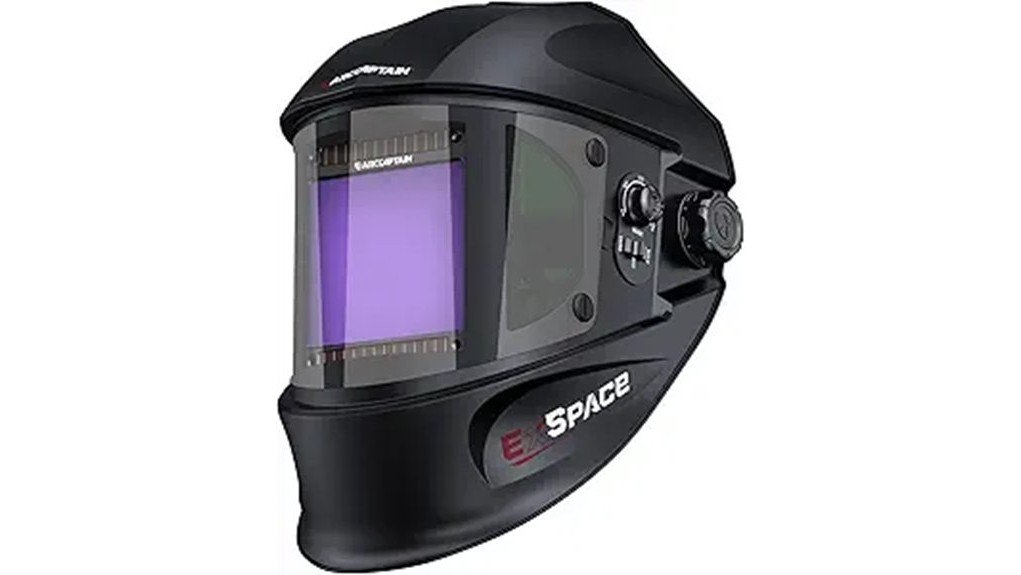
A narrow welding helmet can make positional work harder because you lose sight of nearby clamps, edges, cables, and obstacles. The ARCCAPTAIN LY800J Auto Darkening Welding Helmet addresses that problem with a 180° viewing layout that combines a large center auto-darkening filter with two fixed-shade side windows. Its panoramic visibility, 1/1/1/1 true-color optics, and four arc sensors make it a practical choice for MIG, TIG, Stick, cutting, and grinding. The main tradeoffs are its roughly 2.55-pound weight and side windows that stay at DIN 5 instead of darkening with the center lens.
Quick Verdict
Rating: 8.7/10, recommended with caveats
Best For: Welders who want wider peripheral visibility, external glove-friendly controls, and broad process compatibility without moving to a premium digital helmet.
Bottom Line: The LY800J delivers an unusually wide view and strong optical specifications for its class. It is less appealing for overhead work or anyone who wants auto-darkening side lenses, a very light shell, or internal digital presets.
| Specification | Detail |
|---|---|
| Brand | ARCCAPTAIN |
| Model | LY800J, Amazon style LY800Js-BK; current brand line EXSpace X300 |
| Product type | Panoramic auto-darkening welding helmet |
| Total viewing layout | 3.94 × 7.06 inches across the center and side windows |
| Center auto-darkening area | 3.94 × 3.66 inches |
| Side windows | Two 3.94 × 1.70-inch non-auto-darkening windows, fixed DIN 5 |
| Optical class | 1/1/1/1 true color |
| Light state | DIN 4 |
| Dark shade range | DIN 5–9 for cutting and DIN 9–13 for welding |
| Arc sensors | 4 |
| Switching speed | 1/25,000 second |
| UV/IR protection | Up to DIN 16 |
| Power | Dual solar panels plus two replaceable CR2450 lithium batteries |
| Material | Polypropylene, PP |
| Listed weight | About 2.55 pounds |
| Fit | One size, adjustable ratchet headgear |
| Operating range | 23°F to 131°F, or -5°C to 55°C |
| Listed standards | ANSI Z87.1, EN379 CE, and CSA Z94.3 |
| Included items | Helmet, storage bag, two CR2450 batteries, and three replacement lenses |
| Warranty | 180-day limited product warranty as listed |
What Is the ARCCAPTAIN LY800J?
The ARCCAPTAIN LY800J is a solar-assisted auto-darkening helmet built around a three-window panoramic layout. The center filter is the working auto-darkening lens, while the side windows expand your peripheral view at a fixed DIN 5 shade. ARCCAPTAIN currently groups this design under the EXSpace X300 name on its own store, while Amazon identifies the model as LY800J and the black style as LY800Js-BK.
It is designed for MIG, TIG, Stick or ARC welding, plasma cutting, and grinding. The controls sit outside the shell, so you can adjust shade and sensitivity without taking the helmet off. This makes the helmet especially useful when you switch between tack welds, longer beads, cutting, and cleanup work during the same project.
Key Takeaways
- Panoramic visibility is the main reason to buy: The 3.94 × 7.06-inch layout gives you more awareness than a standard single-window helmet.
- The center optics are strong: A 1/1/1/1 optical rating and true-color lens help reduce distortion and the heavy green cast common in lower-cost filters.
- Protection settings cover common shop work: You get DIN 4 in the light state, DIN 5–9 for cutting, and DIN 9–13 for welding.
- The extra view adds weight: At about 2.55 pounds, this is not the best option for long overhead sessions or welders who are sensitive to neck strain.
- The side windows are fixed shade: They improve awareness, but they do not darken with the center filter.
Design and Build Quality
The shell uses polypropylene, a common welding-helmet material that balances impact resistance, heat tolerance, and manageable cost. ARCCAPTAIN lists the shell for operation from 23°F to 131°F and storage from -4°F to 158°F. The product documentation also lists ANSI Z87.1, EN379 CE, and CSA Z94.3 compliance.
The ratchet headgear adjusts for circumference, depth, and viewing angle. The large exterior knob is easier to reach with gloves than a small internal dial. The panoramic lens assembly makes the shell wider and heavier than a basic single-window hood, so correct headgear tension matters more than it does on a lighter helmet.
Before You Buy: The side windows stay at DIN 5 and are meant for peripheral awareness. Keep the welding arc in the center auto-darkening filter, select the correct shade for your process and amperage, and do not use a scratched or cracked lens cover.
Viewing Features and Visibility
The center auto-darkening filter measures 3.94 × 3.66 inches. That is already a large working window, and the two 3.94 × 1.70-inch side panels extend the total layout to 3.94 × 7.06 inches. The wider view helps when you are working around tubing, fixtures, vehicle panels, railings, or crowded benches where hazards sit outside a narrow forward view.
The 1/1/1/1 optical classification covers optical accuracy, light diffusion, shade consistency, and angle dependence. In practical terms, the lens is designed to show a clearer puddle with less distortion when you look through it from different positions. True-color technology also reduces the strong green tint seen through older or cheaper auto-darkening filters.
The fixed DIN 5 side windows are useful for orientation before and between arcs. They do not provide the same variable protection as the center filter, so they should not become your primary line of sight during welding.
Auto-Darkening Protection and Sensor Performance
Four arc sensors detect the start of an arc and switch the center filter from DIN 4 to the selected dark shade in 1/25,000 second. Four sensors are helpful when one or more sensors are partly blocked by your hands, torch, workpiece, or a tight joint. They cannot eliminate every obstruction, but they give the filter more opportunities to detect the arc than a two-sensor design.
The shade controls cover DIN 5–9 for cutting and DIN 9–13 for welding. Full-time UV and IR protection is listed up to DIN 16, including when the filter is in its light state. You still need to choose the correct visible-light shade for the welding process, current, and technique rather than assuming the darkest setting is always best.
External shade and sensitivity controls are faster to reach between passes. The tradeoff is that exterior knobs can be bumped against clothing, a bench, or a confined work area. Check the settings before each session and after any impact.
Power, Controls, and Maintenance
The helmet uses two solar panels and two replaceable CR2450 batteries. The solar panels support the power system under shop lighting and arc exposure, while the replaceable batteries let you restore operation without discarding the filter assembly. Keep spare CR2450 batteries in a dry place if the helmet is used intermittently or stored for long periods.
Clean the viewing surfaces with a soft lint-free cloth. Replace an outer cover lens when it becomes pitted, cloudy, deeply scratched, or distorted by spatter. Do not use abrasive cleaners, solvents, or a rough shop rag on the filter. Inspect the shell, headgear, sensor openings, and battery compartment before use.
Pro Tip: Before striking an arc, use the helmet’s test or self-check function when available, confirm the selected mode and shade, and make a brief low-risk test tack. This catches a low battery, blocked sensor, or accidental grind-mode setting before a longer weld.
Comfort and Usability
The adjustable ratchet headgear and padded contact points help distribute the helmet’s weight. You can change the band diameter, depth, and tilt to bring the filter into a natural viewing position. A snug top strap is important because it prevents the full 2.55-pound load from sitting on the forehead band alone.
For bench work, fabrication, and short positional welds, the weight is reasonable for the visibility you gain. During repeated overhead welding, the wider shell can create more neck fatigue than a lighter single-lens model. Fit also varies by head shape, so check the return terms before buying if you have had trouble with ratchet headgear in the past.
Who Should Buy It?
Best For
- Fabricators and repair welders who need better awareness around fixtures, tubing, body panels, and cluttered work areas
- MIG, TIG, Stick, cutting, and grinding users who want one helmet with external controls
- Hobbyists and working welders who value a wide view more than the lowest possible weight
Skip If
- You do long overhead sessions and need a helmet closer to one pound
- You want auto-darkening side panels instead of fixed DIN 5 windows
- You prefer an internal digital display, memory presets, or a premium flip-up face shield
How It Performs in Real Use
For MIG and Stick Fabrication
The panoramic layout is most useful when the workpiece has several nearby reference points. You can keep clamps, joint edges, and surrounding metal in view while positioning the gun or electrode. The four sensors also help when the arc starts near a corner or fixture that could block part of the filter.
For TIG and Lower-Amperage Work
The true-color 1/1/1/1 center lens helps you read the puddle and filler-wire position with less color distortion. Sensitivity may need adjustment for low-amperage TIG because shop lights, nearby welders, or reflections can affect triggering. Start with the manufacturer-recommended settings and fine-tune one control at a time.
For Cutting and Grinding
The DIN 5–9 range supports cutting tasks, while grind mode keeps the center lens in its light state for surface preparation and cleanup. The external controls make switching faster, but grind mode also creates a common safety risk: forgetting to return the helmet to weld mode. Check the mode before every arc start.
For Long or Overhead Sessions
The large lens assembly gives you more visibility but also raises the listed weight to about 2.55 pounds. Proper strap adjustment can reduce pressure points, but it cannot make the helmet as light as a compact single-window hood. For frequent overhead work, a lighter professional model may be worth the added cost.
Setup Tips Before First Use
- Remove protective film: Check every cover lens and window for shipping film before judging clarity.
- Balance the headgear: Adjust the top strap first, then the rear ratchet, depth, and tilt. The helmet should stay stable without excessive forehead pressure.
- Inspect the batteries: Confirm both CR2450 batteries are installed correctly and replace them if the filter fails a self-check.
- Choose the correct mode: Set weld, cut, or grind mode before putting the helmet into service.
- Set shade and sensitivity: Follow the manual’s shade guidance for your process and amperage. Increase sensitivity only as much as needed for reliable triggering.
- Test before production work: Confirm the lens darkens consistently before starting a long bead or entering a confined position.
Pros and Cons
Pros
- 3.94 × 7.06-inch panoramic layout improves peripheral awareness
- Large 3.94 × 3.66-inch center auto-darkening filter
- 1/1/1/1 true-color optics support a clearer puddle view
- Four sensors and 1/25,000-second switching speed
- External controls, replaceable batteries, included storage bag, and replacement lenses
Cons
- About 2.55 pounds, heavier than many single-window helmets
- Side windows are fixed at DIN 5 and do not auto-darken
- External knobs can be bumped and require a setting check before use
Is It Worth the Price?
The LY800J sits in the value-to-mid-range part of the auto-darkening helmet market. Its strongest value is not a digital interface or premium headgear. It is the combination of a large center filter, fixed-shade side views, true-color 1/1/1/1 optics, four sensors, and replaceable batteries.
It is worth considering if panoramic awareness is your priority and you can accept the extra weight. It is not the best fit if you mainly weld overhead, need auto-darkening side panels, or want memory presets and a refined digital control system. Amazon offer and seller availability can change, so confirm the current style, package contents, warranty, and return terms on the listing before ordering.
How It Compares to Alternatives
The YESWELDER Q800D is the closest like-for-like alternative because it also combines a true-color center filter, four sensors, and fixed-shade side views. Compare headgear fit, replacement-lens access, warranty support, and current seller terms rather than choosing by screen size alone.
The ESAB Sentinel A60 and Lincoln Electric VIKING 3350 series target buyers who want more refined professional headgear, digital controls, or established industrial support. They usually make more sense for daily production work. The ARCCAPTAIN is the better fit when your main goal is broad visibility and solid core specifications at a lower value tier.
Frequently Asked Questions
Are the side windows auto-darkening?
No. The two side windows are fixed at DIN 5. They are intended to improve peripheral awareness, while the center 3.94 × 3.66-inch filter provides the variable auto-darkening protection used for viewing the arc.
Which welding processes does the LY800J support?
The listed shade ranges and modes support MIG, TIG, Stick or ARC welding, plasma cutting, and grinding. Select the correct mode and shade for the process and amperage before starting work.
How heavy is the ARCCAPTAIN panoramic helmet?
The listed weight is about 2.55 pounds. That is manageable for many shop tasks, but it is heavier than a compact single-window helmet and may be tiring during long overhead sessions.
Does it use replaceable batteries?
Yes. The power system combines two solar panels with two replaceable CR2450 lithium batteries. Replace both batteries when the filter becomes unreliable, fails a self-check, or shows a low-power warning.
Can you use a magnifying cheater lens?
The product listing identifies the helmet as compatible with a magnifying lens. Confirm the required size and mounting method for the exact LY800J or EXSpace X300 style before ordering a cheater lens.
What comes in the package?
The current product information lists one helmet, an ARCCAPTAIN storage bag, two CR2450 batteries, and three replacement lenses. Package contents can change by seller or style, so verify the listing before purchase.
What warranty does the helmet include?
The Amazon product information lists a 180-day product warranty. Amazon also lists its voluntary 30-day return guarantee for many purchases, but eligibility and conditions depend on the seller, location, and order.
Who should choose a different helmet?
Choose a lighter helmet if you spend much of the day welding overhead. A premium digital model may also be better if you need memory presets, internal push-button controls, auto-darkening side panels, or a flip-up clear grinding shield.
The Bottom Line
The ARCCAPTAIN LY800J is a strong value for welders who want a genuinely wide field of view, clear 1/1/1/1 optics, four-sensor performance, and simple external controls. Skip it if low weight, auto-darkening side lenses, or premium digital headgear matters more than panoramic awareness. Its center filter is the main strength, while the 2.55-pound build and fixed DIN 5 side windows are the key limitations.
Ready to Buy?
Check the latest seller, style, package contents, and product details before you decide.