A cold garage finds the weak spot in a cheap auto-darkening welding helmet. Coin cells sag, cover lenses fog, headgear slips, and a slow filter turns a quick tack into a flash.
The strongest all-round pick here is the ARCCAPTAIN LY800Js-BK, which lists a 3.94 by 7.06 in panoramic view and four arc sensors, so you track clamps and fixtures without turning your head. On a tighter budget, the YESWELDER LYG-L600A covers routine MIG and stick work.
Picks come from manufacturer spec sheets and manuals, owner feedback trends outside Amazon, and current recall records. Nothing here was bench-tested for this guide.
Auto-Darkening Welding Helmets Compared
| Product | Best for | Viewing area | Arc sensors | Shade range |
|---|---|---|---|---|
|
Budget
|
Everyday value | 3.64 x 1.67 in | 2 | 3.5 light / 9-13 weld |
|
Mid-range
|
Large front view | 3.93 x 3.66 in | 4 | 3 light / 5-9 cut / 9-13 weld |
|
Budget
|
Compact four-sensor hood | 3.86 x 1.69 in | 4 | 4 light / 9-13 weld |
|
Mid-range
|
Beginners on a big view | 3.94 x 3.23 in | 4 | 4 light / 5-9 cut / 9-13 weld |
|
Premium
|
Panoramic on a budget | 3.94 x 3.23 in main, plus fixed side windows | 4 | 4 light / 5-9 cut / 9-13 weld |
|
Budget
|
Built-in work light | Not published | 2 | 9-13 weld plus grind mode |
|
Budget
|
Cheapest hood with a light | Not published | 2 | 4 light / 9-13 weld |
|
Mid-range
|
Large view plus a light | 3.94 x 3.66 in | 4 | 4 light / 5-8 cut / 9-13 weld |
|
Budget
|
Simplest occasional-use hood | 3.62 x 1.65 in | Not consistently published | 4 light / 9-13 weld |
|
Premium
|
Best overall awareness | 3.94 x 7.06 in total, main lens plus side windows | 4 | 4 light / 5-9 cut / 9-13 weld |
Auto-Darkening Welding Helmets: Our Top Picks
Quick Navigation
- YESWELDER LYG-L600A – Best value
- YESWELDER LYG-M800H – Best large front view
- ARCCAPTAIN HSH-S800 – Best compact four-sensor
- MIGVAN H-21 – Best for beginners
- YESWELDER LYG-Q800D – Best panoramic value
- TRQWH KTS-JD03 – Best built-in light
- TRQWH TRQ-HS0103 – Best budget hood with light
- ARCCAPTAIN XK-LY800H – Best large view with light
- BESTCLUB Flag Eagle – Simplest basic pick
- ARCCAPTAIN LY800Js-BK – Best overall
- Shade-by-amperage chart
- Auto-darkening vs passive helmets
- FAQs
1. YESWELDER LYG-L600A
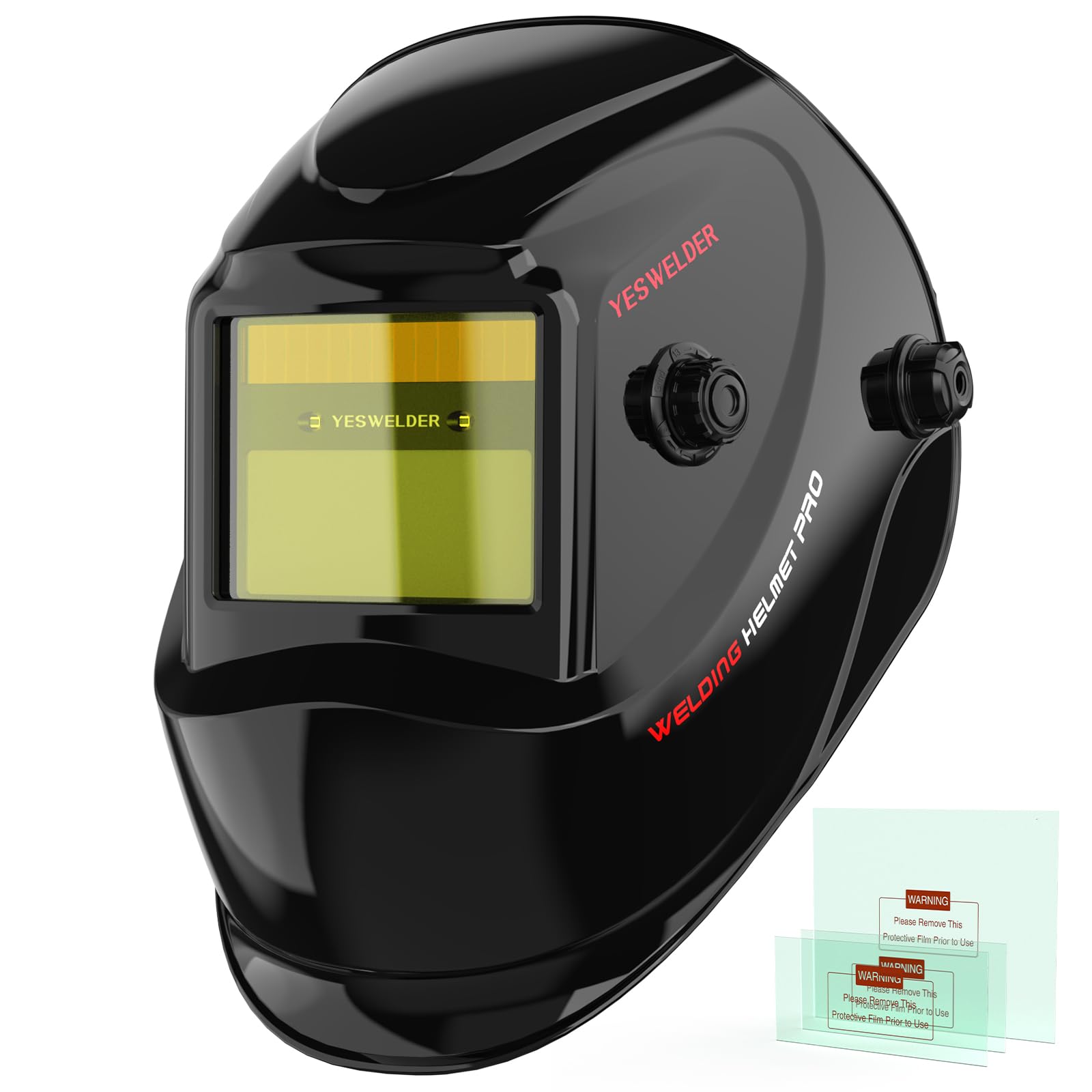
Bottom line: The YESWELDER LYG-L600A puts top-class optics and a replaceable cell in the lightest shell here. Buy it for weekend MIG, stick and grinding when you do not need a big window.
Key specs
- Viewing area: 3.64 x 1.67 in, a letterbox window that suits flat bench work
- Optical class: 1/1/1/1, the best score in all four EN 379 categories
- Arc sensors: 2, enough for open joints in normal positions
- Shade range: DIN 3.5 grind, DIN 9-13 weld, adjusted on an outside knob
- Power: solar assist plus a replaceable CR2450 cell you can carry spares for
The small cartridge is the point. Less glass means less weight on your neck, and the external knob lets you drop from weld to grind with gloves on. YESWELDER rates the switch at 1/30,000 second and builds the shell in PP, with cheater-lens compatibility if you need magnification.
The trade-off is coverage. Two sensors sit further apart than four, so a torch, a clamp or your own hand can shade both at once when you weld into a corner. It also meets ANSI Z87.1 and CSA Z94.3, which matters if your shop has a written PPE rule.
Owner feedback

Owner feedback shifts as sellers change batches. Confirm the model code and manual on arrival.
- Top 1/1/1/1 optical class at the lowest price tier here
- External shade knob is easy to reach with gloves
- Replaceable CR2450 cell instead of a sealed pack
- Lightest cartridge in this group, so less neck load
- Only two arc sensors, so awkward angles can block both
- Smallest viewing area of any pick in this guide
- No separate cut range on this listing, unlike the M800H
2. YESWELDER LYG-M800H

Bottom line: The YESWELDER LYG-M800H gives you a near-square window and the widest process range here without going panoramic. Buy it if you switch between welding, cutting and grinding on one project.
Key specs
- Viewing area: 3.93 x 3.66 in, roughly four times the glass of a letterbox hood
- Optical class: 1/1/1/1, so shade stays even as you move your head
- Arc sensors: 4, which keeps detection alive when one gets blocked
- Shade range: DIN 3 light, 5-9 cut, 9-13 weld, covering every process here
- Power: solar assist plus a replaceable CR2450, with adjustable delay and sensitivity
The tall window is what you feel first. You can see the joint, the fixture and your filler hand at once, which cuts down on the head-bobbing that makes long fit-up sessions tiring. Switching is rated at 1/30,000 second and the blue-light-filtering outer lens is standard on current stock.
Certification is broad here: ANSI Z87.1, EN 379 CE and CSA Z94.3 all appear on YESWELDER’s own spec sheet. That is worth more than a marketing phrase if you ever have to show a supervisor what you are wearing. Our full YESWELDER LYG-M800H review covers the powered-air version of the same platform.
Owner feedback

Owner feedback shifts as sellers change batches. Confirm the model code and manual on arrival.
- 3.93 x 3.66 in window shows joint and fixtures together
- Four sensors plus a full 5-9 cut range and 9-13 weld range
- Fastest listed switch here at 1/30,000 second
- ANSI, EN 379 and CSA marks all published by the maker
- Headgear hardware feels lighter than the cartridge it carries
- Bigger shell is harder to work in inside tanks or frames
- Older M800H listings quote different optical and shade wording
3. ARCCAPTAIN HSH-S800

Bottom line: The ARCCAPTAIN HSH-S800 is the only compact hood here with four sensors, in a shell ARCCAPTAIN lists at about 1 lb. Buy it when you want redundancy without bulk.
Key specs
- Viewing area: 3.86 x 1.69 in, wider than the L600A but still a letterbox
- Optical class: 1/1/1/1, with permanent DIN 16 UV and IR blocking
- Arc sensors: 4 in a small cartridge, unusual at this price
- Shade range: DIN 4 light, DIN 9-13 weld, with no separate cut range
- Power: solar assist plus a replaceable CR2450 in a PA shell
Four sensors in a compact cartridge is the reason this one earns its place. The sensors sit closer together than on a large hood, but you get four chances to catch the arc instead of two, which helps on tacks and short repeat welds where you are constantly moving.
ARCCAPTAIN builds it from polyamide rather than PP, and quotes a tensile strength of 120 MPa for the shell. The listed switch is 1/25,000 second, slightly behind the YESWELDER pair, and it carries ANSI Z87.1, EN 379 CE and CSA Z94.3 marks. It also accepts a cheater lens.
Owner feedback

Owner feedback shifts as sellers change batches. Confirm the model code and manual on arrival.
- Four sensors in the lightest shell in this guide
- 1/1/1/1 optics with permanent DIN 16 UV and IR blocking
- PA shell rated for shock, heat and wear resistance
- Cheater-lens compatible for close-up work
- No dedicated cut range on this listing, only 4 and 9-13
- Short window compared with the large-view picks
- Accessory bundles vary between graphic versions
4. MIGVAN H-21
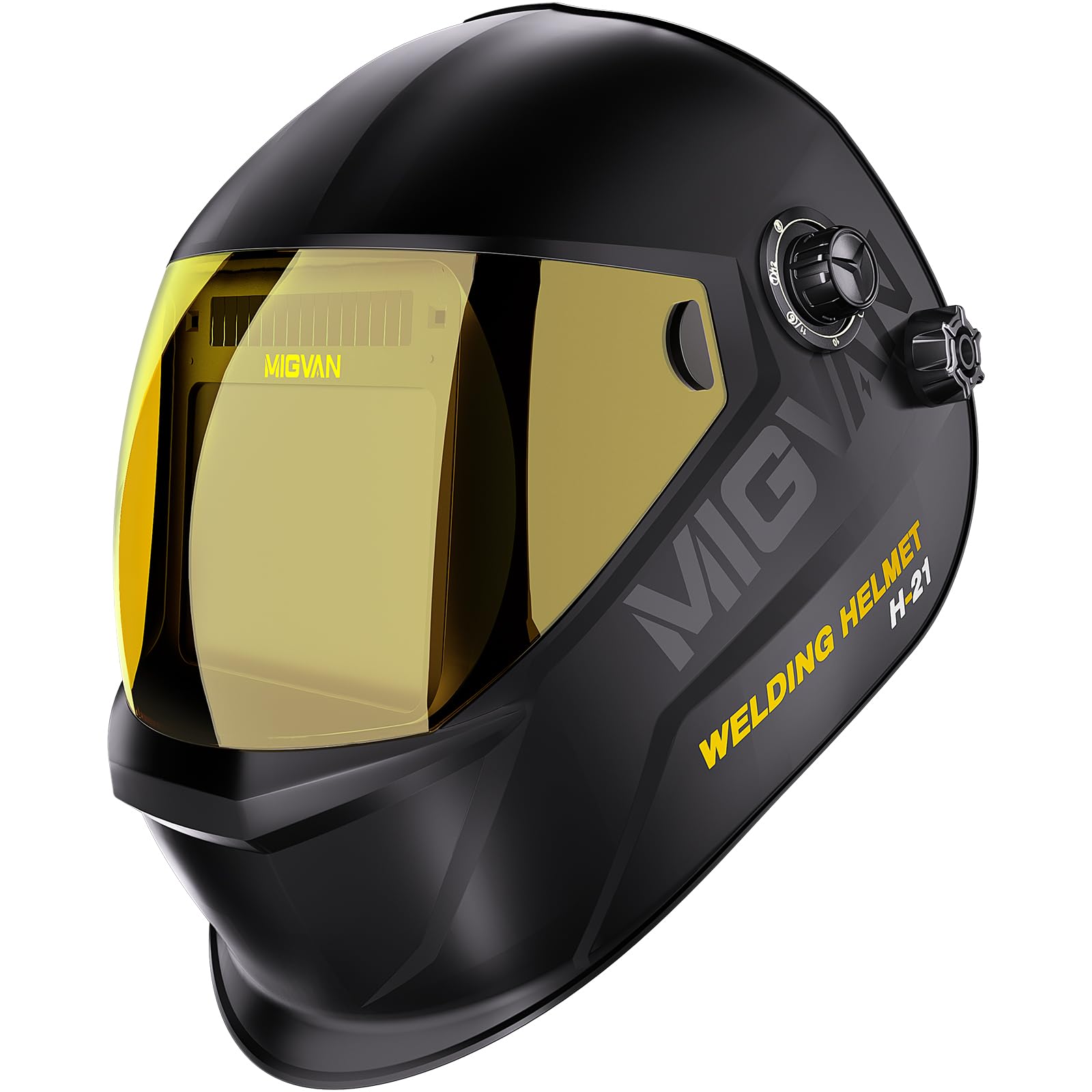
Bottom line: The MIGVAN H-21 pairs a large window with four sensors and a dual power system. Buy it as a first hood if you value seeing the puddle over having gloved control access.
Key specs
- Viewing area: 3.94 x 3.23 in, close to the panoramic hoods’ main lens
- Optical class: not published for this model, so check the filter marking yourself
- Arc sensors: 4, giving cover when a sensor is shaded
- Shade range: DIN 4 light, 5-9 cut, 9-13 weld, covering the usual garage jobs
- Power: solar panels plus a lithium cell, so it works in dim corners
A big window genuinely helps when you are learning. You can watch the leading edge of the puddle and the joint line together instead of guessing, and four sensors mean you are less likely to get flashed while your body position is still inconsistent.
Two things temper that. The shade and sensitivity knobs sit inside the shell, so changing settings means taking the helmet off, and the listed switch of 1/10,000 second is the slowest in this guide. That is still fast, but it is a real gap next to the 1/25,000 and 1/30,000 second filters here.
Owner feedback

Owner feedback shifts as sellers change batches. Confirm the model code and manual on arrival.
- Large 3.94 x 3.23 in window makes the joint line easy to follow
- Four arc sensors at a mid-range price
- Weld, cut and grind ranges all covered
- Replacement outer-lens buckles are sold for H-21 and H-24
- Controls are inside the shell, so you remove the hood to adjust
- 1/10,000 second switch is the slowest listed here
- No published optical class and thin manufacturer documentation
5. YESWELDER LYG-Q800D
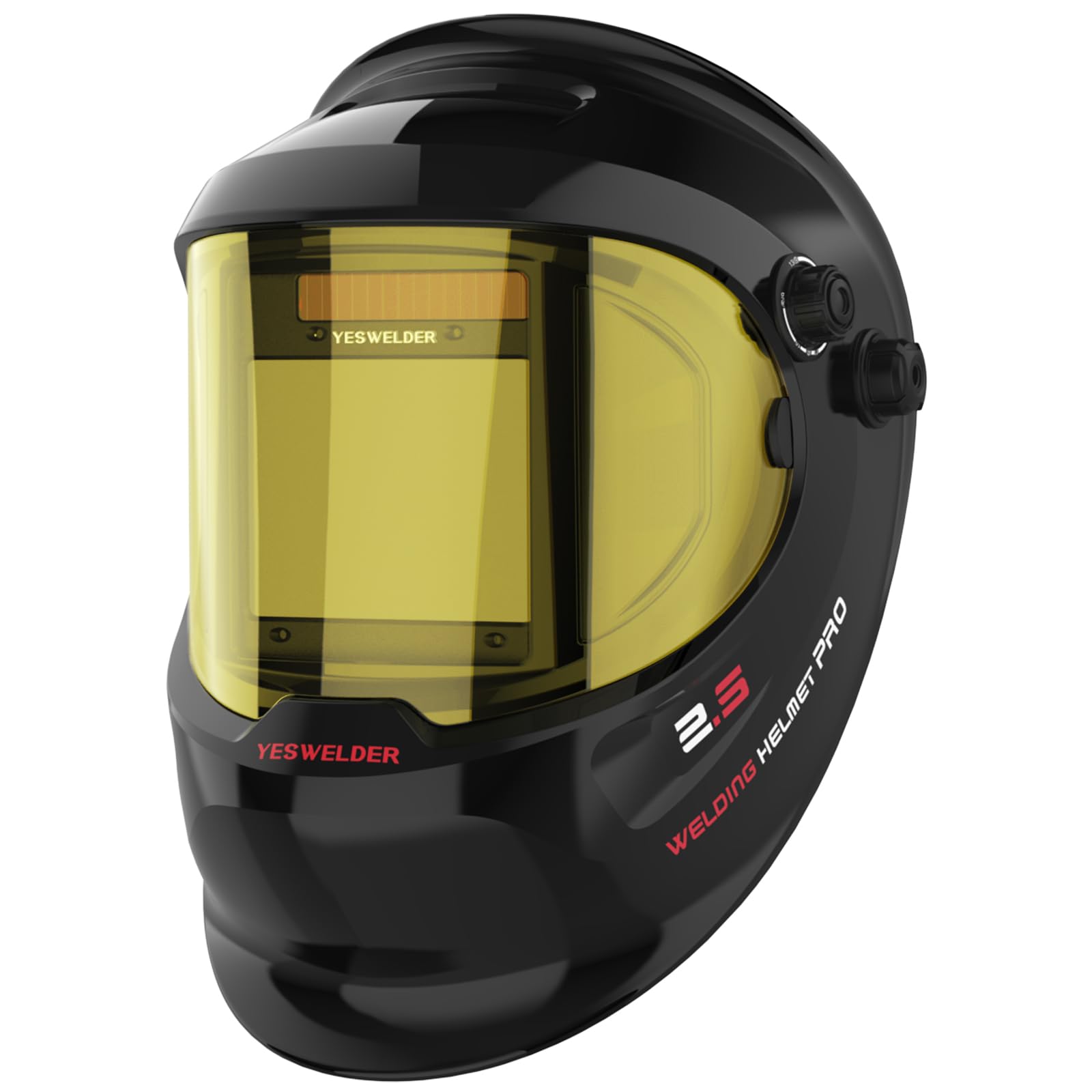
Bottom line: The YESWELDER LYG-Q800D adds two fixed-shade side windows to a familiar four-sensor platform. Buy it if tunnel vision, not window size, is what slows you down.
Key specs
- Viewing area: 3.94 x 3.23 in main lens, plus 1.96 x 4 in side windows each
- Optical class: 1/1/1/1 across the main lens on current stock
- Arc sensors: 4, with adjustable sensitivity and delay
- Shade range: DIN 4 main light, DIN 5 fixed sides, 5-9 cut, 9-13 weld
- Power: solar assist plus a replaceable CR2450 and a low-voltage indicator
The side windows are fixed DIN 5 glass. They never auto-darken, so they are for awareness only, not for looking at an arc through. What you gain is knowing where the bench edge, the clamp and the person walking past actually are without lifting the hood.
Everything behind the main lens is the same proven YESWELDER stack: 1/30,000 second switching, an outside variable knob, reinforced PP, and pivot-style headgear. The low-voltage indicator is genuinely useful in a cold shop, where a marginal cell shows its age first.
Owner feedback

Owner feedback shifts as sellers change batches. Confirm the model code and manual on arrival.
- Side windows cut tunnel vision around fixtures and benches
- Four sensors and a full 5-9 cut, 9-13 weld range
- Low-voltage indicator warns you before the cell dies
- Cheater-lens compatible like the rest of the YESWELDER line
- Side windows are fixed DIN 5 and never auto-darken
- Wider shell is awkward inside frames and tanks
- Reflections through the sides bother some welders
6. TRQWH KTS-JD03 Helmet

Bottom line: The TRQWH KTS-JD03 puts a USB-rechargeable lamp on the crown and an external grind button on the side. Buy it if your bench sits in a dark corner.
Key specs
- Viewing area: not published on the current listing, so measure before buying spare lenses
- Optical class: 1/1/1/2, one step behind the 1/1/1/1 picks on angle consistency
- Arc sensors: 2, which suits open joints more than cramped corners
- Shade range: DIN 9-13 weld plus a grind mode on an external button
- Power: solar assist with replaceable coin cells, and a separately charged LED
The lamp earns the pick. Setting up a joint in a dim garage normally means a work light on a stand or a torch in your teeth, and a crown-mounted LED removes that step. It does not replace shop lighting, and it does nothing once the arc is lit.
TRQWH lists the switch at 1/20,000 second with adjustable sensitivity and delay, and the helmet carries ANSI Z87.1, EN 379 CE and CSA Z94.3 marks in a PP shell. The external grind button is the other quiet win: no reaching inside between passes.
Owner feedback
No owner trend was consistent enough across independent sources to report here. Test every function before the first weld.

Owner feedback shifts as sellers change batches. Confirm the model code and manual on arrival.
- USB-rechargeable crown light for setup in dark corners
- External grind button keeps the hood on between passes
- Adjustable sensitivity and delay at a budget price
- ANSI, EN 379 and CSA marks published by TRQWH
- Only two arc sensors, so awkward positions are riskier
- 1/1/1/2 optical class shifts more with viewing angle
- Viewing-area size is not published on the listing
7. TRQWH TRQ-HS0103 Helmet

Bottom line: The TRQWH TRQ-HS0103 is the cheapest way here to get an auto-darkening filter and a built-in lamp together. Buy it as an occasional-use hood or a spare, not a daily driver.
Key specs
- Viewing area: not published on the current listing, worth measuring on arrival
- Optical class: 1/1/1/2, workable for general welding, less consistent off-angle
- Arc sensors: 2, suited to flat and horizontal work
- Shade range: DIN 4 light, DIN 9-13 weld, adjustable for MIG, TIG and stick
- Power: solar assist plus replaceable CR2032 cells, not the CR2450 used elsewhere
The battery difference matters more than it sounds. Four of the picks here run CR2450 cells, so if you stock spares for a shop full of hoods, this one needs its own size. TRQWH bundles spare cells with some packages, but contents change between sellers.
Adjustment is straightforward: knobs on both sides set the angle, a knob at the back sets headband tension, and a thickened forehead pad takes the pressure. The shell is PP and carries ANSI Z87.1, EN 379 CE and CSA Z94.3 marks.
Owner feedback
No owner trend was consistent enough across independent sources to report here. Treat the first session as a test and check every function.

Owner feedback shifts as sellers change batches. Confirm the model code and manual on arrival.
- Lowest-cost route to an integrated work light
- Replaceable CR2032 cells rather than a sealed pack
- Angle and tension knobs plus a thick forehead pad
- ANSI, EN 379 and CSA marks published for the shell
- Only two arc sensors and a 1/1/1/2 optical class
- Response time is not stated on the current listing
- Built for occasional use rather than daily production
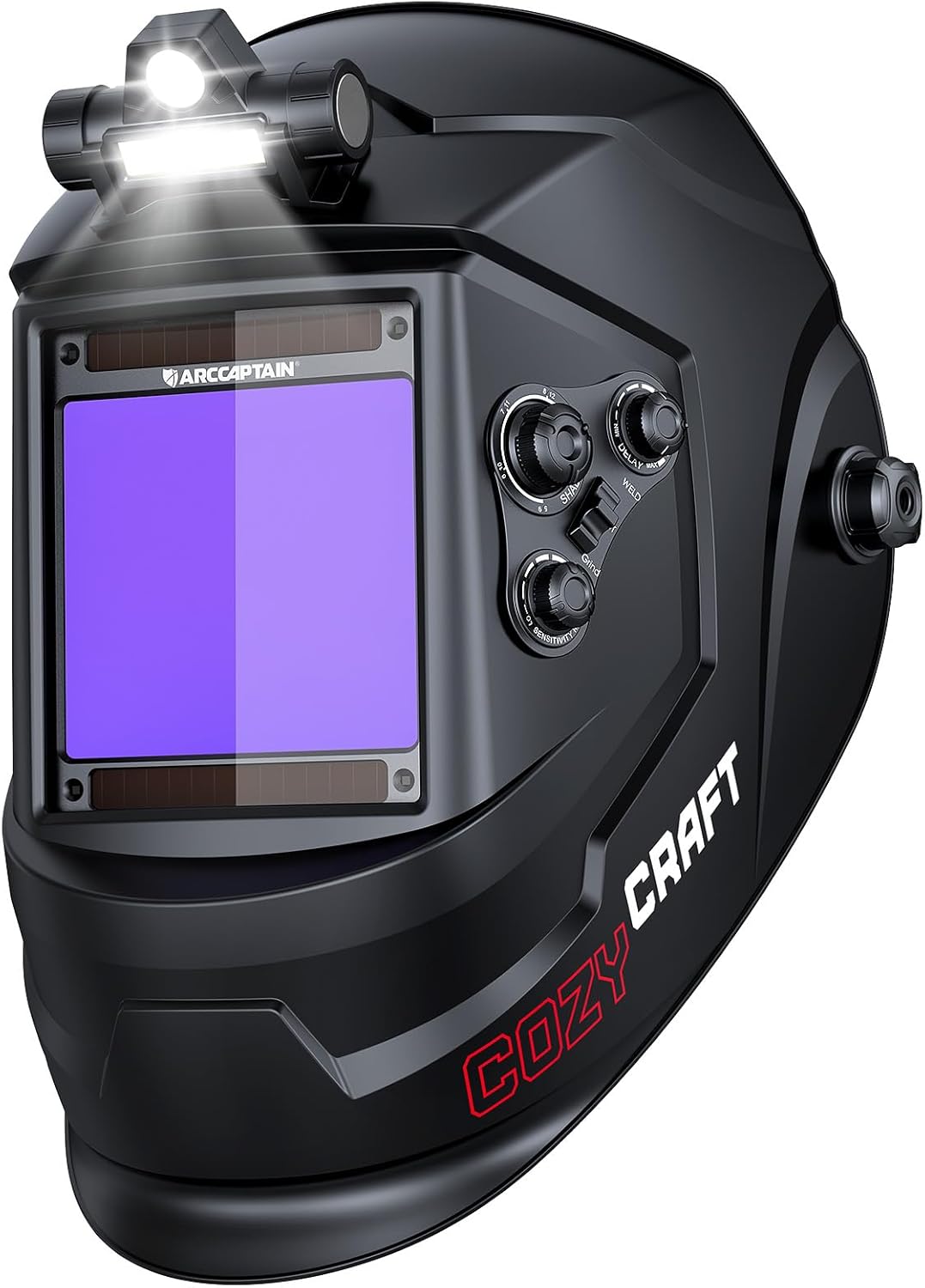
8. ARCCAPTAIN XK-LY800H
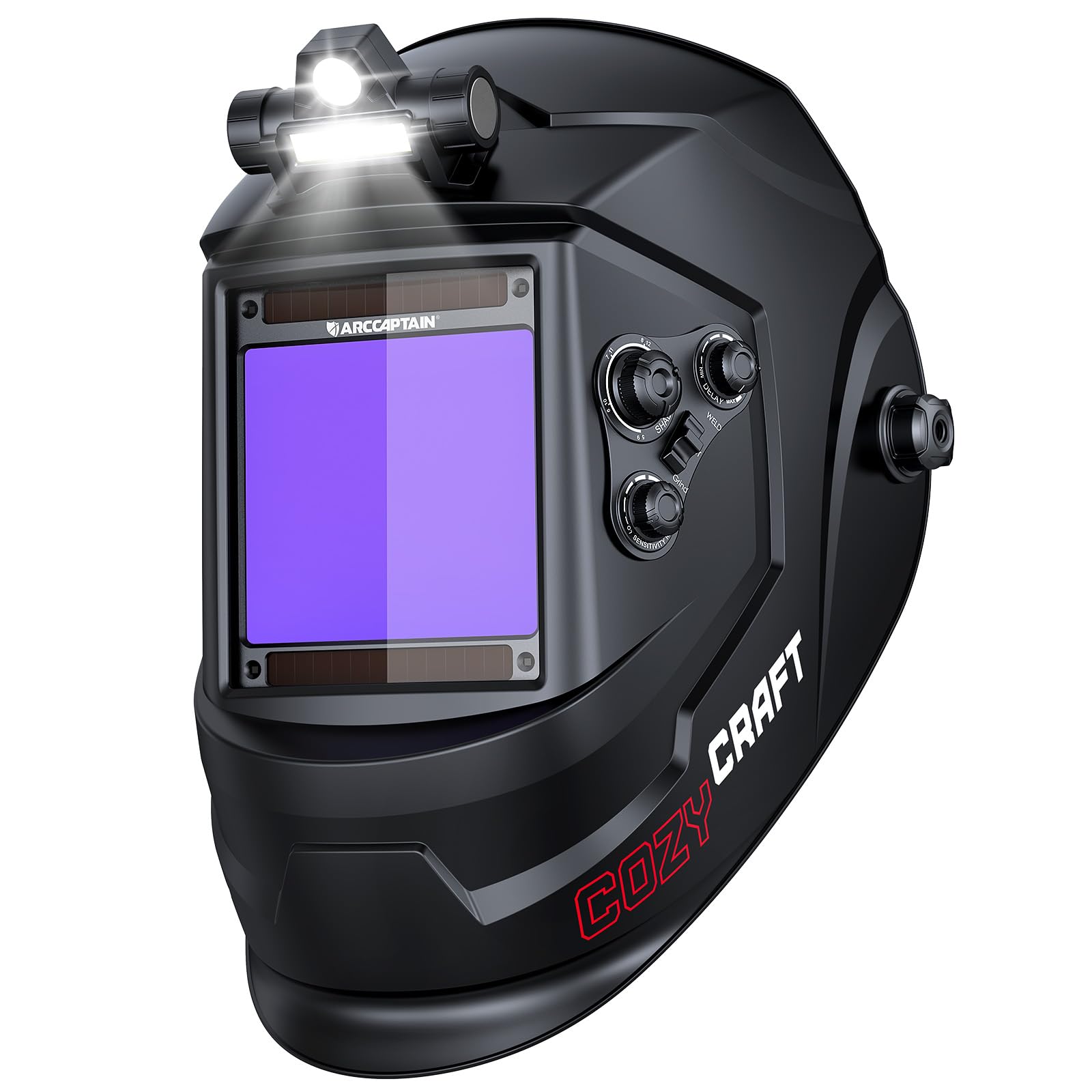
Bottom line: The ARCCAPTAIN XK-LY800H is the only pick that combines a full-size window, four sensors and a two-level work light. Buy it for a dim bench where you also need to see the whole joint.
Key specs
- Viewing area: 3.94 x 3.66 in, the largest single-lens window in this guide
- Optical class: 1/1/1/1, so shade holds steady as your head moves
- Arc sensors: 4, with adjustable shade and sensitivity
- Shade range: DIN 4 light, 5-8 cut, 9-13 weld on the current with-light listing
- Power: solar assist plus a replaceable CR2450, with a USB-charged lamp
This is the large-view hood with the setup problem already solved. The lamp has two brightness levels and clips to the crown, so you position the joint, clamp it and strike without moving a stand light. ARCCAPTAIN rates the filter switch at 1/25,000 second.
Two small catches. The light ships uninstalled, so budget a minute with the instructions before your first job, and it charges separately from the filter. The shell is PP and ARCCAPTAIN lists it at about 1 lb, which keeps the big cartridge manageable.
Owner feedback
No owner trend was consistent enough across independent sources to report here. Inspect the battery tray, charging cable and headgear before keeping it.

Owner feedback shifts as sellers change batches. Confirm the model code and manual on arrival.
- Largest single-lens window here at 3.94 x 3.66 in
- Four sensors plus 1/1/1/1 optics
- Two-level USB work light included
- Replaceable CR2450 keeps the filter serviceable
- Two power systems to keep charged and maintained
- Light arrives uninstalled and needs fitting
- Larger shell is less agile in confined work
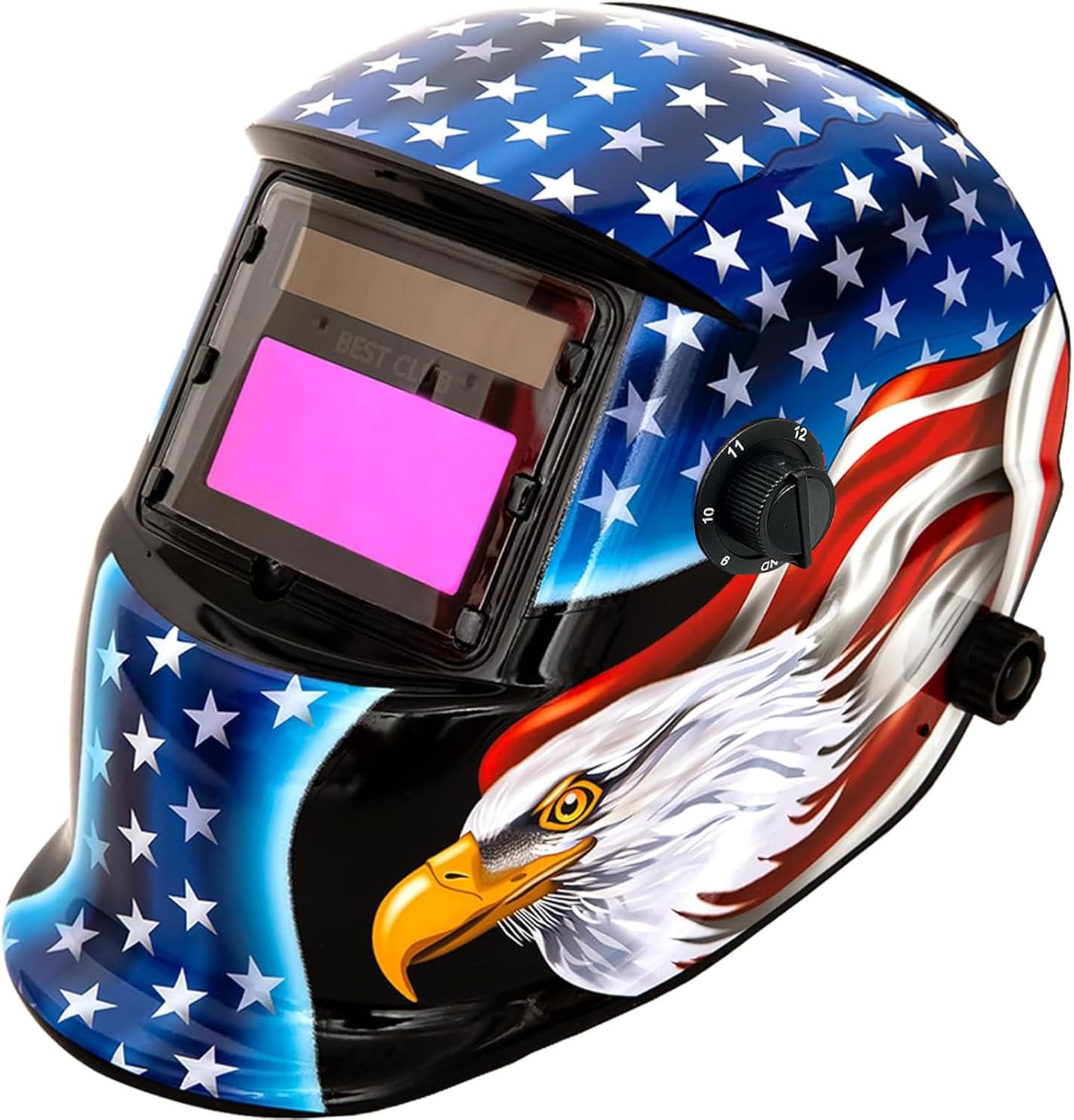
9. BESTCLUB Flag Eagle
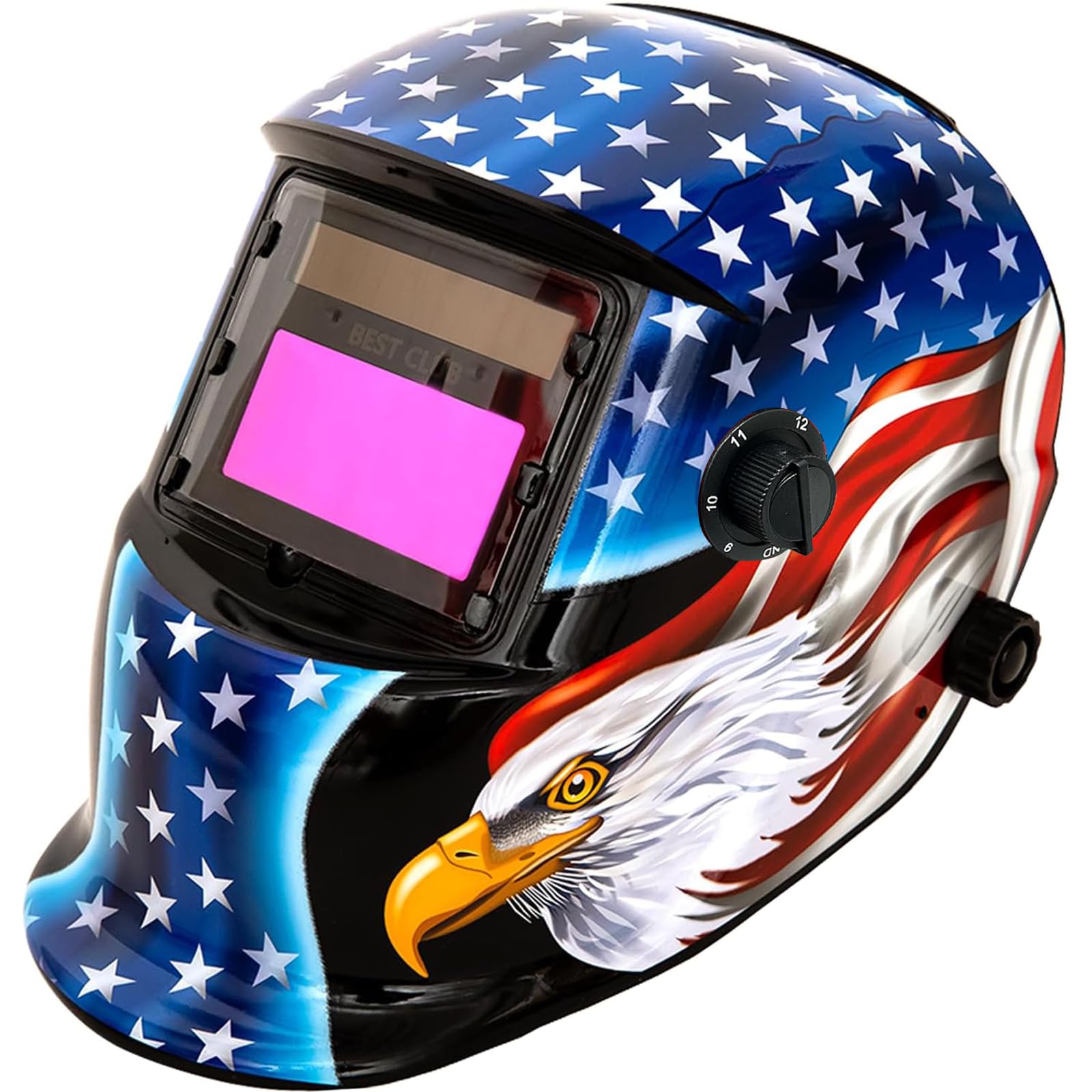
Bottom line: The BESTCLUB Flag Eagle is a light, plain auto-darkening hood with sensitivity and delay control. Buy it only for very occasional repairs, and inspect it carefully.
Key specs
- Viewing area: 3.62 x 1.65 in, the narrowest window in this guide
- Optical class: 1/1/1/2, acceptable for general work, not for precision
- Arc sensors: not consistently published for this graphic variant
- Shade range: DIN 4 light, DIN 9-13 weld, with a 0.1 to 1.0 second delay
- Power: solar assist with battery backup, at roughly 18.3 oz total
The weight is the honest selling point. Under 19 oz is genuinely easy on your neck, and the shell extends further down than a basic hood, which helps protect the neck from arc glare on longer beads.
Documentation is the weak spot. Sensor count and some dimensions differ between the BESTCLUB variants sold under different graphics, so the filter marking and the manual in the box are the only sources worth trusting. The seller return window matters more here than on the better-documented picks.
Owner feedback
No owner trend was consistent enough across independent sources to report here. Test the filter and inspect the headgear before relying on it.

Owner feedback shifts as sellers change batches. Confirm the model code and manual on arrival.
- About 18.3 oz, among the lightest hoods here
- Sensitivity and delay adjustment despite the low price
- Extended shell covers the neck as well as the face
- Simple layout makes it easy to learn the controls on
- Sensor count and specs vary between listings
- Narrowest viewing area of any pick here
- No cut range, so it is weld and grind only
10. ARCCAPTAIN LY800Js-BK

Bottom line: The ARCCAPTAIN LY800Js-BK combines the widest published view here with four sensors and a full weld, cut and grind range. Buy it if you work in a crowded shop and value awareness.
Key specs
- Viewing area: 3.94 x 7.06 in total, the main lens plus two fixed side windows
- Optical class: 1/1/1/1, the top score in every EN 379 category
- Arc sensors: 4, so a blocked sensor rarely leaves you unprotected
- Shade range: DIN 4 light, 5-9 cut, 9-13 weld on an outside control
- Power: solar assist plus replaceable CR2450 cells you can keep spares for
In a garage packed with benches, a trailer and a parts rack, the difference is not weld quality, it is how often you stop. Peripheral glass means you see the clamp you are about to knock and the cable you are about to drag, without lifting the hood every few minutes.
ARCCAPTAIN lists the switch at 1/25,000 second. The side windows use a fixed shade and never auto-darken, so they add awareness, not arc protection. They also catch shop light, which some welders find distracting on a bright bench.
Owner feedback
No owner trend was consistent enough across independent sources to report here. Confirm the battery count and orientation on arrival.

Owner feedback shifts as sellers change batches. Confirm the model code and manual on arrival.
- Widest published viewing area in this guide
- Four arc sensors with 1/1/1/1 optics
- Full weld, cut and grind ranges on an outside control
- Replaceable CR2450 cells rather than a sealed pack
- Side windows are fixed shade and never auto-darken
- Wide shell is the most awkward here in confined spaces
- Side reflections distract some welders on a bright bench
ARCCAPTAIN LY800Js-BK vs YESWELDER LYG-L600A: Is the Upgrade Worth It?
Both filters carry the same 1/1/1/1 optical class, so this is not a question of picture quality. You are paying for glass area and sensor redundancy.
- Viewing area: 3.94 x 7.06 in of panoramic glass instead of a 3.64 x 1.67 in slot
- Arc sensors: four instead of two, which matters when a fixture shades the cartridge
- Process range: a 5-9 cut range as well as 9-13 weld, instead of weld and grind only
- Shell size: the L600A is easier inside frames and lighter on the neck all day
Which Welding Helmet Should You Buy?
- You want the most awareness: get the ARCCAPTAIN LY800Js-BK.
- You want the biggest single window: get the YESWELDER LYG-M800H.
- You want to spend as little as possible: get the YESWELDER LYG-L600A.
- Your bench is dark: get the ARCCAPTAIN XK-LY800H.
- You work in tight corners: get the ARCCAPTAIN HSH-S800.
- You are learning to weld: get the MIGVAN H-21.
How We Chose These Welding Helmets
- Verified specs only: every figure comes from a manufacturer spec sheet, manual or product page, checked against the exact model each link sells.
- Sensor coverage and viewing area: ranked highest, because both decide whether you get flashed or have to keep lifting the hood.
- Shade range against real processes: a helmet with no cut range is scored lower for plasma work, not described as universal.
- Battery serviceability: replaceable coin cells beat sealed packs in a cold shop, and battery type is listed for every pick.
- Owner feedback and safety records: trends were taken from non-Amazon retailers, forums and owner videos, and each model was checked against CPSC and manufacturer recall notices. No recalls were found.
How to Test Your Helmet Before First Use
- Read the manual for your exact model. Confirm operating temperature, shade range, battery type, test method and process limits.
- Inspect the shell and cover lenses. Do not use a helmet with cracks, missing retainers, deep pits or damaged covers.
- Clean the sensors and solar cells. Dust, stickers, sleeves and tight positions all block the arc signal.
- Install or check the battery. Confirm orientation, and replace a weak cell before welding rather than after.
- Use the maker’s filter test. Some helmets have a test button; others use a bright source or an arc-safe procedure from the manual.
- Set shade, sensitivity and delay. Start from the shade chart, then adjust without dropping below the required minimum.
- Wear safety glasses with side protection. A welding helmet does not replace impact-rated eyewear for flying particles.
- Stop if the lens flickers or fails. Do not keep welding until the battery, sensors, settings or filter fault is fixed.
Helmets to Avoid: Red Flags
- No readable model, manual, filter marking or standards information.
- Cracked shell, missing inner or outer cover lens, damaged filter, or loose retention parts.
- Battery type cannot be identified and the helmet cannot pass its own test procedure.
- Replacement cover lenses are unavailable or the seller cannot identify the correct size.
- The shade range does not cover your welding process and amperage.
- The headgear cannot hold the helmet securely in the working position.
- The seller makes extreme safety promises without documentation to back them.
Shade-by-Amperage Chart
Use your helmet manual and workplace rules first. The table below summarises OSHA minimum protective shades and common ANSI and AWS comfort recommendations. Start darker, then move lighter only while staying at or above the minimum.
| Process | Arc current | OSHA minimum shade | ANSI and AWS suggested shade |
|---|---|---|---|
| Stick, SMAW | Under 60 A | 7 | No value listed |
| Stick, SMAW | 60 to 160 A | 8 | 10 |
| Stick, SMAW | Over 160 to 250 A | 10 | 12 |
| Stick, SMAW | Over 250 to 550 A | 11 | 14 |
| MIG or flux-core | Under 60 A | 7 | No value listed |
| MIG or flux-core | 60 to 160 A | 10 | 11 |
| MIG or flux-core | Over 160 to 250 A | 10 | 12 |
| MIG or flux-core | Over 250 to 500 A | 10 | 14 |
| TIG, GTAW | Under 50 A | 8 | 10 |
| TIG, GTAW | 50 to 150 A | 8 | 12 |
| TIG, GTAW | Over 150 to 500 A | 10 | 14 |
| Plasma arc cutting | Under 300 A | 8 | 9 |
| Plasma arc cutting | 300 to 400 A | 9 | 12 |
| Plasma arc cutting | Over 400 to 800 A | 10 | 14 |
| Torch brazing | Not current-based | 3 | 3 or 4 |
| Torch soldering | Not current-based | 2 | 2 |
Safety note: a variable-shade helmet that stops at DIN 13 cannot deliver a suggested shade 14. Use a darker suitable filter or different equipment when the process calls for it. Every helmet in this guide tops out at DIN 13.
Auto-Darkening vs Passive Helmets
| Factor | Auto-darkening | Passive fixed shade |
|---|---|---|
| Lens behaviour | Switches from a light state to the selected dark shade when the arc is detected | Stays at one dark shade |
| Setup and tacking | Hood can usually stay down | Often needs lifting or nodding |
| Power | Solar cells, batteries or both | No electronic power needed |
| Failure checks | Battery, sensors, controls and filter must all be tested | Inspect the fixed filter and cover lenses |
| Best fit | Mixed-process work and frequent tacks | Repeatable work at one suitable shade |
Auto-darkening is convenient, but a passive hood stays dependable when the fixed shade is right for the job. The choice depends on the work, not on a blanket claim that one type is always safer.
How to Choose an Auto-Darkening Welding Helmet for a Cold Garage
Viewing area: how much glass you actually need
A letterbox window around 3.6 by 1.7 in is fine for flat bench work you can line up before the hood comes down. Once you are working around fixtures or out of position, a near-square window of roughly 3.9 by 3.6 in stops the constant head-bobbing. Panoramic hoods add fixed side windows for awareness only, and they are wider, so they are harder to use inside frames and tanks. If your garage is crowded, the ARCCAPTAIN LY800Js-BK gives the most peripheral glass here.
Arc sensors and where they sit
Two sensors handle open joints in normal positions. Four give you cover when a torch, a clamp or your own hand shades part of the cartridge, which is exactly what happens on vertical and overhead work. Sensor placement and sensitivity setting matter as much as the count, and sensors coated in dust or covered by a sleeve are the most common cause of a filter that will not darken.
Shade range and your amperage
Match the range to your processes before anything else. Weld mode of DIN 9 to 13 covers MIG, stick and most TIG in a home shop. A separate 5 to 9 range is what you need for plasma cutting, and not every helmet here has one: the HSH-S800, TRQ-HS0103 and BESTCLUB are weld and grind only. Check the shade-by-amperage chart against the current you actually run.
Optical class: what 1/1/1/1 buys you
The four EN 379 digits score optical quality, light diffusion, variation in luminous transmittance, and angle dependence, where 1 is best. Most helmets here are 1/1/1/1. The three rated 1/1/1/2 shift slightly more as your viewing angle changes, which is workable for general fabrication and less ideal for thin-material TIG or out-of-position work where your head is never square to the joint.
Power, batteries and cold-weather limits
Solar assist extends life but does not recharge the cell. Replaceable coin cells are the practical choice, and CR2450 is the common size across these picks, with the TRQWH TRQ-HS0103 as the CR2032 exception. On temperature, YESWELDER’s helmet manual gives a working range of minus 10 to 60 degrees Celsius and a storage range of minus 20 to 70, while instructing you to use the chart for your own model. Treat that as a starting point, not a universal figure.
Headgear, fit and long sessions
Pivot-style headgear on budget hoods is adequate for a few hours a week and wears faster under daily use. Set crown height, tilt and side tension before the first weld, and re-check them with whatever you actually wear underneath, whether that is safety glasses, a respirator or a thin winter cap. A hood that will not stay in position is a hood you will take off.
Mistakes to Avoid When Buying an Auto-Darkening Welding Helmet
- Buying on window size alone: check sensor count and shade range too, or you will be flashed through a beautiful big lens.
- Assuming a cold-weather label: find the actual operating range in the manual for your model number.
- Ignoring the cut range: grind mode is not a cutting shade, and three picks here have no 5 to 9 range at all.
- Not sourcing cover lenses first: panoramic and large-view hoods take non-standard sizes that are hard to find in a hurry.
- Treating a hood as fume protection: none of these filter what you breathe, so plan ventilation or a respirator separately.
FAQs
Do all auto-darkening welding helmets work below freezing?
No. Operating ranges are set per model. YESWELDER’s helmet manual gives a working range of minus 10 to 60 degrees Celsius and storage of minus 20 to 70, but also tells you to use the specification chart for your own model. Cold weakens coin cells too, so test the filter before you strike an arc.
How do I choose a welding helmet for a cold garage?
Start with the operating-temperature range in the manual for that exact model, not a marketing label. Then compare battery type and serviceability, sensor count, viewing area and headgear adjustment. A helmet stored below its rated range should warm up first, then pass a filter test before you use it.
What shade do I need for MIG welding at 150 amps?
OSHA sets a minimum of shade 10 for MIG and flux-core between 60 and 160 amps, and ANSI and AWS suggest shade 11 for comfort. Every helmet in this guide reaches 9 to 13 in weld mode, so all of them cover it. Start darker and lighten only while staying at or above the minimum.
Are four arc sensors always better than two?
Not automatically. Four sensors give more coverage when one is blocked by the torch, a fixture or your own hand, which helps in awkward positions. Placement, sensitivity setting and keeping the sensors clean matter just as much. For flat bench work at normal amperage, a well-set two-sensor helmet is fine.
What is the difference between 1/1/1/1 and 1/1/1/2 optical class?
These are EN 379 scores for optical quality, light diffusion, variation in luminous transmittance and angle dependence, where 1 is the best score in each position. A final 2 means shade can shift more as your viewing angle changes. It is workable for general welding but less consistent for precise or out-of-position work.
How do I stop a welding helmet fogging up in winter?
Let the helmet reach shop temperature before you put it on, keep the inner cover lens clean, and do not block the shell’s vent paths. Use only anti-fog products the maker approves for that lens coating. If you wear a respirator, fit it so warm breath is not pushed up onto the filter.
Do I still need safety glasses under a welding helmet?
Yes. A welding helmet protects against arc radiation, spatter and heat, but it is not impact eyewear on its own, and you will lift it to inspect or chip slag. Wear ANSI Z87.1 safety glasses with side shields underneath whenever grinding, chipping or flying particles are possible.
Our Picks at a Glance

Final Verdict
The right auto-darkening welding helmet depends on where you weld, not on which one has the longest feature list. In a crowded, poorly lit garage, awareness and sensor coverage are worth more than a fraction of a millisecond in switching speed.
Spending less, the YESWELDER LYG-L600A keeps the same optical class in a smaller window, while the YESWELDER LYG-Q800D is the other panoramic option if you want side glass with a familiar front lens. For more background, see our guides to auto-darkening lenses and the latest welding helmets.
Full Product Comparison
| Product | Image | Best for | Optical class | Response time |
|---|---|---|---|---|
 |
Everyday value | 1/1/1/1 | 1/30,000 s | |
 |
Large front view | 1/1/1/1 | 1/30,000 s | |
 |
Compact four-sensor hood | 1/1/1/1 | 1/25,000 s | |
 |
Beginners on a big view | Not published | 1/10,000 s | |
|
Panoramic on a budget | 1/1/1/1 | 1/30,000 s | |
 |
Built-in work light | 1/1/1/2 | 1/20,000 s | |
 |
Cheapest hood with a light | 1/1/1/2 | Not stated | |
 |
Large view plus a light | 1/1/1/1 | 1/25,000 s | |
 |
Simplest occasional-use hood | 1/1/1/2 | 1/25,000 s | |
 |
Best overall awareness | 1/1/1/1 | 1/25,000 s |
Specifications come from manufacturer spec sheets and manuals. Verify the exact model code and the manual in the box before use.