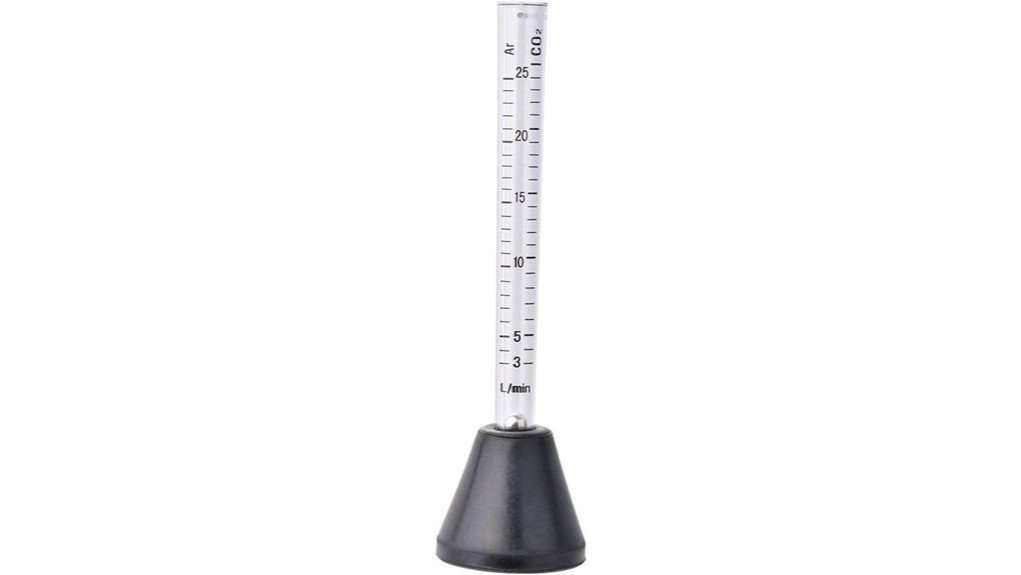
This argon CO2 flow meter tester is a peashooter flow tester: a small tube you hold against the torch nozzle to check how much shielding gas is actually leaving it. Per the listing it reads 0 to 25 litres per minute (L/min) in one-litre steps, is about 14 cm long and weighs 0.352 oz. It is a cheap way to confirm your gas flow on MIG or TIG, not a replacement for a regulator or inline flowmeter.
Quick Verdict
Worth having in the toolbox if you chase porosity or change regulators, hoses, torches or bottles often. Skip it if you need a calibrated instrument. Calibration and material details are not confirmed here, so check the listing.
Peashooter Flow Tester Specs
| Specification | Detail |
|---|---|
| Product | Argon CO2 Professional Gas Flow Meter Tester (ASIN B06XW8H8W1) |
| Style | Peashooter-type handheld tester |
| Flow range | 0 to 25 L/min, per the listing |
| Graduations | One-litre markings |
| Length / weight | About 14 cm / 0.352 oz, per the listing |
| Use | Checking shielding gas flow at the torch nozzle on MIG and TIG |
| Not confirmed here | Materials, included accessories and calibration |
How to Use a Peashooter Flow Tester
- Set your regulator or flowmeter to the flow you want, with the gas running.
- Hold the tester upright and press its open end against the torch nozzle, so gas passes through the tube.
- Read the marking at the floating ball or indicator while the gas flows (check the product instructions for exactly where to read).
- Adjust the regulator until the reading matches your target, then release the trigger or stop the gas.
- Repeat after any change of regulator, hose, torch, nozzle or bottle.
Many MIG setups run roughly 15 to 25 CFH, which is about 7 to 12 L/min, and TIG is often lower, but follow your welder manual and filler or wire maker for the right number. One CFH is about 0.47 L/min.
Who It Is For
- Hobby, mobile and shop welders troubleshooting porosity or poor gas coverage.
- Anyone who wants to check flow at the nozzle rather than trust the regulator dial.
- Welders who want a small tool for a cart, toolbox or consumables drawer.
Who Should Skip It
- You need a regulator, a fixed inline flowmeter or a lab-grade calibrated instrument.
- You need formal calibration documents or a confirmed material list.
Accuracy and Gas Notes
The listing says the tester works with all gases. Floating-ball style testers are usually calibrated for one gas (often argon), and other gases or mixes can read differently, so check the product instructions before relying on a reading with CO2 or a blend. Treat it as a quick check, and keep it clean and undropped so the markings stay readable.
Pros and Cons
Pros
- 0 to 25 L/min range covers common MIG and TIG settings
- One-litre markings are easy to read
- Small and light
Cons
- Not a substitute for a regulator or inline flowmeter
- Gas calibration, materials and accessories not confirmed here
- Reads flow only when you hold it on the nozzle
Is It Worth Buying?
For a low cost, it gives you a real reading at the nozzle, which is where gas matters. If you would rather have a gauge fitted permanently, compare a flowmeter regulator. To size or understand your setup, read our guides on how a welding gas regulator works and how to size a shielding gas regulator for MIG welding, or see the BOWELD BO191 flow meter review.
Frequently Asked Questions
What is a peashooter flow tester?
It is a small handheld tube with a graduated scale that you press against the torch nozzle to read the shielding gas flow rate leaving it.
Can I use it with gases other than argon and CO2?
The listing says it works with all gases, but these testers are usually calibrated for one gas, so check the product instructions and expect readings to vary with other gases.
How do I clean the tester?
Wipe it with a soft cloth and keep the tube free of dust, oil and weld debris. Avoid harsh cleaners unless the instructions allow them.
Does it need calibration?
Calibration details are not confirmed here. Check the product instructions if you need a documented process for regulated work.
Final Verdict
This peashooter flow tester is a simple, low-cost way to verify shielding gas flow at the torch. Use it for setup checks and troubleshooting, and skip it if you need a calibrated instrument or a fixed gauge.