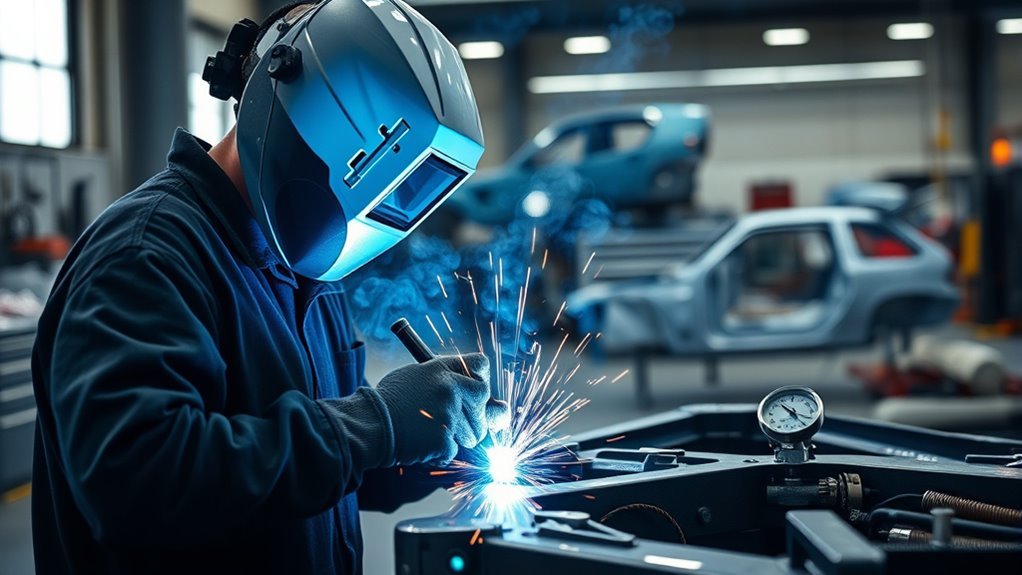
Automotive welding certifications prove that you can make safe, repeatable welds on vehicle parts, panels, frames, fixtures, or production assemblies. The right credential depends on the work you want: collision repair, manufacturing, inspection, robotic welding, restoration, or custom fabrication. You may be tested on MIG/GMAW, TIG/GTAW, resistance spot welding, fit-up, joint position, heat control, visual inspection, and sometimes destructive testing. Certification can help you get hired, but it does not replace OEM repair procedures, shop rules, or safe welding practice.
Quick Answer
For most auto welding jobs, start with strong MIG/GMAW skills, then choose credentials that match the role. AWS Certified Welder helps prove hands-on welding ability. ASE B Series supports collision repair knowledge. AWS CRWT fits resistance spot welding, and AWS CRAW fits robotic welding in manufacturing.
Key Takeaways
- There is no single universal automotive welding certification for every shop, material, and repair type.
- AWS Certified Welder is a strong general performance credential, but collision shops may also value ASE, OEM, I-CAR-style, or employer-specific welding qualifications.
- Modern auto work may involve MIG, TIG, squeeze-type resistance spot welding, plug welds, aluminum welding, robotic weld cells, and strict heat control.
- Pay depends on experience, location, process skill, overtime, industry, and whether you move into inspection, supervision, robotics, or advanced manufacturing.
- Always follow the approved WPS, OEM repair manual, and workplace safety rules before welding on a vehicle structure.
What Are Automotive Welding Certifications?
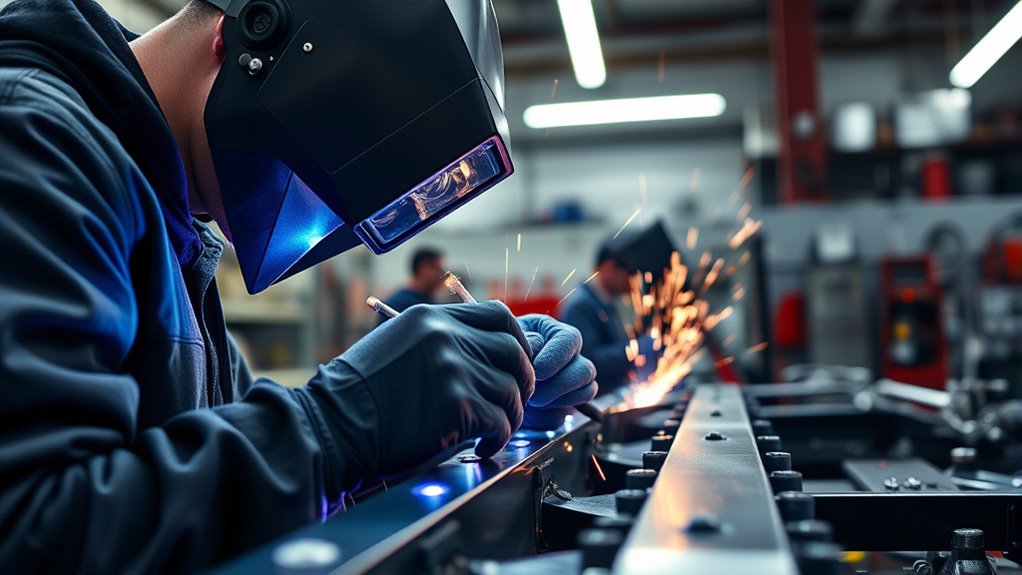
Automotive welding certifications are formal credentials, employer tests, or OEM training records that show you can weld vehicle-related parts to a defined standard. They may apply to collision repair, production welding, custom fabrication, restoration, inspection, or automated welding systems.
The AWS Certified Welder program is one common path because it tests your ability to make an acceptable weld to a specific Welding Procedure Specification, often called a WPS. It is performance-based, so the test focuses on the weld you produce, not a written classroom exam.
For auto body and collision work, certification can also mean ASE collision repair tests, OEM network training, insurer-required welding programs, or shop-specific weld coupons. For manufacturing, resistance spot welding and robotic welding credentials may matter more than a basic manual welding test.
In practice, certification gives you a documented way to prove skill. It shows that you can follow a procedure, control heat, prepare the joint, make a sound weld, and inspect the finished work against a real acceptance standard.
Why Automotive Welding Certifications Matter
You need automotive welding certifications because vehicle welds affect fit, strength, corrosion resistance, crash behavior, and repair quality. A clean-looking bead is not enough. You must show that your weld meets the procedure, material, position, and inspection requirements for the job.
Safety and Structural Integrity
Vehicle structures use mild steel, high-strength steel, ultra-high-strength steel, aluminum, and sometimes stainless or coated materials. These materials do not respond to heat the same way. Too much heat can weaken the heat-affected zone, burn through thin sheet metal, damage coatings, or distort the panel.
Certification helps prove that you can control arc length, travel speed, fit-up, penetration, weld size, and distortion. That matters when a weld sits near a frame rail, rocker panel, pillar, suspension mount, battery tray, or crash-management area.
Warning: Do not weld on a structural vehicle part just because you know how to weld. Follow the OEM repair procedure, the approved WPS, and your shop’s safety rules. Welding, cutting, and brazing can expose you to fumes, gases, arc radiation, burns, electric shock, and fire hazards, so use proper PPE, ventilation, fire watch, and electrical safety controls.
Better Jobs and Pay
Certifications can make your skill easier for employers to trust. A shop manager can see that you have passed a defined test instead of relying only on your word or a quick interview weld.
That can help you qualify for better roles in collision repair, production welding, frame repair, quality control, robotic weld cells, prototype fabrication, and restoration work. It can also support raises or promotions when combined with experience, good attendance, safe habits, and consistent weld quality.
Certification does not guarantee a wage. It gives you leverage. The more specialized your skill, the more useful that leverage becomes.
Which Certifications Matter for Auto Work?
The best automotive welding certification depends on the job you want. A collision repair technician, robotic weld-cell operator, weld inspector, and custom fabricator do not need the exact same credential.
| Credential or Training Path | Best For | What It Proves |
| AWS Certified Welder | General welding, fabrication, shop work, and transferable proof of welding skill | You can make an acceptable weld to a specific WPS, material, process, position, and code requirement. |
| ASE B Series Collision Repair and Refinish | Collision repair technicians and refinishers | You understand collision damage analysis, repair knowledge, and related auto body skills. Welding may be one part of the larger repair skill set. |
| AWS Certified Resistance Welding Technician | Automotive manufacturing, resistance spot welding, and weld-line support | You understand resistance welding principles, equipment, process control, troubleshooting, and quality checks. |
| AWS Certified Robotic Arc Welding | Automated welding cells, production lines, and advanced manufacturing | You can support robotic welding setup, programming, operation, and weld quality in an automated environment. |
| AWS Certified Welding Inspector | Inspection, quality control, supervision, and procedure compliance | You can evaluate weld quality, read procedures, understand standards, and help verify compliance. |
| OEM, network, or employer-specific weld tests | Collision shops, dealer networks, and brand-specific repairs | You can follow the repair method, weld coupons, equipment settings, and inspection rules required by that shop or vehicle maker. |
If you are new, start with the process your target shop uses most. In many auto shops, that means MIG/GMAW on steel and plug weld practice. If you work around aluminum panels, battery trays, or custom parts, TIG and aluminum MIG skills become more valuable. If you want manufacturing work, resistance spot welding and robotic welding can move you into higher-tech roles.
Pro Tip: Before paying for a test, search job ads in your area and ask local body shops which credentials they actually accept. A certification is most useful when it matches the employer’s repair procedures, equipment, and hiring requirements.
What Test Methods Do Automotive Welders Face?
Automotive welders may face hands-on weld coupons, visual inspection, bend or break tests, tensile tests, peel or chisel tests for spot welds, and non-destructive testing in higher-control production environments. The exact test depends on the process, material, thickness, joint type, position, and acceptance standard.
Visual Inspection Checks
Visual inspection usually comes first. You or the inspector check the weld before any advanced testing. The goal is to catch obvious defects before time and material are wasted.
- Check bead profile, weld size, length, and location.
- Look for cracks, porosity, undercut, overlap, burn-through, and incomplete fusion.
- Confirm the weld is in the correct location and position.
- Compare the finished weld to the WPS, shop procedure, OEM repair instructions, or acceptance standard.
- Measure welds with gauges when size or profile limits apply.
For collision repair, visual checks also include panel fit, heat marks, plug weld fill, corrosion protection, and whether nearby parts were damaged by heat or spatter.
Destructive Test Methods
Destructive testing proves how a weld performs after the coupon is cut, bent, broken, pulled, or peeled apart. You sacrifice the test piece so you can see whether the weld fused correctly.
Common destructive tests include bend tests, break tests, macro-etch checks, tensile tests, and spot-weld peel or chisel tests. A bend test can expose lack of fusion or cracking. A break test can reveal penetration and internal flaws. A spot-weld peel test can show nugget size and whether the weld pulled a proper button.
These tests are valuable because a weld can look clean on the surface while still failing inside the joint.
Non-Destructive Testing Techniques
Non-destructive testing, or NDT, checks weld integrity without destroying the part. It is more common in manufacturing, inspection, and critical assemblies than in basic hobby or small-shop repair work.
- Visual testing finds surface flaws quickly.
- Dye penetrant testing highlights surface-breaking cracks.
- Magnetic particle testing can find surface and near-surface defects in ferromagnetic steel.
- Ultrasonic testing can help locate internal discontinuities.
- Radiographic testing uses imaging to reveal hidden defects where the procedure allows it.
For most entry-level auto welding certification tests, expect coupon fit-up, welding to a WPS, visual inspection, and a destructive bend, break, or peel test rather than advanced NDT.
What Materials and Joints Will You Weld?
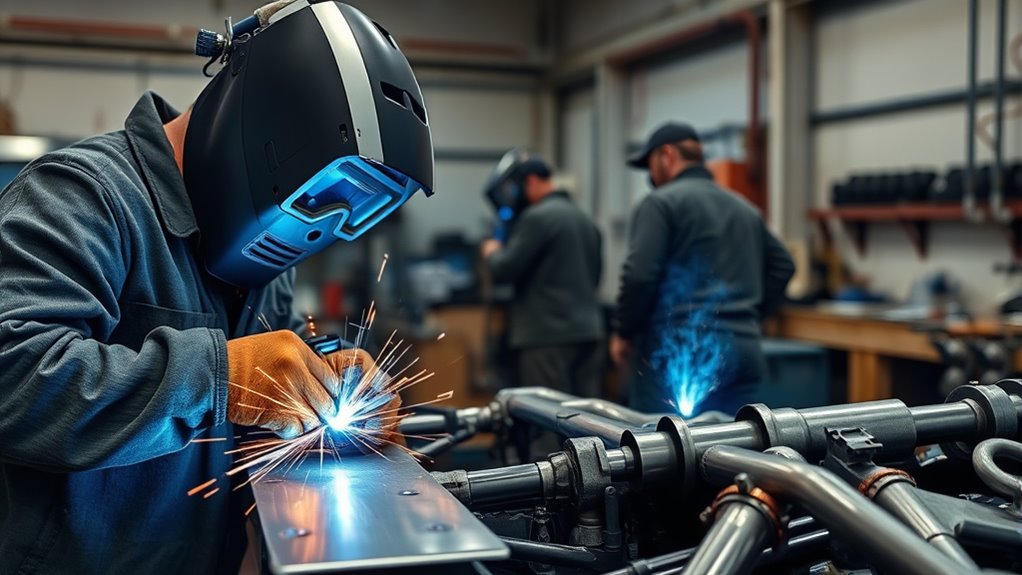
In automotive welding, you may work with mild steel, high-strength steel, ultra-high-strength steel, stainless steel, galvanized or coated steel, and aluminum. Each material needs the right process, filler metal, surface prep, shielding gas, and heat control.
Mild steel is forgiving, so many students learn on it first. High-strength and ultra-high-strength steels need much more care because excess heat can reduce strength. Aluminum needs clean surfaces, correct filler, and tighter heat control because it conducts heat quickly and forms oxide on the surface. Galvanized or coated parts need extra ventilation and prep because coatings can create fumes and weld contamination.
You also need to understand joint types. Common automotive joints include butt joints, lap joints, plug welds, stitch welds, fillet welds, T-joints, and resistance spot welds. In fillet welding, 1F is flat, 2F is horizontal, 3F is vertical, and 4F is overhead.
For auto body repair, plug welds and lap joints are common when replacing panels. For custom fabrication, butt joints and fillet welds are common. For manufacturing, resistance spot welds and robotic arc welds may dominate the work.
How to Choose Your Certification Path
Choose your certification path by matching the credential to the work you want, not by chasing the longest list of certificates.
- Pick the job target. Decide whether you want collision repair, manufacturing, inspection, restoration, custom fabrication, or robotic welding.
- Identify the main process. Most auto roles involve MIG/GMAW, but some need TIG/GTAW, resistance spot welding, or robotic arc welding.
- Check employer requirements. Ask shops, dealers, unions, schools, or manufacturers which credentials they accept.
- Train on the right material. Practice on the same thickness, coating, joint type, and position used in the test.
- Take a practice coupon seriously. Cut, bend, peel, or break sample welds before you pay for the official test.
- Keep records. Save certificates, continuity forms, training records, eye exam forms, and employer weld test results.
If your goal is a body shop, combine collision repair knowledge with strong MIG and plug weld skills. If your goal is an assembly plant, learn resistance welding variables, weld schedules, electrode force, nugget quality, and robotic cell safety. If your goal is inspection or supervision, add code reading, documentation, visual inspection, and CWI preparation.
Products Worth Considering

🧲 Sticks to Toolboxes & Welders – Heavy-duty magnetic welding chart adheres to metal surfaces like your welding table, toolbox, or wall for instant reference while working.
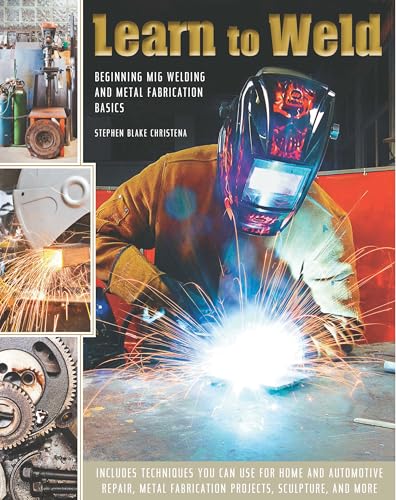

Richard Finch, Welder's Handbook: A Complete Guide to MIG, TIG, Arc & Oxyacetylene Welding, "Completely Revised and Updated Edition!" paperback
How Do Automotive Welding Certifications Help You Get Hired?
Automotive welding certifications help you get hired because they reduce doubt. Employers need welders who can follow instructions, control heat, use equipment safely, and make repeatable welds without creating rework or safety risks.
- They verify your skill before or during the interview process.
- They show that you can follow a WPS or shop procedure.
- They help you stand out from applicants with only informal experience.
- They can qualify you for higher-control work, such as structural repair, production welding, inspection support, or robotic welding.
- They show that you take safety and documentation seriously.
A certification does not make you a master welder by itself. It makes your skill visible, testable, and easier for an employer to trust.
Experience still matters. A certified welder who can set up the machine, read the repair information, protect nearby parts, document the work, and pass inspection will always be more valuable than someone who only has a card.
What Can Certified Auto Welders Earn?
Certified auto welders can earn more than entry-level welders, but pay depends on location, industry, overtime, specialization, and experience. The U.S. Bureau of Labor Statistics lists the median annual wage for welders, cutters, solderers, and brazers at $51,000 in May 2024. The lowest 10 percent earned less than $38,130, and the highest 10 percent earned more than $75,850.
Automotive welding pay can vary widely. A small repair shop may pay differently from a union plant, prototype shop, heavy repair facility, EV battery enclosure manufacturer, or robotic welding department. You may earn more if you add aluminum welding, inspection, CWI, resistance welding, robotic welding, leadership, or overtime-heavy production work.
Can welding reach $100,000 a year? Yes, but it is not typical for every auto welding job. It is more realistic in specialized industrial roles, high-overtime plants, travel work, union positions, supervision, inspection, pipeline work, or advanced manufacturing. Treat $100,000 as a possible high-end path, not a guaranteed result from one certificate.
Where Can You Train for Automotive Welding Certifications?
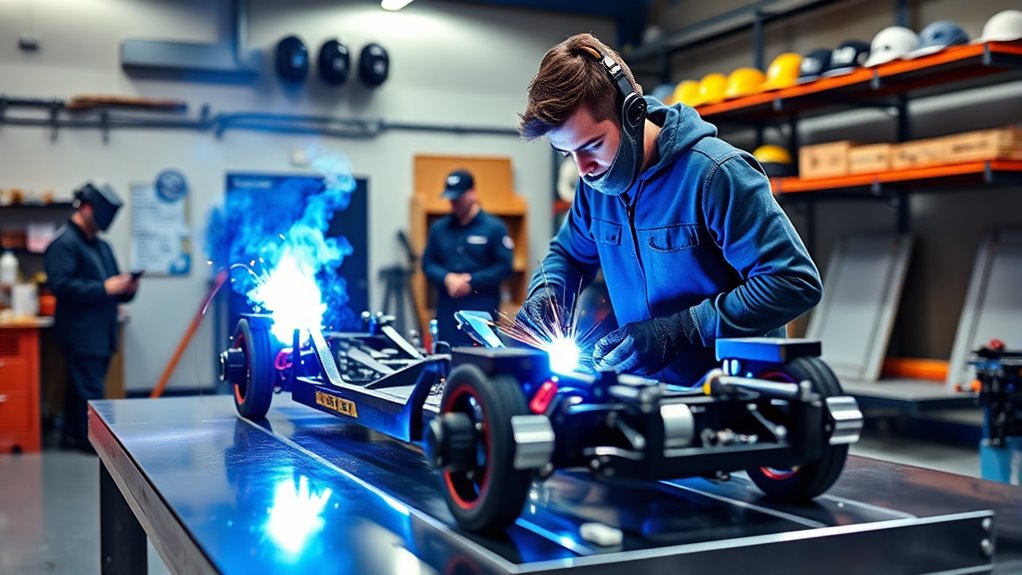
You can train for automotive welding certifications at vocational schools, community colleges, technical institutes, union programs, manufacturer training centers, employer labs, and AWS Accredited Testing Facilities. Choose a program that gives you real booth time, not just classroom theory.
Look for training that includes:
- MIG/GMAW on thin sheet steel and thicker structural coupons.
- Plug welds, lap joints, butt joints, and fillet welds.
- Aluminum welding practice if your target jobs require it.
- Resistance spot welding basics if you want manufacturing or collision work.
- WPS reading, fit-up, machine setup, shielding gas, wire selection, and inspection.
- Destructive coupon testing so you can see why welds pass or fail.
- Safety training for PPE, ventilation, fire prevention, electrical safety, and hot work.
Before enrolling, ask the school which certification tests it prepares you for, whether the test is included in tuition, what processes are covered, and whether local employers hire from the program.
Products Worth Considering

Crafted with precision, our steel plates are laser-cut, offering unparalleled edge smoothness and dimensional accuracy compared to stamped and sheared parts.

【Complete Set】: The package includes 48 pieces of welding coupons with welding magnets, can welding 2 dice, 2 cube frames, 2 cuboid frames, and 2 cuboids, a complete tools to improve welding skills quickly.

201 STAINLESS STEEL - Made of Premium Type 201 stainless steel with excellent corrosion and heat resistance. Ideal for consistent practice across MIG, TIG, Stick, and wire-feed welding applications.
How Do You Keep Your Certification Current?
Keeping your certification current depends on the credential. Do not assume every welding certification renews on the same schedule.
For AWS Certified Welder, your certification can stay active as long as you maintain continuity. That means you must submit maintenance documentation every six months showing that you still use the welding process for which you were certified.
For AWS Certified Resistance Welding Technician, AWS states that the credential is not renewed in the normal way. You must recertify every five years by reexamination. For CWI, renewal and recertification have their own requirements, including a nine-year recertification path.
For ASE, OEM, and employer-specific programs, follow the issuing organization’s rules. Some credentials require retesting, some require continuing education, and some require updated training when new vehicle materials or procedures are released.
To stay current, keep a folder with your cards, test records, continuity forms, renewal dates, training certificates, and employer weld approvals. Then schedule reminders before anything expires.
Note: If you change process, material, thickness range, position, or code, your old qualification may not cover the new work. Always check the WPS, employer rules, and certifying body requirements before assuming you are qualified.
Frequently Asked Questions
What certification should I get first as an automotive welder?
Start with the credential that fits your target job. For general welding and fabrication, AWS Certified Welder is a strong first choice. For collision repair, look at ASE B Series, OEM requirements, and any shop-specific welding tests. For production work, resistance welding or robotic welding credentials may fit better.
What is 1F, 2F, 3F, and 4F in welding?
1F, 2F, 3F, and 4F are fillet weld positions. 1F is flat, 2F is horizontal, 3F is vertical, and 4F is overhead. Do not confuse them with F-numbers, which can refer to filler metal groupings in code qualification work.
Can you make $100,000 a year welding?
Yes, but it usually takes specialization, overtime, travel, union work, inspection, supervision, pipeline work, advanced manufacturing, or robotic welding experience. A basic automotive welding certification alone does not guarantee $100,000 a year.
What welding process is best for automotive work?
MIG/GMAW is the main process for many auto body and fabrication jobs because it is fast and works well on steel. TIG/GTAW is useful for precise aluminum, stainless, and custom work. Resistance spot welding is common in production and some collision repair settings. The best process is the one approved by the repair procedure or WPS.
Do I need a certification to weld on cars?
For personal projects, a legal certification may not always be required, but skill and safety still matter. For paid shop work, structural collision repair, manufacturing, or insurance/OEM network work, employers often require training records, weld tests, or recognized credentials.
How long does automotive welding certification take?
The test itself may take only a few hours, but preparation can take weeks or months depending on your current skill. If you already weld well, you may be ready quickly. If you are new, expect to spend time practicing fit-up, machine settings, travel speed, heat control, and test coupons before paying for the exam.
Conclusion
Automotive welding certifications help you turn welding skill into proof an employer can trust. The best path depends on the work you want. AWS Certified Welder can prove hands-on welding performance, ASE collision credentials can support repair knowledge, CRWT can fit resistance welding work, CRAW can fit robotic welding, and OEM or employer tests can qualify you for specific repairs.
If you want a stronger career, choose the credential that matches your shop, process, material, and long-term goal. Then keep practicing, follow the WPS or OEM procedure, document your work, and keep your certification current.
Sources
- American Welding Society – Certified Welder Program – backs AWS Certified Welder eligibility, performance testing, ATF testing, WPS use, and six-month continuity maintenance.
- ASE – All Test Series – backs ASE B Series Collision Repair and Refinish certification test coverage.
- American Welding Society – Certified Resistance Welding Technician – backs resistance welding certification, automotive manufacturing relevance, and five-year recertification by exam.
- American Welding Society – Certified Robotic Arc Welding – backs robotic arc welding credential scope and automation career relevance.
- U.S. Bureau of Labor Statistics – Welders, Cutters, Solderers, and Brazers – backs wage ranges, job outlook, and general welder occupation data.
- OSHA – Welding, Cutting, and Brazing – backs welding safety, hazards, and standards references.