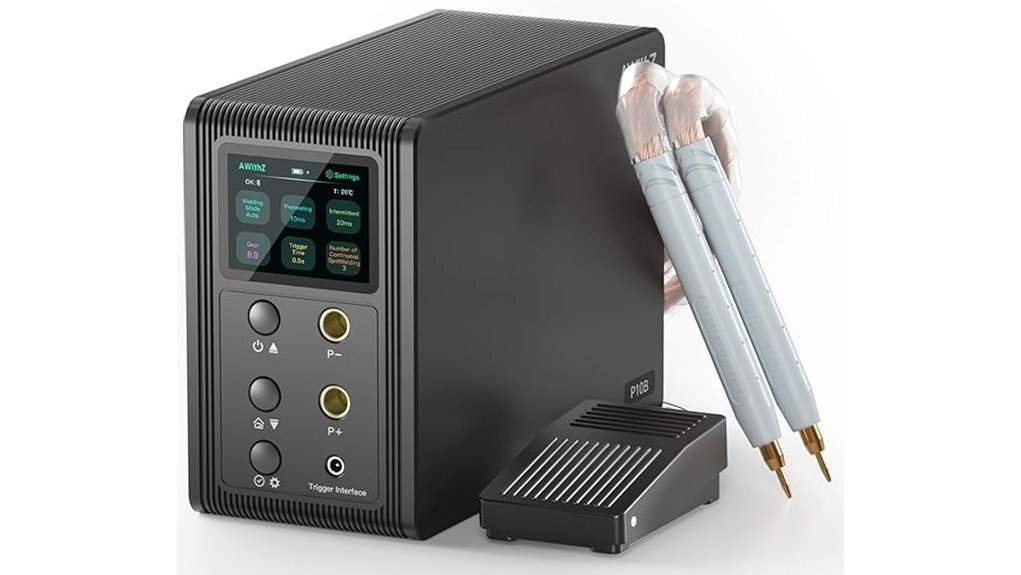
Building a battery pack requires controlled welds that hold the tab securely without sending unnecessary heat into the cell. The AWithZ Spot Welder P20B is a capacitor-based machine aimed at that job, with automatic and foot pedal triggering, 999 output settings, and a listed maximum pulse welding power of 14.6 kW. This review explains where those features help, which materials the P20B is designed to handle, and what you should check before buying. Its control range and included kit are useful strengths, but it still requires careful setup, scrap testing, and safe battery-handling practices.
At a Glance: Quick Verdict
Editorial Rating: 8/10, recommended with caveats
Best For: DIY battery pack builders who want a bench-style capacitor welder with fine output control
Bottom Line: The P20B combines 999 settings, a 2.4-inch display, two trigger modes, and a useful starter kit in a compact AC-powered unit. Its main tradeoff is that strong results depend on correct probe pressure, clean tips, suitable tab material, and patient testing rather than one universal setting.
Key Takeaways
- The P20B is a battery spot welder, not a replacement for a MIG, TIG, or stick welder.
- Its listed 14.6 kW maximum pulse power and 999 settings give you a wide tuning range for thin battery-tab materials.
- Automatic mode suits repeat work, while the included 2-meter foot pedal gives you more time to position the probes.
- The listing supports common cylindrical cells, including 14500, 18650, and 21700 formats, plus LiFePO4 battery-pack work.
- Start low, test on matching scrap, inspect each sample weld, and follow the manual before working on live cells.
Key Specifications
| Specification | Detail |
|---|---|
| Brand | AWithZ |
| Model | P20B |
| ASIN | B0DNLXHC23 |
| Product type | Capacitor battery spot welder |
| Maximum pulse welding power | 14.6 kW, manufacturer-listed maximum |
| Power source | AC-powered through the included 15A charger |
| Input range | 100 to 240V |
| Adjustment range | 000 to 999 welding levels |
| Operating modes | Automatic trigger and foot pedal trigger |
| Display | 2.4-inch LCD |
| Welding pen lead | 60 cm / 23.6 inches |
| Compatible battery work | 14500, 18650, 21700, LiFePO4, and other battery-pack tab work listed by the seller |
| Listed materials | Nickel-plated sheet, stainless steel, iron, pure nickel, and copper |
| Item weight | 5.52 lb |
| Package dimensions | 9.41 x 8.58 x 5.71 inches |
| Included accessories | 15A charger, 2 m foot pedal, three pairs of replacement pins, 5 m of 0.15 mm nickel-plated sheet, 18650 holder, file, and manual |
| Best use | Controlled battery-tab welding and small thin-sheet spot-welding tasks |
What Is the AWithZ Spot Welder P20B?
The AWithZ P20B is a bench-style capacitor spot welder made for joining thin conductive tabs to battery terminals. It stores energy in two internal supercapacitors, then releases a short welding pulse through the handheld probes. This process is different from arc welding because you are creating small resistance welds at the probe contact points instead of forming a continuous bead.
Who Should Buy It?
Best For
- DIY builders assembling or repairing 14500, 18650, 21700, or LiFePO4 battery packs
- Users who want a wide adjustment range for testing different strips and weld schedules
- Bench users who prefer precise foot pedal triggering but also want an automatic mode for repeat work
Skip If
- You need to weld thick steel, structural parts, automotive panels, or aluminum frames
- You want a cordless handheld welder for field use without an AC setup
- You are not prepared to test settings, inspect sample welds, and follow battery safety procedures
Before You Buy: The maximum material thickness figures are seller and manual claims, not a promise that every strip will weld cleanly at the same setting. Alloy, plating, surface condition, probe pressure, tip condition, and joint design all affect the result, so plan to test the exact material combination you intend to use.
Power Delivery and Capacitor Design
The P20B is rated for up to 14.6 kW of pulse welding power. That figure describes a brief welding pulse, not continuous output like a conventional fabrication welder. The two built-in supercapacitors store energy between welds and deliver it through the probes when triggered.
The practical benefit is repeatable short pulses without an external car battery. You still need to match the settings to the strip, cell terminal, and probe contact.
Controls, Display, and Fine Adjustment
The 2.4-inch LCD gives you a clear place to view the selected mode and welding settings. The 999-level range offers much finer adjustment than a basic welder with only a few preset steps. That can help when one level gives a weak joint but the next large preset on another machine would burn or mark the strip.
Automatic Mode vs. Foot Pedal Mode
Automatic Mode
Automatic mode triggers after the probes make contact, which can speed up repeated tab placement once your setup is stable. It works best when the cell fixture, strip position, tip spacing, and pressure stay consistent from weld to weld.
Foot Pedal Mode
Foot pedal mode lets you place both probes first and trigger the pulse with your foot. This is the better starting point for careful work because you can confirm tip position before the weld fires. The included pedal has a 2-meter cable, giving you more flexibility around a bench or battery fixture.
Keep both probe tips firmly seated and stop if you see excessive sparking or inconsistent marks.
Battery and Material Compatibility
The seller lists the P20B for cylindrical cells such as 14500, 18650, and 21700, along with LiFePO4 and industrial battery-pack work. Compatibility refers to the tab-welding task, not permission to weld any cell without checking its condition and manufacturer guidance.
The listing claims support for nickel-plated sheet, stainless steel, iron, pure nickel, and copper. It lists maximum examples of 0.6 mm for nickel-plated sheet, stainless steel, and iron, 0.3 mm for pure nickel, and 0.2 mm for copper. Treat those numbers as upper claims under suitable conditions, not recommended starting thicknesses.
Build, Portability, and Included Accessories
At 5.52 pounds with package dimensions of 9.41 x 8.58 x 5.71 inches, the P20B is compact enough for a small workbench but is not a pocket welder. The 60 cm welding-pen leads provide useful reach while keeping the main unit away from the immediate weld area.
The kit includes a 15A charger, 2-meter pedal, three pairs of replacement pins, 5 meters of 0.15 mm nickel-plated sheet, an 18650 holder, a file, and a manual. Confirm the current package before ordering.
Pro Tip: Keep one short piece of the exact tab material beside your project as a setup coupon. Use it to confirm tip condition and output after changing settings, replacing pins, or returning to the machine after storage.
How It Performs in Real Use
For an 18650 Pack With Nickel-Plated Strip
This is the P20B’s most direct use case. A cell holder can keep the row aligned, while foot pedal mode gives you time to place the probes on each tab. Once the setting and technique are consistent, automatic mode may speed up repeated welds.
For 21700 or LiFePO4 Pack Work
The same control features remain useful, but larger cells and different terminals can require a new setup. Do not copy an 18650 setting without testing. Match the sample joint to the actual strip, terminal material, and cell format you plan to use.
For Pure Nickel or Copper Tabs
The wide adjustment range helps, but these materials are less forgiving than thin nickel-plated steel. Start below the claimed maximum thickness, use clean surfaces, and test on representative samples. A weld that looks neat can still be weak, while a deep mark may indicate too much heat.
For Repeated Bench Repairs
The AC input, quick charge-up period, replaceable pins, and included foot pedal suit a fixed bench setup. The machine is less convenient when you need truly cordless operation or must carry the welder between remote work areas.
Setup Tips and Common Mistakes to Avoid
- Read the manual before powering the unit. Confirm the charger, ports, controls, and trigger mode before connecting the probes.
- Connect the included 15A charger. The listing says the unit can reach its ready status in about five minutes, with the display indicating when welding is available.
- Seat the probe leads and tips firmly. Loose or oxidized tips can cause weak welds, heat, or excessive sparking.
- Begin at a low setting. Test on scrap made from the same material and thickness as the intended tab.
- Keep the tab flat against the terminal. Gaps reduce contact and can produce inconsistent welds.
- Inspect sample joints. Check for secure attachment without severe burn-through, torn terminals, or excessive heat marks.
- Pause if the unit or leads become unusually hot. Allow the machine to cool before continuing.
Do not solve every weak weld by raising power. Check tip condition, probe pressure, strip contact, and material first.
Battery Welding Safety
Battery spot welding combines electrical energy, heat, metal, and cells that can be damaged by shorts or overheating. Wear safety glasses, work in a dry and well-ventilated area, and keep flammable material away from the bench. Follow the P20B manual and the cell manufacturer’s handling limits.
- Do not weld damaged, swollen, leaking, corroded, or overheated cells.
- Prevent loose tools, strips, and probe tips from bridging positive and negative terminals.
- Use an insulating work surface and organize cells so they cannot roll or shift.
- Disconnect power before cleaning, replacing pins, or inspecting the machine.
- Do not open, modify, or bypass protective functions in the welder.
- Stop immediately if you notice smoke, a sharp chemical odor, cell venting, or uncontrolled heat.
For high-energy or commercial packs, use proper insulation, fusing, pack design, and testing procedures, or work with an experienced battery technician.
Maintenance and Storage
Inspect the welding pins before each session. The manual recommends using the included file when oxidation or residue causes excessive sparks, then confirming that the tips are secure. Replace badly worn, uneven, or damaged pins rather than compensating with more power.
Store the P20B in a clean, dry area. Coil the leads loosely, protect the probe tips, and make sample welds before a long session.
Pros and Cons
Pros
- 999 welding levels provide fine control for different strip materials and thicknesses
- Automatic and foot pedal modes support both speed and deliberate probe placement
- 14.6 kW listed maximum pulse power gives the machine headroom for demanding battery-tab work
- 2.4-inch LCD makes settings easier to view than a simple indicator-only control panel
- Starter kit includes a charger, pedal, replacement pins, nickel-plated strip, holder, file, and manual
Cons
- The large adjustment range requires testing and record-keeping rather than a simple one-setting workflow
- Claimed maximum material thicknesses may not be repeatable with every alloy, strip supplier, or joint design
- It is AC-powered and bench-oriented, so it is less convenient than a small cordless welder for mobile repairs
Is It Worth the Price?
The P20B is worth considering when you want more control than a basic handheld battery welder and do not need the output of a larger professional pack-building system. Its value comes from the capacitor design, 999 settings, two trigger modes, readable display, and included accessories rather than from one headline power figure.
You will get the most value if you build or repair packs often enough to document repeatable settings. It is not ideal for a one-time repair, general fabrication, or cordless field work.
How It Compares to Alternatives
The AWithZ UF20B is worth comparing when you want a lower 10.5 kW listed output and a third manual trigger option in addition to automatic and foot pedal modes. The AWithZ P30C steps up to a listed 21.8 kW maximum pulse output for buyers who expect more demanding tab combinations and are willing to pay for additional headroom.
A 10 kW-class SEESII capacitive spot welder is another alternative if you want to compare controls, included probes, and protection features across brands. The P20B makes the most sense when you prefer AWithZ’s 999-level interface, 14.6 kW position in the range, and included foot-pedal kit.
Frequently Asked Questions
What is the AWithZ P20B used for?
It is used for resistance spot welding thin battery tabs and conductive sheets to battery terminals. It is aimed at battery-pack assembly and repair, not continuous-bead fabrication work.
Can the P20B weld 18650 and 21700 batteries?
Yes. The listing identifies 14500, 18650, and 21700 cylindrical cells, plus LiFePO4 battery-pack work. You still need to match the tab and settings to the actual cell terminal and follow the cell maker’s handling limits.
Can it weld pure nickel or copper?
The seller lists pure nickel up to 0.3 mm and copper up to 0.2 mm under suitable conditions. Treat those as maximum claims and test thinner samples first because alloy, surface preparation, pressure, and joint design can change the result.
Is automatic mode or foot pedal mode better?
Foot pedal mode is better for careful positioning because the pulse does not fire until you press the pedal. Automatic mode is faster for repeated welds after you have confirmed the material, setting, tip spacing, and pressure.
How do you choose the correct welding level?
Begin at a low level on matching scrap and increase gradually until the sample joint holds without severe burn-through or excessive heat. Do not rely on a setting from a different strip thickness, alloy, cell type, or probe arrangement.
Does the P20B need time to charge before welding?
Yes. The listing says the included 15A charger can bring the machine to its ready status in about five minutes. Wait for the display’s ready indication and follow the manual rather than triggering the welder immediately after connection.
What comes with the AWithZ P20B?
The listed kit includes the P20B, 15A charger, 2-meter foot pedal, three pairs of replacement pins, a 5-meter roll of 0.15 mm nickel-plated sheet, an 18650 holder, a file, and a manual. Confirm the current package before buying because seller bundles can change.
Can the P20B replace a MIG or TIG welder?
No. The P20B makes small resistance spot welds on thin battery-related materials. It is not designed for structural joints, thick steel, automotive body panels, aluminum frames, or general fabrication.
The Bottom Line
The AWithZ P20B is a strong fit for battery-pack builders who want fine control, automatic and pedal triggering, and a complete bench-ready kit. Skip it if you need general fabrication capability, cordless portability, or a machine that removes the need for material testing. Its main strength is adjustable capacitor-powered spot welding, while its main limitation is the technique and setup required to turn the listed capability into repeatable, safe joints.
Ready to Buy?
Check the latest price, package contents, seller details, and product instructions before you decide.