Disclosure: As an Amazon Associate, we earn from qualifying purchases. If you click a link on this page and make a purchase, we may receive a small commission at no extra cost to you.
Building or repairing a battery pack calls for clean, repeatable tab welds without putting extra heat into the cell. The AWithZ H1 Handheld Spot Welder gives you a compact, rechargeable option with 11 power levels and automatic or manual triggering. Its simple two-button design is friendly for small DIY jobs, but it is not a substitute for a higher-power bench welder when you need thick or pure nickel strip.
Quick Verdict
Rating: 7.5/10, recommended with caveats
Best For: Hobbyists and light repair users welding thin nickel-plated strip onto 18650, 26650, or 36650 cells
Bottom Line: The AWithZ H1 is easy to carry, quick to set up, and flexible enough for small battery-tab repairs. Its main tradeoff is limited power for thicker material and pure nickel, so serious pack builders should choose a stronger machine.
At a Glance
| Specification | Detail |
|---|---|
| Brand | AWithZ |
| Model | H1 |
| Product type | Rechargeable handheld battery spot welder |
| Power control | 11 adjustable levels |
| Welding modes | Automatic and manual |
| Compatible cells | 18650, 26650, and 36650 cylindrical cells; selected mobile battery tab work |
| Recommended strip range | Best suited to about 0.1 to 0.15 mm nickel-plated strip; 0.2 mm is an edge case that needs testing |
| Material limitation | Not intended for pure nickel sheet |
| Tip spacing | About 0.8 mm |
| Charging | Type-C cable; USB power adapter not included |
| Claimed output per charge | More than 200 spot welds under suitable conditions |
| Battery type | Two internal lithium-polymer cells |
| Item weight | 9.6 ounces |
| Package dimensions | 8.35 × 3.31 × 1.26 inches |
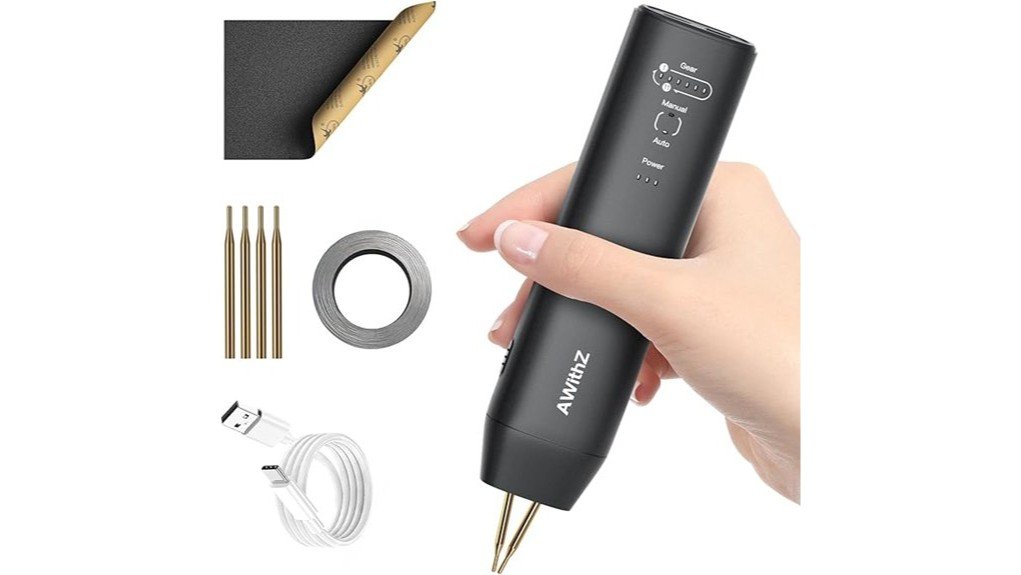
| Included accessories | 2-meter nickel-plated sheet, frosted paper, Type-C cable, and user manual |
| Built-in protections | Overcharge, temperature, short-circuit, abnormal-temperature, and low-voltage protection or alarms |
Key Takeaways
- The integrated welding tips and internal power supply make the H1 easier to carry than a bench machine with a separate pen.
- Eleven power levels let you tune the pulse for thin nickel-plated material instead of relying on one fixed output.
- Automatic mode speeds up repeated welds, while manual mode gives you direct control over when each pulse fires.
- The H1 is best for light-duty battery-tab work, not thick strip, pure nickel, or industrial production.
- The package includes practice material and a charging cable, but you still need a compatible USB power adapter and proper battery-safety equipment.
What Is the AWithZ H1 Handheld Spot Welder?
The AWithZ H1 is a cordless spot welder built for attaching thin metal tabs to battery cells. Its integrated design combines the power source and welding tips in one handheld body, so you do not need a separate welding pen or a large bench unit for basic work.
The H1 is aimed at DIY battery-pack builders, electronics hobbyists, and light repair users. It supports common cylindrical cell sizes, including 18650, 26650, and 36650 cells, and it can work with nickel-plated strip, iron, and selected thin metal tabs. The main selling point is convenience: you can charge it, select one of 11 output levels, choose automatic or manual mode, and weld with one hand.
Who Should Buy It?
Best For
- DIY users repairing small 18650, 26650, or 36650 battery packs
- Hobbyists who want a cordless tool for thin nickel-plated tabs
- Light workshop users who value simple controls and easy storage
Skip If
- You need reliable welds on pure nickel or thick strip
- You build battery packs at production volume
- You are not trained or equipped to work safely around lithium cells
Before You Buy: The H1 is designed around thin nickel-plated material. The product listing says it cannot reliably weld pure nickel, and its best working range is about 0.1 to 0.15 mm. Buy a higher-power capacitor or bench welder if pure nickel or thicker strip is part of your project.
Design and Build Quality
The H1 uses an all-in-one body with the welding tips at the front, the mode and gear controls on the housing, and a Type-C charging port. At 9.6 ounces, it is light enough to move around a workbench or store in a small tool drawer.
The grip is shaped for one-handed use, but the integrated design also means your hand stays close to the welding area. Keep your free hand away from the cell terminals and conductive strip, and never steady the work with bare fingers near the tips.
Controls and Ease of Use
The H1 has two labeled buttons. Hold the side power button for about two seconds to turn the unit on or off. A short press on the top button cycles through the 11 power settings, while holding that button switches between automatic and manual mode.
Automatic mode fires after the tips make contact and the short trigger delay passes. It is useful when you need to place a series of similar welds. Manual mode waits for you to press the side button, which gives you more control while you learn the tool or work around an awkward pack layout.
Pro Tip: Fully charge the H1, clean the tips and strip, then make several test welds on the included nickel-plated material. Start low and raise the power one level at a time until the strip holds without burning through or marking the cell more than necessary.
Welding Performance and Material Limits
The 11 power levels are the H1’s most useful feature. The maker recommends levels 1 to 3 for thin mobile-battery tab work, levels 3 to 6 for 0.1 mm nickel plate, and levels 6 to 11 for 0.12 to 0.15 mm material. Surface condition, charge level, tip contact, strip composition, and cell shape can all change the result.
A full charge is advertised to support more than 200 spot welds. Actual output varies with power level, retries, battery condition, and material thickness. Output also drops as the H1’s charge falls, so a nearly empty unit may create weaker welds than the same setting produced at full charge.
The main limitation is material strength. The listing says the H1 can weld nickel-plated sheet and iron but is not powerful enough for pure nickel sheet. It also presents 0.2 mm strip as a practice-heavy edge case. For consistent work on thicker or higher-conductivity material, a capacitor welder with greater stored energy is a better fit.
Battery and Welding Safety
The H1 includes overcharge, temperature, short-circuit, abnormal battery-temperature, and low-voltage protection or alarms. The protections do not make battery work risk-free. A misplaced weld, shorted cell, damaged wrapper, or overheated terminal can lead to burns, cell failure, smoke, or fire.
- Work on a clean, nonflammable surface with good lighting and ventilation.
- Wear eye protection and remove rings, watches, and other conductive jewelry.
- Do not weld damaged, swollen, leaking, punctured, or overheated cells.
- Inspect cell wraps and insulating rings before building or repairing a pack.
- Keep the two tips from bridging positive and negative terminals.
- Stop if the tool, strip, or cell becomes unusually hot, and allow everything to cool.
- Follow the cell maker’s limits, the pack design, and the H1 manual. Ask a qualified battery technician for help when you are unsure.
The welding tips can become hot during repeated use. Let the tool cool before touching, cleaning, or replacing any tip component. Do not charge or store the H1 in direct sun, near a heat source, or in a damp location.
Package Contents and Setup
The package is listed with the H1 welder, a 2-meter roll of nickel-plated sheet, one piece of frosted paper, a Type-C charging cable, and an English manual. You need a compatible USB power adapter for charging.
Before the first project, charge the H1 fully and inspect the welding tips for dirt or oxidation. Clean the strip and cell contact surface so both tips can touch at the same time. The manual recommends holding the welder at about a 60-degree angle, making firm contact, and lifting the unit straight up after the pulse.
How to Use It Correctly
- Plan the pack first. Confirm cell orientation, insulation, strip width, current path, and protection needs.
- Prepare the surfaces. Remove dirt and oxidation from the strip and welding tips with an appropriate dry cleaning method.
- Start with a test piece. Use the included strip to find the lowest setting that creates a secure weld.
- Place both tips evenly. Uneven pressure can create one strong point and one weak point.
- Check every weld. A gentle peel test on scrap helps you learn what a proper weld looks like. Do not pry aggressively on a finished cell.
- Pause between runs. Fast sequences can heat the tips, strip, tool, and cells.
- Recharge before output falls. Weak welds can appear when the internal battery is low.
How It Performs in Real Use
Small 18650 Pack Repairs
For replacing a damaged connection on a small 18650 pack, the H1’s compact nose makes it easier to reach a tab without setting up a large machine. Manual mode is the safer choice while you confirm position and power. The repair still requires correct cell matching, insulation, and pack protection.
Power-Tool Battery Projects
The H1 can be useful for light tab work on compatible cylindrical cells, but power-tool packs often carry high current and have tight internal layouts. You should not assume a weld is safe because the strip stays attached. Check the original strip material and thickness, and use a stronger welder when the pack requires pure nickel or heavier conductors.
Repeated Bench Work
Automatic mode reduces button presses when you are making many similar welds. The tool can heat up during a long run. Work in short batches, watch the temperature, and inspect weld consistency as the battery charge falls.
Portable or Occasional Use
The H1 is most convincing as an occasional-use tool. It stores easily, charges through Type-C, and does not require a separate pen cable. For daily production, a bench or capacitor machine offers more power and repeatability.
Cleaning, Charging, and Storage
After use, power the unit off and let the tips cool. Wipe the tips with a clean, dry cloth and remove visible residue or oxidation without changing their shape. Dirty or uneven tips can reduce contact and cause weak welds.
Recharge the unit when the low-voltage indicator appears rather than storing it fully depleted. Keep the H1 in a cool, dry place away from direct sunlight, metal scraps, and loose conductive tools. Before the next session, inspect the housing, port, and tips for damage or unusual heat.
Pros and Cons
Pros
- Integrated power supply and welding tips reduce setup and cable clutter
- Eleven output levels give you useful control for thin nickel-plated strip
- Automatic and manual modes support both repeated work and careful placement
- More than 200 welds per charge is a practical claimed capacity for small jobs
- Package includes test material, charging cable, and manual
Cons
- Not suitable for pure nickel and may struggle with 0.2 mm material
- Weld quality depends on charge level, contact pressure, clean tips, and practice
- No fixed warranty term is confirmed, and current Amazon offer availability may vary
Is It Worth the Price?
The AWithZ H1 offers strong value for the price when your goal is occasional work with thin nickel-plated strip. You get adjustable output, two welding modes, an integrated pen, and a starter roll of material in a tool that takes little space.
Its value drops if you need pure nickel, thick tabs, a display, very fine power adjustment, or production-level repeatability. In those cases, a capacitor welder or newer display model is a better investment.
How It Compares to Alternatives
A SEESII handheld model is worth comparing for compact 0.2 mm work. A newer AWithZ LCD model offers a screen and finer adjustment. AWithZ’s larger capacitor and foot-pedal machines are the stronger choice for thicker strip, pure nickel support, or frequent pack building.
The H1 makes the most sense when portability, simple controls, and light-duty use matter more than maximum output or advanced settings.
Frequently Asked Questions
Which battery sizes work with the AWithZ H1?
The listing and manual name 18650, 26650, and 36650 cylindrical cells, along with selected mobile-battery tab work. Cell size alone does not confirm suitability, so also check strip material, thickness, pack design, and required current capacity.
Can it weld pure nickel strip?
The product listing says the H1 does not have enough power for pure nickel sheet. It is better matched to thin nickel-plated material, so choose a higher-power capacitor welder for pure nickel projects.
What strip thickness is best?
The listed sweet spot is about 0.1 to 0.15 mm. The H1 may weld 0.2 mm material under favorable conditions, but that thickness needs practice and should not be treated as its most reliable range.
What is the difference between automatic and manual mode?
Automatic mode triggers a weld after the tips detect contact and the brief delay passes. Manual mode waits for you to press the side button, giving you more control over the exact firing moment.
Does it really make more than 200 welds per charge?
More than 200 welds is the maker’s claim for a full charge. Your result can be lower when you use high settings, repeat failed welds, work with thicker material, or use an older internal battery.
Does the package include a charger?
It includes a Type-C charging cable, but the manual says a compatible USB power adapter is not included. Check the current listing and use a suitable adapter that follows the manual’s charging guidance.
What warranty does the AWithZ H1 have?
A fixed warranty length is not confirmed in the available product information. The manual directs buyers to the seller or purchase platform for return, replacement, and support terms, so review those policies before ordering.
Is this spot welder suitable for beginners?
The two-button controls are simple, and the included material gives you a place to practice. It is still a battery-repair tool, so beginners should learn lithium-cell safety, test on scrap, and avoid live pack work until they understand insulation, polarity, and short-circuit risks.
The Bottom Line
The AWithZ H1 is a practical buy for hobbyists who need a portable spot welder for thin nickel-plated tabs on common cylindrical cells. Choose it for simple controls and light repair work, but skip it when you need pure nickel, thicker strip, high-volume output, or industrial consistency.
Ready to Buy?
Check the latest price, seller, and product details before you decide.