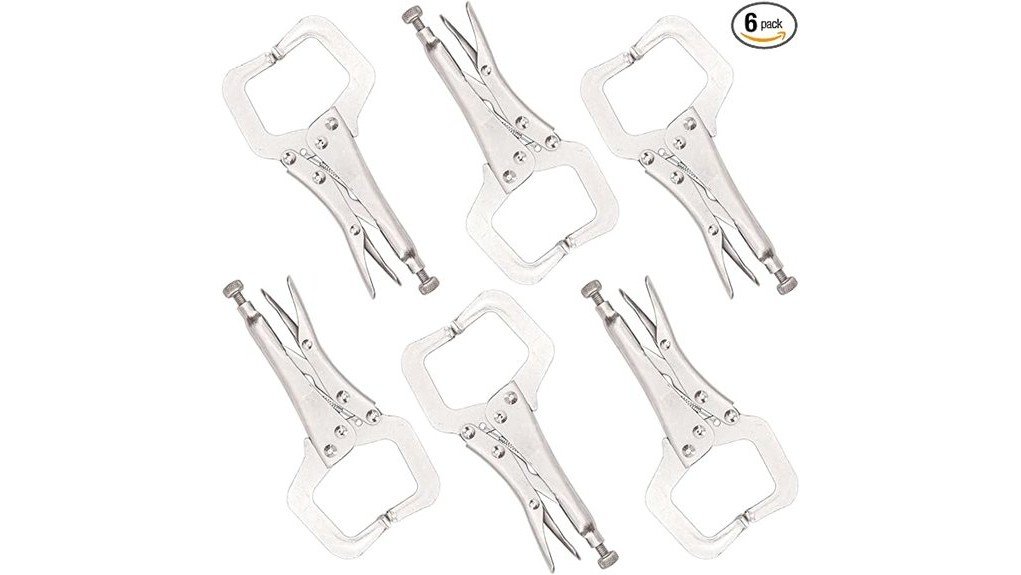
The Biugaaufai 6 inch locking C clamp is a pliers-style clamp with nickel-plated alloy steel construction and a screw adjustment for setting jaw pressure, per its Amazon listing. It is a sensible add-on for fabricators who need to hold plate, angle or tube for tack welding, and a weak pick for jobs that need very deep reach or wide capacity. Verify the actual jaw opening in the listing before you order.
Biugaaufai Locking C Clamp at a Glance
| Item | Per the listing |
|---|---|
| Type | Locking C clamp (pliers style) |
| Size | 6 inch (tool length; check jaw opening) |
| Material | Nickel-plated alloy steel |
| Adjustment | Screw-adjustable lock with release trigger |
| Suggested uses | Woodworking, auto body panels, general workshop |
What the Biugaaufai 6 Inch Locking C Clamp Is and Who It Suits
A locking C clamp works like locking pliers with C-shaped jaws. You set the screw so the jaws just fit the work, squeeze the handle until it locks, and release with the trigger. Because the clamp holds itself, it frees both hands for tacking or measuring.
For welding it is mostly a positioning tool. It holds sheet and plate flush, pulls panel edges together and keeps tubing against a stop while you place tack welds. The wider C-shaped jaws are better than flat pliers on thin flat stock because they spread contact over more area.
It suits hobbyists, auto body workers and general fabricators who want a handy extra clamp. It is not a substitute for a heavy bar clamp or a welding-table clamp when you need force over a long distance or high-load clamping.
How to Check It Fits Your Work
- Find the real capacity. Look for jaw opening and throat depth in the listing. A 6 inch overall tool length does not equal a 6 inch opening.
- Match the jaw to the workpiece. Flat C jaws work on sheet and plate edges. Round tube may need V-shaped or swivel pads.
- Consider the plating. Nickel plating helps with rust protection but will not survive repeated weld spatter. Keep it away from the joint.
- Check release feel. A trigger release should open smoothly even with heavy clamping force. Stiff releases suggest burrs or contamination.
- Buy a few if you tack a lot. One clamp seldom holds a frame square; plan on two or more.
Pros and Limitations
Pros
- One-hand operation once the screw is set
- Lock-and-release action holds work hands-free
- Alloy steel body with corrosion-resistant plating
- Useful beyond welding, for wood and body work
Limitations
- Capacity is limited by the C-jaw size
- Not made for high-heat or spatter-heavy positions
- Locking clamps can slip if the screw is not reset for a new thickness
- Not a replacement for a rated ground clamp or a table clamp
Using a Locking C Clamp Safely
- Adjust the screw each time you change material thickness; the lock should feel firm but not need extreme effort.
- Keep the clamp off the weld joint. Spatter fuses to jaws and damages the locking surface.
- Do not use the clamp as part of the welding current path unless the maker rates it for that.
- Remove the clamp only after the part cools; hot tools and parts burn bare hands.
- Clean spatter with a wire brush and put a drop of light oil on the pivot and screw threads.
Alternatives and Related Guides
- For more reach and a larger set, see the Japchet C clamp locking pliers set review.
- Prefer a simple screw-type clamp? Read the heavy-duty C clamps review.
- For a name-brand locking pliers option, check the Olympia Tools 9 inch locking pliers review.
- If you need to hold parts at right angles, read the V-type magnetic welding clamps review.
Frequently Asked Questions
What is a locking C clamp used for?
A locking C clamp is a pliers-style clamp with C-shaped jaws that lock shut under adjustable pressure. Welders use it to hold plate, angle and tube in position before tacking, and it also works for woodworking and auto body panel holding.
Does a 6 inch locking C clamp have a 6 inch opening?
Not necessarily. The 6 inch figure usually describes the tool length, while the jaw opening and throat depth are smaller. Check the listing dimensions for the actual capacity, and measure your material before you buy.
Can I leave a locking C clamp on while I weld?
You can clamp parts for tack welding, but spatter and heat can pit the plating and jaws. Keep the clamp off the weld zone, avoid welding through it, and let it cool before adjusting. Do not rely on it as your ground connection.
How do I release a stuck locking clamp?
Use the trigger or release lever to open the jaws. If it will not release, back off the adjusting screw first to reduce pressure, then pull the lever. Avoid hammering on the handles, which can bend the linkage.
Final Thoughts
This locking C clamp makes sense as a lightweight positioning tool for tack welding, auto body work and general shop jobs. Confirm the jaw opening against your thickest part before buying.