As an Amazon Associate, Garage Welding may earn from qualifying purchases. This does not change the price you pay.
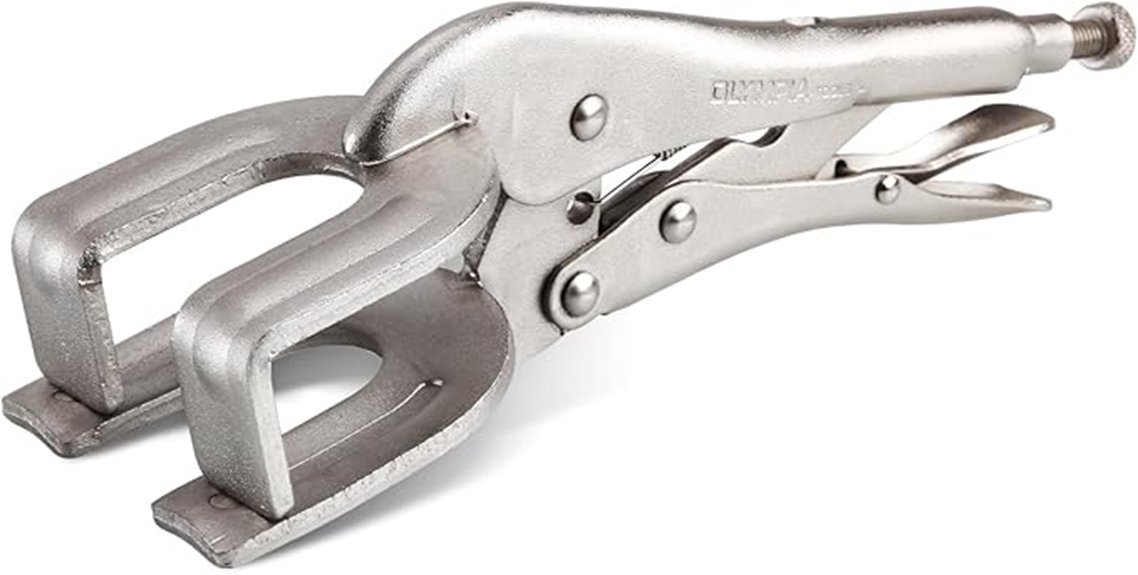
The Olympia Tools 9 inch locking pliers are a brand-name locking plier with heat-treated, U-shaped jaws, an adjustable tension screw and a quick-release lever, per the Amazon listing. They suit welders and fabricators who want a trusted-brand holding tool for tacking angle, flat bar and sheet, and are less suited to anyone needing wide clamp capacity or a rated ground. The listing gives few numeric specs, so verify jaw opening before you buy.
Olympia Tools 9 Inch Locking Pliers at a Glance
| Item | Per the listing |
|---|---|
| Type | Locking pliers with U-shaped jaws |
| Length | 9 in |
| Jaws | Heat treated, U-shaped |
| Adjustment | Tension screw sets lock force |
| Release | Quick-lock release lever |
| Handles | Ergonomic design |
Jaw capacity, handle material and steel grade are not clearly stated, so confirm them on the product page.
Check Current Price on Amazon →
What They Are and Who They Suit
Locking pliers clamp a workpiece and keep their grip until you release the lever. A U-shaped jaw is a wide opening that wraps around flat bar, angle iron and rectangular tube, and it keeps the surface visible.
The brand name matters because several knock-off locking pliers use softer steel and less precise locking linkages. Olympia is a known tool brand, but you still need to verify the exact model listed.
These pliers suit welders who want one dependable pair for tacking, bending, pulling and holding. A 9 inch size is a common balance between reach and control.
How to Check They Fit Your Work
- Find jaw capacity. Look for the maximum opening in the product details or manual.
- Check the jaw shape. U-shaped jaws hold flat and angled stock well, but round tube may need V or curved jaws.
- Test the lock. The pliers should lock firmly and release easily without excess effort.
- Check tension screw feel. It should move smoothly across its range.
- Compare to your other tools. If you already own a 10 inch pair, a 9 inch adds a bit more maneuverability.
Brand-Name or Budget Locking Pliers?
Budget locking pliers can work fine for occasional clamping, but the linkage and jaw teeth are where quality differences show up. A tool that slips under load or will not release cleanly is frustrating and can pinch your hand. A branded pair costs more, yet you are paying for tighter tolerances and a better chance of consistent locking over time.
If you tack weld every week, a name-brand pair or two is a sensible spot to spend money. If you only need to hold parts occasionally, a budget set may be enough. Either way, test the lock on scrap before relying on it for a real project.
Pros and Limitations
Pros
- Known tool brand name
- Heat-treated jaws resist wear
- Adjustable tension handles different thicknesses
- U-shaped jaws offer a clear view of the joint
Limitations
- Specs in the listing are sparse
- Not intended as a ground clamp
- Spatter can pit jaws and the lock
- Limited capacity compared with larger clamps
Using Locking Pliers Safely and Well
- Set the tension for each material; a pliers that locks too loosely can slip, and too tightly can deform thin sheet.
- Close the pliers before putting your fingers near the jaws.
- Wear gloves and eye protection. Spring-loaded jaws can pinch.
- Keep them away from the weld pool and shield them from spatter.
- Do not hammer on the handles or use a pipe for extra leverage.
- After use, brush off spatter and oil the pivots lightly.
Alternatives and Related Guides
- For a generic 10 inch alternative, see the URASISTO 10 inch locking pliers review.
- Need multiple sizes? See the JAPCHET locking pliers set.
- For C-shaped jaws, read the Biugaaufai 6 inch locking C clamp.
- For heavier clamping, see the heavy-duty C clamps pack.
Frequently Asked Questions
Is a 9 inch locking plier a good size for welding?
Nine inches is a middle size that fits most bench work. It has enough leverage for tacking angle, flat bar and sheet, yet it stays manageable in tighter spots. Many welders keep a 6 inch, a 9 inch and a 10 or 11 inch for different jobs.
What does the adjustable tension screw do?
The screw sets how far the jaws close before the handle locks, which controls clamping force. Adjust it for each thickness so the handle closes with firm pressure. Turn it in to increase force and out to reduce it.
Are heat-treated jaws important?
Heat treatment hardens the jaw surface so it resists wear and deformation under clamping pressure. It does not make the pliers weld-proof, and spatter can still mark the jaws. Keep them away from the joint and clean them after use.
Can I use locking pliers instead of a welding clamp?
For tack welding and positioning, yes, within the pliers’ grip. For heavy fixturing or long welds, use a C-clamp or table clamp. Never use them as a ground clamp in the welding current path.
Final Thoughts
These Olympia pliers are a sensible brand-name locking plier for tack welding and general fabrication. Confirm the jaw capacity and model number before ordering.
View Current Listing on Amazon →
See Latest Price and Details →