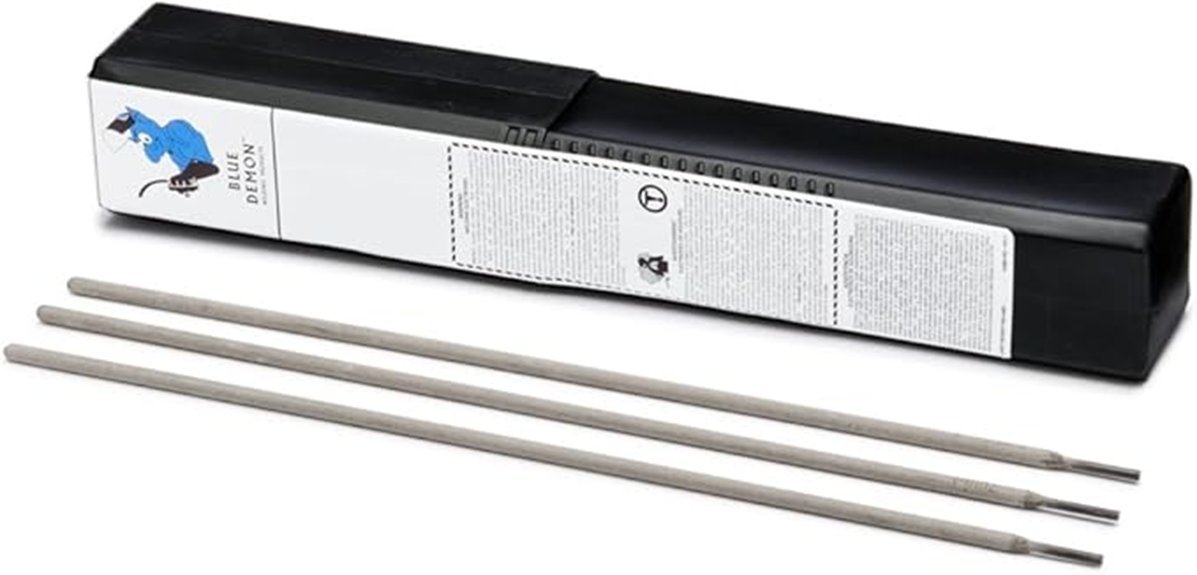
The Blue Demon 6013 is a mild-steel E6013 stick electrode that runs on AC or DC, so it suits small AC buzz-box welders and hobby shops. The listing describes it as 1/16 in by 14 in, a thin rod for light work such as sheet and thin brackets. This Blue Demon 6013 review covers the specs, who it suits, how to run it and what to check on the listing before you buy. The Blue Demon 6013 electrode in 1/16 in is a small rod for thin steel.
Blue Demon 6013 specs at a glance
| Item | Detail (per retailer and listing data) |
|---|---|
| Classification | E6013 mild-steel stick electrode (AWS A5.1) |
| Size on this listing | 1/16 in diameter, 14 in long; the line also comes in larger diameters |
| Current | AC or DC; works well on low-voltage AC machines |
| Positions | Flat, horizontal, vertical and overhead |
| Penetration | Shallow to medium |
| Minimum strength | 60 ksi tensile, 48 ksi yield, 17% elongation |
| Typical use | General fabrication, metal structures, machine parts, shaft buildup |
Check the Amazon listing for the pack weight and rod count before ordering. Retailer data for this line shows 1 lb tubes.
What E6013 rods are and who they suit
E6013 is a general-purpose rod with a soft arc, easy slag removal and a smooth bead. It forgives poor fit-up better than low-hydrogen rods and starts easily, which is why beginners often start here. Penetration is shallow to medium, so it is not the rod for thick joints or critical structural work.
- Good for: light fabrication, repair of mild steel, sheet and thin plate, practice on an AC welder.
- Less suited to: heavily rusted or painted steel (a 6010 or 6011 rod penetrates better), thick plate and code work that calls for 7018.
How to check the rod size and your welder
- Diameter: 1/16 in is a thin rod for thin metal. If you weld 1/8 in plate or thicker, a 3/32 in or 1/8 in rod is a better match, so make sure the listing size is the one you want.
- Minimum amps: a thin rod needs a welder that can hold a stable arc at low current. Some small AC machines struggle below about 30 A, so check the low end of your machine range.
- Current type: the rod runs on AC or DC. Use the settings printed on the package or in your machine manual.
- Rod length and holder: 14 in rods fit standard electrode holders.
- Storage: keep the rods dry in their tube or in a rod storage tube.
For reference, retailer data lists about 40 to 80 A for 3/32 in rods and 70 to 120 A for 1/8 in rods. Use the figures on your own package for the 1/16 in size.
Pros and limitations
Pros
- Runs on AC and DC.
- Easy arc starts and easy slag removal.
- All-position rating, so it can handle vertical and overhead repairs on light metal.
- A thin 1/16 in rod gives control on sheet and small parts.
Limitations
- Shallow to medium penetration, so it is a poor choice for thick or dirty steel.
- Not a low-hydrogen rod, so it is not a substitute for 7018.
- A 1/16 in rod burns fast and is easy to burn through if you run too hot.
How to weld with 6013
- Clean the joint of loose rust, oil and paint.
- Set the current for the rod size. Start low and adjust on scrap.
- Hold a short arc and drag the rod at a slight angle; light weaving works on wider gaps.
- Chip the slag and wire-brush between passes.
Wear an approved welding helmet, gloves and flame-resistant clothing, and ventilate the area.
Alternatives and related guides
For more rod comparisons, read the E6013 welding rod review and the Blue Demon 6010 electrode review. Use the stick welding amperage chart to pick a starting current, and see how to prevent burn-through when stick welding if you work on thin metal.
Frequently Asked Questions
Can I use Blue Demon 6013 on an AC welder?
Yes. The rod is listed for AC and DC and is known for running well on low-voltage AC machines.
Is E6013 good for beginners?
It is one of the easier stick rods because the arc starts easily and the slag is simple to remove. Practice on clean mild steel before moving to harder rods.
Is 6013 a cellulose rod like 6010?
E6013 has a rutile-type coating that gives a softer arc. E6010 is the deep-penetrating cellulosic rod and runs on DC only. Always follow the data on the package.
What amperage should I use for 1/16 in 6013?
Use the range printed on the package or in your machine manual. Thin rods need low current, and exact settings depend on your welder and the metal thickness.
Can I weld rusty steel with 6013?
Light surface rust can be tolerated, but it will not penetrate heavy rust or mill scale as well as 6010 or 6011. Grind to clean metal when you can.
Verdict
The Blue Demon 6013 is an easy, AC and DC rod for light mild-steel work. Choose it if you weld thin metal and want a forgiving arc, confirm the 1/16 in size and pack on the listing, and step up to a thicker rod or a different class for heavy, dirty or structural jobs.