As an Amazon Associate, Garage Welding may earn from qualifying purchases. This does not change the price you pay.
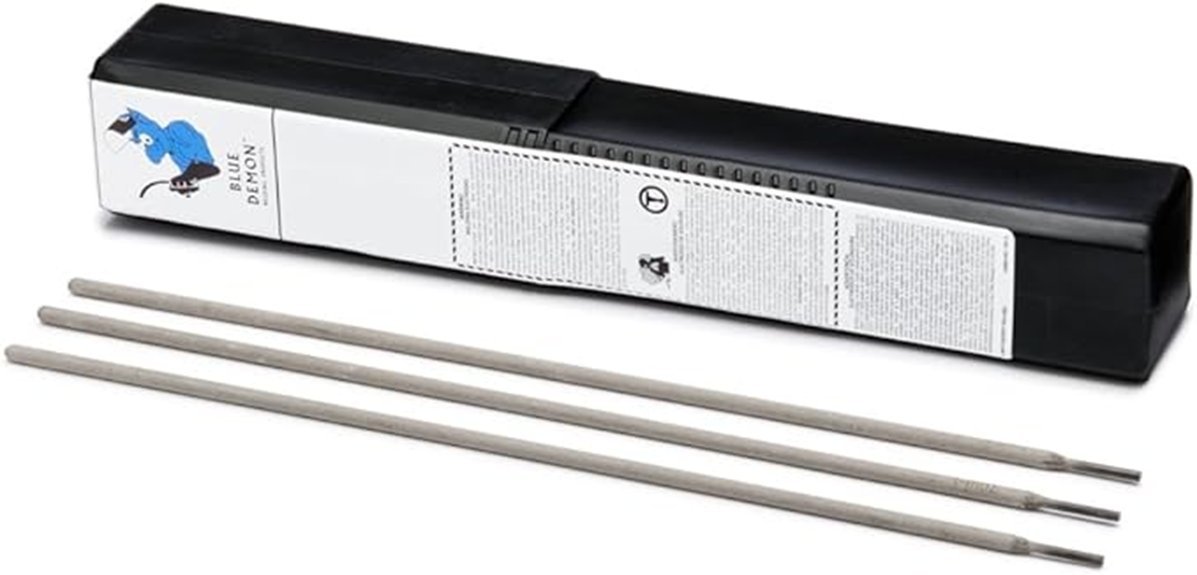
The Blue Demon 6010 is a 1/8 in by 14 in E6010 stick electrode, a deep-penetrating, fast-freezing rod favored for pipe root passes and for welding through rust, paint and mill scale. It is worth considering if your welder is DC capable and you do repair or pipe-style work. Skip it if you have an AC-only transformer welder, since 6010 is a DC-only electrode.
This Blue Demon 6010 review is based on the Amazon listing and the AWS E6010 classification, not hands-on testing. Check the listing for pack weight and quantity before ordering.
Quick specs at a glance
| Item | Detail |
|---|---|
| Classification | E6010 (cellulosic, high-cellulose sodium coating) |
| Size | 1/8 in diameter x 14 in long per listing |
| Current | DC electrode positive (DCEP) only |
| Positions | All-position rod class, widely used for vertical-up and pipe |
| Penetration | Deep, digging arc; thin slag |
| Typical use | Pipe root passes, rusty or dirty steel, farm and repair work |
| To check | Pack weight, rod count, brand markings on the rods |
Check Current Price on Amazon →
What E6010 rods are and who they suit
E6010 is one of the oldest stick electrodes. The cellulose coating burns to create a forceful arc that penetrates deeply and tolerates poor fit-up. That is why pipeline welders use it for root passes.
The Blue Demon brand supplies this rod in common hobby and shop sizes. Treat it as a repair and root-pass rod, not an easy first rod: the arc is more aggressive and the bead is rough compared with E6013.
- Good for: pipe roots, rusty or dirty steel, vertical-up repairs, farm equipment.
- Less suited to: thin sheet, AC-only welders, finishing passes where appearance counts.
How to check it works with your welder
- DC output: E6010 needs DC electrode positive. AC-only machines can’t run it reliably. Many inverter stick welders do; some small machines have a dedicated 6010 setting. See the ESAB Rogue ES 180i review for an example.
- Open-circuit voltage: 6010 likes a machine with enough OCV and arc force. Check whether the welder’s manual lists 6010 as supported.
- Current range: For 1/8 in 6010, common reference ranges sit roughly in the mid-70s to mid-120s amps. Use the range printed on the package or the machine manual.
- Rod length: 14 in rods fit standard holders; make sure your holder jaw closes on the rod securely.
- Quantity: The listing does not make weight obvious; confirm how many pounds or rods you receive.
Pros and limitations
Pros
- Deep penetration and a forceful arc for dirty or rusty steel.
- All-position, with a reputation for good vertical-up work.
- Thin slag that chips and cleans quickly.
Limitations
- DC electrode positive only; not for AC-only welders.
- Rough, spattery bead compared with E6013 or 7018.
- Higher fume, and the technique has a learning curve.
- Not low-hydrogen, so it isn’t a substitute for 7018 where code or procedure require it.
See Blue Demon 6010 Rods on Amazon →
How to weld with 6010
- Use a tight arc with a slight whip or step motion. Keep the arc short; 6010 likes to be driven.
- For pipe roots, use a keyhole technique and a steady, tight arc.
- Run vertical welds uphill.
- Use the amperage printed on the package; too low gives a sticky arc, too high gives undercut.
- Keep the rods dry; cellulosic coatings should not be baked, so follow the manufacturer’s storage advice.
Safety
Use a proper auto-darkening helmet, leather gloves and flame-resistant clothing. Ventilate well because 6010 produces more fume than most rods, and grind off coatings like galvanizing and heavy paint before welding. A rod storage tube keeps rods tidy, though 6010 isn’t baked like 7018.
Alternatives and related guides
- E6013 welding rod review: an easier rod for light work and finish passes
- E6011 welding rod review: a similar penetrating rod that runs on AC and DC
- E7018 welding rod review: the low-hydrogen choice for structural work
- Forney 298 Easy Weld 100 ST review: a 120V DC stick machine to run small rods
Frequently Asked Questions
Can I use 6010 rods on an AC welder?
No. E6010 is designed for DC electrode positive and is unreliable on AC. If your welder is AC only, E6011 or E6013 are better choices. Many inverter welders support DC and can run 6010.
What amperage should I use for 1/8 in 6010?
Reference ranges for 1/8 in E6010 usually run from the mid-70s to the mid-120s amps. Use the range on the package or manual, then adjust for position and joint, keeping a short arc.
Is 6010 good for beginners?
It is harder than E6013 because the arc is aggressive and the bead is rough. Beginners can learn it on scrap after getting comfortable with an easier rod, and should prioritize ventilation.
Do 6010 rods need to be baked or kept in an oven?
Low-hydrogen rods like 7018 need ovens, but 6010 cellulose rods generally should not be over-dried. Keep them dry and sealed, and follow the manufacturer instructions.
Final verdict
Blue Demon 6010 rods are a classic choice for deep penetration on dirty or rusty steel and for pipe root passes, as long as you have a DC welder that can run them. Confirm pack size on the listing and practice on scrap first.
Check Blue Demon 6010 Availability on Amazon →