As an Amazon Associate, Garage Welding may earn from qualifying purchases. This does not change the price you pay.
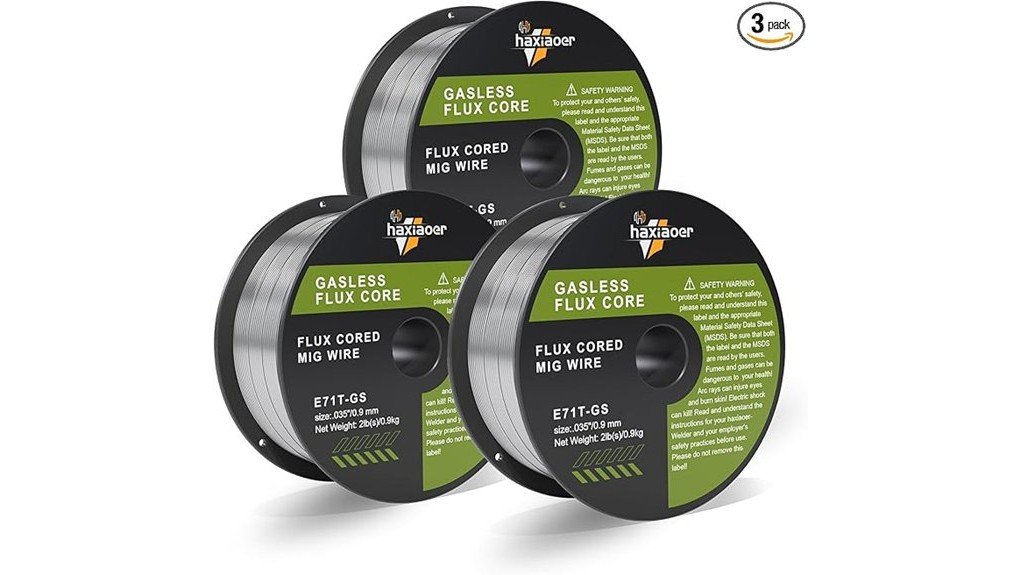
This E71T-GS welding wire is a 0.035 in. self-shielded flux-core wire sold on a 2 lb spool, aimed at gasless welding of mild steel. It is worth considering for outdoor repairs and light fabrication on a flux-core capable machine. Skip it if you need certified multi-pass structural work, or if your machine cannot run flux-core wire. This review is based on the Amazon listing and standard wire classification knowledge, not hands-on testing.
E71T-GS Wire at a Glance
| Item | Details |
|---|---|
| Classification | E71T-GS, self-shielded flux-cored |
| Wire diameter | 0.035 in. |
| Spool weight | 2 lb, per the listing |
| Gas needed | None (self-shielded) |
| Positions | All-position classification (E71T) |
| Base metal | Mild steel |
| Typical polarity | DC electrode negative (check wire maker’s data) |
Prices change, so check the current listing before you buy.
Check this E71T-GS wire on Amazon →
What E71T-GS Wire Is and Who It Suits
E71T-GS is a flux-cored wire with the shielding material inside the wire. It does not need a gas cylinder, so it works outdoors in light wind where gas MIG would suffer. The GS suffix means it is intended for single-pass welds, which suits thin to moderate sheet and general repair jobs.
Who it suits:
- Hobbyists with a gasless-capable MIG machine.
- Outdoor, rusty or dirty steel repairs where gas would blow away.
- Light farm, trailer and fence repairs on non-critical parts.
Who should skip it: anyone welding critical structures, pressure parts or anything requiring a certified procedure; people who want low smoke indoors; and users with machines that can only run solid wire with gas.
How to Check It Works With Your Machine
- Machine support. Confirm your welder supports flux-core. Many entry machines do, but some are gas-only.
- Polarity. Self-shielded flux-core usually runs DC electrode negative. Check your manual to swap the leads if needed.
- Wire size. Match the contact tip and drive roll to 0.035 in. Use knurled or V-knurled drive rolls for flux-core, as smooth rolls can slip.
- Spool size. A 2 lb spool needs an adapter or a machine spindle that suits it. Many small machines use 2 lb to 10 lb spools; check yours.
- Liner and gun. Make sure the liner is clean. Flux-core leaves residue that can build up.
- Power. Check amp range. 0.035 in. flux-core generally needs moderate heat, so a very small machine may struggle on thicker steel.
View the current E71T-GS listing →
Pros and Limitations
Pros
- No gas bottle or regulator to buy.
- Works outdoors where shielding gas would blow away.
- Tolerates some rust and mill scale better than solid wire.
- Slag protects the weld as it cools.
Limitations
- More smoke and spatter than gas MIG, so ventilation matters.
- Slag must be chipped off before the next pass.
- GS wires are intended for single-pass use.
- Not for aluminum or stainless steel.
- Quality of generic wire can vary from spool to spool, so check cast, feeding and arc behavior when you start.
Technique and Safety Tips
- Use a drag (pull) technique so you can see the slag and puddle, and so the slag stays behind the weld.
- Keep a short stick-out. A long one can cause porosity.
- Clean heavy rust, paint and oil. Flux-core tolerates more than solid wire but not everything.
- Wear an auto-darkening helmet, leather gloves and flame-resistant clothing.
- Ventilate or use extraction. Flux-core fume is heavy, and indoor welding needs proper airflow and, where appropriate, a respirator.
- Do not weld galvanized, plated or unknown coatings without ventilation and protective equipment.
- Chip slag with eye protection, because it flies.
Alternatives and Related Guides
- Prefer gas MIG? See the ER70S-6 MIG welding wire review.
- Different brand? Compare the AWT flux core welding wire review and the Waltyotur gasless flux core wire review.
- Need a flux-core capable machine? See the DURATECH 140A MIG welder review, and stock spare parts with the Forney 140 FC-i consumables kit review.
Frequently Asked Questions
What does E71T-GS mean?
E71T-GS describes a self-shielded flux-cored wire with a 70 ksi tensile class, for all positions, and the GS suffix means a general-purpose wire rated for single-pass welds. For structural or multi-pass work, use a wire certified for it.
Can I use E71T-GS wire in a gas MIG machine?
You can use it in a MIG-type wire feeder if the machine supports flux-core wire and you set the correct polarity, which is usually electrode negative. Do not use shielding gas with a self-shielded wire, and use knurled drive rolls designed for flux-core.
What thickness can E71T-GS weld?
It is generally used on light to medium mild steel. Light sheet around 18 gauge up to roughly 1/4 inch is a common rough range for this wire class, but the right limit depends on your machine, settings and wire manufacturer data. For thick or structural joints, use a certified procedure and appropriate wire.
How do I store flux-core wire?
Keep the spool in a dry, sealed place and remove it from the machine if you will not use it soon. Flux absorbs moisture, which can cause porosity and rust on the wire, so store with a desiccant and use older spools first.
Verdict
E71T-GS is a reasonable gasless wire for single-pass repairs on mild steel if your machine supports it. Check polarity, drive rolls and ventilation, and use certified wire for anything critical.
See the E71T-GS wire on Amazon →