As an Amazon Associate, Garage Welding may earn from qualifying purchases. This does not change the price you pay.
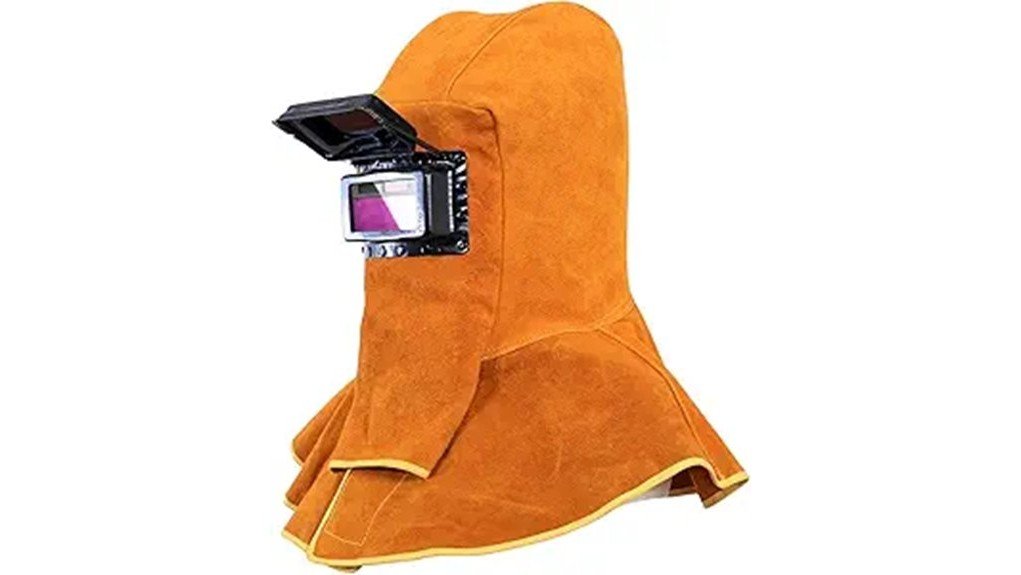
This cowhide leather welding hood is a soft leather head-and-neck cover with a built-in solar auto-darkening filter, listed at about 400 g. It is aimed at welders who want a lighter, cooler alternative to a rigid plastic helmet, especially for overhead and awkward positions. It is worth a look if you like the hood style, but you should confirm the shade range and certification, because the listing text is vague on both.
This review is based on the seller’s Amazon listing and general knowledge of leather hoods. We have not tested this hood.
Cowhide leather welding hood at a glance
| Item | Detail |
|---|---|
| Type | Leather welding hood with auto-darkening filter |
| Outer material (per listing) | Cowhide leather |
| Filter power (per listing) | Solar with a 60 mAh lithium battery |
| Switching speed (per listing) | 1/25000 second |
| Weight (per listing) | Approximately 400 g |
| Protection claim (per listing) | UV/IR protection from the filter |
| To confirm | Shade range, ANSI Z87.1 or EN379 marking, sensor count and sensitivity controls |
Check current price on Amazon →
What a leather hood offers and who it suits
A welding hood covers more of the head and neck than a standard helmet. Leather is flexible, resists spatter and can protect the ears, neck and hair from sparks. Hoods also tend to be less bulky, which helps in tight spaces such as under a vehicle, inside a frame or in overhead work.
Choose a leather hood if you value coverage and a soft feel, and if you are comfortable with heat building up inside leather during long sessions. If you mainly weld flat on a bench for hours, a rigid helmet with a larger lens and headgear might be more comfortable.
How to check the filter and fit before buying
- Shade range. The old marketing line about “99% shading” is not a shade rating. Look for a shade number or range, such as a variable #9 to #13 range, and match it to your amperage using the filter chart.
- Marking. Check the listing and the filter for ANSI Z87.1 or EN379. If neither is shown, ask the seller.
- Low-amp TIG. A solar filter with one sensor can struggle at very low amps. Check for sensitivity and delay controls.
- Size. Check the opening for your head and neck. Leather hoods usually need a fit that is snug at the collar but does not pull the filter off-line.
- Glasses and respirator. Make sure there is room for safety glasses and a half-mask respirator if you use one.
Pros and limitations
Pros
- Lightweight, around 400 g per the listing.
- Leather covers the neck and sides of the head.
- Solar-assisted auto-darkening lens with a 1/25000 second switching claim.
Limitations
- Leather traps heat in warm weather, and it can stiffen if it gets wet or is stored poorly.
- A small fixed lens may give a narrower view than modern helmets.
- Durability over time varies. Check seams and filter mounting after the first few uses.
- Not a replacement for a respirator. Fume exposure needs separate controls.
Use and care tips
- Test the lens by striking an arc on scrap before the first real weld. If it does not darken, do not use it.
- Brush off dust and spatter and wipe the leather with a barely damp cloth. Condition leather occasionally with a leather-safe product, keeping it off the lens.
- Store the hood away from damp, heat and direct sun.
- Replace the filter or the hood if the lens is cracked, delaminated or stays light during welding.
Alternatives and related guides
- SturdyShape pancake welding hood for a hood-style helmet with a different shape.
- Sarges pancake black welding hood another pancake-style option to compare.
- Wendys pancake welding hood a third hood-style listing to compare.
Frequently Asked Questions
Is a leather welding hood better than a helmet?
Neither is better for everyone. Leather hoods are lighter and cover more of the head and neck, which helps in tight spaces. Rigid helmets usually give larger viewing areas and easier headgear adjustment. Pick based on your work position.
Does the hood have a shade range?
The listing text emphasizes UV/IR protection and a 1/25000 second switch time but does not clearly state a shade range. Confirm the range and certification on the Amazon listing or with the seller before relying on it.
Can I use it for TIG welding?
Possibly, but low-amp TIG needs a filter that responds to a weak arc and a suitable shade. Check the listing for sensitivity adjustment and test the hood on scrap before critical work.
How should I clean a leather hood?
Brush off dust and wipe with a barely damp cloth. Avoid soaking leather, and keep any conditioner away from the lens. Let it air dry away from heat so the leather does not crack.
Bottom line
The cowhide leather welding hood suits welders who want light weight and extra neck and head coverage. Verify the shade range and certification, test the filter on scrap, and keep a spare cover lens if one is available.
Check current price on Amazon →