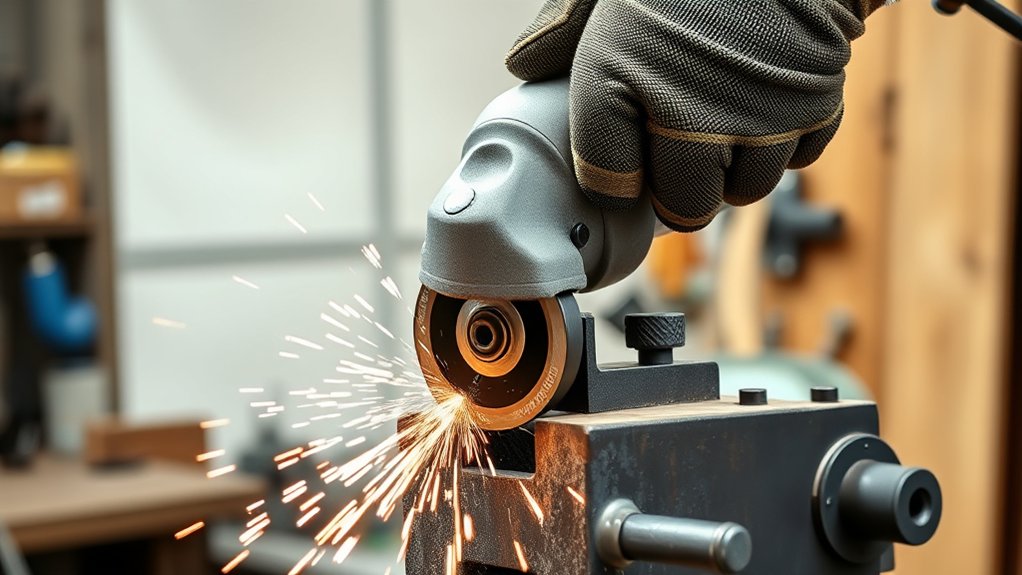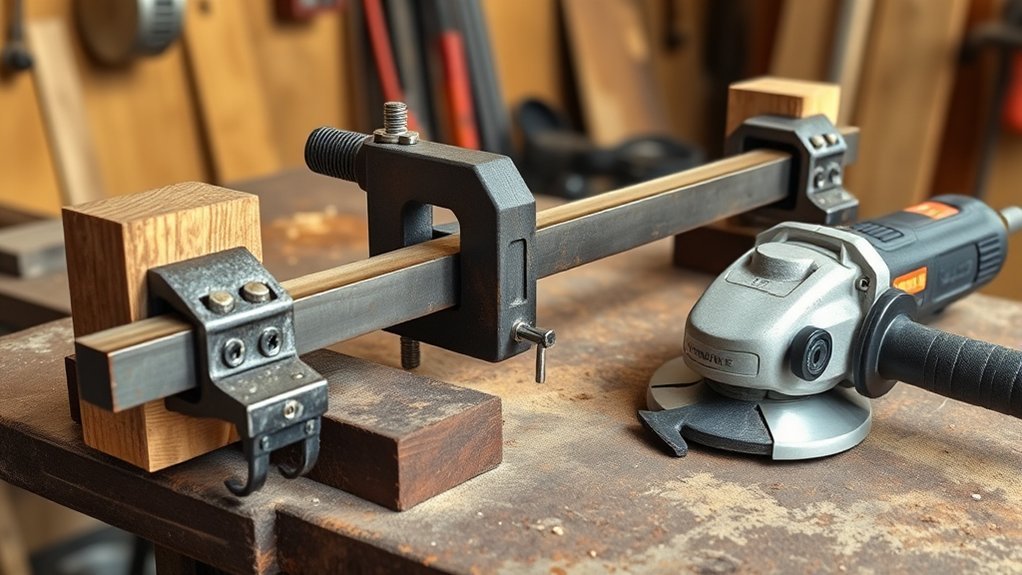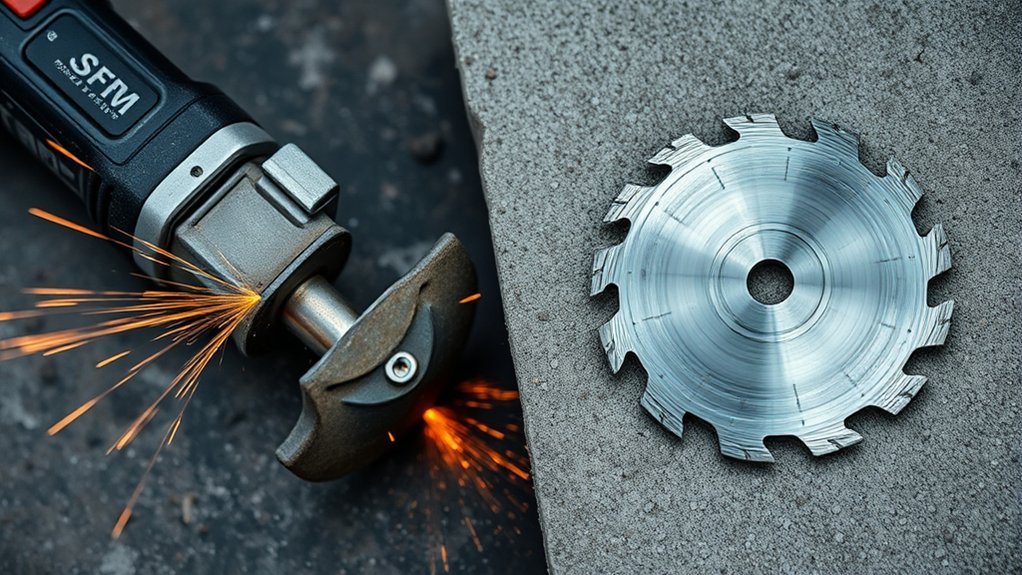
Cutoff wheels and diamond blades can fit many of the same cutting tools, but they are not interchangeable. The safest choice depends on the accessory’s material rating, size, arbor or mount, maximum speed, guard requirements, and wet or dry approval. Bonded abrasive cutoff wheels are usually best for metal separation cuts, while diamond blades are usually best for concrete, brick, stone, pavers, and tile.
Quick Answer
Choose a bonded abrasive cutoff wheel rated for the metal when cutting pipe, bolts, rod, or sheet. Choose a diamond blade rated for concrete, brick, stone, pavers, or tile. Exceptions exist, so follow the accessory label—not appearance alone—and match its diameter, arbor, maximum RPM, guard, and wet or dry rating to the tool.
Key Takeaways
- Use a metal-rated bonded abrasive cutoff wheel for most fast steel, stainless steel, pipe, bolt, rod, and sheet-metal cuts.
- Use a material-rated diamond blade for most concrete, brick, block, stone, paver, and tile cuts.
- A cutoff wheel is not automatically a metal wheel. Masonry-rated abrasive cutoff wheels also exist.
- A standard masonry diamond blade is not automatically safe or effective on metal. Use it on metal only when the label specifically allows that material.
- Match the diameter, arbor or attachment system, maximum RPM, flanges, guard, rotation direction, and wet or dry rating before mounting an accessory.
- Control silica dust with compatible water delivery or dust extraction instead of relying on a dust mask alone.
Warning: Never mount an accessory because it merely fits the spindle. The wheel or blade must be approved for the tool, material, speed, guard, flanges, and cutting method. Follow both the tool manual and the accessory label.
Cutoff Wheel vs Diamond Blade: Main Differences
In this comparison, “cutoff wheel” means a thin bonded abrasive wheel. Its abrasive grains are held together in a resin-based bond, often with reinforcement. The wheel slowly becomes smaller as the abrasive and bond wear away.
A diamond blade normally has a steel core with a rim or separate segments that contain industrial diamond particles. The metal core keeps its diameter more consistently, while the diamond-bearing edge wears as it cuts.
| Feature | Bonded Abrasive Cutoff Wheel | Diamond Blade |
|---|---|---|
| Usual best use | Fast separation cuts in metal when the wheel is metal-rated | Concrete, brick, block, stone, pavers, and tile when material-rated |
| Cutting action | Bonded abrasive grains fracture and expose new cutting edges | Diamond particles abrade the material along the rim or segments |
| Diameter during use | Becomes smaller as the entire wheel wears | Steel core keeps a more consistent diameter |
| Typical debris | Sparks, hot metal particles, abrasive fragments, and dust | Mineral dust and slurry; sparks may occur with metal-rated products |
| Finish | Good for metal separation cuts but may leave burrs | Can produce clean masonry or tile edges with the correct rim |
| Upfront cost | Usually lower | Usually higher |
| Main limitation | Shorter life, diameter loss, and sensitivity to twisting or side pressure | Performance depends heavily on the bond, rim, cooling method, and exact material |
| Exceptions | Masonry-rated abrasive cutoff wheels are available | Specialty diamond blades may be rated for metal or mixed materials |
What Are Cutoff Wheels and How Do They Work?
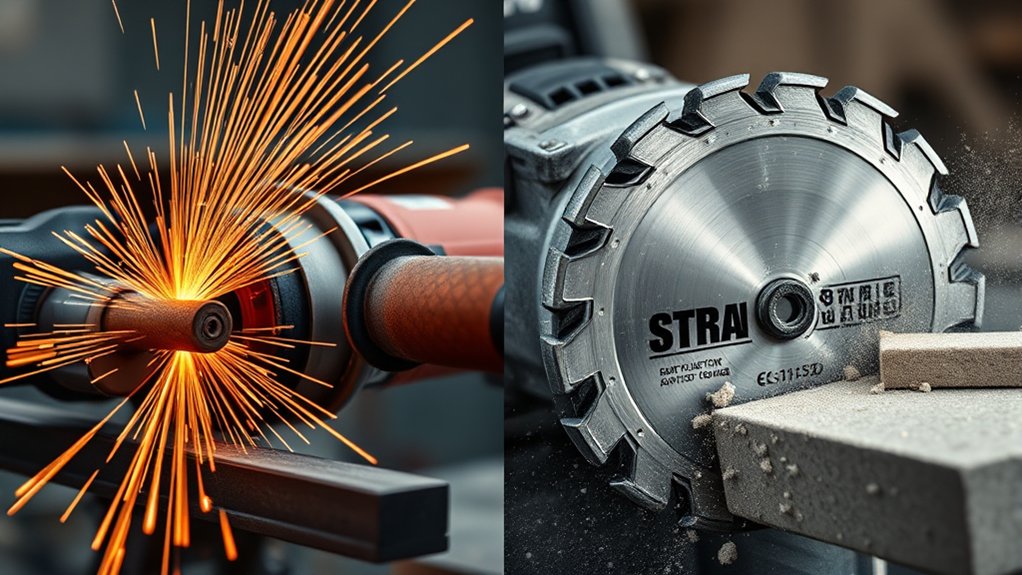
Cutoff wheels are thin circular discs that remove material by abrasion. As the wheel spins, exposed grains cut into the workpiece. Worn grains and bond material break away, revealing fresh abrasive underneath.
You can use cutoff wheels with compatible angle grinders, die grinders, chop saws, stationary cutoff machines, and other tools designed for them. Common angle-grinder diameters include 4-1/2, 5, 6, 7, and 9 inches, but the tool manual controls the permitted size.
Metal-cutting wheels commonly use aluminum oxide, zirconia alumina, ceramic alumina, or a blend selected for the target metal. Wheels for aluminum and other nonferrous metals need a formulation designed to resist loading. Stainless steel should be cut with a wheel whose label specifically lists stainless steel and any applicable contaminant limits.
Straight and Depressed-Center Cutoff Wheels
Straight cutting wheels are commonly marked Type 1, Type 01, or Type 41. Depressed-center cutting wheels may be marked Type 42 or with paired terminology such as Type 27/42, depending on the manufacturer and labeling system.
Do not assume every Type 27 accessory is a cutting wheel. Many Type 27 products are thicker grinding wheels. Read the full description and pictograms to confirm whether an accessory is for cutting only, grinding only, or approved combination use.
Warning: Do not grind, deburr, or press sideways with a cutting-only wheel. Norton explains that side grinding can damage the wheel’s reinforcement and contribute to breakage. Use only the outer cutting edge unless the accessory is specifically marked for combined cutting and grinding. See Norton’s cutting-versus-grinding safety guidance.
What You Need to Know About Diamond Blades
Diamond blades use industrial diamond particles in a bonded cutting rim or in separate segments attached to a steel core. The diamonds scratch and grind through hard materials while the surrounding bond wears and exposes new particles.
The correct diamond blade depends on more than diameter. Check the approved material, rim type, segment design, arbor or mount, maximum RPM, rotation arrow, cut depth, and whether the product is approved for wet cutting, dry cutting, or both.
Types of Diamond Blades
Manufacturers offer several rim styles because cutting speed, cooling, debris removal, and edge quality place different demands on the blade.
- Segmented rim: Open spaces between the segments improve cooling and debris removal. These blades commonly make fast cuts in concrete, brick, block, stone, and pavers.
- Turbo rim: A ridged or grooved rim provides more continuous contact than a segmented blade while still moving air and debris. It often balances speed with a smoother edge.
- Continuous rim: A nearly unbroken cutting edge helps reduce chipping on ceramic, porcelain, stone, and other finish materials when the blade is rated for them.
- Specialty blade: The bond and segment design may target asphalt, green concrete, reinforced concrete, hard aggregate, glass, metal, or another specific material.
Bosch’s current diamond-blade range, for example, separates continuous-rim products for cleaner tile cutting, turbo-rim products for smooth masonry cutting, and segmented products for fast concrete and masonry work. Review the Bosch diamond cutting blade categories for examples of material- and rim-specific labeling.
Applications for Diamond Blades
Diamond blades work well on hard, gritty, or brittle materials when the blade bond and rim match the job. Typical applications include concrete, cured concrete, brick, mortar, masonry block, pavers, ceramic tile, porcelain tile, and natural or engineered stone.
A blade that cuts soft, abrasive block efficiently may wear too quickly in that material if it has the wrong bond. A blade intended for abrasive asphalt may use a different segment design than one intended for hard cured concrete. Choose by the exact material printed on the label.
Advantages of Diamond Blades
A properly matched diamond blade can outlast a bonded abrasive masonry wheel and maintain a more consistent cutting depth. It can also cut faster and produce a cleaner edge when its rim style matches the finish requirement.
Continuous-rim blades can reduce chipping on tile, while segmented blades allow faster debris removal in concrete and brick. Turbo rims sit between those approaches and often provide a useful mix of speed and edge quality.
Wet cutting can suppress dust and cool the cutting zone when both the blade and tool are designed for water. Never add water to a standard angle grinder or another electrical tool that is not specifically approved for wet operation.
How to Choose the Right Wheel or Blade
Use the following checks in order. A failure at any step means the accessory should not be mounted.
- Identify the exact material. Distinguish carbon steel from stainless steel or aluminum, and distinguish concrete from asphalt, porcelain, brick, or stone.
- Read the approved-material list. Do not rely on the accessory’s color, shape, marketing name, or exposed diamond edge.
- Match the diameter and mount. Confirm the wheel diameter, arbor hole, threaded hub, X-LOCK interface, bushing, or other mounting system allowed by the tool.
- Check maximum speed. The accessory’s maximum RPM must be equal to or higher than the tool’s no-load spindle speed.
- Use the required guard and flanges. The guard, backing flange, lock nut, and any blotters or adapters must be approved for the accessory and operation.
- Confirm the cutting method. Check dry or wet approval, rotation direction, maximum cut depth, dust-control requirements, and whether the blade can cut embedded metal such as rebar.
OSHA’s portable-tool standard requires checking that the tool’s spindle speed does not exceed the maximum operating speed marked on an abrasive wheel. It also addresses inspection, mounting clearances, flanges, and guarding. See OSHA 29 CFR 1910.243.
Pro Tip: Photograph the accessory label before mounting it. The photo preserves the maximum RPM, material rating, rotation arrow, and wet or dry instructions after dust and wear make the printing harder to read.
Products Worth Considering


CLEAN PRECISION CUTS: Flat Type 1 design and aluminum oxide abrasive deliver burr-free, precise cuts for pipes, tubes, sheet metal, and rebar while minimizing vibration for smoother operator handling

THIN-PROFILE PRECISION: Designed for clean, accurate cuts on metal, steel, stainless steel, aluminum, pipes, tubes, and flat sheets with a 6" diameter, 0.045" thin kerf and 7/8" arbor for minimal material loss. Built for craftsmen and DIY enthusiasts
Best Choice by Material
| Material | Usual Choice | Important Check |
|---|---|---|
| Carbon steel | Metal-rated bonded abrasive cutoff wheel | Confirm steel rating, thickness, RPM, and cutting guard |
| Stainless steel | Stainless-rated bonded abrasive cutoff wheel | Use a wheel labeled for stainless to reduce contamination and poor cutting |
| Aluminum | Nonferrous-metal cutoff wheel or another manufacturer-approved accessory | Avoid a wheel that loads with soft metal; never improvise lubricants near sparks |
| Concrete and block | Segmented or turbo diamond blade | Confirm concrete rating and silica-dust controls |
| Brick and pavers | Segmented or turbo diamond blade | Choose the rim based on speed and visible-edge quality |
| Ceramic or porcelain tile | Continuous-rim or fine turbo diamond blade | Confirm the blade lists the exact tile and the selected wet or dry method |
| Natural stone | Stone-rated diamond blade | Match the blade to granite, marble, slate, or the specific stone |
| Asphalt | Asphalt-rated diamond blade | General concrete blades may wear quickly in highly abrasive asphalt |
| Reinforced concrete | Diamond blade specifically rated for concrete with rebar | Do not assume every masonry blade can safely cross embedded steel |
Top Uses for Cutoff Wheels
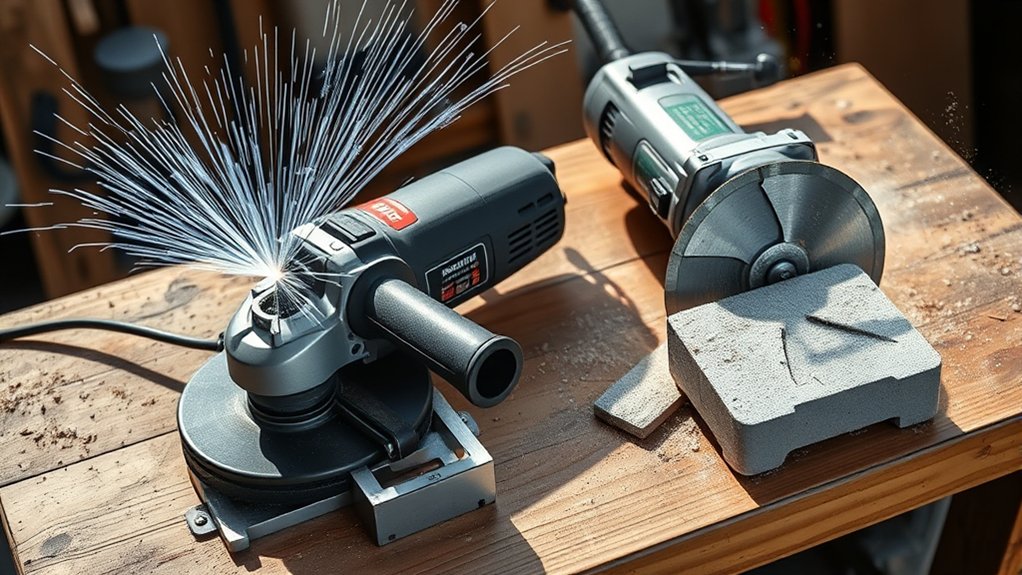
Metal-rated cutoff wheels are useful when you need a fast separation cut rather than broad stock removal or surface grinding.
Common uses include:
- Cutting steel pipe and tubing
- Trimming bolts, screws, and threaded rod
- Cutting sheet metal and flat stock
- Removing rusted fasteners or brackets
- Separating weldments during repair or fabrication
- Making narrow slots when the wheel and tool are approved for the task
A thinner wheel usually makes a narrower kerf and removes less material, but it is also less tolerant of twisting. Keep the wheel aligned with the cut and use light, steady feed pressure. Do not lever the tool sideways to widen the slot.
Clamp the workpiece so it cannot roll, shift, or vibrate. Support both sides of the cut while arranging the supports so the kerf stays open. The offcut should be able to move away from the wheel rather than drop inward and pinch it.
Note: Cutting wheels and grinding wheels may look similar from a distance. A thick grinding wheel is not a substitute for a thin cutoff wheel, and a cutting-only wheel is not a substitute for a grinding wheel.
Best Uses for Diamond Blades in Masonry
Diamond blades suit masonry work because a properly selected diamond rim can cut dense mineral materials efficiently while maintaining a more consistent diameter than a bonded abrasive wheel.
Common Masonry Applications
- Tile cutting: Use a tile-rated continuous or fine turbo rim to reduce edge chipping.
- Concrete cutting: Use a concrete-rated segmented or turbo blade that matches the aggregate and cut method.
- Brick and block: Use a masonry-rated blade with effective debris clearance.
- Paving stones: Choose a blade that balances cutting speed with the finish needed on visible edges.
- Stone work: Match the blade to the exact stone because granite, marble, slate, and engineered stone can cut differently.
- Reinforced concrete: Use only a blade whose label permits concrete containing rebar.
Recommended Blade Types
Choose a segmented rim when fast cutting and cooling are more important than a polished edge. Choose a continuous rim when minimizing tile or stone chipping is the priority. A turbo rim can provide a middle ground for masonry and stone.
A blade can still be a poor match even when it technically cuts the material. Warning signs include rapid segment loss, excessive glazing, slow progress, wandering, heavy chipping, unusual vibration, overheating, or a need for excessive feed pressure.
Pro Tip: Let a diamond blade reach full speed before entering the material, then maintain a straight cut and moderate feed. Forcing the blade can increase heat and deflection without producing a faster, cleaner cut.
Can Cutoff Wheels Cut Masonry or Diamond Blades Cut Metal?
Yes, but only when the accessory is specifically rated for the material.
A masonry abrasive cutoff wheel can be approved for concrete, brick, block, or stone. It is not the same product as a metal-rated cutoff wheel. Compared with a suitable diamond blade, it may wear down faster and lose cutting depth as its diameter becomes smaller.
A metal-rated diamond blade may be approved for steel, mixed construction materials, or rescue and demolition work. A standard masonry diamond blade should not be treated as a universal metal blade. Its bond, segments, attachment method, and cooling characteristics may not be designed for prolonged metal cutting.
The safest rule is simple: if the material is not listed on the wheel or blade, do not use that accessory on it.
How Cost and Service Life Compare
Bonded abrasive cutoff wheels usually cost less per wheel, which makes them practical for occasional metal cutting and jobs that consume only a small number of accessories. Their diameter shrinks during use, so cutting depth and wheel speed at the contact point change as the wheel wears.
Diamond blades usually cost more upfront, but a properly matched blade can make many masonry cuts while keeping a more consistent diameter. For repeated concrete, brick, paver, or tile work, this can lower accessory changes and improve cost per cut.
The lowest shelf price is not always the lowest cutting cost. Compare useful life, cutting speed, finish quality, accessory changes, and material loss.
Before buying, consider:
- How many cuts the project requires
- The material thickness and hardness
- The cut depth available from the blade diameter
- Whether visible edges need a clean finish
- Whether the job requires wet cutting or dust extraction
- The cost of changing accessories and stopping work
- The manufacturer’s storage and inspection instructions
Discard any wheel or blade with cracks, warping, impact damage, loose or missing segments, damaged mounting surfaces, or another defect identified by the manufacturer.
Safety Considerations for Cutoff Wheels and Diamond Blades
Cutting accessories operate at high speed and can cause severe injuries if they break, bind, kick back, or throw debris. OSHA requires appropriate guarding for abrasive-wheel machinery and addresses mounting, inspection, and guard coverage in 29 CFR 1910.215.
Warning: Disconnect corded tools or remove the battery before mounting, adjusting, or inspecting an accessory. Never remove a guard to gain cutting depth, and never use a larger wheel than the tool permits.
Before Mounting the Accessory
- Read the tool manual and accessory label.
- Inspect the wheel or blade for cracks, chips, warping, impact damage, missing segments, or a damaged arbor.
- Confirm that the accessory diameter is allowed by the tool and guard.
- Confirm that the arbor, threaded hub, or locking interface matches without force.
- Verify that the accessory’s maximum RPM is at least as high as the tool’s no-load speed.
- Install the correct flanges, lock nut, guard, and side handle.
- Follow the rotation arrow on directional diamond blades.
- Remove adjustment tools and wrenches before starting.
Controlling Binding and Kickback
Secure the workpiece before cutting. Pipes, bars, and other round pieces must not roll. Support the material so the cut stays open and the offcut does not fall inward against the accessory.
Use two hands when the tool is designed for two-handed control. Keep your body out of the accessory’s plane, allow the tool to reach full speed, and begin with light contact. Maintain a straight cutting path without twisting the wheel or blade.
Stop immediately if the tool vibrates, the motor repeatedly stalls, the accessory wanders, the cut closes, or the wheel begins to bind. Disconnect the power before correcting the setup.
Controlling Sparks and Fire
Metal cutting can throw hot sparks and particles far beyond the immediate work area. Remove fuel, solvents, sawdust, cardboard, dry vegetation, aerosols, batteries, and other combustibles. Use screens when needed to protect nearby people and finished surfaces.
Check the area behind walls, floors, panels, or vehicle parts before cutting. Sparks can enter hidden cavities and start a fire after the work appears finished.
Controlling Silica Dust
Cutting concrete, brick, block, mortar, stone, and some tile can release respirable crystalline silica. Use the dust-control method required for the tool and task, such as integrated water delivery or a compatible shroud connected to an appropriate dust extractor.
OSHA’s construction silica standard lists water-delivery and dust-collection controls for several saw and grinder tasks. Review OSHA 29 CFR 1926.1153. NIOSH also identifies water sprays and HEPA-filtered ventilation as ways to suppress or capture silica-containing dust in its silica safe-work-practices guidance.
Do not dry sweep or blow settled silica-containing dust with compressed air when that can create another airborne dust cloud. Use wet cleanup or an appropriate HEPA-filtered vacuum.
Wet Cutting and Electrical Safety
Use water only with a blade and tool specifically designed for wet cutting. Follow the manufacturer’s water-flow instructions, keep electrical connections protected, and use required ground-fault protection.
Do not spray water onto a standard dry angle grinder. A blade marked for wet use does not make a dry-only power tool safe around water.
Personal Protective Equipment
Wear safety glasses with side protection and a face shield where flying fragments or sparks are possible. Also use suitable hearing protection, work gloves, protective footwear, and close-fitting clothing that will not ignite easily or become caught by the tool.
Respiratory protection may also be required, but it does not replace source controls. Workplace respirator use must follow the applicable exposure assessment, respirator-selection, medical-evaluation, fit-testing, and training requirements.
| Safety Check | What to Do |
|---|---|
| Accessory condition | Reject cracks, chips, warping, impact damage, missing segments, or damaged mounting surfaces. |
| Material rating | Confirm that the exact metal, masonry, tile, stone, or mixed material appears on the label. |
| Tool speed | Use only an accessory rated for at least the tool’s maximum no-load RPM. |
| Guard and flanges | Use the guard, flanges, nut, and mounting system specified for cutting with that accessory. |
| Workpiece support | Clamp the work and arrange supports so the kerf remains open and the offcut cannot pinch the accessory. |
| Cutting technique | Use two hands, light feed pressure, and a straight path without side loading. |
| Dust and sparks | Use compatible dust controls and remove combustible materials from the spark path. |
| Wet cutting | Use water only when both the blade and power tool are approved for wet operation. |
Note: OSHA requirements cited here apply to covered workplaces. Home users should still follow the same core principles and all instructions supplied by the tool and accessory manufacturers.
Cutoff Wheels vs Diamond Blades: Which One Should You Choose?
Choose a bonded abrasive cutoff wheel when you need a fast metal separation cut and the wheel label lists the exact metal. This is the usual choice for steel pipe, bolts, rod, brackets, sheet, and fabrication work.
Choose a diamond blade when you need to cut concrete, brick, block, pavers, stone, or tile and the blade label lists that material. Select the rim style according to the balance you need between cutting speed, cooling, debris removal, and edge quality.
Do not treat the categories as absolute. Masonry abrasive cutoff wheels and metal-rated diamond blades exist. The accessory label, tool manual, guard configuration, speed rating, and cutting method always take priority over a general comparison.
Products Worth Considering

Premium and Value: This 10-pack 4-1/2 x 7/8-inch metal/stainless steel cut-off wheel set is specially formulated for fast cutting in metals and stainless steel

[High-Performance Cutting] Designed for cutting metal & stainless steel, these cut off wheels 4 1/2 inch work efficiently with any angle grinder wheel, supporting speeds up to 13,300 RPM.

Frequently Asked Questions
What is the difference between masonry and metal cut-off wheels?
They use abrasive grains and bonds selected for different materials. A metal wheel may target steel, stainless steel, or nonferrous metal, while a masonry wheel may target concrete, brick, block, or stone. Use only the materials printed on the wheel label.
Is a diamond blade the same as a masonry blade?
Not always. A diamond blade is one type of blade commonly used for masonry. A bonded abrasive masonry wheel can also cut masonry, but it has a different construction and normally loses diameter faster during use.
What are the different types of cutting blades?
Common types include bonded abrasive cutoff wheels, segmented diamond blades, turbo diamond blades, continuous-rim diamond blades, carbide-tipped saw blades, carbide-grit accessories, and specialty blades for particular metals, wood products, plastics, tile, stone, asphalt, or concrete.
Can you use a metal cut-off wheel on concrete?
No. Do not use a metal-rated wheel on concrete unless its label also specifically approves concrete. Use a concrete-rated diamond blade or a bonded abrasive masonry cutoff wheel that matches the tool and cutting method.
Can you use a diamond blade to cut metal?
Only when the diamond blade is specifically labeled for that metal or for mixed-material cutting. A standard masonry diamond blade should not be treated as a general-purpose steel blade.
Should you use water with a diamond blade?
Use water only when both the blade and power tool are approved for wet cutting. Water can suppress dust and cool the cutting zone, but using it with a dry-only electrical tool can create a serious shock hazard.
Can you grind with a cutoff wheel?
Do not grind with a cutting-only wheel. Side pressure can damage its reinforcement and cause breakage. Use a grinding wheel or an accessory specifically marked for combined cutting and grinding.
How do you know whether a wheel fits your grinder?
Check the tool manual and accessory label for diameter, arbor or mount, maximum RPM, guard type, flanges, rotation direction, and permitted cutting method. Physical fit alone does not prove compatibility.
Conclusion
The best accessory is the one rated for the exact material, tool, and cutting method. A metal-rated bonded abrasive cutoff wheel is normally the practical choice for fast cuts through steel, pipe, rod, bolts, and sheet. A material-rated diamond blade is normally the better choice for concrete, brick, tile, stone, block, and pavers.
Check the label before every cut. Confirm the diameter, mount, maximum RPM, guard, flanges, rotation direction, cut depth, and wet or dry approval. Secure the work so the kerf cannot pinch the accessory, control sparks and silica dust, and stop immediately if the tool vibrates, binds, or becomes unstable.
Sources
- OSHA 29 CFR 1910.215: Abrasive Wheel Machinery — guarding, mounting, flanges, and abrasive-wheel machinery requirements.
- OSHA 29 CFR 1910.243: Guarding of Portable Powered Tools — portable-tool guarding, wheel inspection, spindle speed, and mounting requirements.
- OSHA 29 CFR 1926.1153: Respirable Crystalline Silica — water-delivery, dust-extraction, respiratory-protection, and cleanup controls for construction work.
- NIOSH Safe Work Practices for Silica — water sprays, ventilation, HEPA filtration, and engineering controls.
- Norton Abrasives: Safety—Cutting vs. Grinding — why cutting-only wheels must not be used for side grinding.
- Bosch Diamond Cutting Blades — examples of continuous, turbo, segmented, wet or dry, and material-specific blade categories.