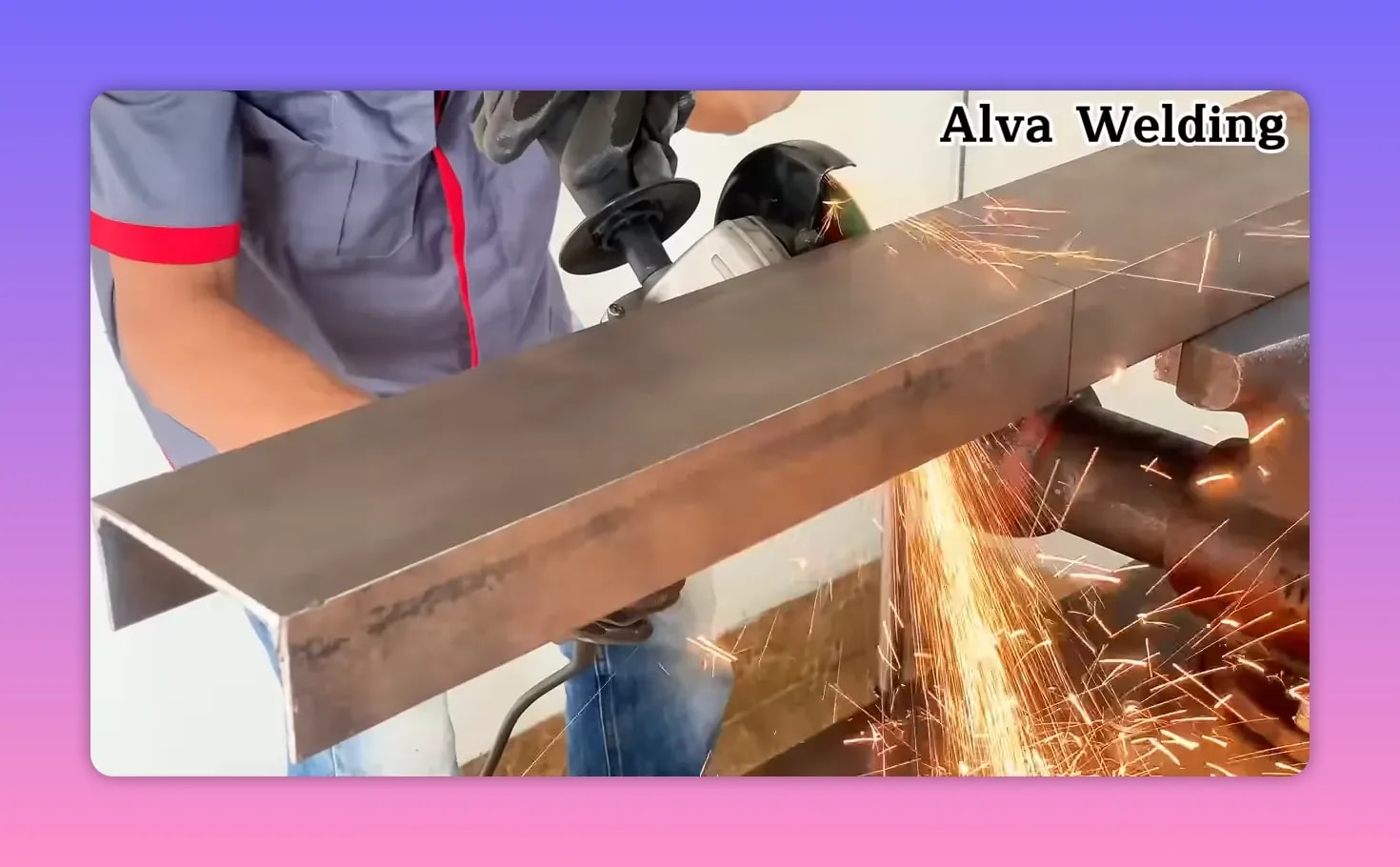
Converting a standard angle grinder into a circular saw may look simple, but attaching a toothed blade, homemade shoe, or aftermarket adapter can create severe kickback and blade-contact hazards. The safe answer depends on the official instructions for your exact grinder model—not on whether a blade or bracket can be made to fit.
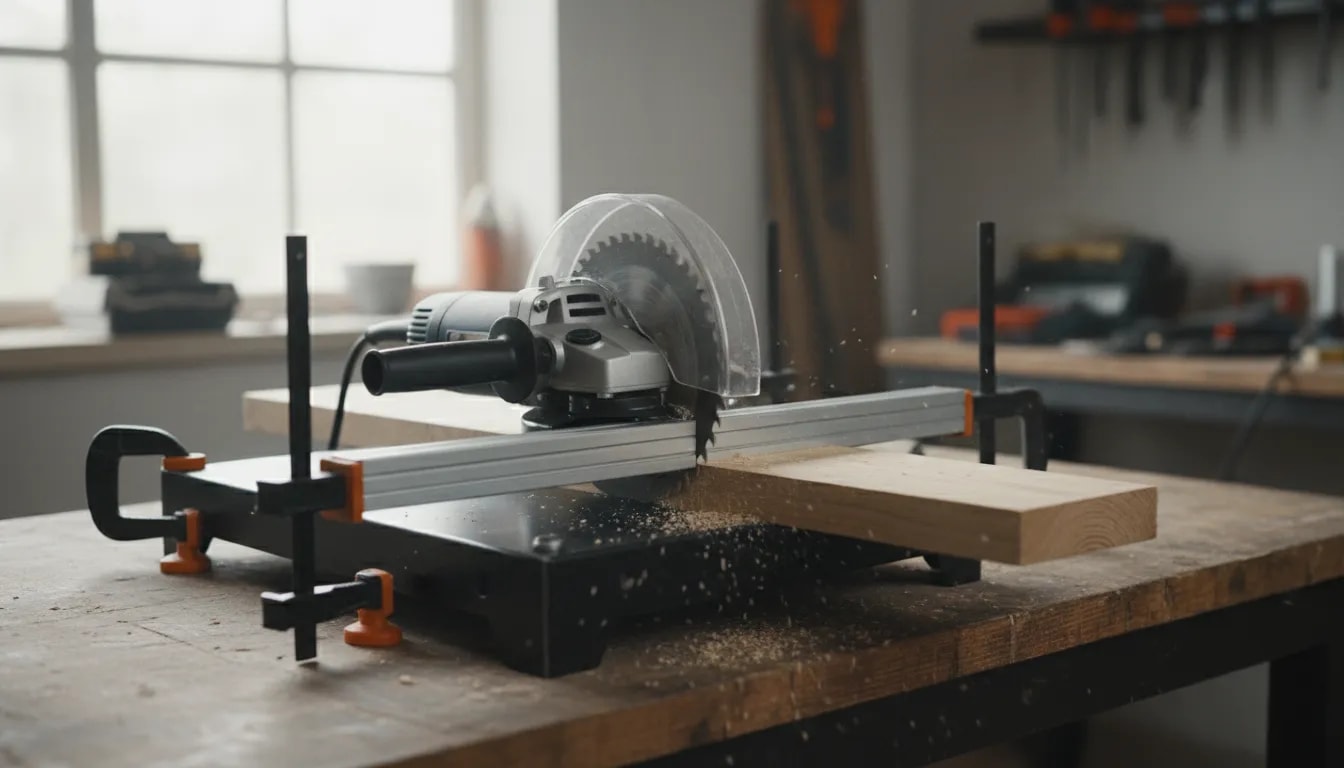
Major angle-grinder manuals commonly prohibit toothed saw blades and wood cutting. Unless the manufacturer explicitly approves a complete saw attachment for your exact grinder, use a purpose-built circular saw, track saw, jigsaw, reciprocating saw, or other tool designed for the material.
Quick Answer
Do not convert a standard angle grinder into a circular saw unless the tool manufacturer explicitly approves a complete attachment for your exact model. Major grinder manuals prohibit toothed saw blades and wood cutting. A homemade shoe or guard does not reproduce a circular saw’s automatic lower guard, blade control, and tested spindle system.
Key Takeaways
- A blade fitting the spindle does not mean it is approved or safe.
- Check the official manual for the exact grinder model before fitting any accessory.
- RPM compatibility is necessary for an approved accessory, but it is not enough by itself.
- A homemade fixed guard cannot replace a circular saw’s upper and automatically returning lower guards.
- Use a purpose-built saw for wood and reserve the grinder for manufacturer-approved grinding, sanding, brushing, and abrasive cutting work.
At a Glance
| Time Required | About 10–20 minutes to identify the model, read its official manual, and select a safe tool |
| Difficulty | Basic safety decision; do not fabricate a grinder-to-saw conversion |
| Tools Needed | Exact grinder model number, official manufacturer manual, and a purpose-built saw for wood cutting |
| Cost | No cost to verify the manual; tool cost varies with the material and type of cut |
What’s in This Article
- What converting an angle grinder into a circular saw means
- Is an angle-grinder circular-saw conversion feasible?
- Safety rules that decide whether an accessory can be used
- What to check instead of fabricating conversion parts
- Safety systems a purpose-built circular saw provides
- Before you begin
- Step-by-step safe decision workflow
- Safe setup for cutting wood
- Common mistakes to avoid
- Maintenance and inspection
- When not to use a conversion
- Frequently asked questions
- Final key takeaways
- Sources
What It Means to Convert an Angle Grinder Into a Circular Saw
A portable circular saw is designed as a complete cutting system. Its motor, spindle, blade flanges, shoe, handles, switch, upper guard, retracting lower guard, and depth adjustment are designed to work together.
An angle grinder has a different intended use, operating position, guard system, spindle arrangement, and accessory range. Mounting a toothed blade and adding a metal plate does not change the grinder into a tested circular saw.
The official manual for the exact grinder model is the controlling document. For example, the DEWALT DCG410 instruction manual states that the tool must not be used for wood cutting or woodcarving, must not use toothed blades, and must not be converted for an operation not specified by the manufacturer.
A saw blade may physically fit an abrasive-wheel tool, but that does not assure safe operation.
Is an Angle-Grinder Circular-Saw Conversion Feasible?
Do not treat this as a general DIY conversion. It is acceptable only when the grinder manufacturer expressly lists a complete cutting attachment as approved for the exact model and provides instructions for its blade or wheel, guard, flanges, diameter, speed, and intended material.
A marketplace listing, social-media demonstration, homemade bracket, or matching spindle thread is not manufacturer approval. If the official manual prohibits saw blades or does not list the proposed attachment, stop and use a purpose-built tool.
Warning: Do not install a toothed wood blade, chainsaw-style wheel, universal saw adapter, oversized wheel, homemade flange, or fabricated blade mount on a standard angle grinder unless the grinder manufacturer explicitly approves the complete system for that exact model.
The OSHA guidance on portable and hand-held power tools warns that substituting saw blades for manufacturer-intended grinder accessories can lead to loss of control, lacerations, and amputations.
Safety First: The Non-Negotiables
The exact manufacturer manual governs the tool
- Find the complete model number on the grinder’s rating label.
- Download the manual from the manufacturer’s official support site.
- Read the intended-use, accessory, guard, flange, and prohibited-operation sections.
- Use only accessories expressly designed or recommended for that exact tool.
- Do not rely on a seller’s claim that an adapter is “universal.”
Do not use toothed saw blades unless specifically approved
The reviewed Makita XAG25 grinder manual says not to attach a saw-chain woodcarving blade or toothed saw blade because these accessories create frequent kickback and loss of control.
A toothed blade can catch the work instead of wearing through it like an abrasive wheel. A grinder’s speed, handle position, guard, and switch may leave the user unable to resist the resulting movement.
RPM compatibility is necessary but not sufficient
- An approved accessory’s rated speed must be at least equal to the grinder’s maximum marked speed.
- Its diameter and thickness must be within the tool’s stated capacity.
- Its arbor or threaded mounting must match the approved mounting hardware.
- The correct manufacturer-specified guard and flanges must be installed.
- The intended material and operation must be listed in the manual.
Note: Lowering the grinder speed does not change its intended use, create an automatic lower guard, correct the flange geometry, or make an unapproved toothed blade safe.
A homemade guard is not a circular-saw guard system
Under OSHA 29 CFR 1910.243, portable circular saws with blades over two inches require guarding above and below the shoe. The lower guard must automatically and immediately return to cover the blade when the saw is removed from the work.
A fixed sheet-metal cover over part of a grinder-mounted blade does not provide the same function. It may leave the lower blade exposed before and after the cut, interfere with the work, loosen under vibration, or direct the tool toward the operator during a bind.
Use normal grinder precautions only for approved operations
- Keep the original approved guard installed and positioned between you and the accessory.
- Use the auxiliary handle and hold the tool with both hands.
- Inspect the tool, guard, flanges, cord or battery, and accessory before use.
- Keep flammable material and combustible dust away from sparks.
- Wear safety glasses and any additional face, hearing, and respiratory protection required by the manual and the material.
- Disconnect the plug or remove the battery before adjusting or changing an accessory.
What to Check Instead of Fabricating Conversion Parts
The safest checklist starts with documents and approved equipment rather than steel plate, brackets, or homemade blade adapters.
Core items to verify
- Exact grinder model number: Similar-looking grinders can have different approved accessories and guards.
- Official instruction manual: Use the current manual from the manufacturer, not a copied marketplace description.
- Approved accessory list: Confirm the accessory type, diameter, thickness, arbor, thread, and speed.
- Correct guard and flanges: Use only the components listed for that accessory and model.
- Purpose-built saw: Use a circular saw, track saw, jigsaw, or reciprocating saw when cutting wood.
Fabrication parts that should not be used to create a saw
- Homemade blade flanges, reducing rings, or spindle adapters
- Welded grinder-housing brackets that bypass the original handles or guard mount
- Fixed sheet-metal guards intended to replace an automatic lower guard
- Improvised steel or plywood shoes attached around a toothed blade
- Homemade pivots, springs, stops, or depth-adjustment assemblies
- Fasteners that enter the grinder housing or interfere with ventilation
Measurement does not establish approval
A square, calipers, protractor, straightedge, or tachometer can measure parts, but these tools cannot prove that a homemade system can withstand a blade snag, kickback event, flange load, guard impact, or spindle failure.
Safety Systems a Purpose-Built Circular Saw Provides
A circular saw is more than a motor attached to a rotating blade. Its safety depends on several engineered parts working together.
Products Worth Considering
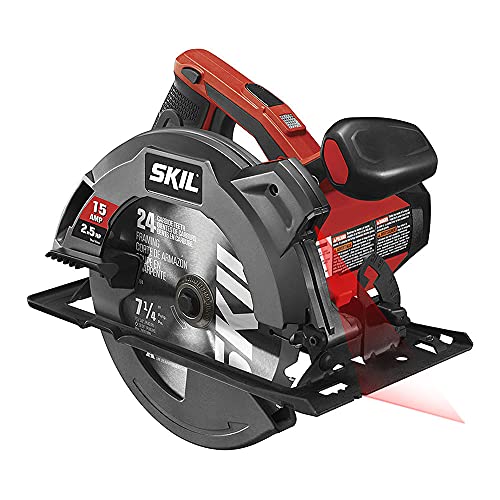
Powerful 15-amp motor delivers 5 300-RPM for greater speed and faster cuts

13 Amp motor for more power and performance than the SKIL 5380

Application:Fast smooth clean cutting and widely used in Miter Saws, Circular Saws, Table Saws, Hand Saws and Chop Saws.
Upper and automatically returning lower guards
The upper guard covers the top of the blade. The lower guard retracts only as the saw enters the work and returns over the exposed teeth when the saw leaves the material.
A stable shoe and tested depth mechanism
The shoe supports the saw on the work, while the depth mechanism locks the cutting depth without placing homemade fasteners near the blade path.
A purpose-designed spindle and flange system
The arbor, inner flange, outer flange, bolt, blade bore, rotation direction, and guard clearances are designed for the listed blade range. A grinder flange intended for abrasive accessories should not be assumed to secure a thin toothed blade.
Handles, switch, and blade path designed for sawing
A circular saw positions the handles and switch so the operator can guide the shoe while staying out of the blade path. Many saws also include electric braking, overload protection, dust ports, guide notches, and other features specific to sawing.
Before You Begin
Estimated time: Allow about 10–20 minutes to identify the exact grinder, obtain its official manual, and decide whether the proposed accessory is expressly approved.
Disconnect the grinder from power before reading labels or inspecting the spindle area. Do not mount the blade or adapter for a “quick test.” Testing an unapproved setup at no load can still expose you to an ejected blade, flange failure, or unexpected startup.
Pro Tip: Search the manufacturer’s official support site using the complete model number from the tool label. Manuals for another grinder in the same product family may list different guards, flanges, speeds, and approved operations.
Step-by-Step Safe Decision Workflow
- Identify the exact grinder. Record the brand, complete model number, wheel capacity, maximum speed, and spindle information from the rating label.
- Obtain the official manual. Download it from the manufacturer’s website and confirm that it matches the full model number and type.
- Read the intended-use section. Look for explicit statements about wood cutting, saw blades, toothed accessories, conversions, and third-party attachments.
- Check the accessory requirements. Verify the approved accessory type, diameter, thickness, rated speed, mounting method, flange set, and guard.
- Require explicit approval. If the manual does not expressly approve the complete attachment for the exact grinder, do not use it.
- Reject partial compatibility. A matching thread, arbor hole, diameter, or RPM does not override an intended-use restriction.
- Select the correct tool. Use a circular saw or track saw for straight wood cuts, a jigsaw for curved cuts, or a reciprocating saw for rough demolition cuts.
- Follow the approved tool’s manual. Install the listed blade, inspect all guards, secure the work, and use the saw only for its stated materials and applications.
Warning: If you already assembled a grinder-to-saw conversion, disconnect the grinder or remove its battery before handling it. Do not power it on to evaluate vibration or alignment. Remove the unapproved blade and adapter according to the grinder’s manual, or ask an authorized service center to inspect the tool.
Safe Setup for Cutting Wood
Use a purpose-built circular saw, track saw, jigsaw, or other woodworking tool. Read its manual before installing a blade or making a cut.
Products Worth Considering
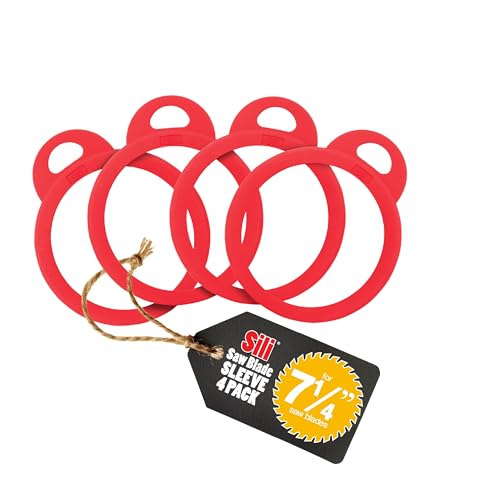
PROTECT YOUR BLADES - Use this silicone saw blade cover to protect edges and carbide teeth from damage during storage, transport, or jobsite handling.

Comprehensive Saw Blade Protection: The soft yet durable silicone saw blade storage wraps around the blade, effectively preventing stacked blades from rubbing against each other or making contact, which avoids chipped teeth, blunting, and surface marring, ensuring the blades remain sharp and extending their lifespan

Saw Blade Storage Cover: This circular saw accessories provides a snug, secure fit that prevents direct contact between the blade and other hard objects. The rim of the miter saw accessories only the teeth, making blade information easy to read while allowing quick access and convenient portability
Blade and guard inspection
- Use a blade approved for the saw, wood type, stock thickness, arbor, and maximum speed.
- Remove cracked, bent, chipped, or otherwise damaged blades from service.
- Confirm that the upper guard is secure.
- Check that the lower guard moves freely and returns completely without help.
- Make sure the blade is installed in the marked rotation direction.
Workpiece support
- Place the work on stable supports that will not be cut by the blade.
- Support large panels so their weight does not close the kerf and pinch the blade.
- Clamp work that could slide, rotate, lift, or fall during the cut.
- Keep the electrical cord, saw track, clamps, and supports outside the blade path.
Cutting technique
- Use both designated handles and keep your hands outside the blade area.
- Keep the shoe flat against the work.
- Do not force, twist, or back the moving blade through the cut.
- Release the trigger if the saw binds and hold it still until the blade stops.
- Wait for the blade to stop and the lower guard to close before setting the saw down.
Note: Wood dust can affect breathing and may create a combustible-dust hazard when it accumulates. Use the saw’s approved dust collection connection where available, maintain ventilation, and keep dust away from sparks and ignition sources.
Common Mistakes to Avoid
- Assuming physical fit means safe fit: Matching threads or arbor dimensions do not establish manufacturer approval.
- Using a toothed blade because its RPM rating is high enough: Speed compatibility does not correct the guard, flange, switch, or intended-use problems.
- Trusting a universal adapter: A seller cannot override the grinder manufacturer’s instructions.
- Fabricating a fixed guard: It does not provide the automatically returning lower protection required on a portable circular saw.
- Adding a speed controller: Lower speed does not convert the grinder into a purpose-designed saw.
- Removing the original guard or auxiliary handle: These parts are required for approved grinder operations.
- Copying an online demonstration without model verification: A video does not show whether the attachment is approved, damaged, or tested.
- Using abrasive grinder wheels to make routine wood cuts: Use a woodworking saw or another tool specifically approved for the material.
- Testing an unapproved setup on scrap: No-load or scrap testing can still lead to ejection, kickback, or blade contact.
Maintenance and Inspection Routine
Maintain the grinder only as a grinder and use approved accessories listed in its manual.
- Disconnect the plug or remove the battery before inspection or accessory changes.
- Check the guard, auxiliary handle, spindle, flanges, switch, vents, cord, and battery interface.
- Remove damaged guards, flanges, accessories, cords, batteries, or tools from service.
- Do not grind, drill, or weld the grinder housing to mount a bracket.
- Keep ventilation openings clear without pushing debris into the motor.
- Have internal damage or abnormal spindle movement checked by an authorized service provider.
- Inspect a purpose-built circular saw’s blade, shoe, guard return, cord or battery, and controls according to its own manual.
When You Should Not Build or Use This Conversion
Do not build, test, lend, sell, or use a grinder-to-circular-saw conversion when any of the following applies:
- The grinder manual prohibits wood cutting, toothed blades, saw blades, or unauthorized conversion.
- The proposed accessory is not expressly listed for the exact grinder model.
- The attachment requires removing or bypassing the original guard or handle.
- It uses a homemade arbor, flange, bushing, reducing ring, spindle extension, or blade bolt.
- It relies on a fixed homemade guard instead of a tested upper and retracting lower guard system.
- The blade diameter, thickness, arbor, or rated speed falls outside the tool specifications.
- The adapter contacts the housing, vents, battery, switch, guard mount, or spindle lock.
- The seller provides no model-specific manufacturer documentation.
- You need repeated, long, precise, plunge, bevel, overhead, or production cuts.
- Any part of the setup feels uncertain.
For wood, choose a circular saw, track saw, jigsaw, reciprocating saw, table saw, or miter saw suited to the cut. For metal, masonry, or tile, use a purpose-built tool or a grinder accessory specifically approved for that material and exact grinder.
Frequently Asked Questions
Can I safely convert an angle grinder into a circular saw?
Not as a general DIY project. Proceed only when the grinder manufacturer explicitly approves a complete saw attachment for your exact model and supplies instructions for the blade or wheel, guard, flanges, speed, and intended material. Otherwise, use a purpose-built saw.
What blade can I use on an angle-grinder circular-saw conversion?
Do not select a blade for a homemade conversion. Use only accessories that the grinder manufacturer lists for the exact model, guard, flange system, diameter, speed, and application. Common grinder manuals prohibit toothed wood-cutting and saw-chain blades.
Is a blade safe if it fits the grinder spindle?
No. Physical fit does not establish correct flange support, balance, diameter, thickness, speed, guarding, handling, or manufacturer approval. An accessory can attach to the tool and still be unsafe.
Is matching the blade’s RPM rating enough?
No. The accessory must meet the speed requirement, but it must also be an approved type and have the correct diameter, thickness, arbor, flanges, guard, mounting method, and intended application for the exact tool.
Will a homemade blade guard make the conversion safe?
No homemade guard can be assumed equivalent to a tested circular-saw system. Portable circular saws use upper and lower guards, and the lower guard must return automatically when the saw leaves the work.
Can a speed controller make a grinder suitable for a wood blade?
No. Reducing speed does not create manufacturer approval, an automatic lower guard, correct blade retention, suitable handle geometry, or a spindle and flange system designed for a toothed saw blade.
Are universal angle-grinder saw conversion kits safe?
Do not rely on the word “universal.” Verify whether the grinder manufacturer—not only the kit seller—approves the complete kit for your exact model. If that documentation is unavailable, do not install or test it.
How do I prevent binding and kickback?
Use a purpose-built saw with the correct blade, functioning guards, stable shoe, and supported workpiece. Position supports so the kerf stays open, clamp movable stock, keep the shoe flat, and stop the approved saw if the blade binds.
Can this conversion cut materials besides wood?
Do not use a homemade conversion for another material. For metal, masonry, or tile, use a tool and accessory specifically approved for that material, tool model, guard, flange system, diameter, and speed.
Is this project beginner-friendly?
No. It should not be treated as an advanced project either. Fabrication experience does not override manufacturer restrictions or supply the tested guarding, blade retention, controls, and handling system of a purpose-built saw.
How can I check that the blade alignment is correct?
Do not use alignment checks to validate a homemade grinder conversion. On a purpose-built saw, follow the manufacturer’s inspection and adjustment procedure and remove the tool from service if the blade, shoe, spindle, or guard appears damaged or misaligned.
Should I use this setup for long or repeated cuts?
No. Use a purpose-built circular saw, track saw, table saw, or panel saw that is designed for the cut, workload, material, and required accuracy.
What should I do if I already built or bought a conversion?
Disconnect the plug or remove the battery and do not test the setup. Check the official grinder manual. If the complete attachment is not expressly approved, remove it without powering the tool or ask an authorized service provider to inspect the grinder.
Safety Disclaimer: This article provides general safety information and does not replace the official manual, workplace training, or advice from the tool manufacturer. Modified power tools and unapproved rotating accessories can cause severe injury. Use only the tool, guard, flanges, accessories, and applications approved for the exact model.
Final Key Takeaways
Key Takeaways
- Do not turn a standard angle grinder into a circular saw with homemade brackets, flanges, guards, or adapters.
- Use the official manual for the exact grinder model as the deciding authority.
- A matching spindle or adequate RPM rating does not prove that a blade is safe.
- Common grinder manuals prohibit toothed saw blades because they can cause kickback and loss of control.
- A purpose-built circular saw provides guarding, controls, blade retention, and cutting geometry that a homemade conversion does not reproduce.
The safe next step is to read the exact grinder manual before buying or mounting any accessory. If the manufacturer does not expressly approve a complete saw attachment for that model, leave the grinder in its intended role and use a purpose-built saw. The correct tool gives you better guarding, cleaner cuts, and far more predictable control.
Sources
- OSHA — Safe Use of Portable and Hand-Held Power Tools — supports manufacturer-instruction, accessory, guard, speed, and saw-blade substitution warnings.
- OSHA 29 CFR 1910.243 — Guarding of Portable Powered Tools — supports upper-guard, lower-guard, automatic-return, grinder-guard, and control requirements.
- DEWALT DCG410 Instruction Manual — prohibits wood cutting, toothed blades, and unauthorized power-tool conversion for the reviewed model.
- Makita XAG25 Instruction Manual — supports toothed-blade, kickback, guard, flange, and work-support warnings.
- Bosch Professional — Angle Grinder Proper-Use Training — supports reading the manual and using the correct guard and mounting procedure.