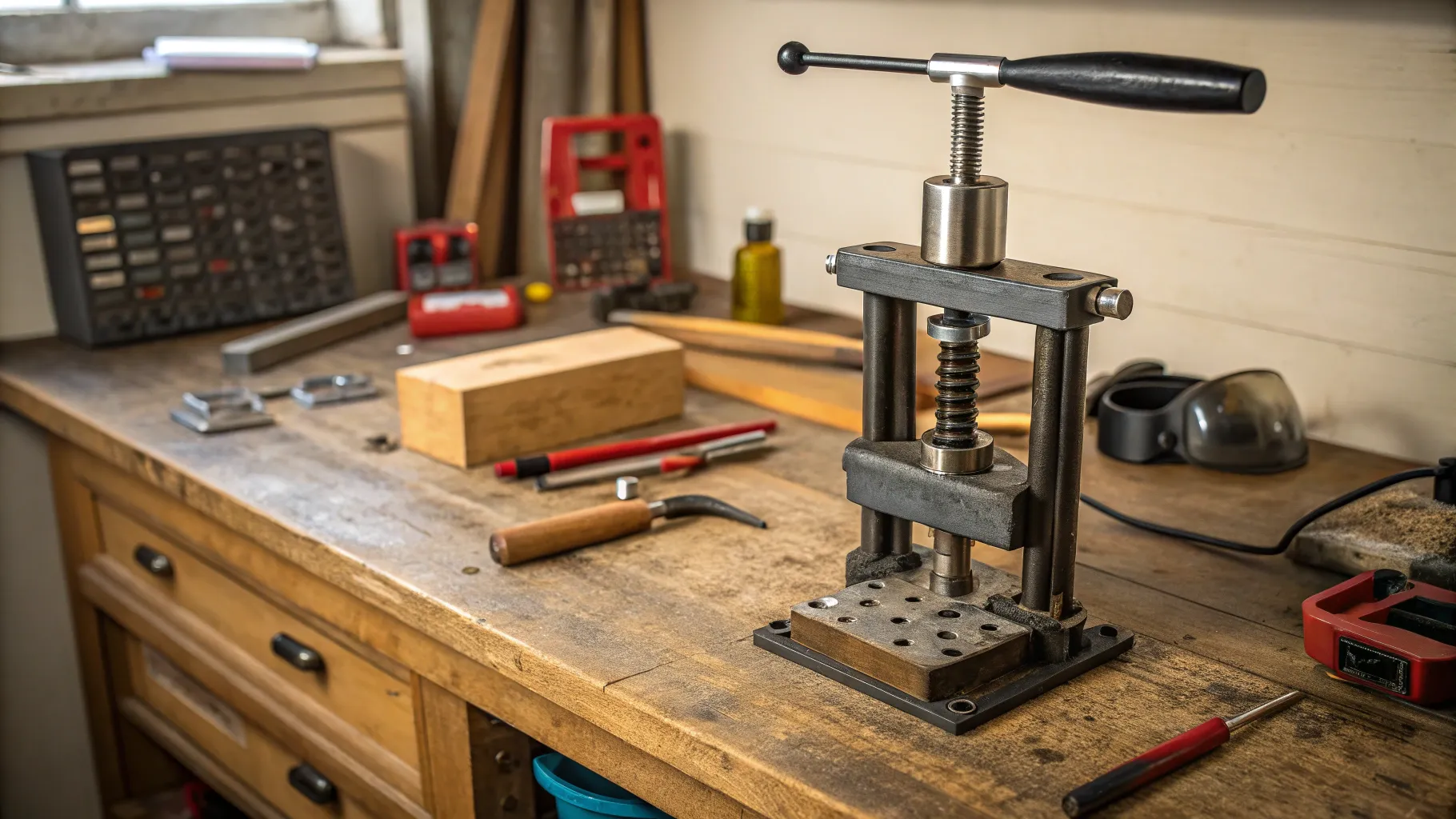
A bottle jack can provide the force for a compact hydraulic press, but the jack is only one part of the machine. The frame, beams, welds, bed, pins, plates, guides, anchors, and dies must all carry that force without bending, cracking, slipping, or throwing the workpiece.
This guide explains how to plan and assemble a mini bottle-jack press for controlled small-shop jobs. It is not a dimensioned engineering drawing. Before cutting steel, have the complete load path and capacity checked by a qualified engineer or experienced structural fabricator who understands press-frame design.
Quick Answer
Build a mini hydraulic press around a verified steel-frame design, keep the bottle jack upright and centered, capture both ends of the jack, and support the work with rated plates and dies. Anchor the press, guard the work zone, use the original jack handle, and test the machine progressively before doing useful work.
Key Takeaways
- The jack label does not establish the safe capacity of the completed press. The lowest-rated frame part, pin, plate, weld, fastener, die, or adapter sets the limit.
- There is no universal tubing, plate, weld, or pin size for a homemade bottle-jack press.
- Keep the jack, moving platen, dies, supports, and workpiece on the designed centerline.
- Use the jack only in an orientation allowed by its manufacturer, normally upright for a standard bottle jack.
- Anchor the frame and install suitable guarding before applying a load.
- Never add a hammer handle, cheater bar, or other improvised extension to the jack handle.
At a Glance
| Time Required | One full shop day or longer after the frame design, materials, welding procedure, guards, and anchors have been approved |
| Difficulty | Advanced fabrication; not a beginner welding project |
| Tools Needed | Welder, metal saw, grinder, drill or drill press, measuring and squaring tools, clamps, approved PPE, anchoring tools, and inspection equipment |
| Cost | Variable. It depends on the verified design, jack, structural steel, machining, pins, rated tooling, guarding, and anchors. A commercially rated shop press may cost less than a properly engineered one-off build. |
Last updated: July 19, 2026
What’s in This Article
- What You Need
- Before You Begin
- Choose a Safe Jack Layout
- Plan the Load Path and Capacity
- Build the Frame
- Design the Press Bed
- Mount the Jack and Moving Plate
- Use the Correct Jack Handle
- Guard and Anchor the Press
- Test the Press Safely
- Jobs the Press Can Handle
- Safety Tips
- Troubleshooting
- Maintenance
- Common Mistakes
- FAQ
- Final Thoughts
- Sources
🛠️ What You Need for a Bottle-Jack Press
Collect the jack and intended tooling before finalizing the frame. The jack dimensions, stroke, base shape, saddle shape, release valve, handle socket, and service points affect the layout.
- Verified press-frame design for the exact jack capacity and working opening
- Hydraulic bottle jack with a readable capacity label and manufacturer’s manual
- Structural steel sections and plates specified by the approved design
- Rated press plates, drifts, sleeves, and dies made for the intended jobs
- Bed-support pins, bolts, nuts, and washers of the specified grade, diameter, and length
- Welding equipment suitable for the steel thickness and joint design
- Metal-cutting tools such as a bandsaw, cold saw, abrasive saw, or plasma cutter
- Grinder, files, and deburring tools
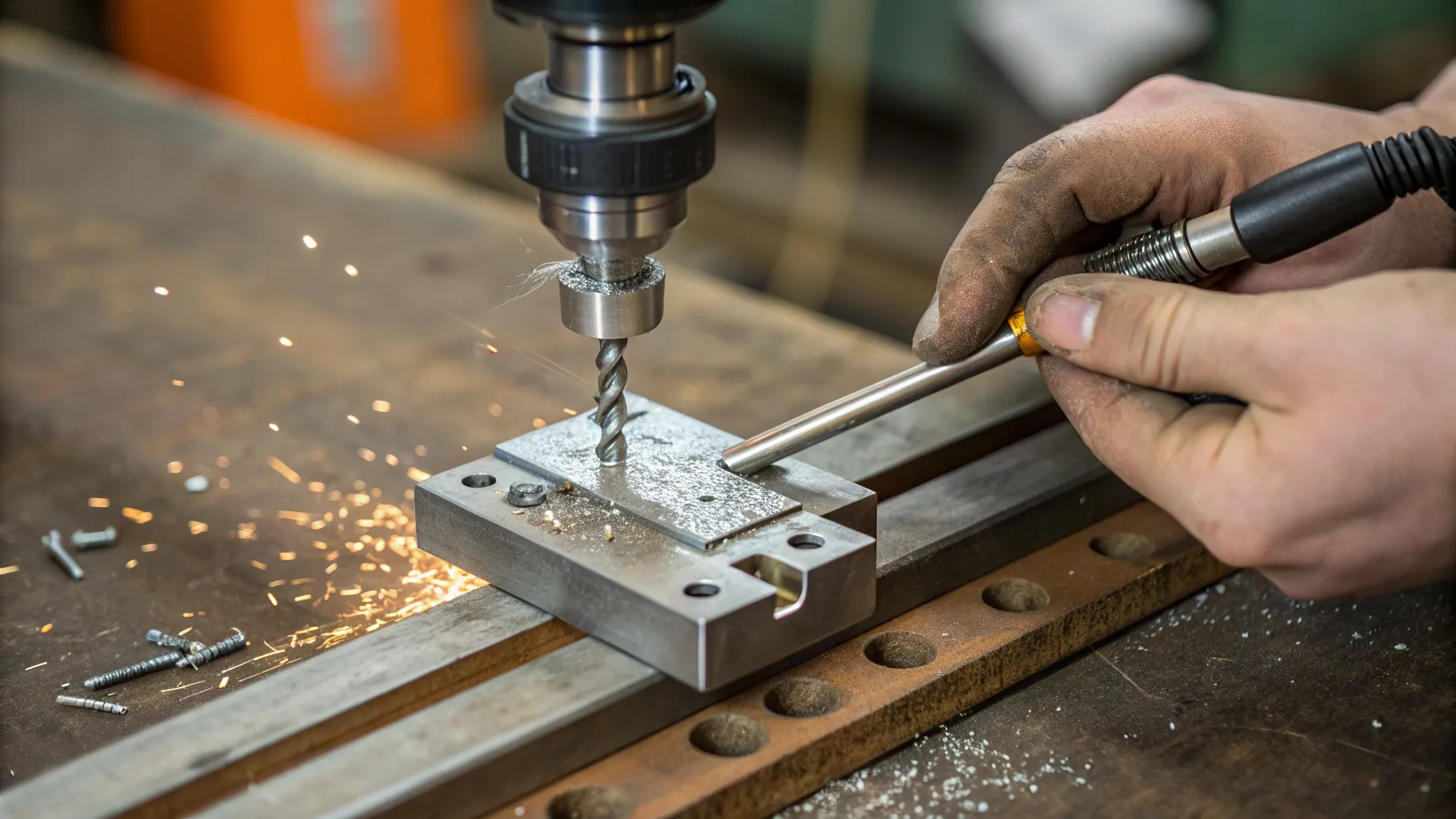
- Drill or drill press with tooling suitable for the required hole size
- Clamps, squares, levels, straightedges, and measuring tools
- Anchors or bench-mounting hardware selected for the press and supporting structure
- Impact-rated guarding designed to contain likely fragments without creating another hazard
- Safety gear, including welding protection, safety glasses, face shield, hearing protection, suitable gloves, protective clothing, and safety footwear
Note: Do not use unidentified scrap, cast-iron brake parts, ordinary sockets, wood blocks, concrete blocks, brittle plate, or improvised pins as press supports. A part that looks thick may still be unsuitable for a concentrated press load.
Products Worth Considering

Stable Lifting: Our hydraulic bottle jack handles up to 20 tons (44,092 lbs), great for box trucks, RVs, pickups, and SUVs. It is ideal for tire changes, quick inspections, and even lifting farm equipment and construction machinery

Powerful Load Capacity: Our hydraulic bottle jack supports up to 50 tons, easily lifting various vehicles like pickups, trucks, and SUVs for tire changes, part repairs, and more. Ideal for heavy-duty jobs, this welded hydraulic car bottle jack handles large loads with ease.

Before You Begin
First decide whether building the press is the sensible option. A commercially rated shop press includes a known frame, compatible jack arrangement, bed supports, instructions, and stated capacity. Building one from raw steel may cost more once you include engineering, machining, rated tooling, guarding, and inspection.
Read the bottle-jack manual completely. Record the rated capacity, minimum height, maximum height, usable stroke, screw-extension limit, approved orientation, handle arrangement, release-valve location, filling procedure, and inspection requirements.
The safe capacity of the completed press is not automatically the number printed on the jack. An example manufacturer’s shop-press manual states that a system cannot be rated above its lowest-rated component. Apply that rule to the frame, bed, pins, fasteners, welds, press plates, dies, adapters, jack mounts, and anchors.
Warning: Do not copy tubing dimensions, weld sizes, plate thicknesses, or support pins from a photograph or an unrelated online build. A compact frame can still store and release enough energy to cause fatal crushing or high-speed fragment injuries.
Skills you need
- Accurate measuring, cutting, drilling, and squaring
- Structural welding on the selected steel thickness
- Understanding of load paths, bending, buckling, shear, bearing stress, and weld loading
- Ability to inspect the jack, welds, pins, plates, and frame for damage
- Ability to stop work when alignment, material identity, or capacity is uncertain
If you cannot verify those points, use a commercially rated press or work with a qualified fabricator.
Choose a Safe Bottle-Jack Layout
A standard bottle jack is normally designed to work upright. Do not invert or operate it horizontally unless the manufacturer specifically allows that orientation.
Two general upright layouts are possible:
- Jack below the work: The jack base rests on a fixed lower support and the ram moves a platen upward toward a fixed upper reaction beam.
- Jack above a moving platen: The upright jack saddle reacts against a fixed upper beam while the jack base pushes a guided plate downward. Many commercial bottle-jack shop presses use this arrangement.
Whichever layout you use, capture the jack so its base and saddle cannot walk, tip, or slip. Keep the jack accessible for operation and removal without weakening its body.
- Do not weld to, drill, grind, or clamp through the jack body.
- Keep the fill plug and release valve accessible.
- Do not let the frame or guide place a sideways load on the ram.
- Provide clearance for the full approved stroke without letting the screw extension become an improvised structural member.
- Design handle access into the frame instead of moving the jack off center.
🔩 Plan the Load Path and Press Capacity
The load path begins where the jack contacts the frame or moving platen. It continues through the upper and lower beams, vertical posts, bed, support pins, base, anchors, dies, and workpiece before returning to the jack.
Every part in that path needs to resist the forces and failure modes that apply to it:
- Upper and lower beams: bending, local crushing, twisting, and weld loading
- Vertical posts: tension, compression, buckling, and spreading
- Bed: bending between support pins and local deformation under the work supports
- Support pins: shear, bending, and bearing stress at the frame holes
- Plates and dies: bending, cracking, surface damage, and slipping
- Welds and fasteners: tension, shear, fatigue, loosening, and incomplete load transfer
- Base and anchors: rocking, sliding, overturning, and pullout
The safe capacity of a bottle-jack press is the verified capacity of its weakest load-bearing component, not simply the number printed on the jack.
Keep the force on the centerline
Center the jack beneath or above the designed pressing point. The moving plate, work supports, dies, and workpiece should share that centerline unless the entire frame and tooling were specifically designed for an eccentric load.
Do not offset the jack for better front access. Off-center loading can twist the frame, bind the moving plate, side-load the ram, overload one post or pin, and launch the workpiece.
Choose the working opening
Measure the tallest workpiece, the support blocks or plates, the dies, the jack’s closed height, and its usable stroke. The press should reach the work without relying on unstable stacks of loose blocks.
- Keep the work as close to the bed or reaction beam as practical.
- Use an adjustable bed rather than tall stacks of spacers.
- Provide enough side clearance for positioning tools and guards.
- Keep hands outside the point-of-operation area.
🧱 Build the Steel Press Frame
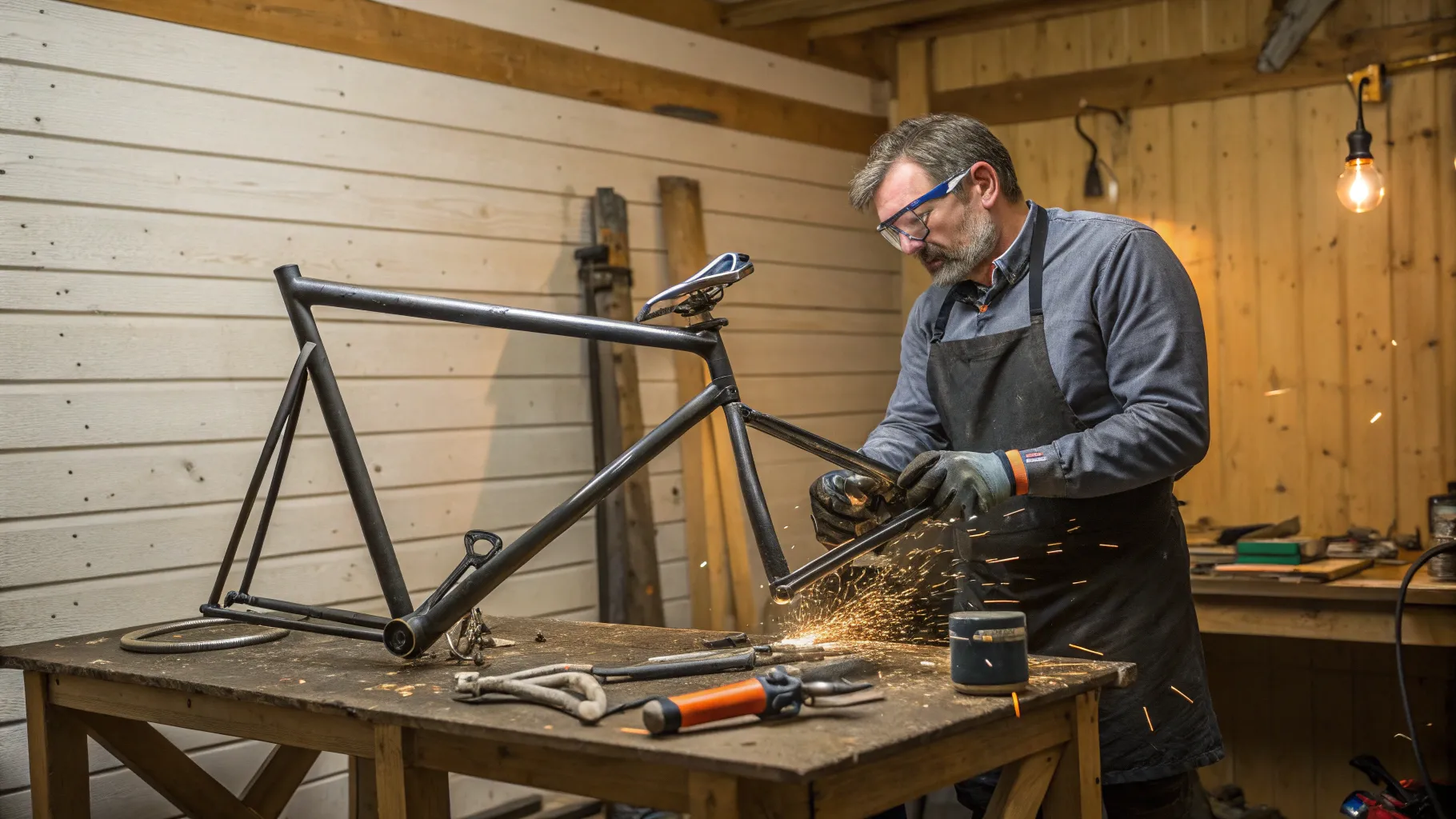
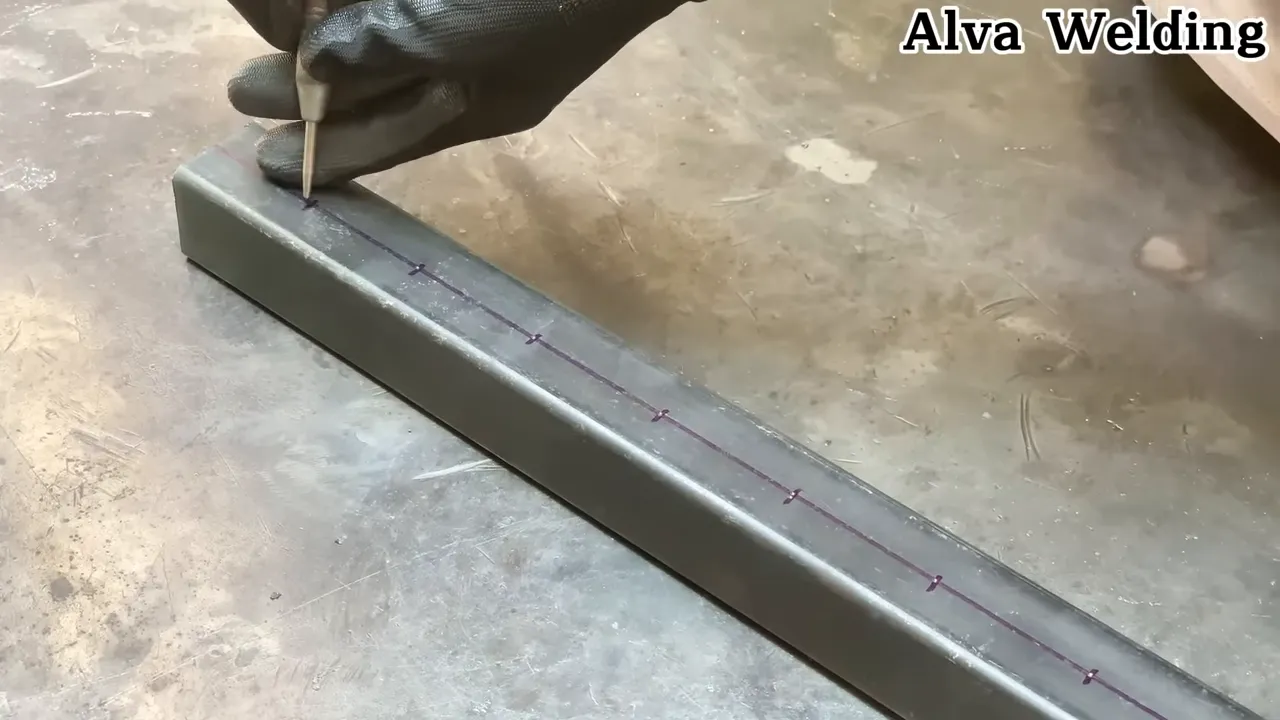
Cut the posts, beams, base members, moving-plate parts, and bed parts according to the verified design. Remove rust, paint, oil, heavy mill scale, and coatings from each weld zone.
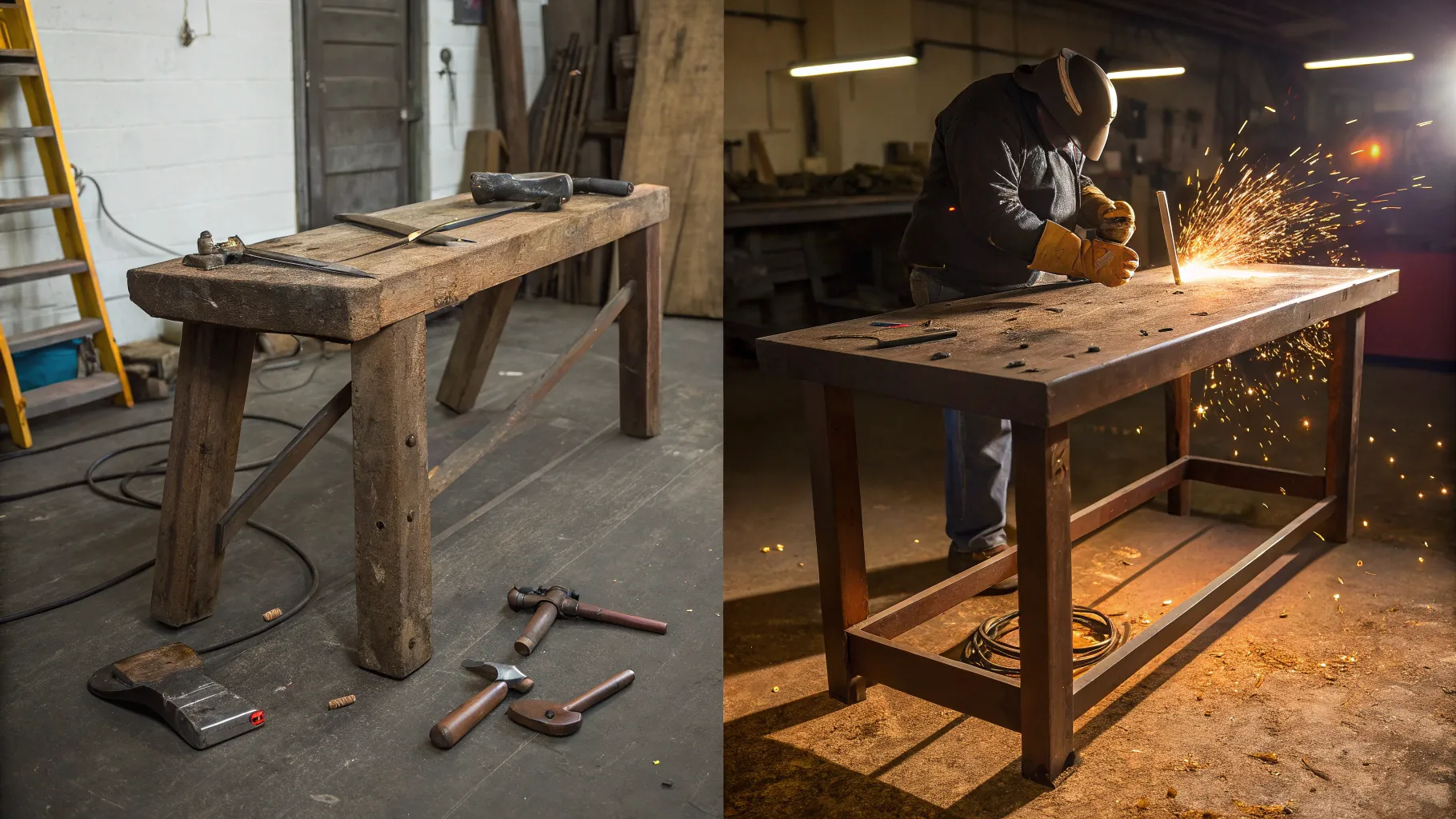
- Lay out the base and frame members on a flat fabrication surface.
- Check diagonals and use a square to confirm the posts are parallel and perpendicular to the beams.
- Tack the frame in enough places to hold alignment without locking in a twist.
- Recheck the jack centerline, bed-hole alignment, platen clearance, and working opening.
- Follow the approved weld sequence to limit heat distortion.
- Allow the frame to cool naturally before final alignment checks.
- Deburr exposed edges without grinding away required weld reinforcement.
- Have the load-bearing welds and frame inspected before installing the jack.
Do not assume that a large-looking weld is a sound weld. Joint preparation, fit-up, penetration, filler selection, procedure, welder skill, and base-metal condition all affect performance. Decorative beads or tack-only joints are not suitable for a press frame.
Pro Tip: Make a rigid centerline fixture before welding. It is easier to prevent a twisted frame than to correct one after the load-bearing welds have cooled.
Products Worth Considering
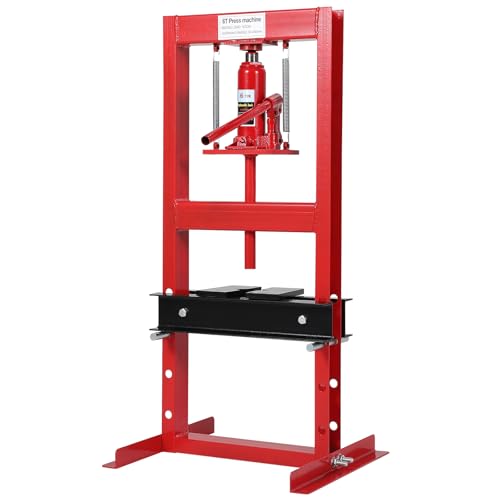
Powerful 6-Ton Capacity: Featuring a strong 6-ton bottle jack, this hydraulic press simplifies metalworking tasks such as bending, straightening, and stamping. Its consistent performance makes it an essential tool for a variety of metal fabrication projects.


Sturdy and Durable: The product is made of high-class iron, using spraying technology, with high strength, wear resistance, and long service life. The precise manufacturing process makes it work with the press to the utmost, ensuring the safety and efficiency of every pressing process.
Design the Adjustable Press Bed and Supports
The press bed carries the workpiece and transfers force into both frame posts. Its beams, holes, support pins, spacers, and plates must be designed as a system.
- Use two matching support pins of the specified material and diameter.
- Insert each pin fully through all intended frame and bed members.
- Keep the bed level and equally supported on both sides.
- Use holes with the specified edge distance and spacing.
- Do not substitute ordinary bolts, threaded rod, screwdrivers, hitch pins, or unknown bar stock for designed press pins.
- Do not place the bed on only one pin or one side of the frame.
- Never move a support pin while the bed or workpiece is loaded.
Use suitable press plates
Use flat plates or arbor plates that are specifically rated or verified for the press load and span. Both plates should sit fully on the bed rather than balancing on an edge.
Inspect plates for cracks, severe mushrooming, deep gouges, permanent bending, and unknown repairs. Remove damaged plates from service.
🔧 Mount the Jack and Moving Press Plate
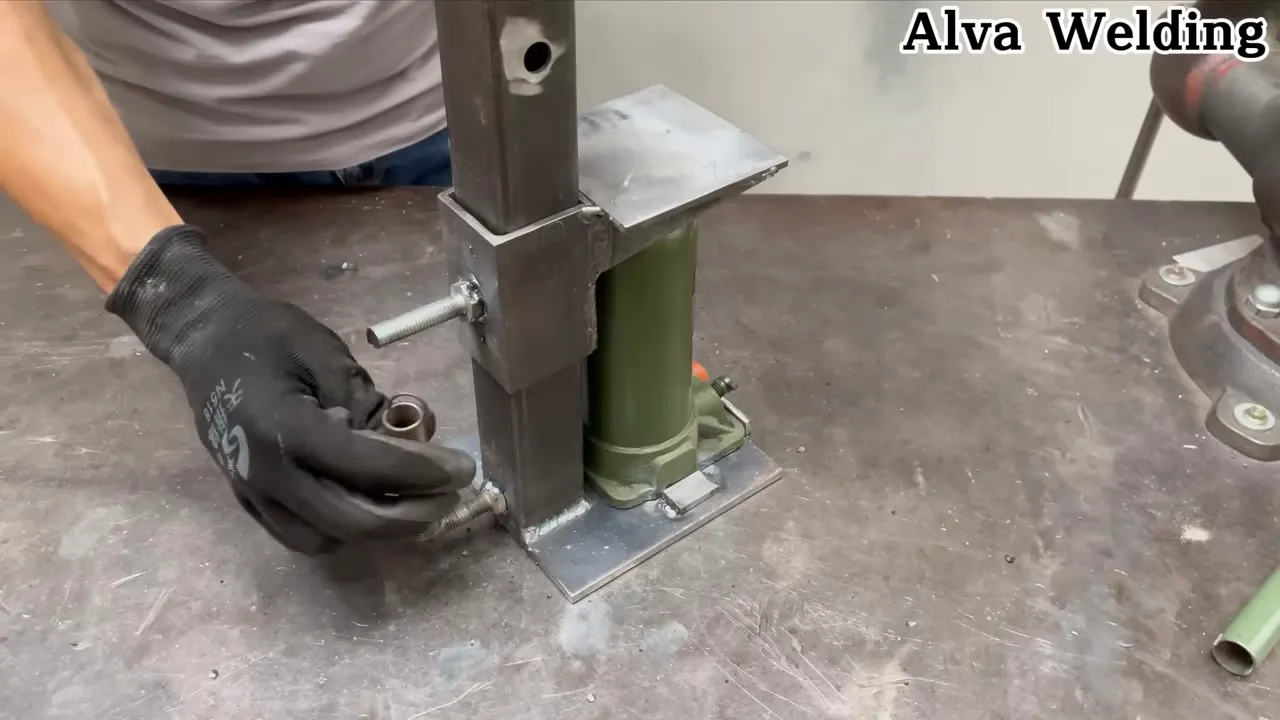
Install the jack upright in the position established by the design. Use a captured seat or cradle that matches the jack base and a centered pocket or bracket that matches the saddle or ram contact.
- Keep the jack centered between the posts.
- Capture both jack contact points without damaging the jack.
- Keep the jack removable for inspection and service.
- Do not rely on friction alone to stop the jack from walking.
- Do not add welds or drilled holes to the jack body.
- Keep the release valve and handle socket accessible.
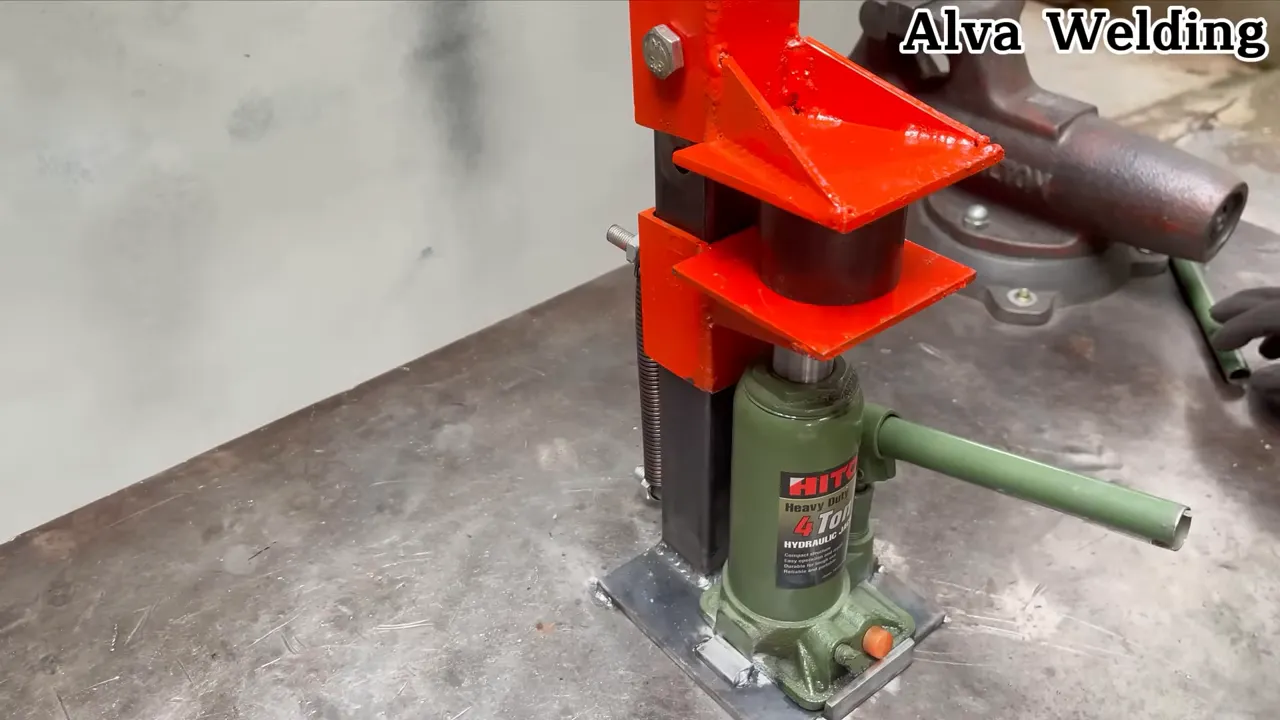
Guide the moving plate without side-loading the jack
A moving plate needs enough guidance to resist rotation while remaining free to travel. A single loose tube may allow tilt, while a tight tube may bind and push sideways on the jack.
If the design uses guides, align them carefully and give them the specified clearance. Two guides spaced apart can control plate rotation better than one central guide, but their mounts and sliding surfaces still need to be designed for the expected load and deflection.
Pro Tip: Cycle the plate through its full travel without a workpiece. It should move freely without rubbing, tilting, catching, or pushing the ram sideways.
🛠️ Use the Correct Jack Handle, Not a Hammer Handle
Use the handle supplied with the bottle jack or a replacement specifically approved by the jack manufacturer. Do not fit a hammer handle, cheater bar, pipe extension, or other improvised lever.
A longer handle may feel easier to pump, but it can slip, reduce control, damage the handle socket, interfere with the frame, or encourage you to keep pumping after the work or structure has stopped moving.
- Check the approved handle for cracks, bending, looseness, or oil contamination.
- Make sure the handle engages the pump socket and release valve correctly.
- Keep your hand outside the frame and pinch zone while pumping.
- Redesign obstructed handle access rather than extending the handle.
- Never adjust or bypass the jack’s overload or safety valve.
Guard and Anchor the Press
A hydraulic press creates a point-of-operation hazard. OSHA’s hydraulic-press guidance identifies severe injury risks when a hand or body part is near the work zone and recommends guarding and positioning tools.
Install suitable guarding
Use an impact-rated barrier or enclosure designed for the parts and operations you expect. The guard should separate the operator from likely fragment and ejection paths without creating sharp edges, pinch points, or a false sense of protection.
- Guard the front and any open side where a part could be ejected.
- Keep observers outside the guarded work area.
- Use tongs, pliers, positioning fixtures, or dedicated tools to place small parts.
- Never reach through or around the guard while pressure remains in the system.
- Do not use ordinary window glass as a fragment shield.
OSHA’s general machine-guarding rule requires guarding where the point of operation exposes a person to injury. Local workplace rules may impose additional requirements.
Anchor the frame
Secure the press to a bench, stand, floor, or other support that can resist its weight and operating reactions. The anchors, supporting structure, and mounting pattern must suit the verified press design.
- Set the press on a flat, rigid surface.
- Check that it cannot rock before tightening the anchors.
- Do not anchor into damaged, thin, or unknown material.
- Keep the base clear of debris that could twist the frame.
- Recheck anchor tightness during inspections.
⚙️ Test and Commission the Press Safely
Do not test a new press by crushing a bearing or other hardened component. Begin with no-load checks, followed by controlled low-risk work behind the guard.
Pre-test inspection
- Confirm the frame is anchored and level.
- Confirm the jack, platen, bed, pins, plates, dies, and work area are centered.
- Verify both bed pins are fully inserted.
- Check every accessible weld and fastener.
- Inspect the jack for leakage, damage, corrosion, and correct operation.
- Confirm the guard is secure.
- Remove unused tools and loose material from the press.
- Keep bystanders out of the area.
No-load test
- Close the release valve as directed in the jack manual.
- Pump the jack slowly through part of its travel.
- Watch the moving plate and guides for rubbing, tilt, or uneven motion.
- Open the release valve slowly and confirm controlled retraction.
- Repeat through the usable travel without exceeding the jack’s limits.
Progressive working test
Use a ductile mild-steel test piece between broad, stable, verified plates or dies. Apply only enough force to confirm controlled operation. Observe from outside the likely ejection path.
Stop immediately if you see or hear:
- Frame movement, rocking, spreading, or twisting
- A plate or workpiece beginning to walk sideways
- Binding or sudden movement of the platen
- Permanent bending
- Cracking, ticking, popping, or unusual noise
- Paint flaking from a highly stressed joint
- A leaking jack or uncontrolled pressure loss
Release the load completely before inspecting or repositioning anything. Do not perform an improvised full-capacity proof test. Any formal proof testing should follow a documented procedure prepared and supervised by a qualified person.
Jobs a Mini Bottle-Jack Press Can Handle
A properly designed press can perform controlled bearing, bushing, flattening, and bending work within the verified capacity of the frame and tooling.
Removing and installing bearings
Support the housing or shaft close to the fitted part. Use a machined sleeve or drift that contacts the correct bearing ring.
- When pressing a bearing onto a shaft, apply force to the inner ring.
- When pressing a bearing into a housing, apply force to the outer ring.
- Do not transmit installation force through the balls or rollers.
- Keep the sleeve square and centered.
- Stop if the bearing cocks, binds, or needs unexpectedly high force.
SKF’s bearing guidance warns that transmitting mounting force through rolling elements can dent the raceways and cause early failure.
Pressing bushings and pins
Use supports that leave clearance for the part being removed. Match the drift closely to the bushing or pin without contacting the surrounding housing.
Check for retaining rings, shoulders, staking, corrosion, taper, or a directional fit before applying force. Never assume a stubborn component is free to move.
Flattening tube or pipe
Thin tube can buckle and shoot sideways. Use broad, parallel plates and a fixture that captures the work. Keep the tube centered and apply pressure slowly.
Bending small metal parts
Use a matched upper tool and lower V-die or other verified bending set. The die opening, material thickness, bend length, material strength, and tooling capacity all affect the required force.
- Keep the bend line centered under the pressing tool.
- Support the lower die evenly.
- Expect springback after pressure is released.
- Do not use loose angle iron as an unsupported die.
- Do not exceed the verified capacity of the frame or tooling.
Warning: Never press springs, gas struts, shock absorbers, batteries, ammunition, sealed containers, pressure vessels, loaded hydraulic parts, unknown assemblies, or anything that may contain stored pressure, combustible material, or hazardous chemicals.
🧯 Hydraulic Press Safety Tips and Best Practices
A bottle-jack press concentrates a large force into a small work zone. Treat the point of operation as a guarded danger area every time you use the machine.
- Wear safety glasses that meet applicable requirements and add a face shield when fragments or fluid may reach your face. OSHA’s eye and face protection standard provides recognized requirements.
- Keep your head, hands, arms, feet, and torso out of the line of force.
- Use tools or fixtures to position small parts.
- Never hold or steady a workpiece by hand while pressure is applied.
- Keep the jack, workpiece, dies, and supports centered.
- Do not exceed the verified capacity of the lowest-rated component.
- Do not keep pumping after movement stops unexpectedly.
- Release all hydraulic pressure before adjusting the work, bed, pins, dies, or guards.
- Keep the standard bottle jack upright unless its manual permits another orientation.
- Keep observers and children out of the work area.
- Do not leave the press unattended while loaded.
- Do not use damaged, cracked, bent, leaking, loose, or binding equipment.
- Do not use the press as a person lift, vehicle support, jack stand, or load-holding device.
- Keep the floor clean and dry.
- Provide suitable lighting so alignment and movement remain visible.
- Follow proper hot-work precautions while cutting and welding the frame. OSHA lists fumes, radiation, burns, and fire among the hazards addressed by its welding safety guidance.
Standing to one side does not replace guarding. A part may leave the press in an unexpected direction, especially when the supports, dies, or workpiece are not parallel.
Troubleshooting a Bottle-Jack Press
| Problem | Possible Cause | Safe Response |
| Jack will not raise | Release valve open, air in the system, low fluid, overload, or internal fault | Remove the load and follow the jack manual. Do not continue pumping or adjust the safety valve. |
| Jack feels spongy | Air in the hydraulic system or incorrect fluid level | Take the press out of service and bleed or service the jack exactly as its manufacturer directs. |
| Moving plate tilts or binds | Misaligned guides, twisted frame, debris, uneven load, or side-loaded ram | Release pressure immediately. Correct the cause before another test. |
| Workpiece walks sideways | Off-center loading, tapered contact, poor supports, or mismatched dies | Stop, release pressure, and replace the setup with centered, parallel, captured tooling. |
| Frame rocks or shifts | Uneven base, loose anchors, unsuitable bench, or frame distortion | Stop using the press. Repair the mounting or supporting structure and recheck frame alignment. |
| Hydraulic oil leaks | Damaged seal, loose plug, corrosion, contamination, or internal jack failure | Remove the jack from service. Do not search for a pressurized leak with your fingers. |
| Crack, permanent bend, or unusual noise | Structural overload, defective material, poor weld, fatigue, or off-center force | Release the load if it can be done safely, isolate the press, and have the complete structure inspected. |
🔁 Maintenance, Inspection, and Safe Improvements
Inspect the press before every use and after any unusual event. Keep a simple dated record if the machine is used regularly or by more than one person.
Before each use
- Check the frame and welds for cracks, rust, distortion, or fresh paint flaking.
- Check bed holes and support pins for elongation, bending, burrs, or wear.
- Check the jack for leaks, corrosion, damage, and correct operation.
- Check that the jack remains captured and centered.
- Check all fasteners and anchors.
- Inspect press plates, sleeves, drifts, and dies.
- Confirm the moving plate travels without binding.
- Check the guard for damage and secure attachment.
After use
- Release the hydraulic load fully.
- Lower or retract the jack as directed by its manual.
- Remove swarf, scale, grease, and loose debris.
- Wipe the jack ram clean without using abrasive tools.
- Store plates and dies so damaged items cannot return to service unnoticed.
Jack service
Use only the fluid, bleeding method, fill level, and replacement parts specified by the jack manufacturer. Do not open or repair the hydraulic unit while it is loaded.
A return mechanism may make a moving plate retract more quickly, but springs and attachment points also store energy. Add return springs only when their rating, travel, guards, mounts, and failure paths are included in the verified design.
Note: A pressure gauge or load cell can improve repeatability only when it is compatible with the jack and installed through an approved design. Do not drill or tap a bottle jack to add a gauge unless the manufacturer provides that procedure.
Common Mistakes to Avoid
- Rating the press from the jack label: The frame and tooling may have a lower capacity.
- Using unidentified scrap: Unknown steel, castings, repaired plate, or damaged components may fail without warning.
- Offsetting the jack: Better access does not justify an eccentric load.
- Using an improvised handle extension: Redesign handle access instead.
- Using loose spacer stacks: Tall, narrow stacks can tip or eject.
- Using ordinary bolts as bed pins: Threaded sections and unknown grades may not suit the designed shear and bearing loads.
- Pressing without guards: Safety glasses alone do not contain a flying workpiece.
- Holding the part by hand: Use fixtures and positioning tools.
- Continuing after movement stops: The force may be rising in a blocked or misaligned setup.
- Grinding welds smooth for appearance: Removing required weld material can reduce capacity.
- Testing by crushing hardened parts: Use controlled ductile test pieces instead.
- Ignoring small permanent bends: Any new deformation is a stop-use condition.
❓ Frequently Asked Questions
What size hydraulic jack should I use for a mini press?
Choose the jack only after defining the jobs and obtaining a verified frame and tooling design. A larger jack does not automatically create a better press. Increasing jack capacity increases the maximum force that the frame, bed, pins, welds, dies, and anchors may experience.
What steel size should I use for the frame?
There is no universal tubing, channel, angle, or plate size. Required sections depend on jack force, clear span, frame width, post length, material grade, joint layout, bed position, weld design, allowable deflection, and safety requirements. Have the complete frame calculated and checked.
Is welding the frame necessary, or can I bolt it together?
Either method can work when properly engineered. A welded frame depends on correct joint preparation, welding procedure, fit-up, and inspection. A bolted frame depends on suitable fasteners, hole geometry, joint slip resistance, bearing strength, torque, and bracing. Do not choose between them only by convenience.
Can I mount a bottle jack upside down?
Not unless the jack manufacturer specifically approves inverted operation. A standard bottle jack normally depends on its upright reservoir and pickup arrangement. Use an upright layout or choose a hydraulic cylinder designed for the intended orientation.
Can I use this press to remove bearings and bushings?
Yes, within the verified capacity and with proper supports. Check for retaining rings, shoulders, taper, and staking first. Use a sleeve or drift that applies force to the fitted bearing ring or bushing without loading rolling elements or unsupported housing sections.
How do I make dies for bending or flattening?
Use verified steel tooling with broad, stable support and a shape suited to the work. A bending setup needs a matched upper tool and lower die. A flattening setup needs parallel plates and a fixture that prevents the tube or part from moving sideways. Do not use loose scrap angle or brittle blocks.
Is it safe to crush sealed bearings or similar parts?
No. Deliberately crushing bearings can eject hardened fragments, grease, seals, and cage material. Use the press to install or remove bearings with correct supports and sleeves, not to destroy them.
Why does my bottle-jack press feel spongy?
Air in the hydraulic system, an incorrect fluid level, an open release valve, a leak, or an internal fault may cause a spongy feel. Remove the load and follow the exact bleeding and service procedure in the jack manual. Do not adjust the overload valve.
Does a small benchtop press need to be anchored?
Yes, if anchoring is part of the verified design. A compact press can still rock, slide, tip, or move when a workpiece shifts. Secure it to a rigid bench, stand, or floor that can carry the reactions and anchor loads.
Can I use a bottle-jack press for forging?
A small homemade bottle-jack press is not a substitute for a purpose-built forging press. Hot scale, heat damage, changing work geometry, off-center loads, unsuitable speed, and unverified dies add serious risk. Use equipment specifically designed and guarded for hot forging.
Safety Disclaimer: This article provides general educational information, not a certified structural design or substitute for professional engineering, welding, machinery-guarding, or workplace-safety advice. Build and operate a hydraulic press only when the complete machine has been properly designed, inspected, guarded, anchored, and used according to the jack manufacturer’s instructions and applicable rules.
✅ Final Thoughts
A bottle jack can power a useful compact press, but safe performance depends on the complete machine rather than the jack alone. Start with a verified frame and tooling design, keep the load centered, capture the jack securely, support the bed correctly, and install guarding and anchors before applying pressure.
Use only the approved jack handle and test the press progressively with controlled, ductile work. Stop at the first sign of movement, binding, leakage, cracking, or permanent deformation. When the required force or structural design is uncertain, use a commercially rated press or have the work completed by a qualified shop.
Sources
- OSHA Hydraulic Presses: Machine Guarding eTool — point-of-operation hazards, guarding, and positioning tools
- OSHA 1910.212, General Requirements for All Machines — machine and point-of-operation guarding
- Harbor Freight 20-Ton Shop Press Manual — centered loading, anchoring, rated components, guarding, inspection, and jack installation
- OSHA 1910.133, Eye and Face Protection — recognized eye and face protection requirements
- OSHA Welding, Cutting, and Brazing: Hazards and Solutions — welding fumes, radiation, burns, fire, and PPE
- SKF Bearing Damage and Failure Analysis — correct application of mounting force to bearing rings