Disclosure: As an Amazon Associate, we earn from qualifying purchases. If you click a link on this page and make a purchase, we may receive a small commission at no extra cost to you.
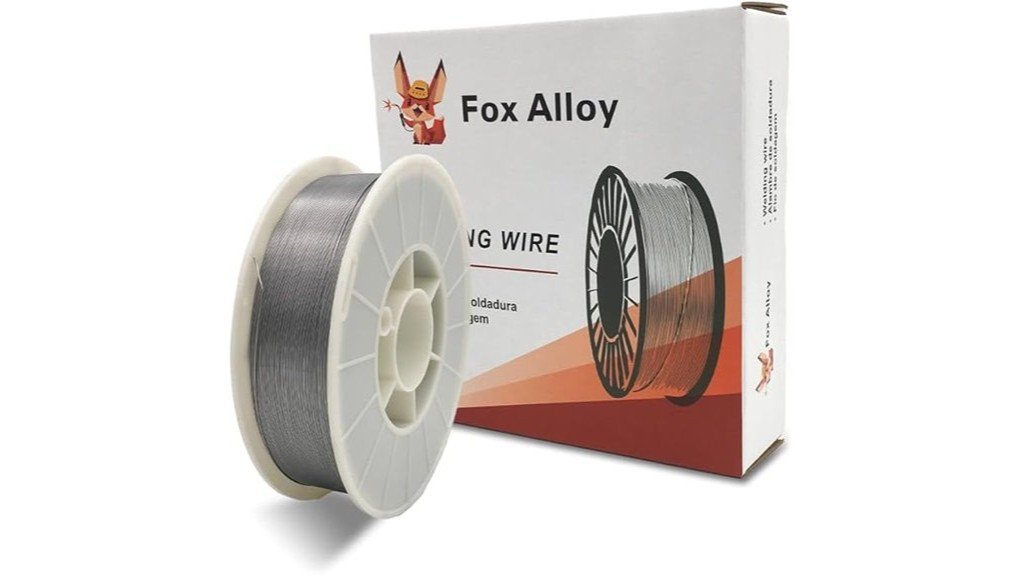
Running shielding gas is not always practical when you need to repair a fence, fabricate thin steel, or work outside. The Fox Alloy E71T-GS 0.035-inch 10 lb flux-core welding wire solves that setup problem with a self-shielded design made for mild-steel FCAW. Its strongest points are gas-free operation, a large 10 lb spool, and positioning for single-pass fillet and lap welds. The tradeoff is that you still need a compatible welder and correct settings, and this wire should not automatically be treated as the right filler for structural, stainless, aluminum, or every multipass application.
Quick Verdict
Rating: 8.4/10, Recommended with caveats
Best For: DIYers and fabricators using a compatible flux-core welder for mild-steel repairs, sheet-metal work, fences, gates, and outdoor projects.
Bottom Line: The Fox Alloy E71T-GS gives you a practical 0.035-inch self-shielded wire that does not require bottled shielding gas. Its main limitation is application scope, so confirm your machine setup, material, joint, and welding requirements before using it for critical work.
Key Takeaways
- Self-shielded FCAW: You do not need an external shielding-gas cylinder for this wire.
- 0.035-inch diameter: The reviewed variant is intended for welders that support 0.035-inch flux-core wire.
- 10 lb nominal spool: It suits repeated fabrication and repair work better than a small hobby spool when your machine can accept it.
- Mild-steel focus: Fox Alloy lists it for carbon-steel sheet structures and thin plate applications such as doors and fences.
- Single-pass emphasis: The listing specifically promotes single-pass fillet and lap welding, so do not assume it is suitable for every code, structural, or multipass weld.
- Outdoor convenience: The self-shielded process removes the dependence on an external gas cloud, which makes outdoor setup easier.
| Specification | Detail |
|---|---|
| Brand | Fox Alloy |
| Model / Part | E71T-GS 4.5Kg |
| Product Type | Self-shielded flux-core welding wire |
| Process | FCAW, flux-cored arc welding |
| Wire Diameter | 0.035 in (0.9 mm) |
| Nominal Spool Weight | 10 lb |
| Listed Item Weight | 10.65 lb |
| Package Dimensions | 8.31 x 8.31 x 2.44 in |
| Base-Metal Focus | Mild / carbon steel |
| Shielding Gas | Not required |
| Recommended Polarity | DCEN, straight polarity |
| Welding Position | Listed as all-position |
| Primary Application | Single-pass fillet and lap welding on mild-steel structures |
| Standards Listed | AWS A5.20 E71T-GS, AWS A5.36 E71T14S-AZ-CS3, ISO 17632-A T42 Z Z V N 1 |
| Storage | Keep dry and use promptly after opening |
What Is the Fox Alloy E71T-GS Welding Wire?
The Fox Alloy E71T-GS is a 0.035-inch self-shielded flux-core wire for mild-steel welding. Instead of relying on a separate shielding-gas cylinder, the flux inside the tubular wire creates the shielding needed during FCAW.
The reviewed version comes on a nominal 10 lb spool. Fox Alloy positions it for single-pass fillet and lap welds, thin steel structures, all-position work, and indoor or outdoor welding. The listing also describes smooth arc behavior, high feedability, low fume generation relative to its stated formulation, and minimal spatter.
A large spool makes the most sense when you weld regularly and your machine can physically accept it. Before ordering, check both the supported wire diameter and the maximum spool dimensions or weight for your welder.
Who Should Buy It?
Best For
- You use a welder that accepts 0.035-inch self-shielded flux-core wire and a 10 lb spool.
- You repair or fabricate mild-steel fences, gates, doors, sheet structures, or similar projects.
- You want to weld outside or avoid carrying a shielding-gas bottle for appropriate FCAW jobs.
Skip If
- Your machine cannot accept 0.035-inch flux-core wire or the 10 lb spool format.
- You need filler metal specifically approved for aluminum, stainless steel, or another non-mild-steel application.
- You are performing code-critical or engineered structural welds without an approved procedure specifying this filler metal.
Before You Buy: E71T-GS does not mean the wire is automatically suitable for every structural or multipass weld. Confirm the filler classification, joint requirements, welder compatibility, and any required welding procedure before using it on safety-critical work.
Fit and Welder Compatibility
The first compatibility check is wire diameter. Your machine, drive roll, liner setup, and contact tip need to support 0.035-inch flux-core wire. The second is spool capacity. A welder designed only for small 1 lb or 2 lb spools may not accept this 10 lb format without a different setup.
Fox Alloy recommends DCEN, direct-current electrode negative, for this wire. Do not assume your machine is already configured correctly. Some welders allow polarity changes inside the cabinet, while dedicated flux-core machines may have a fixed configuration.
Use the machine manufacturer’s chart or manual as your starting point for voltage and wire-feed speed. There is no single correct feed-speed number for every welder because settings change with material thickness, joint type, electrical input, travel speed, and the machine’s output characteristics.
Pro Tip: Run a short test bead on scrap made from the same type and thickness of steel before touching your project. Adjust from your welder’s chart until the arc is stable and the bead shows suitable fusion without excessive burn-through or spatter.
Welding Performance
Self-Shielded Operation
The biggest practical benefit is that you do not need an external shielding-gas cylinder. That reduces the equipment you need to move and makes setup simpler when you work on gates, fences, farm repairs, or other steel away from a fixed welding station.
Self-shielding is also useful outdoors because you are not depending on an externally supplied gas cloud around the arc. You still need to protect the work area from unsafe wind conditions, sparks, fire risks, and contamination.
Arc Stability and Spatter
Fox Alloy describes the wire as providing a smooth, stable arc with minimal spatter and high feedability. Those qualities can reduce cleanup and make the wire easier to control when the machine is correctly set up.
Do not expect the appearance of every flux-core bead to match a carefully tuned gas-shielded MIG weld. Flux-core welding creates slag that needs to be removed, and bead appearance depends heavily on voltage, wire speed, stickout, travel angle, surface condition, and operator technique.
Single-Pass Thin-Steel Work
The product is specifically marketed toward single-pass fillet and lap welding and thin mild-steel structures. That makes it relevant to fabrication jobs such as doors, fencing, light brackets, and similar carbon-steel work where the joint and engineering requirements allow this filler.
Thin material still requires control. Too much heat, moving too slowly, or using the wrong setup can cause burn-through even with wire intended for thin steel.
How It Performs in Real Use
Fence and Gate Repairs
This is one of the clearest use cases. You can take a compatible flux-core welder to the work instead of arranging a separate shielding-gas cylinder. The 10 lb spool also reduces how often you need to stop and change wire during repeated fabrication or repair jobs.
Thin Mild-Steel Fabrication
For lap joints and fillet welds on appropriate thin steel, the 0.035-inch E71T-GS wire gives you the self-shielded characteristics the product is designed around. Clean test pieces first and establish settings before welding the finished part.
Outdoor Maintenance
The lack of external shielding gas is useful for outdoor repair work. You still need a dry, safe work area and suitable protection around combustible materials. “Outdoor capable” does not mean welding is safe in rain, around standing water, or where sparks can start a fire.
Repeated Workshop Projects
A 10 lb spool is more convenient than small spools when you regularly fabricate mild-steel parts and your welder accepts the larger spool. Occasional users should consider storage as well, because opened flux-core wire should be protected from moisture.
Setup Tips Before You Weld
- Confirm the machine accepts 0.035-inch flux-core wire. Check the drive roll, contact tip, wire path, and spool capacity.
- Verify polarity. Fox Alloy recommends DCEN for this product. Follow your welder’s instructions when changing internal connections.
- Clean the joint. Remove water, oil, heavy contamination, and loose surface material before welding.
- Start with the machine chart. Set voltage and wire-feed speed for the material thickness, then tune on scrap.
- Maintain consistent technique. Stickout, gun angle, travel speed, and joint fit can change arc behavior and penetration.
- Remove slag between relevant operations. Inspect the bead before continuing with additional work.
Storage and Wire Care
Flux-core wire should be protected from moisture and contamination. Fox Alloy specifically recommends storing this wire in a dry environment and using it within a reasonable period after opening.
Do not describe the shelf life as automatically indefinite. Storage conditions matter. If wire becomes rusty, contaminated, visibly damaged, or begins feeding poorly after improper storage, replacing it can be cheaper than troubleshooting repeated weld defects.
Welding Safety
Self-shielded wire eliminates an external gas bottle, but it does not eliminate normal welding hazards. FCAW produces intense arc radiation, hot metal, sparks, slag, and welding fumes.
Use appropriate welding PPE, including a suitable welding helmet, gloves, protective clothing, and footwear. Keep combustible materials away from the work area and provide ventilation or fume control appropriate for the material and location.
Be especially careful with coated, galvanized, painted, oily, or unknown metals because heating coatings and contaminants can produce hazardous fumes. Follow your welder manual, consumable instructions, workplace requirements, and applicable safety guidance.
Pros and Cons
Pros
- Self-shielded operation removes the need for an external shielding-gas cylinder.
- 0.035-inch wire is a common size for compatible flux-core machines.
- 10 lb nominal spool suits repeated welding work.
- Designed around mild-steel single-pass fillet and lap applications.
- Fox Alloy lists smooth arc behavior, high feedability, and minimal spatter as product characteristics.
Cons
- The 10 lb spool will not fit every compact welder.
- It is intended for mild/carbon steel, not aluminum or general-purpose stainless welding.
- Its single-pass positioning means you should verify requirements before structural or critical multipass work.
Is It Worth the Price?
The Fox Alloy E71T-GS makes the most sense when you value gas-free mild-steel welding and a larger 10 lb spool. A larger spool can be a smart buy for regular fabrication because you spend less time swapping small rolls.
Value depends on your machine, though. A cheap 10 lb roll offers no advantage if your welder accepts only smaller spools or if you mainly weld stainless steel, aluminum, or applications requiring a different filler classification.
For the right setup, it is worth considering if you want an economical self-shielded consumable for appropriate mild-steel repair and fabrication work.
How It Compares to Alternatives
If you want the same E71T-GS classification from another established welding brand, Forney sells 0.035-inch E71T-GS wire in both smaller and 10 lb spool options. Smaller spools can make more sense when you weld only occasionally or own a compact machine.
Lincoln Electric Innershield NR-211-MP is another widely used self-shielded mild-steel option, but it carries the E71T-11 classification rather than E71T-GS. Compare the required classification, spool size, material thickness, machine compatibility, and procedure requirements rather than choosing only by price.
Frequently Asked Questions
Does Fox Alloy E71T-GS need shielding gas?
No. This is a self-shielded flux-core wire, so it is designed to operate without an external shielding-gas cylinder. That makes it useful for compatible FCAW machines and outdoor repair work.
Can I use it with any MIG welder?
No. Your welder must support 0.035-inch self-shielded flux-core wire, the appropriate drive hardware, required polarity, and the physical 10 lb spool. Check your machine manual before ordering.
What polarity does this wire use?
Fox Alloy lists DCEN, or direct-current electrode negative, as the recommended polarity. Confirm the correct connection procedure in your welder’s manual before changing internal leads.
What wire-feed speed should I use?
There is no universal wire-feed speed for every machine and joint. Start with the chart inside your welder or its manual for 0.035-inch self-shielded wire, then fine-tune voltage and feed speed on scrap of the same material thickness.
Can E71T-GS weld aluminum or stainless steel?
This Fox Alloy product is marketed as mild-steel welding wire. Use a filler metal specifically selected for aluminum, stainless steel, or another alloy rather than treating this wire as a universal consumable.
Is E71T-GS suitable for structural welding?
Do not assume that it is suitable for every structural joint simply because it carries an AWS classification. For code-controlled, load-bearing, or safety-critical work, use the filler metal and welding procedure required by the design, engineer, applicable code, or approved WPS.
How should I store the remaining wire?
Keep the wire dry and protected from moisture, dirt, and corrosion. Fox Alloy advises dry storage and recommends using the wire promptly after opening rather than assuming an unlimited shelf life.
The Bottom Line
The Fox Alloy E71T-GS 0.035-inch 10 lb welding wire is a solid choice when you have a compatible FCAW machine and need self-shielded mild-steel wire for appropriate repair, fabrication, fence, gate, or outdoor work. Its strongest benefit is gas-free operation with a large spool, while its main limitation is that E71T-GS should not be treated as a universal filler for every metal, structural joint, or welding procedure.
If those limitations match your work rather than conflict with it, the product earns its 8.4/10 recommended-with-caveats verdict.