Disclosure: As an Amazon Associate, we earn from qualifying purchases. If you click a link on this page and make a purchase, we may receive a small commission at no extra cost to you.
A compact TIG welder can save you a lot of hauling, but portability means little if the machine lacks the arc control you need. The ESAB Rogue ET 200iP PRO combines 200-amp DC TIG and Stick capability with high-frequency TIG starting, pulse control, dual-voltage input, and a 21.2-pound body. It is a strong fit for steel and stainless fabrication, repair work, process piping, and mobile jobs. Its biggest limitation is equally important: this is a DC TIG machine, not an AC/DC TIG welder for aluminum.
Quick Verdict
Editorial Rating: 8.7/10, Recommended with caveats
Best For: Welders who want a portable 200A DC TIG/Stick machine with detailed TIG controls and strong field-work flexibility.
Bottom Line: You get high-frequency TIG starting, pulse control up to 500 Hz, dual-voltage power, and useful Stick settings in a compact package. Skip it if AC TIG aluminum welding or MIG capability is part of your plan.
ESAB Rogue ET 200iP PRO Key Specifications
| Specification | Detail |
|---|---|
| Brand | ESAB |
| Model | Rogue ET 200iP PRO, 0700500073 |
| Processes | DC TIG, HF TIG, Stick/SMAW |
| Input Power | 115/230 VAC ±15%, single phase, 50/60 Hz |
| Current Range | 10–200A |
| Maximum Output | 200A |
| 230V TIG Duty Cycle | 200A at 25%, 129A at 60%, 100A at 100% |
| 230V Stick Duty Cycle | 200A at 25%, 129A at 60%, 100A at 100% |
| TIG Start | High-frequency non-contact start and Live TIG functionality |
| Pulse TIG | Adjustable pulse frequency up to 500 Hz |
| Open Circuit Voltage | 78 VDC |
| Dimensions | Approximately 15.7 x 6 x 10.4 inches |
| Weight | 21.2 lb (9.6 kg) |
| Enclosure | IP23S-rated housing |
| Power Management | Power Factor Control (PFC) |
| Generator Guidance | ESAB recommends a suitably regulated generator, with 7 kW AVR guidance listed in its manual |
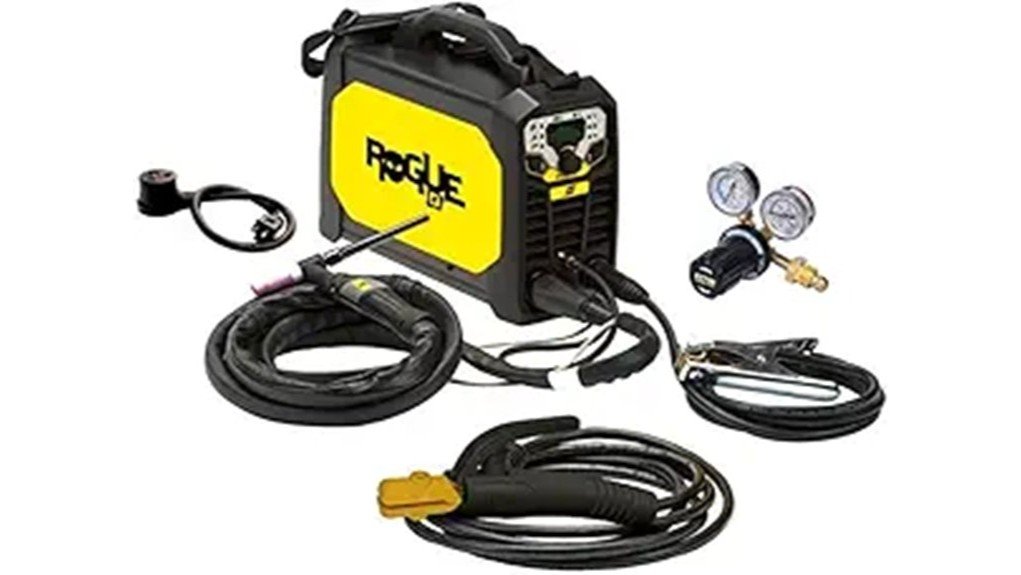
| Typical Package | Power source, shoulder strap, TIG torch, electrode holder, work lead/clamp, regulator, wear parts, and 115/230V adapter for the documented CSA package |
What Is the ESAB Rogue ET 200iP PRO?
The Rogue ET 200iP PRO is an inverter-based DC TIG and Stick welding power source. ESAB designed it for users who need more TIG control than a basic entry-level inverter provides but still want a machine that is easy to carry between a shop, service vehicle, farm, or jobsite.
You can run the machine from compatible 115V or 230V single-phase power. On 230V, it reaches its full 200A output. Its digital controls also give you access to TIG pre-flow, start current, ramp-up, ramp-down, finish current, post-flow, 2T/4T modes, and pulse settings.
For Stick welding, adjustable Hot Start and Arc Force give you more control over electrode starting and arc behavior. ESAB also specifies support for common electrodes including 6010 and 7018, with capacity for electrodes up to 5/32 inch under suitable conditions.
Before You Buy: The Rogue ET 200iP PRO uses DC TIG output. It is a strong choice for steel and stainless work, but it does not provide the AC TIG output normally required for TIG welding aluminum.
Who Should Buy It?
Best For
- Fabricators and repair technicians who work mainly with steel and stainless steel.
- Mobile welders who need a 200A machine that weighs only 21.2 pounds.
- TIG users who want pulse control, HF start, adjustable gas timing, and remote-current options.
Skip If
- You need AC TIG for regular aluminum fabrication.
- You want MIG, flux-core, and TIG from one multiprocess machine.
- You regularly need 200A output for long, uninterrupted production welds.
DC TIG Performance and Arc Control
High-frequency starting is one of the Rogue ET 200iP PRO’s most useful TIG features. You can initiate the TIG arc without intentionally touching the tungsten to the workpiece, helping reduce the chance of tungsten contamination during starts.
The machine’s 10–200A current range also gives you a useful spread between delicate TIG work and higher-output fabrication. At 230V, ESAB rates TIG output at 200A with a 25% duty cycle, 129A at 60%, and 100A at 100%.
For thinner stainless steel and other heat-sensitive DC TIG work, the pulse function is particularly useful. Pulse frequency can be adjusted up to 500 Hz, letting you manage heat input and bead behavior more closely than you can with a simple fixed-output TIG inverter.
Full-Cycle TIG Adjustments
You are not limited to changing amperage. The Rogue lets you adjust gas pre-flow, start current, ramp-up time, ramp-down time, finish current, and post-flow. You can also select 2-stroke or 4-stroke operation.
Those controls become valuable when you move beyond basic practice welds. You can tune how the arc starts, how quickly current rises, how the weld finishes, and how long shielding gas continues after the arc stops.
Stick Welding Performance
The Rogue is not only a TIG machine. Its 200A maximum Stick output makes it useful for repair work, structural fabrication, maintenance, and field jobs where carrying a shielding-gas cylinder may not be practical.
Hot Start temporarily helps establish the electrode at ignition, while adjustable Arc Force changes arc behavior as the electrode gets close to the puddle. These settings can make a noticeable difference when you are working in corners, tight joints, or out-of-position welds.
The ability to run electrodes such as 6010 and 7018 also gives you more flexibility than a TIG-only power source. ESAB states that the 200iP PRO can run Stick electrodes up to 5/32 inch when input power and operating conditions support the required output.
Controls, Portability, and Build
At 21.2 pounds, the machine is light enough for regular transport between jobs. Its power source measures about 15.7 inches long, 6 inches wide, and 10.4 inches high, so it takes up relatively little room in a service truck or small workshop.
The rigid housing, integrated handle, and shoulder strap are designed around field use. ESAB lists the enclosure as IP23S, while its PFC system helps maintain stable performance when input power is less than ideal.
The digital interface keeps important settings accessible without forcing you through an overly complex control system. Once you understand the TIG cycle parameters, you can make detailed adjustments from the front panel instead of accepting factory-fixed values.
Pro Tip: Save full-output work for a suitable 230V circuit when possible. Although the Rogue supports lower-voltage input, your available welding output and duty cycle depend on the power source, circuit capacity, and setup.
Power, Extension Cords, and Remote Control
The North American version supports 115/230V single-phase input, which gives you more location flexibility than a 230V-only shop welder. The machine automatically adapts to the supported input voltage, but you still need the correct circuit protection and cable size specified in the manual.
ESAB’s documentation lists a maximum recommended extension-cord length of up to 328 feet (100 meters) when the required conductor size and installation conditions are met. That can be valuable on farms, construction areas, maintenance sites, and other locations where the power source is far from the weld.
Generator operation is also supported. ESAB recommends properly regulated generator power, including AVR or equivalent regulation, and lists 7 kW guidance for the relevant 200iP PRO configuration. Always check your machine’s rating plate and manual before connecting generator power.
Remote Amperage Options
You can control welding current through compatible remote equipment rather than walking back to the power source for every adjustment. Supported options include compatible TIG torch controls, a foot pedal, and a hand remote.
This matters most during TIG work because you may want to change heat while welding. A compatible foot pedal, for example, lets you vary amperage while keeping both hands positioned for torch and filler control.
How It Performs in Real Use
For Shop TIG Fabrication
For steel and stainless projects, the combination of HF start, a low 10A starting range, pulse control, and adjustable TIG-cycle settings gives you much more control than a basic scratch-start machine. This makes the Rogue suitable for fabrication where bead appearance and heat management matter.
For Repair and Maintenance
Stick capability makes the unit more practical when you cannot bring shielding gas to the repair. The light power source and shoulder strap also make it easier to carry through a plant, farm, or jobsite than a larger transformer-style welder.
For Remote Jobsite Work
PFC, dual-voltage input, generator compatibility, and long-extension-cord guidance make remote work one of this model’s stronger use cases. You still need correctly sized cables and adequate input power, especially as welding amperage increases.
For Longer High-Amperage Welds
This is where you should pay attention to the duty cycle. At 230V, the machine is rated for 200A at a 25% duty cycle rather than continuous 200A output. If your work routinely requires long welds near maximum amperage, a heavier industrial machine with a higher high-amperage duty cycle may be a better fit.
Setup Tips Before First Use
- Check the rating plate first: Confirm the input-voltage requirements of your exact regional version before connecting power.
- Use the correct circuit: Do not assume every household outlet or extension lead can support the amperage you plan to weld at.
- Match the process to the material: Use DC TIG for appropriate steels and stainless applications. Do not buy this model expecting AC TIG aluminum capability.
- Protect gas quality: Keep TIG gas lines, torch components, tungsten, and the workpiece clean to avoid unnecessary contamination.
- Watch the duty cycle: Give the machine the required cooling time when operating near its rated limits.
- Read the ESAB manual: TIG parameters such as pre-flow, downslope, post-flow, and pulse settings should be adjusted to your process and welding procedure.
Compatibility and Safety
The Rogue ET 200iP PRO is electrical welding equipment, so proper PPE, grounding, ventilation, fire prevention, and cylinder handling are essential. Wear welding-rated eye, face, hand, and body protection suitable for the process you are performing.
Do not interpret the IP23S enclosure rating as permission to weld in unsafe wet conditions. Keep the machine and electrical connections protected from moisture and follow ESAB’s safety instructions for outdoor or field use.
Repairs to the internal electrical system should be handled by qualified or authorized service personnel. You should also use compatible torches, remotes, cables, regulators, and consumables rather than assuming every accessory with a similar connector is electrically suitable.
Pros and Cons
Pros
- 200A maximum DC TIG and Stick output.
- High-frequency TIG start plus detailed TIG-cycle controls.
- Pulse frequency adjustable up to 500 Hz for heat control.
- 115/230V input, PFC, and generator-friendly design improve field flexibility.
- 21.2-pound weight and compact dimensions make transport easier.
Cons
- No AC TIG output, so it is not the right TIG machine for aluminum fabrication.
- Maximum 200A output carries a 25% duty-cycle limit on 230V.
- MIG and flux-core processes are not included, so it is not a full multiprocess welder.
Is It Worth the Price?
The Rogue ET 200iP PRO makes the most sense for buyers who value TIG control, Stick capability, portability, and input-power flexibility more than having every welding process in one box. It sits above basic budget TIG inverters in control depth and build, while remaining much smaller than many industrial power sources.
You get the most value from it if you regularly move between TIG and Stick work and can use features such as pulse TIG, HF start, remote amperage control, 2T/4T modes, and detailed gas-cycle adjustment.
It is less compelling if aluminum TIG is central to your work. Paying for a separate DC-only TIG/Stick machine makes little sense when your real requirement is an AC/DC TIG system.
How It Compares to Alternatives
The Miller Maxstar 161 STH is a current DC TIG/Stick alternative that weighs considerably less and offers HF TIG, but its maximum output is 160A rather than 200A. The Rogue is the stronger choice when you value the extra output and its extensive TIG controls.
If aluminum TIG is important, an AC/DC machine such as the Lincoln Electric Square Wave TIG 200 is more appropriate because it supports AC TIG for aluminum as well as DC TIG for steels. ESAB also now lists newer Rogue models, so availability and regional replacement models are worth checking before you buy an older 200iP PRO package.
Frequently Asked Questions
Can the ESAB Rogue ET 200iP PRO TIG weld aluminum?
Not with the AC TIG process normally used for aluminum. The Rogue ET 200iP PRO is a DC TIG/Stick power source, so buyers who primarily want to TIG weld aluminum should choose an AC/DC TIG machine instead.
Does the Rogue ET 200iP PRO work on both 115V and 230V?
The documented North American 0700500073 version supports 115/230V single-phase input. Maximum welding output and duty-cycle capability depend on your input supply, so use a suitable 230V circuit when you need the machine’s higher output range.
What is the duty cycle at 200 amps?
At 230V, ESAB rates both TIG and Stick output at 200A with a 25% duty cycle. The ratings increase to 60% at 129A and 100% at 100A, making lower-output work better suited to longer continuous welding periods.
Can you use a foot pedal with the ESAB Rogue ET 200iP PRO?
Yes. ESAB lists compatible remote-current options including a foot pedal, TIG torch control, and hand remote. Make sure the remote is specifically compatible with the machine rather than choosing one only by connector appearance.
Can the Rogue ET 200iP PRO run 6010 and 7018 electrodes?
ESAB describes the machine as capable of running common Stick electrode types including 6010 and 7018. Its 200A output also supports electrodes up to 5/32 inch under suitable power and operating conditions.
Can you run the ESAB Rogue ET 200iP PRO from a generator?
Yes, generator operation is supported when the generator provides suitable regulated power. ESAB recommends AVR or equivalent regulation and gives 7 kW generator guidance for the relevant configuration, but you should confirm requirements in the manual for your exact regional model.
Who should skip the Rogue ET 200iP PRO?
Skip it if AC TIG aluminum, MIG, or flux-core welding is a core requirement. It is also less suitable for production work that requires long periods near the full 200A output because the maximum-output duty cycle is 25% on 230V.
The Bottom Line
The ESAB Rogue ET 200iP PRO is a strong portable choice for steel and stainless TIG work, Stick welding, repair, fabrication, and mobile applications where detailed arc control matters. Its 200A output, HF TIG start, pulse control, PFC, dual-voltage input, and 21.2-pound body are meaningful strengths, but buyers who need AC TIG aluminum or MIG capability should choose a different machine.
For the right DC TIG/Stick user, it earns our 8.7/10 Recommended with caveats verdict.