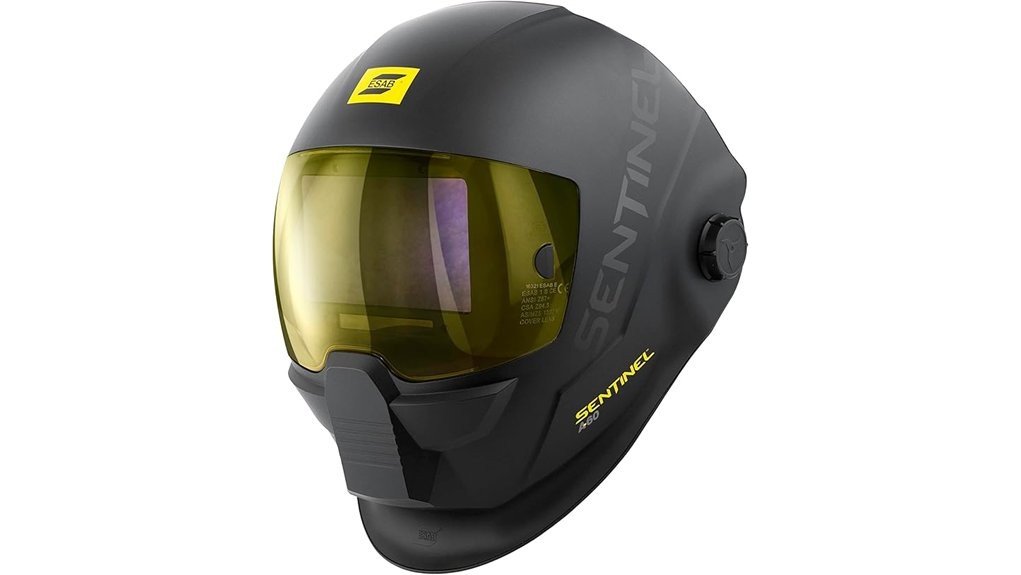
A welding helmet can have excellent protection on paper and still be frustrating if the lens feels narrow, the controls are awkward, or the headgear creates pressure during a long shift. The ESAB Sentinel A60 targets those problems with a 4.65 x 2.80-inch viewing area, true-color optics, digital half-shade adjustments, and balanced HALO headgear. This review explains where those features help, which specifications are verified, and what you should check before ordering. Its strongest advantage is visibility and control, while its premium positioning and replacement-lens costs may be more than an occasional hobbyist needs.
Quick Verdict
Rating: 9/10, recommended with caveats
Best For: Regular MIG, TIG, stick, plasma, and fabrication work where lens clarity and setup control matter
Bottom Line: The Sentinel A60 gives you a large true-color view, 1/1/1/1 optical clarity, four sensors, programmable settings, and comfortable headgear. It is a strong premium helmet, but buyers who weld only a few times per year may not get full value from its advanced controls.
Key Specifications
| Specification | Detail |
|---|---|
| Brand | ESAB |
| Model | Sentinel A60 |
| Product number | 0700600860 |
| ASIN | B0BLQ92744 |
| Product type | Auto-darkening welding and grinding helmet |
| Shell | Black, low-profile, high-impact resistant nylon |
| ADF viewing area | 118 x 71 mm (4.65 x 2.80 in.) |
| Optical classification | 1/1/1/1 EN optical clarity |
| Lens technology | ESAB OpTCS True Color Lens Technology |
| Shade range | DIN 3/5-13, adjustable in 0.5 increments, with shade lock |
| Arc sensors | Four |
| Switching time | 0.04 millisecond on ESAB’s current product page |
| Controls | Internal digital controls for shade, sensitivity, and delay, plus external grind button |
| Memory | Up to nine programmable ADF settings |
| Power | Replaceable CR2450 battery with solar backup |
| Headgear | Fully adjustable HALO headgear |
| Weight | 644 g (1.4 lb) |
| Supported processes | MIG/MAG, TIG, stick, plasma arc welding, plasma cutting, oxy-fuel cutting, and grinding |
| Listed standards | ANSI Z87.1+, CSA Z94.3, CE EN175/EN379/EN166, AS/NZS 1338.1, ISO 16321 +TIG, and UKCA |
| Manufacturer warranty | Four years for Sentinel A60 and A60 Air helmets under ESAB’s current U.S. warranty table |
| Package note | Amazon lists the helmet and batteries as included components; confirm seller-specific contents before purchase |
What Is the ESAB Sentinel A60?
The ESAB Sentinel A60 is a premium auto-darkening helmet made for welding, cutting, and grinding. It replaces the smaller-view Sentinel A50 concept with a 40% larger 4.65 x 2.80-inch viewing area and a reengineered ADF rated at 1/1/1/1 optical clarity.
You get a wide true-color lens, four arc sensors, half-step shade control, nine memory slots, a glove-friendly digital interface, an external grind button, and a low-profile shell. This combination suits welders who move between processes or need to see more of the joint without constant head movement.
Who Should Buy It?
Best For
- Regular welders who want a wider, distortion-controlled view of the puddle and surrounding joint
- Fabricators who switch between MIG, TIG, stick, cutting, and grinding during the same workday
- Users who value balanced headgear, programmable settings, and controls that can be used with gloves
Skip If
- You need the lowest-cost helmet for rare, short repair jobs
- You prefer simple analog knobs and do not need stored welding profiles
- You want a PAPR system included, because the standard A60 is not the A60 Air package
Before You Buy: Confirm that the listing is for the standard Sentinel A60, product number 0700600860, and not an A60 Air package, graphic edition, replacement shell, or ADF-only part. Also verify current seller availability and package contents, because Amazon may show third-party offers instead of a featured offer.
Feature-by-Feature Review
Viewing Area and True-Color Optics
The 118 x 71 mm viewing area is one of the A60’s most useful upgrades. It gives you more vertical and horizontal context around the puddle, which can reduce how often you reposition your head when following a longer bead or checking joint alignment.
ESAB pairs the larger opening with OpTCS true-color technology and a 1/1/1/1 EN optical rating. That rating covers optical quality, light diffusion, shade consistency, and angle dependence. In practical terms, the lens is designed to keep the view clear and consistent when you look through different parts of the filter.
Shade, Sensitivity, and Delay Controls
The ADF covers DIN 3/5-13 and lets you adjust the active shade in 0.5 increments. The extra half steps are useful when a full shade change feels too bright or too dark for your process, amperage, position, and surrounding light.
Sensitivity and delay are controlled through the internal digital interface. Sensitivity affects how readily the ADF responds to an arc, while delay controls how long the lens stays dark after the arc stops. The bright dual-color display and graphical meters make those settings easier to read in a dim booth.
Arc Detection and Switching
Four sensors help the helmet detect an arc even when your hand, torch, fixture, or workpiece partly blocks one sensor. ESAB’s current product page lists a 0.04 millisecond switching time, while some retailer text still lists 0.08 millisecond. Both are very fast, but the manufacturer figure is the better reference for the current model.
The shade-lock function can hold the ADF in its darkest state when that behavior is useful. Grind mode has its own external button, so you do not need to remove the helmet and open the control panel each time you switch from welding to surface preparation.
Programmable Memory and Glove-Friendly Interface
You can save up to nine ADF profiles. You can store separate settings for common MIG, TIG, and stick jobs or repeated production work.
The push buttons are spaced for gloved use, but the controls are still inside the helmet. You may need to flip the hood up for major changes. The external grind button reduces that interruption for the most common mode change.
HALO Headgear and Low-Profile Shell
At 1.4 pounds, the Sentinel A60 is not unusually heavy for a premium auto-darkening helmet. More important, its HALO headgear is designed to spread the load around your head instead of concentrating pressure at one point.
The rounded, low-profile nylon shell gives you better clearance around pipe, vehicle frames, benches, and other tight work. Comfort still depends on adjustment. A helmet that sits too far forward can feel heavier and may interfere with a respirator or safety glasses.
Battery, Cover Lenses, and Service Parts
The ADF uses a replaceable CR2450 battery with solar backup. Internal indicators warn you about low battery, grind mode, and shade lock. Keeping a fresh spare battery in your welding cabinet prevents a simple power issue from stopping work.
ESAB lists clear and amber front cover lenses, inside cover lenses, replacement headgear, sweat bands, an occipital pad, a hard-hat adapter, and magnifying lenses from +1.0 to +2.5 diopter. Those parts improve long-term serviceability, but they also add ownership cost when cover lenses become scratched or spattered.
How It Performs in Real Use
For MIG and Stick Fabrication
The large ADF and four sensors are well matched to bench fabrication, structural work, and general repairs. You can see more of the joint before striking the arc, and the stored profiles help when you return to the same wire, electrode, and amperage range.
For TIG Welding
True-color optics and fine shade adjustment are most valuable when you need to track a small puddle, filler placement, and heat-affected zone. The four sensors also help with low-amperage work, but you still need to set sensitivity correctly and confirm that the helmet responds reliably before welding.
For Grinding and Fit-Up
The external grind button makes the A60 practical for workflows that alternate between tacking, grinding, and welding. Always check the grind indicator before restriking an arc. Leaving the helmet in grind mode is a common and serious setup mistake.
For Tight or Low-Light Work Areas
The low-profile shell can clear obstacles better than a bulky hood, while the illuminated control display is easier to read inside a dark booth or shop corner. The helmet does not replace adequate task lighting for positioning, inspection, and safe movement.
Setup Tips Before First Use
- Fit the headgear first: Adjust the crown, rear support, tilt, and distance from your face before changing lens settings.
- Run a function check: Inspect the cover lenses, confirm battery status, and test ADF response according to the ESAB instruction manual.
- Choose the shade for the actual job: Match the shade to the welding or cutting process, amperage, and applicable workplace guidance. Do not select a lighter shade only for convenience.
- Tune sensitivity carefully: Raise sensitivity for low-current TIG when needed, but reduce false triggering from nearby arcs or bright light.
- Check the mode every time: Verify that grind mode is off and the desired weld profile is active before striking an arc.
- Protect the ADF: Replace a badly scratched, cracked, cloudy, or spatter-damaged cover lens instead of trying to see through it.
Pro Tip: Save one memory slot for each process you use most, then label the matching settings in your shop notes. This makes it easier to confirm shade, sensitivity, and delay before repeated jobs.
Compatibility and Safety
The Sentinel A60 is personal protective equipment, so setup and inspection matter as much as comfort. Follow the ESAB Sentinel A60 product documentation and the instruction manual linked there. Never use a cracked shell, damaged ADF, missing cover lens, or helmet that fails its function check.
The helmet is listed for welding, cutting, and grinding processes, but one setting does not fit every task. Use the correct shade and other required PPE for the process. Welding helmets do not replace safety glasses, hearing protection, protective clothing, ventilation, respiratory protection, or a hard hat when those controls are required.
ESAB lists a universal hard-hat adapter and magnifying lens accessories. Compatibility with your exact glasses, respirator, hard hat, or other PPE depends on fit and adjustment. Check that every item can be worn without breaking seals, blocking movement, or pushing the helmet out of position.
Pros and Cons
Pros
- Large 4.65 x 2.80-inch ADF gives you a broad view of the joint and work area
- OpTCS true-color lens and 1/1/1/1 optical rating support a clear, consistent view
- Half-step shade control, sensitivity, delay, and nine memories suit varied welding work
- Four sensors, shade lock, and external grind control provide useful process flexibility
- HALO headgear, 1.4-pound weight, and low-profile shell support longer sessions and tight access
Cons
- Premium features may be unnecessary for occasional hobby welding
- Most setting changes still use the internal control panel
- Cover lenses, batteries, sweat bands, and other wear parts increase long-term ownership cost
Is It Worth the Price?
The Sentinel A60 sits in the premium helmet tier. Its value comes from the combination of a large ADF, excellent optical classification, detailed digital adjustment, programmable memory, replaceable parts, and balanced headgear. Those features make the most sense when you weld often enough to notice small improvements in visibility, fit, and setup time.
It is worth considering for professional fabrication, serious home shops, welding students who plan to keep one helmet for years, and anyone upgrading from a small or heavily tinted ADF. It is not the best value when you only need a basic helmet for a few short jobs and do not plan to use the memory or fine-adjustment features.
ESAB’s current U.S. warranty table lists four years for Sentinel A60 and A60 Air helmets. Warranty eligibility can depend on region, seller, registration, proof of purchase, and stated terms, so review the current ESAB warranty coverage before buying.
How It Compares to Alternatives
The Lincoln Electric Viking 3350 is a close alternative for buyers who prioritize a large lens and established premium optics. The Miller Digital Infinity is worth comparing if you prefer its headgear feel, control layout, or broader shell design. The Optrel Crystal 2.0 is aimed at buyers who place a very high value on a bright, natural light-state view.
The Sentinel A60 makes the most sense when you want ESAB’s low-profile shell, true-color ADF, half-shade digital control, external grind button, and nine stored profiles in one helmet. Fit is personal, so trying on competing headgear before purchase can be more useful than comparing specification sheets alone.
Frequently Asked Questions
What is the correct viewing area for the ESAB Sentinel A60?
ESAB lists the ADF viewing area as 118 x 71 mm, or 4.65 x 2.80 inches. Smaller figures sometimes seen in older content may refer to another Sentinel model or inaccurate retailer data.
Can you use the Sentinel A60 for TIG welding?
Yes. ESAB lists GTAW/TIG among its supported processes. For low-amperage TIG, confirm sensitivity, sensor exposure, shade, and ADF response before you begin.
Does the ESAB Sentinel A60 have grind mode?
Yes. It has an external grind mode button and an internal grind-mode warning light. Check the indicator before welding so you do not accidentally strike an arc while the ADF is set to grind.
What battery does the Sentinel A60 use?
The ADF uses a replaceable CR2450 battery and has solar backup. Keep the battery compartment clean and follow the manual when replacing the battery.
Can the helmet work with prescription glasses or a cheater lens?
Fit with prescription glasses depends on frame size, face shape, and headgear adjustment. ESAB also sells A60 magnifying lenses in +1.0, +1.5, +2.0, and +2.5 diopters, which may be a cleaner option for some users.
Is the standard Sentinel A60 compatible with a hard hat?
ESAB lists a universal hard-hat adapter for the Sentinel A60 and Savage A50 LUX. Confirm the adapter, hard hat, and site requirements are compatible before relying on the setup for work.
How often should you replace the cover lens?
There is no single replacement interval because wear depends on your process and work environment. Replace the outer or inner cover lens when scratches, cracks, clouding, or spatter reduce visibility or protection.
What warranty does the ESAB Sentinel A60 have?
ESAB’s current U.S. warranty table lists four years for the Sentinel A60 and A60 Air helmets. Check the terms for your country and seller, and keep your dated proof of purchase.
The Bottom Line
The ESAB Sentinel A60 is a strong choice for regular welders who want a wide true-color view, precise digital adjustment, stored profiles, and balanced headgear. Skip it when you need only a low-cost basic hood or when you will not use its advanced controls. Its main strength is the complete optics-and-comfort package, while the main tradeoff is the higher purchase and upkeep cost of a premium helmet.
Ready to Buy?
Check the latest seller, package contents, price, and product details before you decide.