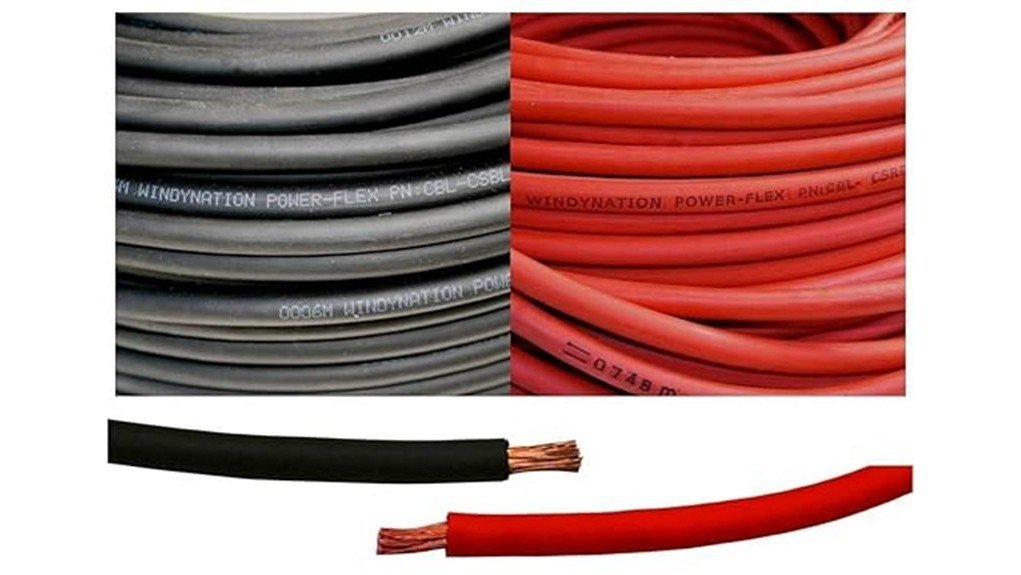
A 4 AWG welding battery cable is a flexible copper cable that suits many battery, inverter, RV, solar and light welding-lead jobs, but 4 AWG is not the right size for every circuit. This guide covers what the linked Amazon listing says about the cable, how 4 AWG compares with nearby sizes, and what to confirm before you buy.
Short answer: choose 4 AWG when your equipment manual or wiring chart calls for it. Choose a larger conductor (lower AWG number) when the run is long, the current is high or your welder needs it.
Is a 4 AWG Welding Battery Cable Right for Your Project?
It can be a good fit when:
- your inverter, battery bank or accessory circuit lists 4 AWG for your cable length
- you want a flexible cable that bends around battery boxes and tight panels
- you plan to cut it to length and crimp your own lugs
Look at a different size or cable type when:
- your welder, inverter or fuse manual calls for a larger conductor
- the cable run is long and voltage drop matters
- the cable will sit in saltwater, constant sun or a wet location and the listing gives no rating for it
- you need building wire for a home circuit; battery and welding cable is not a substitute for code-listed wiring
What the Listing Says
The details below come from the Amazon listing text for ASIN B01MS8ZA6M. They are not our own test results, and the listing can change.
| Item | Per the listing |
|---|---|
| Gauge | 4 AWG |
| Conductor | Fully annealed pure copper, high strand count |
| Insulation | EPDM jacket |
| Voltage rating | Up to 600 V |
| Temperature range | -50 C to +105 C (-58 F to +221 F) |
| Length and color | Not confirmed here; check the variant you select |
| Marine or UV rating | Not confirmed; check before outdoor or boat use |
The listing text also names ASTM, SAE J1127, IEC and RoHS. Compliance is not documented on the page, so ask the seller if you need proof for a regulated job.
4 AWG Compared With Other Sizes
A lower AWG number means a thicker conductor. The cross-section areas below are standard AWG values; they show relative size, not a safe current rating. Safe current depends on insulation rating, cable length, temperature and installation method, so use your equipment manual or a wiring chart.
| AWG size | Approx. cross-section | Relative to 4 AWG |
|---|---|---|
| 8 AWG | 8.4 mm2 | Smaller |
| 6 AWG | 13.3 mm2 | Smaller |
| 4 AWG | 21.2 mm2 | This cable |
| 2 AWG | 33.6 mm2 | Larger |
Many welding machines call for larger leads than 4 AWG, so check your welder manual before using this cable as a welding lead.
Installing 4 AWG Battery Cable
- Confirm the gauge and fuse size in your equipment manual.
- Measure the full routing path, not the straight-line distance.
- Cut the cable square and strip only the length the lug needs.
- Crimp a lug sized for the cable and the stud with a tool made for heavy cable.
- Cover the joint with heat-shrink and secure the cable away from sharp edges and heat.
- Fuse the circuit as the equipment maker requires and check the connections for heat after first use.
Related reading: WindyNation 4 gauge welding battery cable review | 4 AWG battery cable review | Shirbly 4 gauge battery cable review
Frequently Asked Questions
Is 4 AWG enough for my inverter?
It depends on the inverter wattage, battery voltage and cable length. Check the inverter manual, which usually lists the cable gauge and fuse size for each run length.
Can I use this cable as a welding lead?
Only if your welder manual allows 4 AWG for your amperage and lead length. Many machines call for a larger conductor, so check before you buy.
Is this cable rated for marine or outdoor use?
The listing does not confirm a marine or UV rating here. For boats or constant sun, look for tinned marine cable or a clearly stated UV rating, or protect the cable in conduit.
Does it come with lugs?
Do not assume so. Check the variant you select on the listing to see whether you get bare cable or a finished cable with terminals.